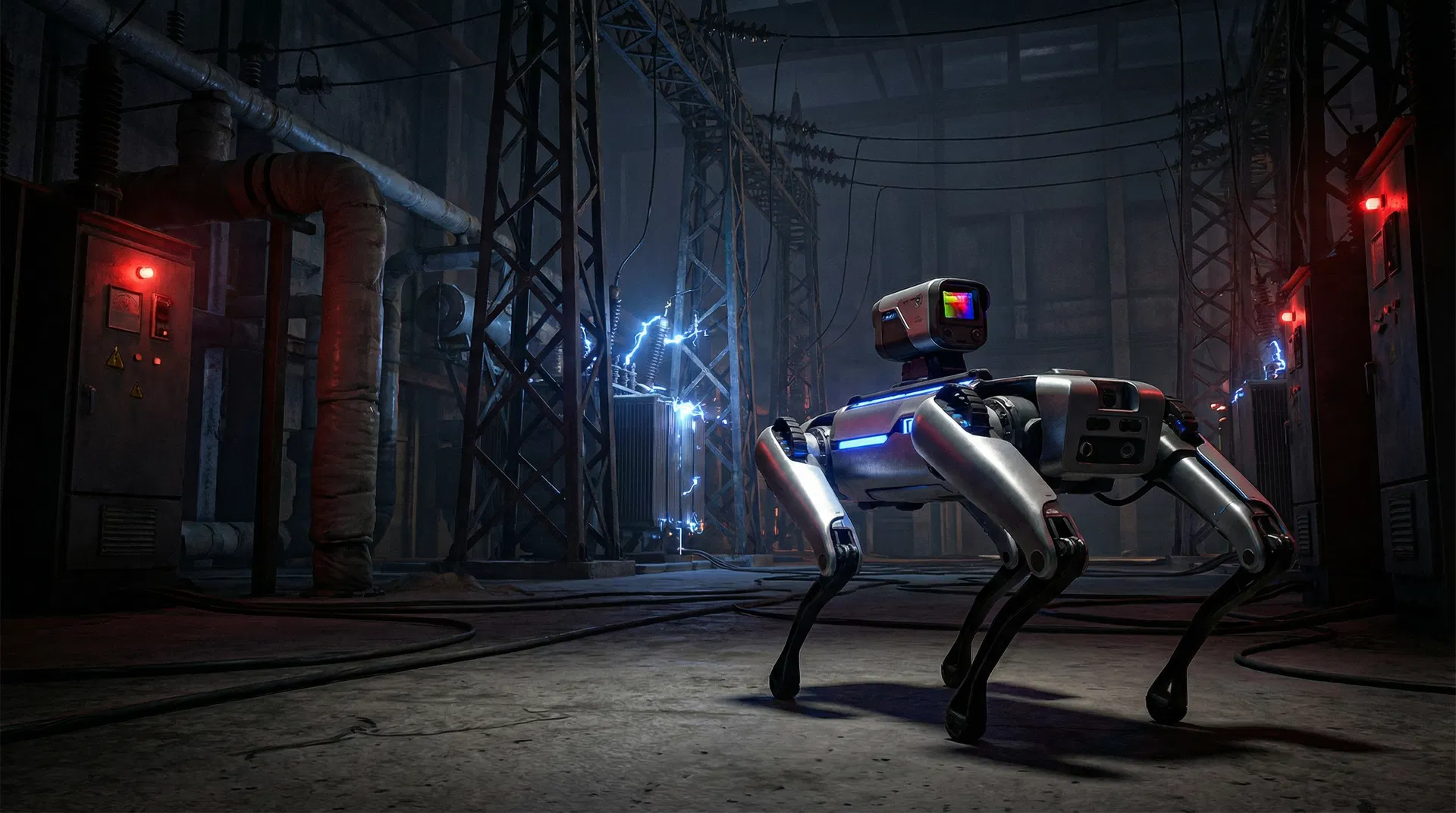
Every procurement manager who has evaluated a quadruped robot for the first time asks the same question: is this a robot dog, or is this an industrial tool? The answer determines everything — how you specify it, how you justify the capital expenditure, and how you measure its performance against your existing inspection program. This guide answers that question definitively, and gives you the five-criteria evaluation framework that separates industrial-grade quadruped platforms from consumer-grade novelties.
A quadruped robot is a four-legged autonomous machine designed to traverse complex terrain, carry sensor payloads, and execute programmed inspection or security missions without continuous human control. In an industrial context, the relevant question is never “what is it?” — it is “what does it replace, what does it cost to own, and what does it need to survive in my environment?” This guide addresses all three.
How Quadruped Robots Work: Locomotion, Actuators, and Autonomy
The mechanical foundation of every quadruped robot is its joint actuator system. Each leg contains three or four actuated joints — hip abduction/adduction, hip flexion/extension, and knee flexion — controlled by high-torque servo motors or hydraulic actuators. The quality of these actuators determines the robot’s terrain capability, payload capacity, fall recovery speed, and long-term reliability. This is the single most important engineering variable to evaluate when comparing platforms from different manufacturers.
Industrial quadruped robots operate across three autonomy levels. At the lowest level, the robot is teleoperated — a human operator drives it via joystick with live video feed. At the intermediate level, the robot follows pre-programmed waypoint routes, executing inspection tasks at each waypoint autonomously while a human monitors remotely. At the highest level, the robot operates in fully autonomous fleet mode — scheduling its own missions, docking for charging, and uploading inspection reports without human intervention. Most industrial deployments begin at the intermediate level and progress toward full autonomy as operators gain confidence in the system.
Proprietary vs. Off-the-Shelf Actuator Systems
The actuator question is where manufacturers diverge most significantly. Platforms built on proprietary self-developed actuators — where the manufacturer designs and produces the joint motors, gearboxes, and control electronics in-house — offer tighter integration between mechanical and software systems, faster fault recovery, and more predictable long-term spare parts availability. Platforms assembled from off-the-shelf servo components are faster to bring to market but introduce supply chain dependencies that affect serviceability in the field.
When evaluating any quadruped robot manufacturer, ask directly: Are your actuators proprietary or third-party? What is your spare parts lead time for actuator replacement? The answer reveals both the technical depth of the organization and the realistic maintenance cost over a five-year deployment horizon.
Autonomy Levels: Teleoperated vs. Semi-Autonomous vs. Fully Autonomous
The autonomy level you need depends on your inspection use case. For hazard response and emergency reconnaissance, teleoperation gives you human judgment in dangerous situations. For routine scheduled inspections — the majority of industrial use cases — semi-autonomous waypoint patrol delivers consistent coverage without operator fatigue. For 24/7 continuous monitoring at unmanned facilities, full autonomy with self-docking charging is the only viable approach. Specify the autonomy level before evaluating platforms, not after.
Quadruped Robots vs. Wheeled Robots: When Legs Win
The choice between a quadruped and a wheeled inspection robot is an engineering decision, not a preference. Wheeled robots are faster on flat surfaces, cheaper to maintain, and simpler to operate. Quadruped robots are slower on flat surfaces but capable of terrain that eliminates wheeled platforms entirely. The decision comes down to your facility’s terrain profile.
Terrain Scenarios Where Quadrupeds Outperform Wheeled Platforms
Quadruped robots are the correct choice when your inspection route includes any of the following: stairs or elevated catwalks, grated metal flooring (which catches wheeled robot treads), pipe racks and cable trays requiring step-over navigation, uneven outdoor terrain with slopes exceeding 15°, confined spaces with irregular floor surfaces, or environments where debris accumulation is common. In power substations, oil refineries, and rail tunnels — the three most common quadruped deployment environments — all of these conditions appear simultaneously.
Speed and Payload Trade-offs
The speed advantage of wheeled robots disappears when terrain complexity forces them to stop or reverse. A wheeled robot that achieves 3 m/s on flat concrete but cannot navigate a single flight of stairs is slower than a quadruped that moves at 1.5 m/s but completes the full inspection route without interruption. Evaluate mission completion time, not maximum speed, when comparing platforms for a specific facility.
Payload capacity follows a similar logic. A robot with a 40 kg payload rating that cannot carry that payload up a 30° slope is not a 40 kg payload robot for your application. Always specify payload requirements at the terrain conditions of your actual deployment environment, not at flat-surface laboratory conditions.
5 Key Specifications to Evaluate Before Purchasing Any Quadruped Robot
Most quadruped robot datasheets list the same categories of specifications. The following five are the ones that determine real-world performance in industrial environments — and the ones where marketing language most frequently obscures the engineering reality.
1. IP Rating: Why IP67 Matters in Industrial Environments
The Ingress Protection (IP) rating tells you how well the robot’s enclosure resists solid particles and liquid ingress, per IEC 60529. The first digit (0–6) rates solid particle protection; the second digit (0–9) rates liquid protection. IP54 means protected against dust in limited quantities and water splashed from any direction. IP67 means fully dust-tight and protected against temporary immersion in water up to 1 meter for 30 minutes.
For indoor industrial environments — manufacturing plants, data centers, indoor substations — IP54 is typically sufficient. For outdoor deployments, oil and gas facilities, chemical plants, and any environment where the robot may encounter rain, mud, or chemical spray, IP67 is the minimum acceptable rating. The difference in sealing engineering between IP54 and IP67 is substantial; do not assume an IP54 robot can be upgraded to IP67 through aftermarket sealing.
2. Payload Capacity and Modular Payload Architecture
Payload capacity is the maximum additional weight the robot can carry while maintaining its rated performance specifications. But the number alone is insufficient — you need to understand the payload interface architecture. A robot with a 25 kg payload capacity and a standardized top-mount interface with hot-swap capability is fundamentally more useful than a robot with the same capacity but a fixed, single-payload configuration. The former can be reconfigured for different inspection missions; the latter is locked to a single use case.
Evaluate payload architecture by asking: How many payload mounting points does the platform have? What is the interface standard (proprietary or open)? Can payloads be swapped in the field without tools? Is there a published payload compatibility list from the manufacturer?
3. Operating Temperature Range for Extreme Environments
Battery chemistry, actuator lubricants, and electronic components all have temperature-dependent performance curves. A robot rated for operation at -20°C to 50°C has been engineered with thermal management systems — battery heating circuits, lubricant formulations, and component selection — that a robot rated only for 0°C to 40°C has not. For outdoor deployments in northern climates, desert environments, or facilities with extreme process temperatures, the operating temperature specification is a hard constraint, not a soft preference.
4. Autonomy and Navigation Technology
The navigation technology determines what environments the robot can operate in without GPS. LiDAR-based SLAM (Simultaneous Localization and Mapping) builds a 3D point cloud map of the environment and uses it for real-time localization — effective in structured industrial environments with consistent geometry. Visual SLAM uses camera-based feature tracking — effective in visually rich environments but degrades in low-light or featureless areas. For underground, tunnel, or GPS-denied environments, LiDAR SLAM is the more reliable choice.
5. Fleet Management and Data Integration
A robot that generates inspection data but cannot deliver it to your existing asset management or SCADA systems is a data silo. Before purchasing, confirm: Does the platform have an open API for data export? Does it integrate with your existing CMMS, DCS, or SCADA system? Can inspection reports be automatically generated and timestamped for compliance documentation? The value of an inspection robot is not in the data it collects — it is in the actions that data triggers.
Platform Comparison: ZSL-1, ZSL-1W, and ZSM-1 vs. Market Alternatives
The following table compares Rongzhitong’s three quadruped platforms against the two most widely deployed Western alternatives — Boston Dynamics Spot and ANYbotics ANYmal X — across the five evaluation criteria defined above.
| Specification | ZSL-1 | ZSL-1W (Wheel-Legged) | ZSM-1 | Boston Dynamics Spot | ANYbotics ANYmal X |
|---|---|---|---|---|---|
| Robot Weight | 15 kg | 20 kg | 30 kg | 32 kg | 50 kg |
| Max Payload | 8 kg | 10 kg | 25 kg | 14 kg | 10 kg |
| Max Speed | 3.7 m/s | 9 km/h | 8 m/s (wheeled) | 1.6 m/s | 1.0 m/s |
| IP Rating | IP54 | IP54 | IP67 | IP54 | IP67 |
| Operating Temp | -10°C ~ 45°C | -10°C ~ 45°C | -20°C ~ 50°C | -20°C ~ 45°C | -25°C ~ 50°C |
| Max Slope | 35° | 35° | 45°+ | 30° | 35° |
| Actuator Type | Proprietary self-developed | Proprietary self-developed | Proprietary self-developed | Proprietary | Proprietary |
| OEM/ODM Available | Yes | Yes | Yes | No | No |
Two observations are worth highlighting. First, the ZSM-1’s 25 kg payload capacity is the highest in this comparison — nearly double that of Spot and 2.5× that of ANYmal X — making it the only platform capable of carrying heavy tactical payloads or multiple simultaneous sensor systems. Second, the ZSM-1’s 8 m/s wheeled speed is significantly faster than any pure-legged platform in this comparison, which matters for large-area outdoor deployments where inspection coverage rate is a key performance metric.
Quadruped Robot Buyer’s Checklist: 12 Questions to Ask Any Manufacturer
The following questions should be asked of every quadruped robot manufacturer during the evaluation process. They are designed to surface information that is rarely volunteered in standard sales presentations but is critical to procurement decisions.
Technology and Engineering
- Are your actuators proprietary or sourced from third-party suppliers? What is the spare parts lead time?
- What is the robot’s fall recovery time from a lateral fall on a flat surface? From a slope?
- What navigation technology does the platform use? What are the limitations in your specific environment?
- What is the maximum slope the robot can climb with full rated payload — not empty?
- What is the battery runtime at full payload in your operating temperature range — not at room temperature?
Certification and Compliance
- What IP rating has been independently certified? Can you provide the test report?
- What is the operating temperature range based on — component ratings or full-system field testing?
- Does the platform carry any ATEX or IECEx certification for explosive atmosphere deployment?
- What safety certifications does the platform hold for your target deployment region?
Support, Integration, and Lifecycle
- What is the warranty period and what does it cover? What is excluded?
- What is your on-site response time for hardware failures in my region?
- Does the platform have an open API for integration with SCADA, CMMS, or DCS systems?
Which Platform Fits Your Application?
| Deployment Scenario | Recommended Platform | Key Reason |
|---|---|---|
| Indoor substation inspection, stairways, catwalks | ZSL-1 | Compact 15 kg frame, 8 kg payload, IP54 sufficient for indoor |
| Mixed indoor/outdoor substation, large campus | ZSL-1W | Wheel-legged hybrid covers distance efficiently, 9 km range |
| Outdoor oil refinery, chemical plant, IP67 required | ZSM-1 | IP67 rated, -20°C operation, 25 kg payload for multi-sensor config |
| Industrial park perimeter security, 24/7 patrol | ZSM-1 | 8 m/s wheeled speed for rapid response, AI recognition payloads |
| Data center, server room thermal inspection | ZSL-1 | Compact form factor, low noise, precise navigation in narrow aisles |
| Metro tunnel, GPS-denied underground inspection | ZSL-1 | LiDAR SLAM navigation, 3D lining scan capability |
| OEM/custom integration for system integrators | All platforms | Open OEM/ODM program with SDK, white-label, and custom payload options |
About Rongzhitong Technology
Rongzhitong Technology (Beijing) Co., Ltd. is a civil-military integration enterprise specializing in the design, manufacture, and deployment of quadruped robotic platforms for industrial inspection, security patrol, and tactical applications. All core technologies — including joint actuator systems, locomotion control software, and AI recognition algorithms — are self-developed, giving Rongzhitong full control over platform performance, customization depth, and long-term support capability.
The company’s product lineup spans three platforms: the ZSL-1 (15 kg, IP54, designed for indoor and semi-outdoor inspection), the ZSL-1W (20 kg, wheel-legged hybrid, designed for large-area mixed terrain), and the ZSM-1 (30 kg, IP67, designed for outdoor, extreme environment, and tactical applications). All platforms are supported by Rongzhitong’s cloud-based fleet management platform.
Rongzhitong offers OEM and ODM programs for system integrators and distributors, including custom payload integration, software white-labeling, and hardware modification — a capability absent from Western competitors.
Next Step: Specify the Right Platform for Your Facility
The evaluation framework in this guide — terrain capability, payload architecture, IP rating, operating temperature, and fleet integration — gives you the criteria to compare any quadruped robot platform objectively. If your application involves specific terrain conditions, hazardous area classifications, payload requirements, or integration constraints not covered here, our engineering team can provide a detailed technical assessment.
To request technical specifications for the ZSL-1, ZSL-1W, or ZSM-1, or to discuss your inspection automation requirements, contact Rongzhitong Technology. We respond to all technical inquiries within one business day.
For a detailed comparison of the ZSL and ZSM platforms, see our full product lineup. For deployment case studies in your industry, visit our case studies section. To explore intelligent inspection solutions or security patrol applications, our solutions pages provide deployment-specific technical detail.
—
## Related Solutions
Explore how SG Trading Asia’s quadruped inspection robots are deployed in real-world applications:
– [Intelligent Inspection Robot System](/solutions/inspection)
– [Security & Tactical Robot System](/solutions/security)
– [OEM/ODM Partnership Services](/oem-odm)
*[Contact our engineering team](/contact) to discuss your specific inspection requirements.*
Tagged: