Autonomous Inspection for
Power Distribution Rooms
Replace hazardous manual inspection rounds with a 24/7 intelligent robot patrol system. Three deployment configurations — indoor quadruped, wheeled robot, and rail-mounted robot — cover every distribution room layout, delivering continuous thermal monitoring, partial discharge detection, meter reading, and AI-powered fault prediction.
Why Traditional Inspection Falls Short
Distribution rooms are among the most critical — and most difficult — environments to inspect. The combination of electrical hazards, scale, and data complexity creates gaps that manual processes cannot close.
Hazardous Live-Equipment Access
Distribution rooms house live switchgear, transformers, and busbars. Safety regulations restrict personnel from entering during energized operation, creating inspection blind spots that accumulate undetected faults.
Scale Outpaces Staffing
The number of distribution rooms continues to grow faster than maintenance headcount. Dividing responsibility into smaller zones increases management complexity and reduces cross-team coordination.
Manual Data Processing Bottleneck
Traditional paper-based or spreadsheet-based inspection records are slow to aggregate, prone to transcription errors, and cannot support real-time trend analysis or predictive fault detection.
Reactive Rather Than Predictive
Without continuous monitoring, faults are only discovered after they manifest — often causing equipment damage or outages. Early-warning indicators (temperature rise, partial discharge, abnormal acoustics) go undetected.
Three Configurations for Every Facility
No two distribution rooms are identical. Shaanxi Smart Innovation Future Technology offers three proven robot configurations — each optimized for a different facility type — so you can match the deployment to your specific layout and operational requirements.
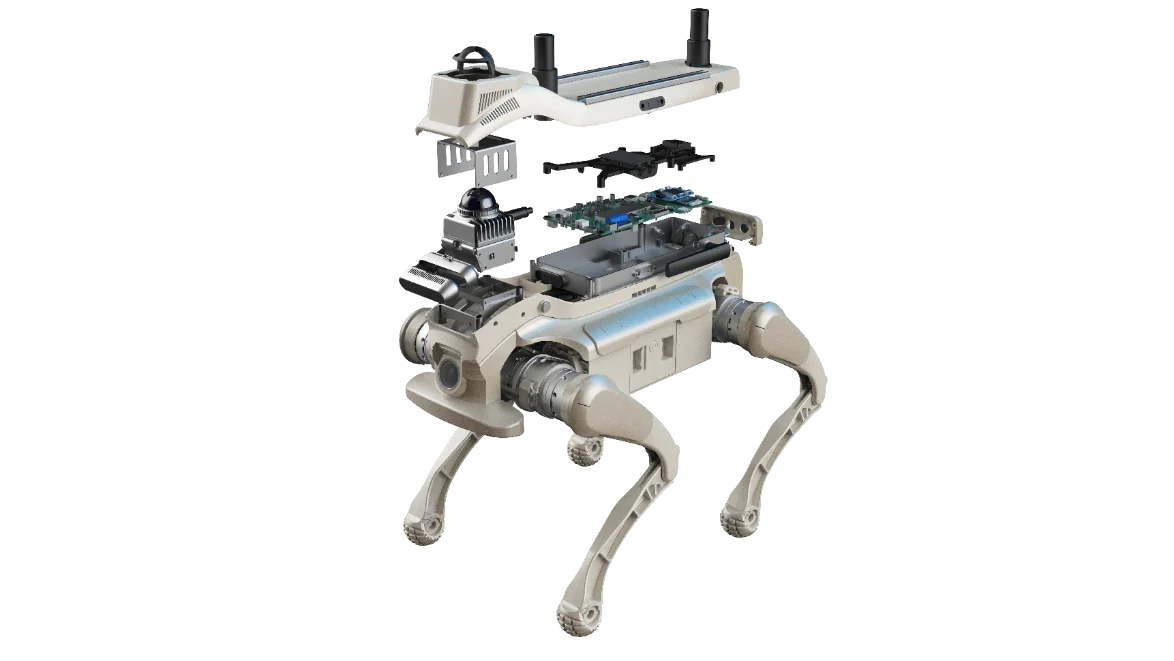
Indoor Quadruped Robot
Maximum Terrain Flexibility
- Navigates stairs, cable trays, and uneven floors that wheeled robots cannot traverse
- Dual-spectrum PTZ payload: HD video, infrared thermometry, visible-light fill, remote voice broadcast
- Autonomous patrol with configurable waypoints and electronic fence zones
- Modular payload rail supports partial discharge, gas, and environmental sensors
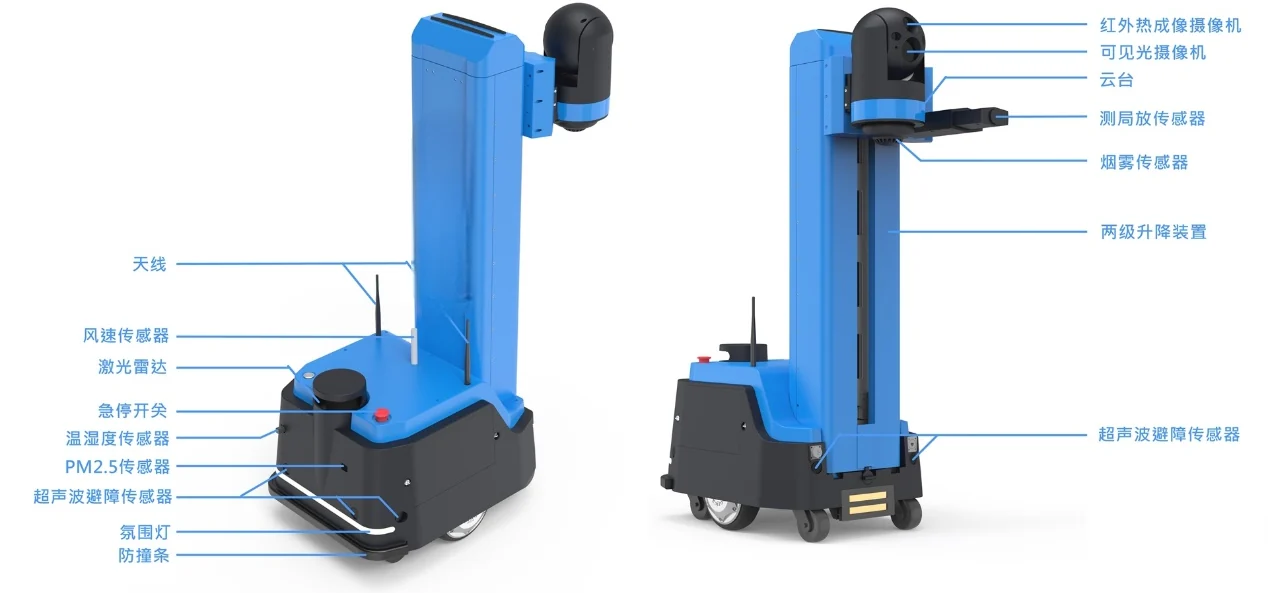
Wheeled Inspection Robot
High-Density Sensor Coverage
- Comprehensive sensor suite: thermal camera, visible camera, partial discharge (EM/ultrasonic/ground wave), smoke, LiDAR, wind speed, temperature/humidity, PM2.5, gas
- Two-stage lift mechanism extends sensor reach to high-mounted equipment
- Stable platform for long-duration continuous monitoring missions
- Automatic docking and charging for 24/7 unattended operation
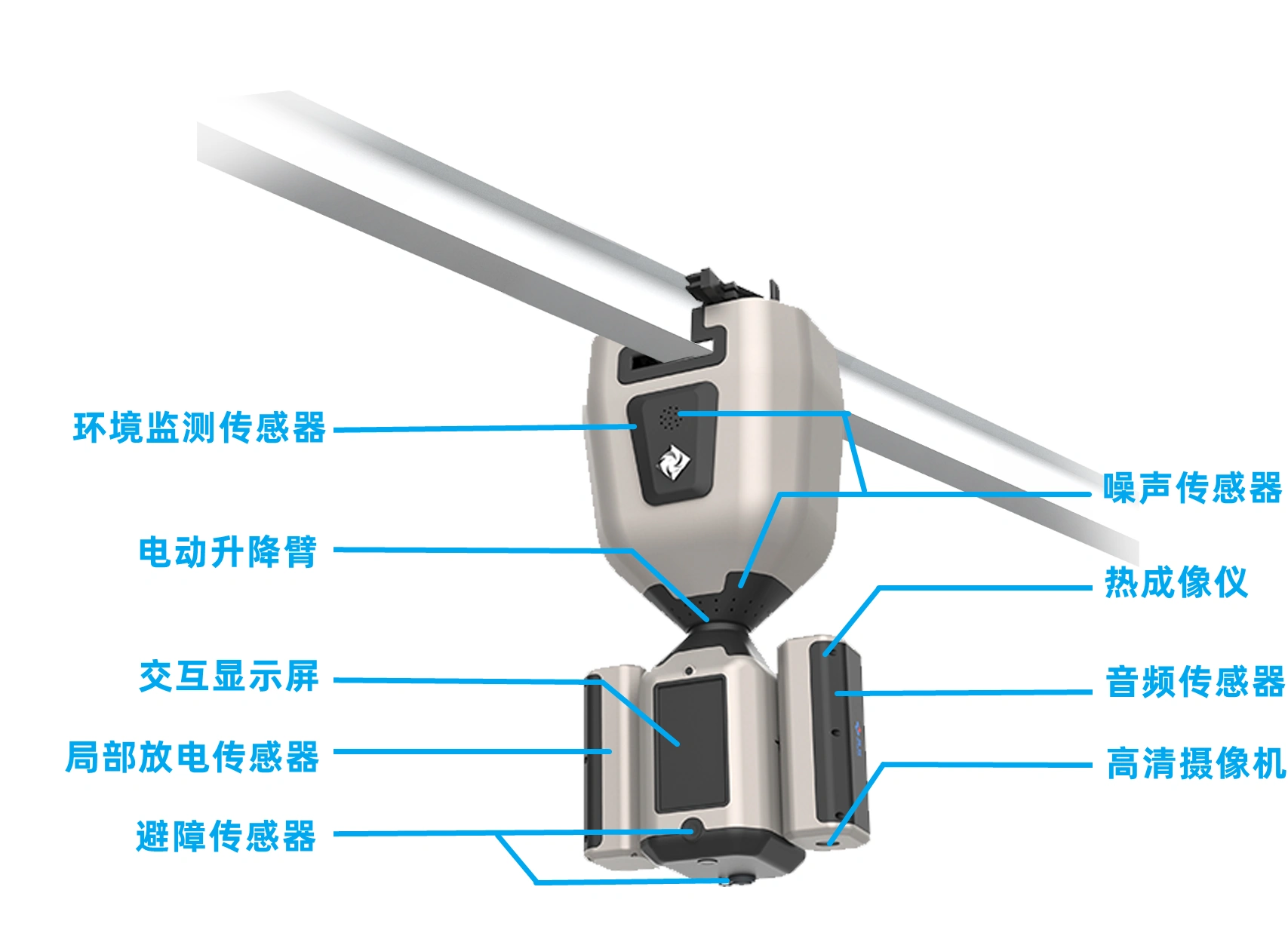
Rail-Mounted Robot
Zero Floor Footprint
- Overhead H-profile aluminum alloy track — zero floor space consumed, no interference with maintenance access
- Track bends 0–90° to follow any room geometry; anodized surface for corrosion and wear resistance
- Tri-modal partial discharge detection: electromagnetic wave + ultrasonic + ground electric wave
- Environmental sensor module, noise sensor, obstacle avoidance, and HD camera in a single compact head
Shared Intelligence Across All Configurations
Regardless of which robot platform is deployed, all three configurations share the same AI inspection engine and backend management platform.
Machine Vision + Acoustic Recognition
Reads panel meters, pointer gauges, and fault indicator lamps automatically. Simultaneously performs acoustic pattern recognition to detect abnormal equipment sounds — combining visual and auditory inspection in a single pass.
Infrared Thermal Inspection
Continuous infrared scanning identifies thermal anomalies in switchgear, busbars, cable joints, and transformers. Automatic fault diagnosis triggers alerts before thermal defects escalate to failures. Post-mission reports include high-density temperature maps.
Meter & Status Recognition
AI vision reads SF6 gauges, oil-level indicators, oil-temperature gauges, switch open/close text, plate states, liquid levels, handle directions, and LED digit displays — eliminating manual meter rounds entirely.
AI Cloud Analytics & Trend Prediction
Next-generation neural network algorithms process historical inspection data to identify degradation trends and predict faults before they occur. Automated report generation, anomaly alerts, and issue management with configurable notification channels (SMS/email/API).
Structured Inspection Reports
Every patrol mission automatically generates a structured report with equipment readings, environmental data, thermal images, alert events, and patrol path logs. Historical data review and trend charts support continuous operational optimization.
Partial Discharge Monitoring
Tri-modal PD detection (electromagnetic wave, ultrasonic, ground electric wave) provides comprehensive coverage of insulation degradation in switchgear and cable terminations — the leading indicator of high-voltage equipment failure.
Early-Warning Thermal Anomaly Detection
The infrared thermal imager continuously scans all electrical equipment. Color-coded heat maps instantly reveal temperature anomalies — from overloaded busbars to degraded cable insulation. Alerts are generated before visible damage occurs, enabling preventive maintenance rather than emergency repair.
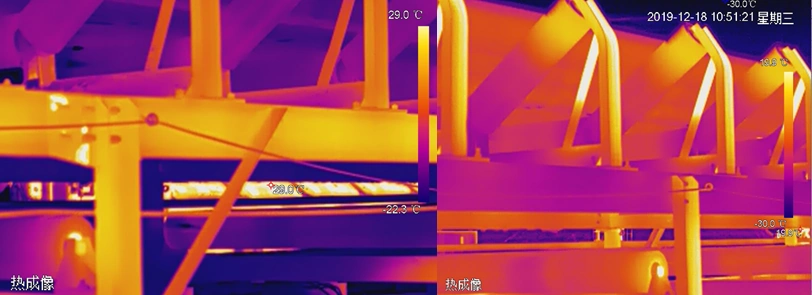
Dual thermal image comparison — color gradient maps temperature distribution across electrical equipment
Automated Equipment State Verification
AI vision models read every instrument and verify every switch state without human intervention. The system cross-references readings against configured thresholds and flags deviations immediately — eliminating transcription errors and ensuring no equipment state goes unrecorded.
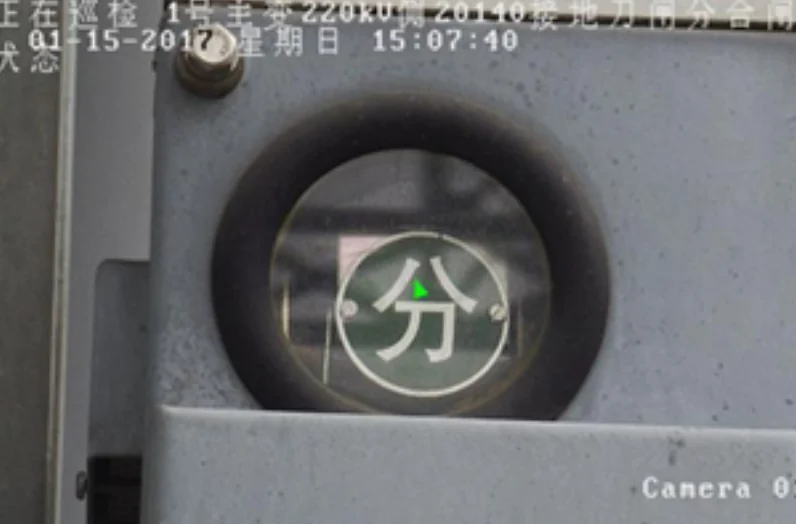
AI vision reading switch open/close state — one of eight equipment status types recognized automatically
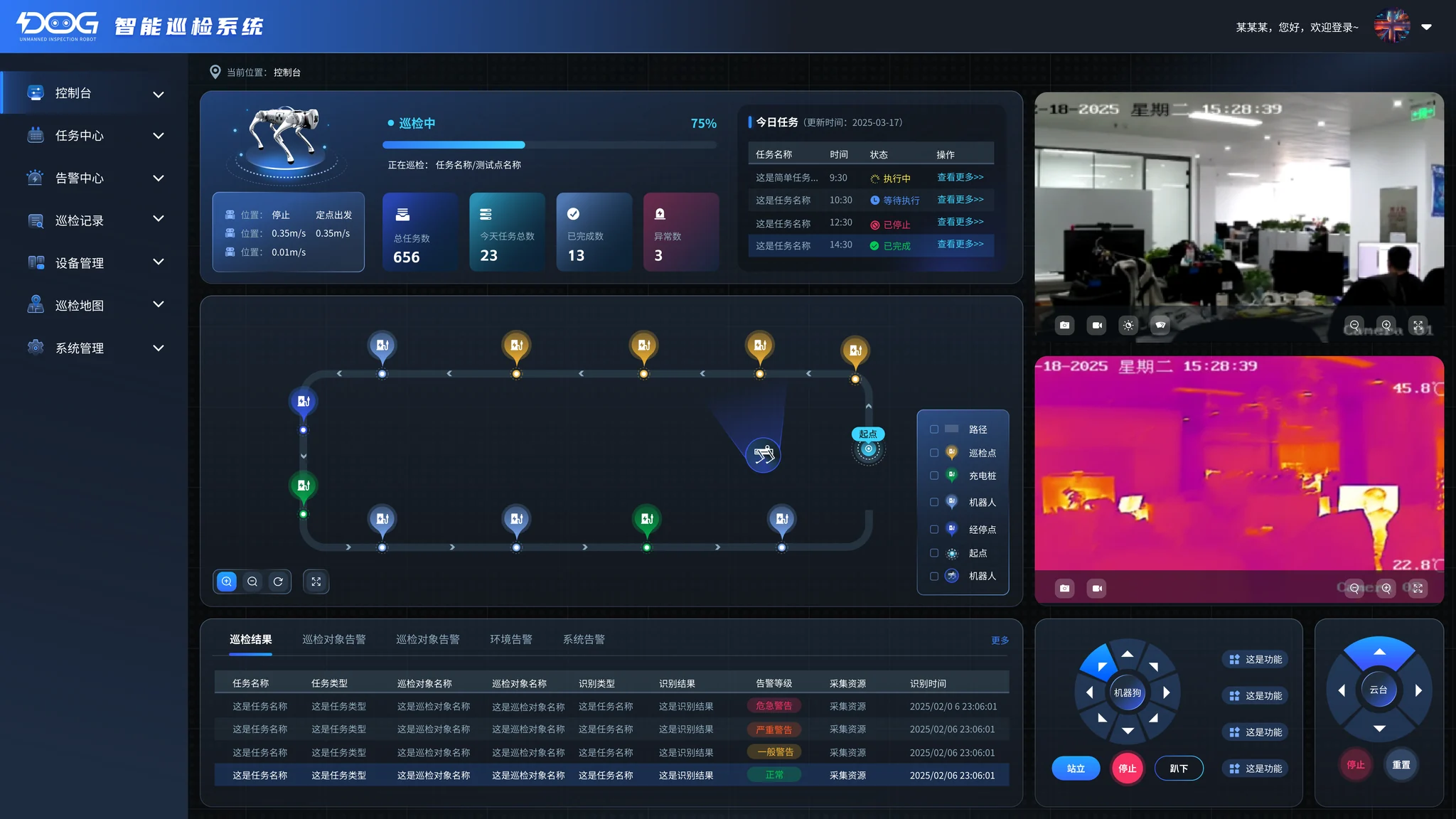
Centralized management dashboard — real-time robot status, patrol map, task queue, live video + thermal feeds, and alert management
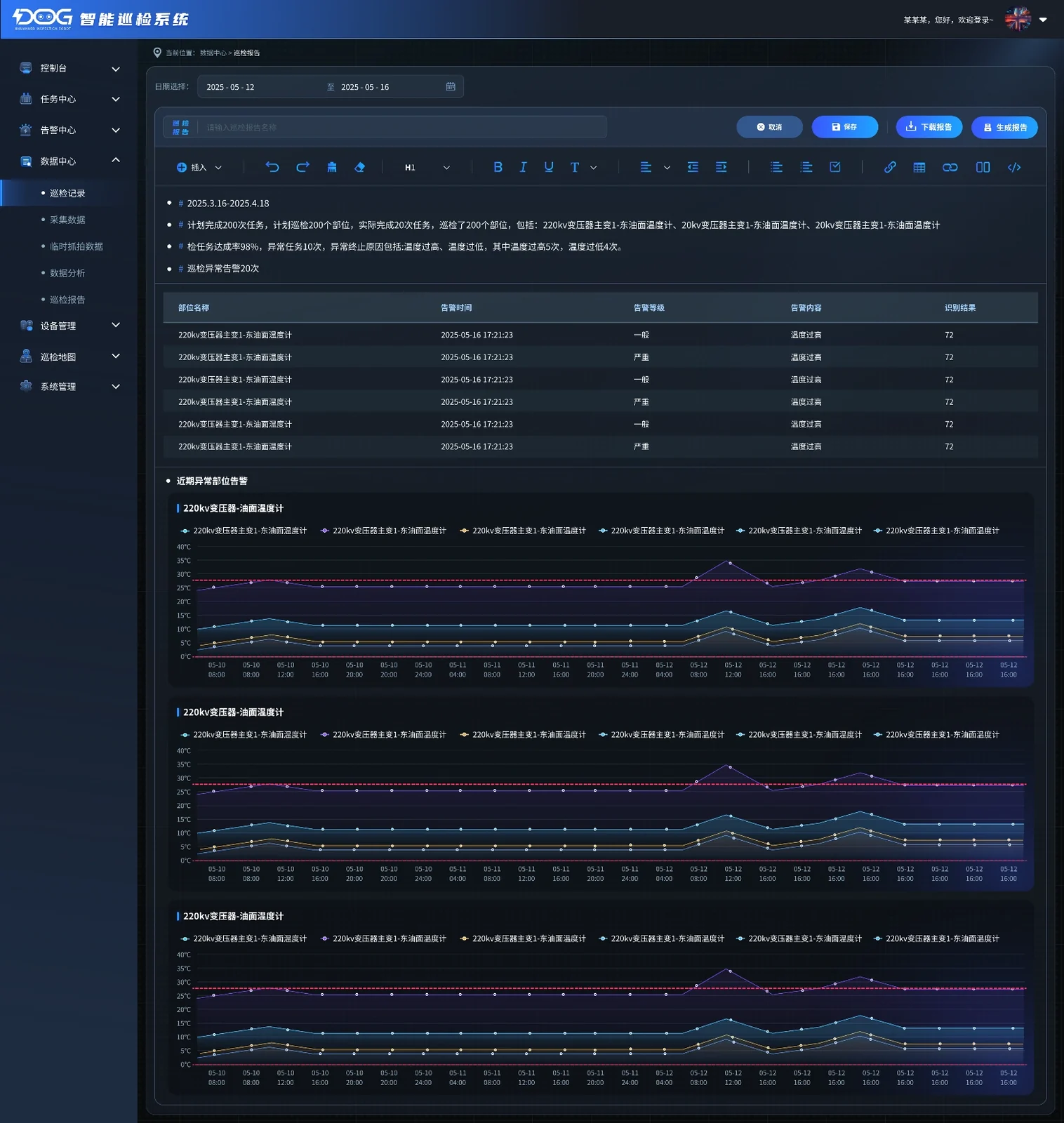
Inspection report analytics — temperature trend charts, anomaly event log, and downloadable structured reports
Unified Command & Analytics
The intelligent inspection management platform integrates robot technology, IoT, pattern recognition, navigation, and AI into a single interface. It enables fully autonomous, around-the-clock inspection and monitoring — reducing labor intensity while providing predictive analytics and visualization through a cloud-based intelligence layer.
Integration-ready: The platform exposes REST API and HTTP Client interfaces for seamless integration with existing SCADA, EMS, or enterprise asset management systems.
Applicable Facility Types
Any facility with indoor electrical distribution infrastructure that requires regular inspection and continuous monitoring.
Ready to Automate Your Distribution Room Inspections?
Our solutions team will assess your facility layout, equipment inventory, and inspection requirements to recommend the optimal robot configuration and deployment plan.
Common Questions About Electrical Room & Switchgear Inspection Robot
Answers to the most common questions from procurement managers, system integrators, and engineering teams evaluating our robotic platforms.
Electrical rooms and switchgear facilities contain high-voltage equipment that poses serious electrocution and arc flash risks to human inspectors. Robots eliminate human exposure to these hazards while enabling more frequent inspections — daily or even hourly — that would be impractical with human teams.
Electrical room inspection robots are equipped with thermal imaging cameras (to detect overheating components), partial discharge detectors (to identify insulation failures), acoustic sensors (to detect abnormal equipment sounds), and visual cameras for meter reading and indicator light monitoring.
Yes. AI-powered visual inspection systems on the robots can automatically read analog gauges, digital displays, and indicator light states using computer vision. Readings are compared against baseline values and alert thresholds, with anomalies flagged automatically in the inspection report.
Manual electrical room inspection is typically performed weekly or monthly due to labor constraints and safety protocols. Robot inspection can be scheduled hourly or continuously, dramatically increasing the probability of detecting developing faults before they cause equipment failure or outages.
Yes. Inspection robots are designed with non-conductive materials in critical areas and maintain safe operating distances from high-voltage equipment as defined in IEC and IEEE standards. They do not require the equipment to be de-energized during inspection, unlike many manual inspection procedures.
Still have questions?
Our application engineers are available to answer technical questions, discuss deployment requirements, and provide custom quotations.
Talk to an EngineerRelated Resources
Average response time: within 24 hours on business days