Automated Electrical Room Inspection Detects 14 Thermal Faults Before Equipment Failure
Live Electrical Environments: High Risk, Low Inspection Frequency, Reactive Maintenance
A municipal power distribution company operating 28 medium-voltage distribution rooms across an eastern Chinese city faced a fundamental operational dilemma: the environments most critical to inspect were also the most dangerous for human entry. Each distribution room contained live 10 kV switchgear, transformer banks, and cable terminations operating continuously — environments where arc flash incidents, even with full PPE compliance, carry serious injury risk.
The company’s inspection protocol required each distribution room to be inspected twice daily, but compliance data showed that only 61% of scheduled inspections were completed on time, with the shortfall concentrated in rooms located in difficult-access locations such as underground car parks, building basements, and remote industrial sites. The consequence was a reactive maintenance posture: faults were typically discovered only after equipment failure or customer outage reports, rather than through proactive detection.
A thermal imaging audit conducted by the company’s engineering team identified that 8 of the 28 distribution rooms had equipment operating at temperatures above recommended thresholds — faults that had been present for an estimated 3–6 months without detection. The engineering director concluded that the manual inspection model was structurally incapable of delivering the inspection frequency and data quality needed to support a predictive maintenance programme.
“We had thermal faults sitting undetected for months in rooms that were theoretically being inspected twice a day. The inspection records showed visits, but the data quality was insufficient to catch developing faults. We needed objective, consistent, high-frequency data — not just a signature in a logbook.”
— Chief Engineer, Municipal Power Distribution Company
Mixed Fleet Deployment: RZTL-1W for Standard Rooms, Tongchui M1 for Complex Environments
Shaanxi Smart Innovation Future Technology’s engineering team conducted a site classification exercise across all 28 distribution rooms, categorising them by floor plan complexity, access constraints, and equipment density. Twenty rooms were classified as standard single-floor layouts suitable for the RZTL-1W wheeled-legged platform; eight rooms — including three multi-level facilities and five with narrow aisle configurations — were designated for the Tongchui M1, which offers greater obstacle clearance and a higher payload capacity for additional sensor modules.
All robots were equipped with a high-resolution thermal imaging module (±0.5°C accuracy, 640×480 thermal resolution) and a visible-light camera for simultaneous optical and thermal inspection. Each robot was programmed with a custom inspection route covering all critical equipment positions — transformer terminals, cable joints, switchgear bus bars, and capacitor banks — with specific thermal imaging dwell times at each point to ensure consistent data quality across inspection cycles.
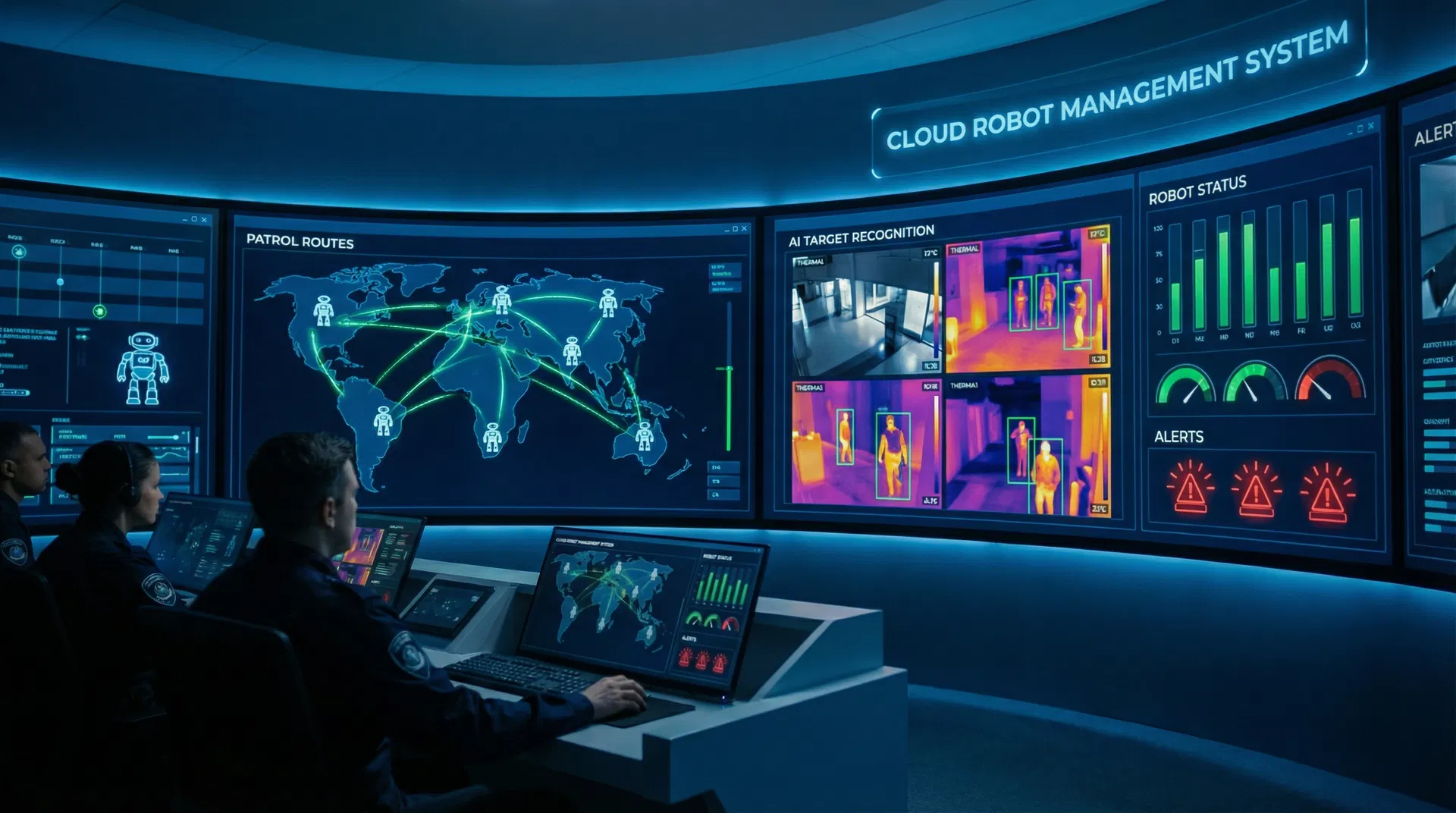
The cloud management platform was configured with equipment-specific thermal thresholds based on the manufacturer’s operating specifications for each device type. A three-tier alert system was implemented: informational alerts for temperatures 5°C above baseline, warning alerts for 10°C above baseline, and critical alerts for 15°C above baseline — the latter triggering immediate SMS and email notification to the on-call engineer with a live thermal image attachment.
14 Pre-Failure Faults Detected, Zero Personnel Exposure, 78% Labour Reduction
In the first six months of operation, the autonomous inspection system detected 14 thermal anomalies that were subsequently confirmed as developing equipment faults — including 6 cable joint overheating events, 5 switchgear bus bar hotspots, and 3 transformer terminal degradation cases. All 14 were addressed through scheduled maintenance before causing equipment failure or service interruption. The company’s engineering team estimated that at least 4 of the 14 faults would have escalated to unplanned outages within 30–60 days if undetected.
Personnel entry into live distribution rooms was eliminated for routine inspection purposes. The company’s safety officer reported that this change alone reduced the organisation’s electrical safety incident risk exposure by an estimated 70%, based on actuarial analysis of industry incident statistics. The inspection team was redeployed from routine patrol duties to maintenance execution and fault investigation — higher-value work that better utilised their technical expertise.
Inspection labour costs fell by 78% as the team size was reduced from 18 inspection technicians to 4 — with the remaining staff managing the cloud platform, responding to critical alerts, and executing maintenance work orders generated by the AI fault detection system. The payback period for the full fleet deployment was calculated at 14 months based on labour cost savings alone, excluding the avoided-outage value of the 14 pre-failure fault detections.
Related solution:
Power Distribution Room Inspection Solution →Get a Free Consultation
Discuss how our robots can replicate these results in your facility. No commitment required.
Related Case Studies
 Power & Energy
Autonomous Substation Inspection Reduces Manual Rounds by 85%
A regional grid operator deployed the RZTL-1W across 12 substations, cutting inspection cycles from 4 hours to 45 minutes with real-time thermal anomaly detection.
Data CenterData Center Achieves 99.99% Uptime with Autonomous Thermal Inspection
A Tier-4 data center eliminated unplanned downtime by deploying autonomous robots for continuous thermal monitoring of server racks and cooling infrastructure.
Rail TransitUrban Rail Transit Authority Cuts Tunnel Inspection Labor by 62%
A metropolitan rail authority deployed autonomous robots for tunnel inspection across 87 km of underground track, eliminating track possession windows and reducing inspection costs.