Zone 1 vs Zone 2 Inspection Robots: Explosive Atmosphere Standards
Zone 1 inspection robots are engineered to operate safely in environments where explosive gas atmospheres are likely to occur during routine operations (10 to 1,000 hours per year), requiring dual-fault explosion protection such as Ex d flameproof enclosures or Ex ib/ia intrinsic safety. In contrast, Zone 2 mobile platforms are designed for areas where explosive atmospheres are abnormal or occur for less than 10 hours per year, utilizing single-fault or non-sparking (Ex ec) containment systems.
Deploying mobile robotics in classified hazardous locations requires strict adherence to international explosion protection standards. The IECEx System and the European ATEX Directive 2014/34/EU define strict operational tiers based on the duration and frequency of flammable vapors, gases, or dusts present in the atmosphere.
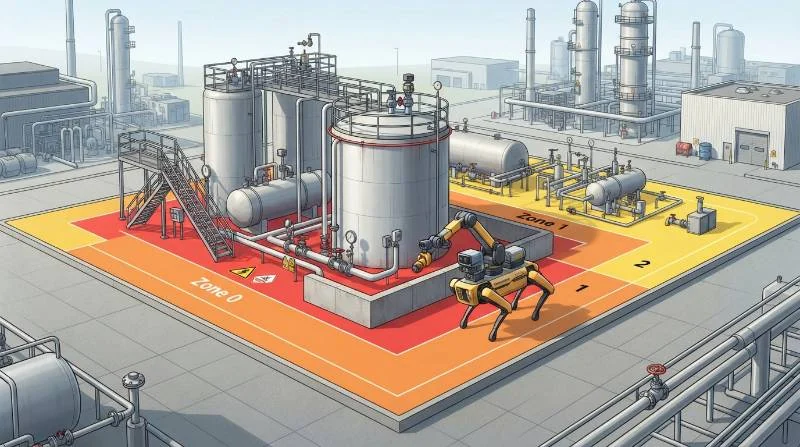
Fixed processing infrastructure categorizes zones based on static release risks. Mobile robotic platforms dynamically cross spatial safety boundaries, requiring agile environmental monitoring and robust onboard mechanical containment.
Hazardous Area Definition (IEC 60079-0): An area in which an explosive gas atmosphere is present, or may be expected to be present, in quantities such as to require special precautions for the construction, installation, and use of equipment.
Selecting an autonomous industrial inspection robot for refinery, offshore, or chemical processing plants requires structural evaluation of certified payloads, thermal limits (T-classes), and transient mechanical sparking risks.
Technical Comparison: Protection Methodologies (Ex d, Ex i, Ex p, Ex ec)
Industrial robotics manufacturers employ multiple protection concepts outlined in the IEC 60079 series. Engineering a compliant quadruped platform requires balancing ignition containment against physical payload constraints and power budgets.
| Protection Type | Standard | Zone 1 Fit | Zone 2 Fit | Weight Impact | Fault Tolerance |
|---|---|---|---|---|---|
| Flameproof (Ex d) | IEC 60079-1 | Yes (Primary) | Yes | High (5–18 kg) | Contains internal blast |
| Intrinsic Safety (Ex i) | IEC 60079-11 | Yes (ib / ia) | Yes (ic) | Low (< 1 kg) | Energy limited (< 1.3W typical) |
| Pressurized Purge (Ex p) | IEC 60079-2 | Yes (pxb / pyb) | Yes (pzc) | Medium (Aux tank required) | Overpressure continuous purge |
| Increased Safety (Ex ec) | IEC 60079-7 | No | Yes (Standard) | Low | No arc/spark in normal operation |
Flameproof (Ex d) enclosures withstand internal explosions without igniting surrounding flammable mixtures. However, cast-aluminum or stainless-steel Ex d housings add substantial mass, reducing mobile robot payload capacities and battery runtimes.
Intrinsic safety (Ex i) limits electrical energy below the minimum ignition energy (MIE) of explosive mixtures (e.g., < 20 µJ for Group IIC hydrogen atmospheres). Ex i is suitable for low-power sensors, thermal cameras, and optical gas imaging (OGI) detectors, but cannot power high-torque BLDC joint actuators.
Galvanic Barrier Isolation vs. Zener Barriers in Mobile Robotic Architectures
Connecting modular payloads to an industrial robot chassis requires strict isolation between unclassified internal systems and intrinsically safe field circuits. Passive Zener barriers require a dedicated, low-impedance connection (< 1 Ohm) to high-integrity plant earth grounds to shunt fault currents.
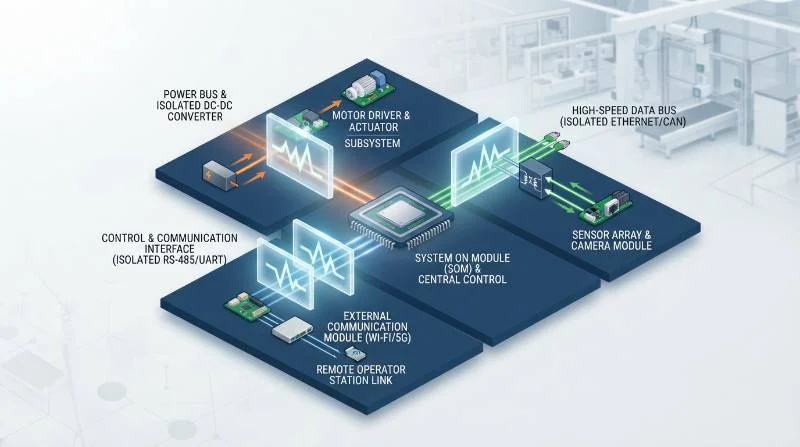
Mobile platforms have floating electrical grounds and cannot maintain a hardwired earth connection while traversing a plant. Using Zener barriers on mobile units creates dangerous chassis return currents and electrostatic spark discharge risks.
Three-Port Isolation Topology
Active galvanic isolation barriers resolve floating ground issues by eliminating physical conductive paths between the robot bus and external modular sensors. The architecture requires three-port physical isolation:
- Power Port: Transformer-isolated DC-DC converters featuring breakdown isolation ratings ≥ 1.5 kVAC RMS and low inter-winding capacitance (< 8 pF).
- Data Bus Port: High-speed digital optoisolators or giant magnetoresistive (GMR) isolators protecting CAN bus, RS-485, and Ethernet telemetry interfaces.
- Chassis Ground Port: Independent electrostatic grounding dissipation pathways that separate high-current drive train returns from sensitive instrumentation shields.
Engineering Insight: In our hardware validation protocols, galvanic isolation prevents circulating common-mode high-frequency noise generated by 48V motor drive inverters (PWM switching frequencies of 20–50 kHz) from coupling into Zone 1 sensor loops.
The Safe-Link Protocol: Entity Parameter Calculation Matrix
Integrating modular payloads on the RZTL-1 explosion-proof robot dog follows our engineering methodology: The Safe-Link Protocol. This protocol guarantees that hot-swappable sensor packages meet intrinsic safety entity matching requirements under IEC 60079-11.
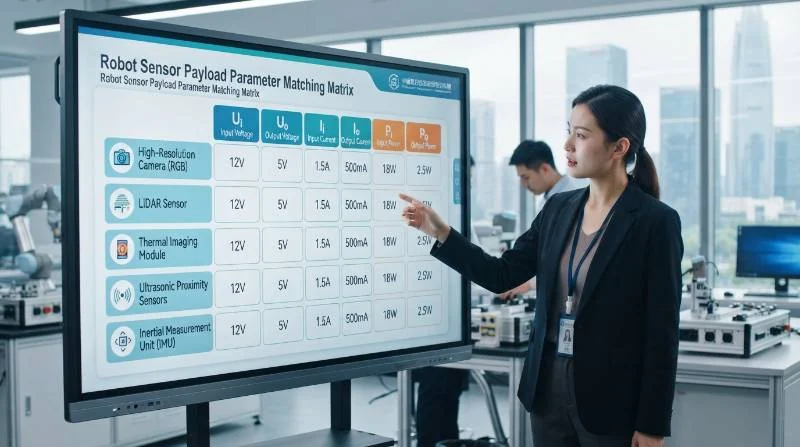
Entity Parameter Mathematical Verification
To ensure modular attachments cannot supply sufficient thermal or spark energy to cause ignition, the source parameters (associated apparatus, marked with subscript ‘o’) must match the field device payload parameters (intrinsically safe apparatus, marked with subscript ‘i’):
- Maximum Voltage: \( U_i \ge U_o \)
- Maximum Current: \( I_i \ge I_o \)
- Maximum Power: \( P_i \ge P_o \)
- Maximum Capacitance: \( C_i + C_{\text{cable}} \le C_o \)
- Maximum Inductance: \( L_i + L_{\text{cable}} \le L_o \)
| Parameter | Base Robot Outlet (Source ‘o’) | Modular Payload (Device ‘i’) | Compliance Status |
|---|---|---|---|
| Voltage (U) | \( U_o = 12.0\text{ V} \) | \( U_i = 15.0\text{ V} \) | Compliant (\( U_i \ge U_o \)) |
| Current (I) | \( I_o = 180\text{ mA} \) | \( I_i = 250\text{ mA} \) | Compliant (\( I_i \ge I_o \)) |
| Power (P) | \( P_o = 540\text{ mW} \) | \( P_i = 900\text{ mW} \) | Compliant (\( P_i \ge P_o \)) |
| Capacitance (C) | \( C_o = 1.41\ \mu\text{F} \) | \( C_i + C_c = 0.22\ \mu\text{F} \) | Compliant (\( C_i + C_c \le C_o \)) |
| Inductance (L) | \( L_o = 0.95\text{ mH} \) | \( L_i + L_c = 0.12\text{ mH} \) | Compliant (\( L_i + L_c \le L_o \)) |
Every modular sensor integration must account for internal wiring harness inductance (\( L_{\text{cable}} \approx 0.65\ \mu\text{H/m} \)) and capacitance (\( C_{\text{cable}} \approx 100\text{ pF/m} \)) within dynamic robotic limbs.
Dynamic Gait Stability & Heavy Ex-d Payload CoG Balancing
Mounting flameproof housings onto quadruped robots shifts the overall center of gravity (CoG). Standard walking trot gaits experience instability when subjected to an elevated 8–15 kg mass along the dorsal rail.
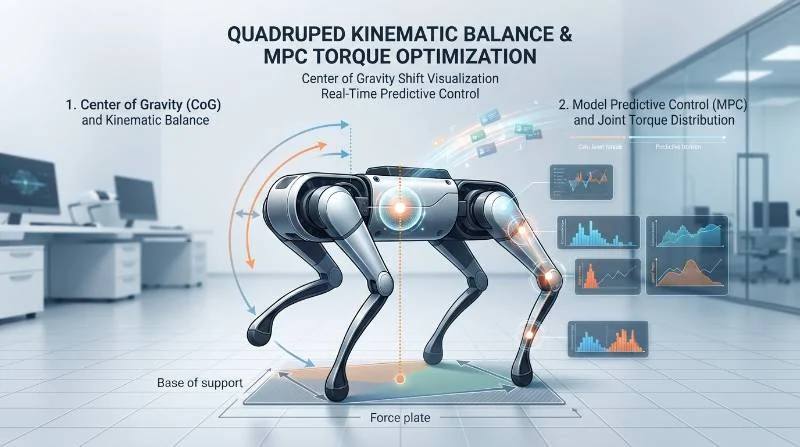
To maintain balance over industrial obstacles such as grated stairs, piping curbs, and containment bunds, the control system dynamically updates foot placement trajectories based on Real-Time Model Predictive Control (MPC).
When operating with payloads in Zone 1 processing units, the platform combines gait stabilization with industrial SLAM navigation in GPS-denied environments. 3D LiDAR point clouds detect uneven floor surfaces, dynamically lowering the robot’s stance to compensate for top-heavy Ex d sensor configurations.
Real-World Deployment: Oil, Gas, and Chemical Asset Integrity
Zone 1 and Zone 2 robotic systems automate routine operator rounds, fugitive emission tracking, and emergency situational assessments in critical infrastructure:
- Offshore Production Platforms: Autonomous acoustic detection of high-pressure gas leaks across wellhead bays and manifold skids.
- Petrochemical Tank Farms: Fixed-frequency thermal imaging to identify tank insulation decay, fluid level anomalies, and pump overheating.
- Hydrogen Generation Facilities: Group IIC T4 certified gas sniffing payloads detecting micro-leaks below lower explosive limits (LEL).
- Disaster Response: Deploying certified systems for emergency response and firefighting robotics to evaluate compromised zones before human entry.
Frequently Asked Questions
Can a Zone 2 certified inspection robot enter Zone 1 areas?
No. Zone 2 inspection robots are certified only for equipment protection level (EPL) Gc or category 3G. They do not possess the dual-fault containment or flameproof housings required to prevent ignition in Zone 1 (EPL Gb / category 2G) areas.
What is the primary difference between IECEx and ATEX certification for mobile payloads?
ATEX is a mandatory European Union directive based on CE marking compliance, while IECEx is an international certification scheme recognized across global jurisdictions. Payloads certified under IECEx require accredited laboratory testing without the self-declaration routes permitted in some ATEX Zone 2 classes.
How do galvanic isolators prevent ignition during robotic payload hot-swapping?
Galvanic isolators decouple the power and signal buses, limiting voltage and current via non-conductive barriers (transformers, optical channels). This ensures that disconnecting sensor plugs does not generate electrical arcs exceeding the minimum ignition energy of the surrounding gas atmosphere.
Why are quadrupeds preferred over wheeled robots in Ex-certified environments?
Industrial facilities feature stairs, pipe racks, and structural grating that wheeled or tracked robots cannot traverse. Legged quadrupeds step over obstacles, maintain omnidirectional mobility, and access elevated inspection points without plant modifications.
Upgrade to Certified Explosion-Proof Robotic Inspection
Eliminate inspection blind spots in classified Zone 1 and Zone 2 hazardous areas. Deploy the field-proven Intelligent Robot Dog RZTL-1 platform with custom galvanic isolation payload modules.