Core Definitions: Kinematic Differences Between Legged Platforms and AMRs
A quadruped robot makes more sense than an AMR when a facility contains stairs, elevation steps above 20 millimeters, open-grate flooring, unstructured outdoor terrain, or legacy layout constraints that make continuous wheeled navigation impossible without expensive civil renovations.
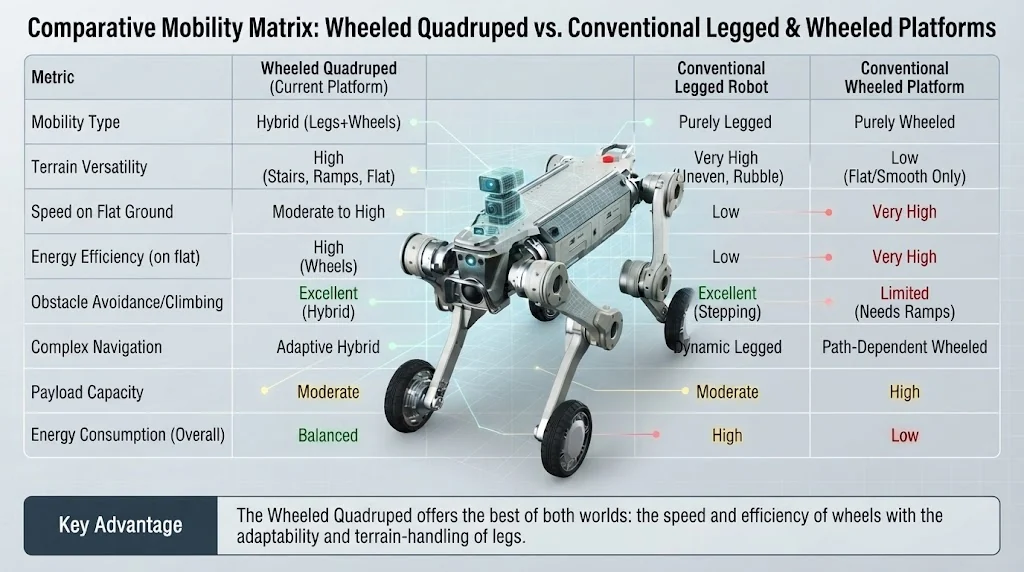
Autonomous Mobile Robots (AMRs) rely on continuous floor contact via differential, omnidirectional, or Mecanum wheels. This mechanical architecture delivers exceptional stability and energy efficiency on polished concrete or flat asphalt.
In contrast, a quadruped robotic platform utilizes twelve or more high-torque joint actuators to generate multi-axis, non-continuous foot placements. By breaking contact with the ground entirely during swing phases, legged robots isolate chassis movement from uneven terrain, mud, debris, and steep vertical rises.
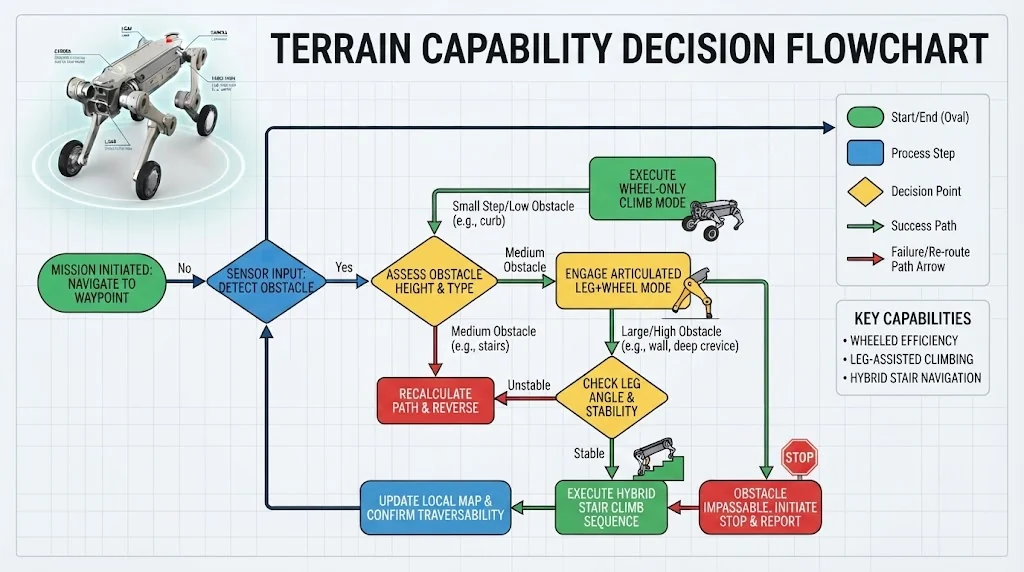
Kinematic Envelope: AMRs operate within planar 2D or 2.5D coordinate planes, while quadrupeds execute true 3D spatial locomotion, managing roll, pitch, and yaw dynamically to clear physical barriers up to 350 mm high.
| Metric / Feature | Wheeled AMR | Industrial Quadruped Robot |
|---|---|---|
| Degrees of Freedom (DoF) | 2 to 3 (Planar motion) | 12+ Active Articulated Joint Motors |
| Obstacle Clearance Limit | 10 mm – 25 mm threshold | Up to 350 mm (Stairs, Curbs, Pipes) |
| Incline Capability | 5° to 10° maximum ramp grade | Up to 35° – 45° dynamic climbing |
| Payload Density | High (100 kg – 1,500+ kg) | Moderate (5 kg – 40 kg specialized sensor payloads) |
| Primary Function | Material transport and intralogistics | Inspection, security patrol, and hazard sensing |
Terrain & Mobility Benchmarks: Navigating Structural Obstacles
Industrial facilities are rarely engineered like modern fulfillment centers. Chemical plants, electrical substations, mines, and offshore platforms feature complex surface discontinuities that halt wheeled robots instantly.
Under standardized testing aligned with ASTM E2803 mobility standards, wheeled AMRs experience drive-wheel high-centering whenever surface voids exceed wheel radius dimensions.
Stair Climbing and Multi-Level Access
A typical industrial flight of stairs has an incline angle between 30 and 38 degrees with a 180 mm riser height. For wheeled AMRs, these vertical transitions represent absolute barriers requiring freight elevators or civil ramps.
Deploying a purpose-built industrial quadruped robot platform resolves vertical navigation challenges natively. The system recalculates its foothold matrix in real time at 1,000 Hz, traversing standard metal grid risers, spiral staircases, and wet industrial steps without auxiliary tooling.
Grated Catwalks, Gravel, and Wet Contamination
Wheeled AMRs often experience loss of traction, slippage, and encoder drift on serrated bar grating or unpaved crushed stone. Legged systems navigate these surfaces by adjusting foot landing compliance and ground reaction forces dynamically.
The 4-Pillar Intelligent Terrain Assessment Framework (ITAF)
Deciding between a wheeled platform and a legged platform requires a clear engineering audit. To help automation teams evaluate deployment environments systematically, we developed The 4-Pillar Intelligent Terrain Assessment Framework (ITAF):
- Pillar 1: Surface Consistency Index (SCI): Evaluates ground composition. Polished concrete rates high for AMRs; gravel yards, mud, railway tracks, and grated gangways mandate quadrupedal locomotion.
- Pillar 2: Vertical Discontinuity Frequency (VDF): Measures stairs, curbs, drainage trenches, and cable trays per 100 meters of transit path. A VDF greater than 0.2 per 100m makes AMRs operationally unviable without major facility retrofits.
- Pillar 3: Atmospheric & Wet Hazard Profile (AWHP): Assesses pooling chemicals, ambient dust, explosive particulates, and outdoor rain exposure. Outdoor industrial sites subject to severe weather demand rugged IP67+ legged platforms.
- Pillar 4: Dynamic Obstacle & Debris Density (DODD): Quantifies unpredictable ground obstructions like loose pipes, dropped hand tools, and dynamic work zones. Quadrupeds simply step over these floor obstacles instead of triggering full safety stoppages.
Application Segregation: When to Choose an AMR vs a Quadruped
Selecting the right robotic architecture comes down to aligning the platform’s physical kinematics with your specific operational workflow.
When an AMR is the Superior Tool
- High-Throughput Pallet Transport: Moving 1,000 kg pallets between warehouse storage racks and dock bays.
- Assembly Line Material Feed: Scheduled kitting delivery inside controlled, single-floor manufacturing environments.
- Ultra-Long Floor Endurance: Tasks requiring 8 to 12 hours of continuous horizontal rolling on level epoxy surfaces without recharging.
When to Use a Quadruped Robot
Understanding when to use a quadruped robot protects your automation projects from terrain-related downtime. Legged robots excel in scenarios focused on data collection and surveillance across variable terrain:
- High-Voltage Substation Inspection: Navigating gravel switchyards, outdoor steps, and cable risers to read gauges, inspect busbars, and check transformer bushings.
- Oil, Gas, and Chemical Plant Audits: Conducting round-the-clock rounds across multi-tier towers, open grating, and areas prone to water or chemical washdowns using autonomous robotic inspection solutions.
- Underground Utility and Mining Tunnels: Traversing wet rock, loose mud, track crossings, and low-visibility confined spaces.
Critical Infrastructure & Security: GPS-Denied and Tactical Patrols
Perimeter protection along expansive industrial sites presents major challenges for conventional automated systems. Outdoor perimeters feature uneven earth, washed-out fence lines, tall grass, and unpaved patrol roads where wheeled robots get stuck.
Modern security teams deploy perimeter security and patrol robots to maintain autonomous, 24/7 boundary protection. Operating in GPS-denied environments like dense industrial facilities or remote substations, quadruped platforms leverage onboard edge AI and multi-spectral cameras to identify intruders, thermal leaks, or structural breaches instantly.
Sensor Payloads and Autonomous Navigation Architecture
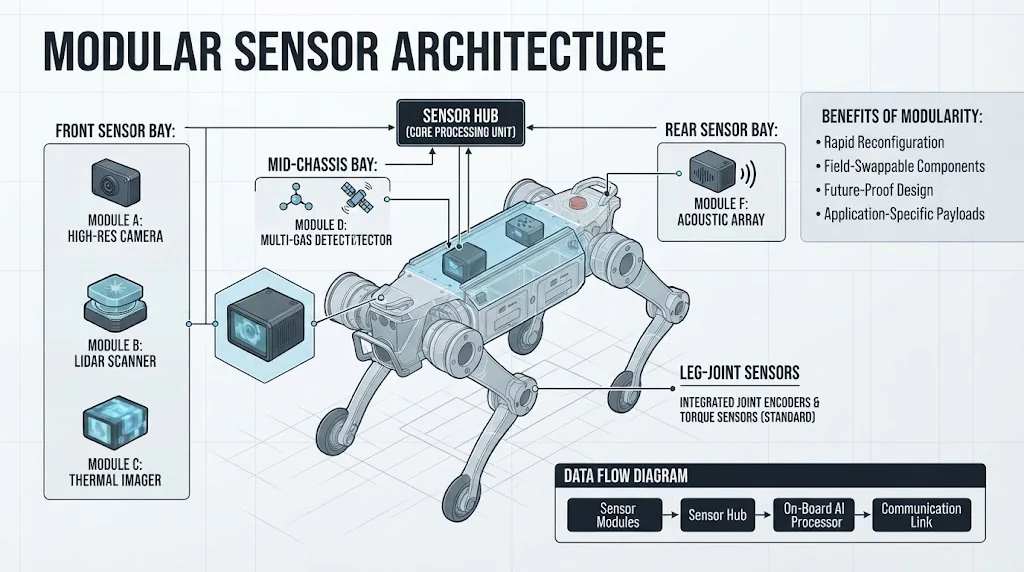
While AMRs carry mechanical transport loads, quadruped robots act as dynamic, high-mobility sensor mounts for edge-AI processing and predictive maintenance diagnostics.
Payload Integration Options
- Radiometric Thermal Cameras: For detecting high-temperature hotspots across electrical contacts and mechanical bearings.
- Optical Gas Imaging (OGI) & Sniffers: Identifying fugitive methane, SF6, and volatile organic compound (VOC) leaks in real time.
- Acoustic Acoustic Imagers: Detecting high-frequency compressed air leaks and electrical partial discharge arcs.
- 30x Optical Zoom PTZ Assemblies: Reading analog meters, valve positions, and digital displays remotely.
Advanced SLAM Navigation Under Extreme Conditions
Standard AMRs often rely on basic 2D LiDAR that can become disoriented in dynamic spaces or outdoor environments lacking vertical walls. Advanced quadrupeds employ advanced LiDAR SLAM navigation systems combined with solid-state depth cameras and inertial measurement units (IMUs).
This sensor setup generates high-density 3D point clouds, enabling reliable localization through steam, airborne dust, heavy shadows, and featureless open terrain.
Total Cost of Ownership (TCO): Retrofitting CAPEX vs Long-Term OpEx
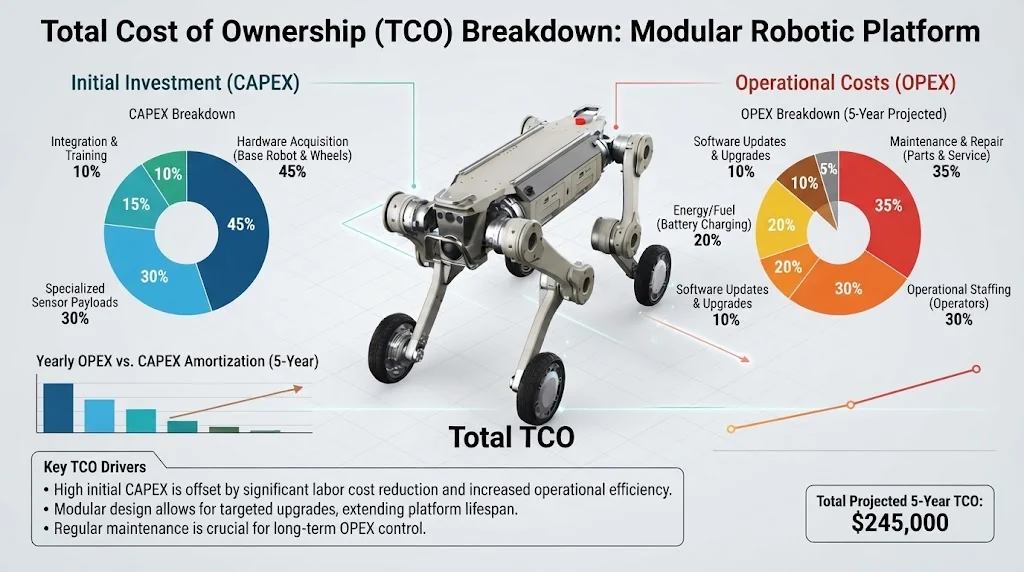
A complete quadruped robot vs AMR financial comparison requires evaluating both the base platform acquisition price and the facility preparation costs necessary to make the robot operational.
| Cost Driver | Wheeled AMR Deployment | Quadruped Robot Deployment |
|---|---|---|
| Platform Base Cost | $40,000 – $75,000 | $60,000 – $110,000 |
| Facility Retrofitting (Ramps/Doors) | $80,000 – $180,000 (Ramps, door actuators) | $0 (Navigates existing stairs and steps) |
| Elevator SCADA Integration | $35,000 – $60,000 per elevator | $0 (Ascends/descends stairs natively) |
| Routine Actuator Maintenance | Low (Wheel bearings, motor drives) | Moderate (Joint seal inspection, periodic lubrication) |
| Estimated 5-Year Total Cost | $175,000 – $340,000+ | $85,000 – $155,000 |
Although the initial purchase price of an industrial legged robot may be higher than an entry-level wheeled AMR, the elimination of facility remodeling, elevator integration, and floor modifications creates a significantly lower Total Cost of Ownership across complex, multi-story plants.
Frequently Asked Questions
What is the typical battery runtime of a quadruped robot vs an AMR?
Industrial wheeled AMRs generally operate for 6 to 12 hours per charge due to the low rolling resistance of flat floors. Dynamic quadruped robots consume more energy maintaining active balance and climbing steps, delivering typical runtimes between 2 and 4 hours per swappable battery pack. Automated self-charging docking stations enable continuous, 24/7 patrol cycles.
Can quadruped robots carry heavy warehouse pallets?
No. Quadruped robots are designed for mobility, inspection, and tactical patrol rather than heavy freight hauling. Their useful payload capacity typically ranges from 5 kg to 40 kg—ideal for high-end optical sensors, LiDAR arrays, gas sniffers, and robotic manipulator arms.
What ingress protection (IP) rating is needed for outdoor industrial patrols?
For dependable performance through heavy downpours, chemical washdown zones, and dusty outdoor facilities, target a minimum ingress protection rating of IP67. This rating ensures internal electronics remain completely protected against particulate ingress and temporary water immersion.
Upgrade Your Industrial Automation Fleet
Evaluate how intelligent quadruped robotics can eliminate facility retrofit costs, automate critical inspections, and secure your complex perimeter infrastructure.