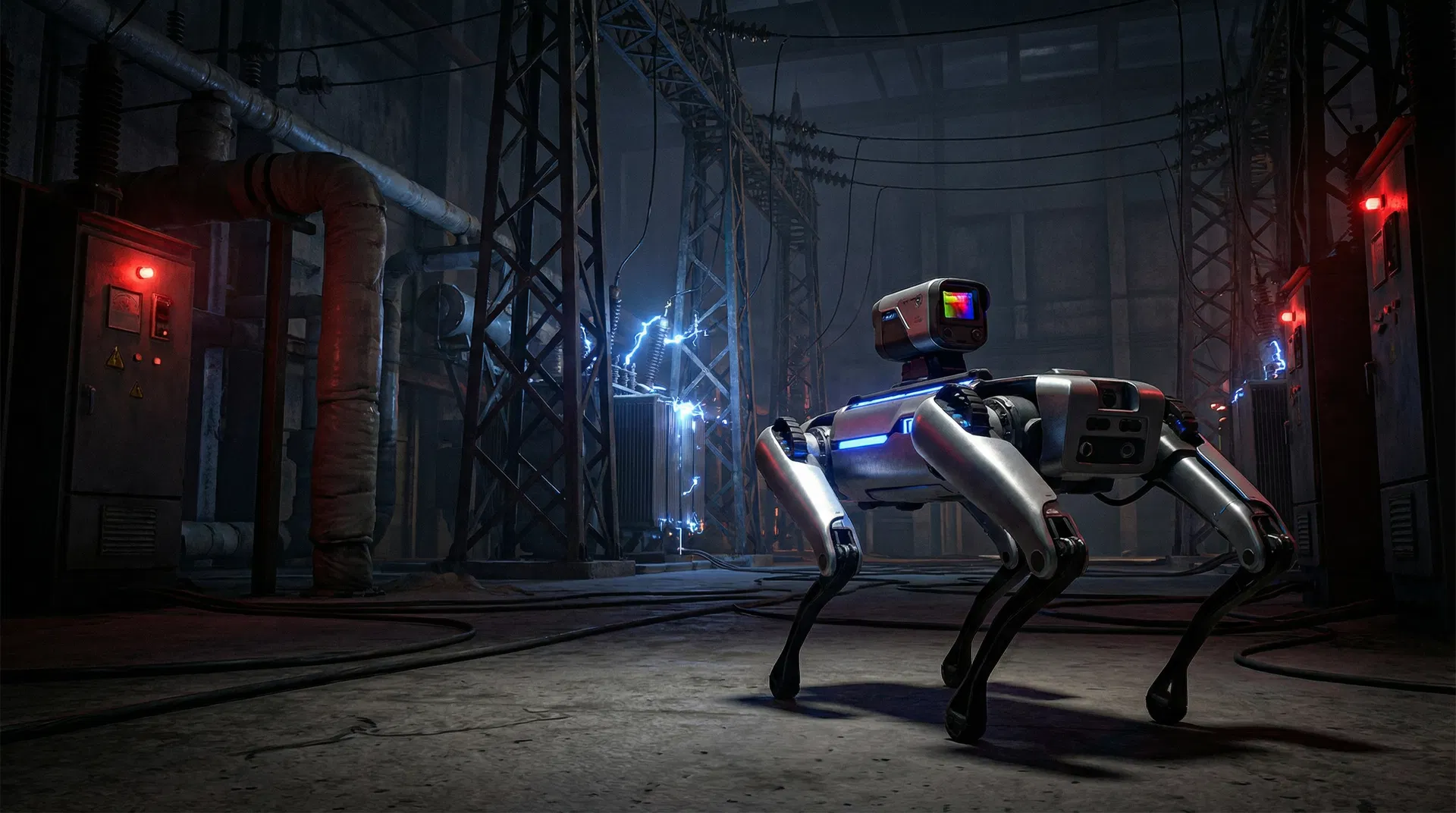
Unitree B2 vs Industrial Inspection Robots: The Payload Question
Unitree Robotics has established itself as a leading manufacturer of agile, cost-effective quadruped robots. The Unitree B2 — their flagship industrial platform — has attracted significant interest from operators evaluating inspection robot options.
However, a recurring theme in industrial inspection evaluations is that the Unitree B2's impressive locomotion capabilities are not matched by its inspection payload ecosystem. This article examines where the Unitree B2 fits in the industrial inspection landscape and where purpose-built inspection platforms offer advantages.
Platform Specifications
| Specification | Unitree B2 | Rongzhitong RZTL-1 |
|---|---|---|
| Payload capacity | 4 kg (standard) | 10 kg |
| IP rating | IP67 | IP67 |
| ATEX certification | Not available | Zone 1/2 available |
| Max speed | 6 m/s | 3 m/s |
| Battery life | 4 hours (no payload) | 3+ hours (with payload) |
| Inspection payloads | Limited ecosystem | Full industrial suite |
| Cloud platform | Basic | Full inspection management |
| Gas detection | Not standard | Standard payload option |
| Thermal imaging | Not standard | Standard payload option |
The Payload Ecosystem Gap
The Unitree B2's 4 kg payload capacity is its most significant limitation for industrial inspection. A comprehensive industrial inspection payload — thermal camera, gas detector, HD visual camera, and LiDAR — typically weighs 6–10 kg. The B2 cannot carry a full inspection sensor suite.
This means operators choosing the B2 for inspection must compromise on sensor capability, accepting reduced inspection coverage compared to purpose-built inspection platforms.
What Industrial Inspection Requires
A complete industrial inspection payload for oil & gas or chemical plant applications typically includes:
- Thermal imaging camera (1–2 kg): Equipment temperature monitoring, hot spot detection
- Multi-gas detector (0.5–1 kg): CH₄, H₂S, CO, LEL, O₂ monitoring
- HD visual camera with PTZ (0.5–1 kg): Visual inspection, gauge reading
- LiDAR sensor (0.3–0.8 kg): Navigation and 3D mapping
- Communication hardware (0.5–1 kg): 4G/Wi-Fi, antenna systems
- Mounting and cabling (0.5–1 kg): Structural integration
Total: 3.3–6.8 kg, often exceeding the B2's 4 kg limit when all sensors are required simultaneously.
ATEX Certification: A Critical Gap
The Unitree B2 is not available in ATEX or IECEx certified configurations. This makes it unsuitable for deployment in explosive atmosphere zones (Zone 1, Zone 2) that are common in oil & gas, chemical, and mining facilities.
For operators with hazardous area inspection requirements, the B2 is not a viable option regardless of its other capabilities.
Where Unitree B2 Excels
The B2 is genuinely impressive for applications that don't require heavy inspection payloads or ATEX certification:
- Research and development: Excellent platform for robotics research
- Light inspection tasks: Visual inspection with a single camera payload
- Non-hazardous environments: Facilities without explosive atmosphere zones
- Cost-sensitive applications: Where inspection capability can be reduced to match the payload limit
Purpose-Built Inspection Platforms
Rongzhitong inspection robots are designed from the ground up for industrial inspection requirements:
- 10–15 kg payload capacity: Supports full inspection sensor suites
- ATEX Zone 1/2 certification: Enables deployment in hazardous areas
- Integrated inspection software: Cloud platform with mission planning, data analytics, and compliance reporting
- Industrial sensor ecosystem: Pre-integrated thermal, gas, visual, and acoustic sensors
- Regional support: Singapore-based support for Asia-Pacific deployments
Conclusion
The Unitree B2 is an excellent locomotion platform but is not optimized for industrial inspection. The payload capacity limitation, absence of ATEX certification, and limited inspection software ecosystem make it unsuitable for the majority of industrial inspection applications.
For operators requiring comprehensive industrial inspection capability — particularly in hazardous areas — purpose-built inspection platforms offer substantially better fit.
Discuss your requirements with our team to identify the right inspection platform for your facility.
Tagged: