The Evolution of Subterranean Inspection: Definitions and Core Operating Benchmarks
Underground mine inspection robots are autonomous or teleoperated mobile systems engineered to navigate hazardous, GPS-denied subterranean excavations to assess environmental stability, atmospheric toxicity, and structural integrity. By replacing manual hazard sweeps, these robotic units provide real-time telemetry across unventilated stopes, blast headers, and conveyor drifts without risking human entry.
Underground extraction environments impose brutal physical and digital constraints on equipment. Narrow shafts, toxic gas pockets, complete darkness, and explosive atmospheres present fatal risks to human survey crews.
Mining operations now mandate remote physical validation before personnel enter active headings. Modern operations rely on high-payload autonomous inspection solutions that pair rugged dynamic chassis with multi-sensor spatial suites.
“Subterranean Robotic Inspection: The deployment of autonomous, explosion-rated, multi-legged or tracked kinematic hardware equipped with non-line-of-sight (NLOS) telemetry and multi-gas arrays to map unventilated or seismically unstable drifts.”
In hard rock and coal production, post-blast clearance protocols historically created 2- to 4-hour dead-zones during re-entry cycles. Transitioning to robotic scouts has compressed that clearance timeline down to under 25 minutes in fully instrumented operations.
Locomotion Architecture Benchmarking: Quadruped vs. Tracked vs. Wheeled vs. Caged Drones
Selecting the appropriate chassis architecture dictates overall mission success in subterranean terrain. Historical mine crawlers relied heavily on tracked or multi-wheel drive bases, but these systems face catastrophic hang-ups when traversing dynamic rockfalls.
Four-legged quadruped platforms isolate foot contact points, dynamically stepping over oversized aggregate, high-angle ballast drifts, and flooded sumps that completely beach rigid-chassis units.
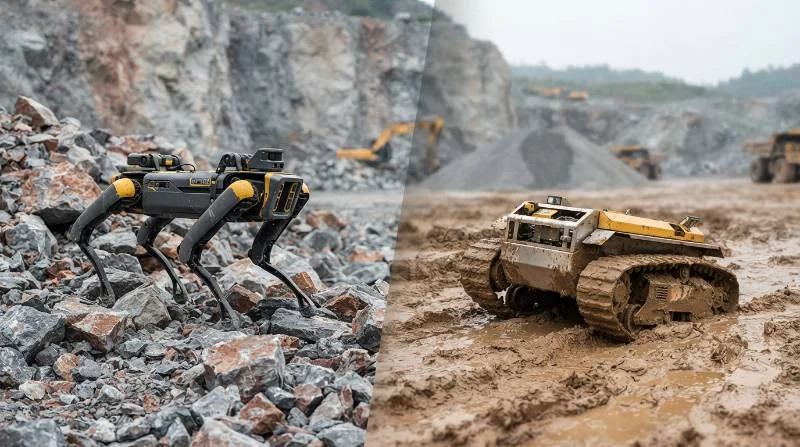
The RZTL-1 industrial quadruped leverages high-torque joint actuators to step across 35-degree inclines, clear 250mm obstacles, and dynamically recover from slips on wet slickensides.
| Platform Type | Obstacle Clearance | Slurry / Mud Ingress | Air Turbulence Limits | Payload Capacity |
|---|---|---|---|---|
| Industrial Quadruped (RZTL-1) | High (Up to 300mm active step) | High (IP67 sealed joints) | Unaffected by shaft ventilation | Up to 20 kg continuous |
| Tracked Crawlers | Moderate (Beaches on boulders) | Moderate (Shedding tracks in mud) | Unaffected | Up to 45 kg |
| Wheeled Rovers | Low (Requires graded roadways) | Poor (Wheel spin in slurry) | Unaffected | Up to 15 kg |
| Caged UAV Drones | Full (Aerial clearance) | N/A (Flight only) | Poor (>8 m/s airflow disrupts flight) | Low (<1.5 kg) |
While caged UAVs excel in vertical drop-raise inspections, their operational endurance rarely exceeds 12 minutes under turbulent auxiliary ventilation fans. Quadruped platforms provide over 2 hours of active ground transit with industrial sensor payloads attached.
Modular Multi-Sensor Payloads: Gas Detection, Thermal Imaging, and Convergence LiDAR
An inspection robot is only as capable as its sensor package. Subterranean drift analysis requires simultaneous measurement of atmospheric chemistry, mechanical thermography, and rock mass convergence.
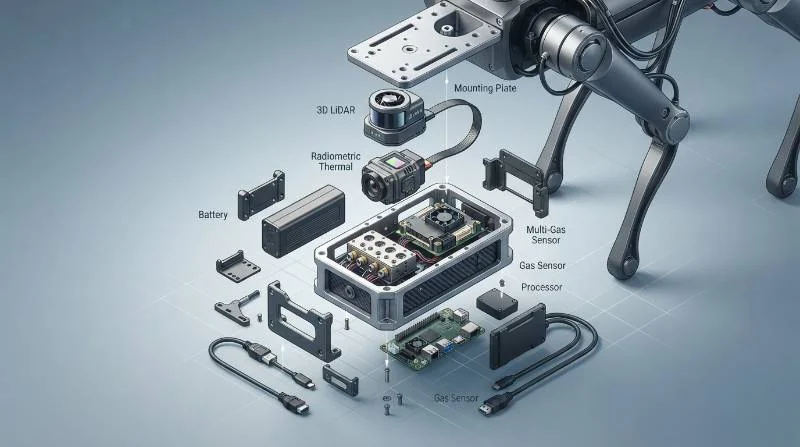
Atmospheric Gas Monitoring
Modular sensor pods incorporate calibrated electrochemical and non-dispersive infrared (NDIR) sensors to track volatile compounds in real time:
- Methane (CH4): Detects flammable concentrations down to 0-100% LEL with sub-second response times.
- Carbon Monoxide (CO): Identifies early stage spontaneous combustion along unventilated coal seams.
- Hydrogen Sulfide (H2S) & Oxygen (O2): Quantifies breathable zones before search-and-rescue teams advance.
- Optical Gas Imaging (OGI): Visualizes fugitive gas plumes in real time using cooled mid-wave infrared cores.
Thermal Radiometrics and Ultrasonic Profiling
Conveyor drive fires account for substantial subterranean property loss. Quadruped robots traverse long overland conveyors with dual-spectrum thermal payloads, capturing surface anomalies in idler bearings operating above 85°C.
Integrated acoustic imaging arrays pinpoint high-frequency compressed air leaks and electrical arcing across switchgear substations, detecting failures before critical outages occur.
3D LiDAR for Structural Convergence
Subsurface rock mechanics require sub-centimeter deformation tracking. High-density LiDAR payloads capture up to 600,000 points per second.
By comparing successive scans against baseline CAD profiles, engineering teams automate drift convergence monitoring, locating unravelling mesh, spalling ribs, and ground movement long before manual taggers notice movement.
Autonomous Navigation in GPS-Denied and Zero-Light Environments
Satellite positioning signals cannot penetrate subterranean rock mass. Inspection platforms must compute precise localization and generate dense maps solely using onboard sensors.
Modern platforms combine solid-state LiDAR with visual-inertial odometry (VIO). This multi-layered approach guarantees sub-centimeter positional accuracy across pitch-black cross-cuts and dust-laden intake airways.
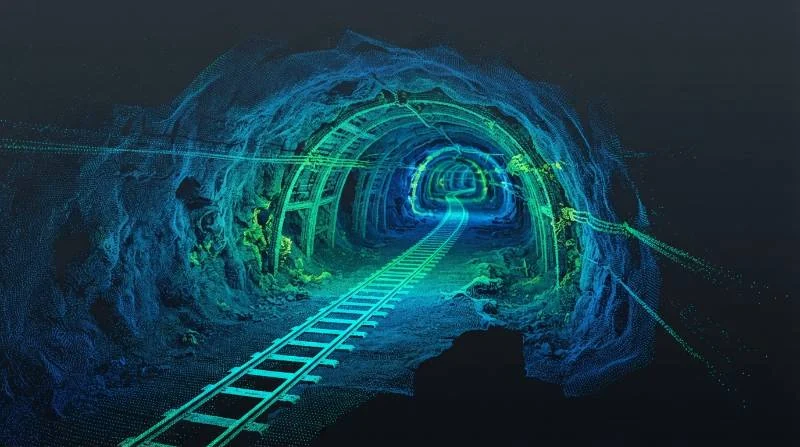
Leveraging specialized subterranean SLAM navigation technology, the robot constructs a spatial map in real time while tracking its trajectory relative to the shaft infrastructure.
Wireless Mesh Telemetry & Non-Line-of-Sight Comms
Radio wave propagation degrades rapidly around sharp corners and deep declines. Inspection robots overcome signal loss using modular ad-hoc mesh radios (COFDM/UWB).
- Autonomous Node Dropping: Robotic platforms release magnetic wireless repeater pucks when link margins hit thresholds below -85 dBm.
- Edge-Compute Independence: If all radio telemetry fails, the onboard computer executes mission tasks autonomously without stalling.
- Autonomous Return-to-Base (RTB): On low battery thresholds or lost communications, the robot backtracks along its mapped breadcrumb path to the ingress station.
The Intelligent Robot Dog Sub-Surface Autonomy & Telemetry Protocol (SATP)
To eliminate operational ambiguity during underground deployment, Intelligent Robot Dog developed the Sub-Surface Autonomy & Telemetry Protocol (SATP). This four-phase standard ensures continuous data continuity and operational safety.
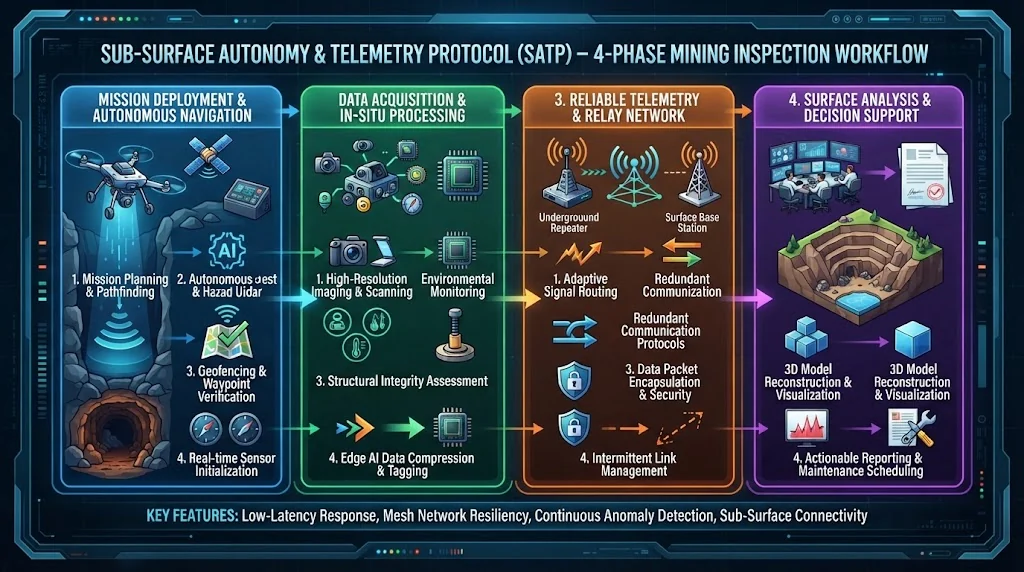
The 4 Phases of the SATP Methodology
- Phase 1: Pre-Survey Mesh Validation: Dynamic range estimation and automatic deployment of signal repeaters at key line-of-sight choke points.
- Phase 2: Dynamic Ingress & Active Locomotion: Autonomous footstep planning adapted to varying friction coefficients (muck, slurry, and wet rails).
- Phase 3: Synchronous Sensor Sweeping: Simultaneous execution of 3D LiDAR drift convergence, multi-gas telemetry, and thermal scan arrays.
- Phase 4: Telemetric Reconciliation & Auto-Ingress: Data package offload to mine dispatch via API, paired with automated docking to sealed charging stations.
Safety Compliance and Regulatory Directives: ATEX, IECEx, and MSHA Alignment
Operating powered electrical equipment in gassy underground mines requires strict adherence to international safety certifications. Sparks from unsealed motors or unmanaged battery thermals can trigger volatile methane-air mixtures.
Mining robots deployed in hazardous atmospheres must conform to globally harmonized intrinsic safety protocols:
- ATEX / IECEx Zone 1 & Zone 2: Equipment must not generate arcs, sparks, or surface temperatures exceeding the auto-ignition threshold of surrounding atmospheric gas groups (Class I, Group D / Group I for mining). Technical requirements follow IECEx 60079 series explosive atmosphere standards.
- MSHA 30 CFR Part 18 & 23: In the United States, autonomous robotic systems operating in coal mines must meet MSHA Permissibility and Intrinsic Safety Directives for electrical apparatus.
- Ingress Protection (IP67 / IP68): Complete sealing against airborne abrasive silica dust, continuous water sprays, and caustic mine drainage under ISO/IEC standards.
Encapsulated brushless motor actuators, nitrogen-purged electronics chassis, and non-sparking titanium foot pads ensure the RZTL-1 operates safely within demanding regulatory environments.
Economic Impact & ROI: Quantifying Downtime Reduction and Risk Elimination
Investing in subterranean robotics delivers measurable operational payback across human safety and asset utilization metrics. Manual clearance cycles represent direct productivity bottlenecks for Tier-1 extraction operations.
Detailed performance logs from operational deployments highlight significant bottom-line gains:
- Post-Blast Clearance Velocity: Reduces shift re-entry delays by 68%, enabling haul trucks to resume hauling operations significantly sooner.
- Conveyor Fire Prevention: Continuous thermal scans isolate overheating idlers before catastrophic belt failures happen, mitigating unscheduled stoppages that cost upwards of $45,000 per hour.
- Safety Hazard Exposure Reduction: Eliminates manual surveys across unground-supported stopes, achieving a 100% reduction in direct personnel exposure during initial re-entry checks.
Review our documented field deployment benchmarks in our mining robotics case studies to evaluate full production cost savings.
Deployment Roadmap: Maintenance and Durability under Abrasive Mining Dust
Subterranean environments contain highly abrasive dust particles, including quartz, silica, and pyrite slurries. Deploying autonomous robot fleets requires structured maintenance routines to maximize operational uptime.
Preventative Maintenance & Asset Protection
- High-Pressure Washdown: IP67-rated seals permit daily standard pressure washing to purge acidic mine slurries from actuators and chassis joints.
- Optical Sensor Maintenance: Self-cleaning compressed air blasters and sapphire lens coatings prevent mud splatters from blinding forward LiDAR and stereoscopic cameras.
- Hot-Swap Battery Interfaces: Heavy-duty sealed battery latches allow quick power pack replacements in under 60 seconds without breaking interior environmental seals.
To evaluate autonomous quadruped systems for your specific shaft, drift, or conveyor network, request a mining robotics consultation with our subterranean engineering team.
Frequently Asked Questions (FAQ)
How long does a quadruped robot operate underground on a single charge?
Under standard inspection payloads (LiDAR, PTZ camera, and gas sniffer), modern industrial quadrupeds provide between 2 to 3.5 hours of continuous locomotion. Autonomous inductive docking stations deployed along drift sub-levels enable 24/7 continuous cycles without manual retrieval.
Can the robot navigate through dense post-blast smoke and total darkness?
Yes. By combining 3D solid-state LiDAR, long-wave thermal imaging, and radar sensor fusion, the navigation system bypasses airborne particulate obscurants and operates independently of ambient lighting.
What happens if the robot loses wireless communication deep in a mine shaft?
The onboard autonomy engine executes an automatic Return-to-Base (RTB) routine. The robot retraces its calculated LiDAR breadcrumb trail back to the last confirmed wireless mesh connection point without requiring operator intervention.
How does a robot dog handle wet, muddy slopes and loose mine muck?
Dynamic gait control algorithms calculate foot contact friction in real time at 1,000 Hz. If a paw slips on wet rock or loose aggregate, the system adjusts torque distribution across the other three limbs instantly to maintain stability.