What Are Thermal Imaging Inspection Robots? (Definition & Core Metrics)
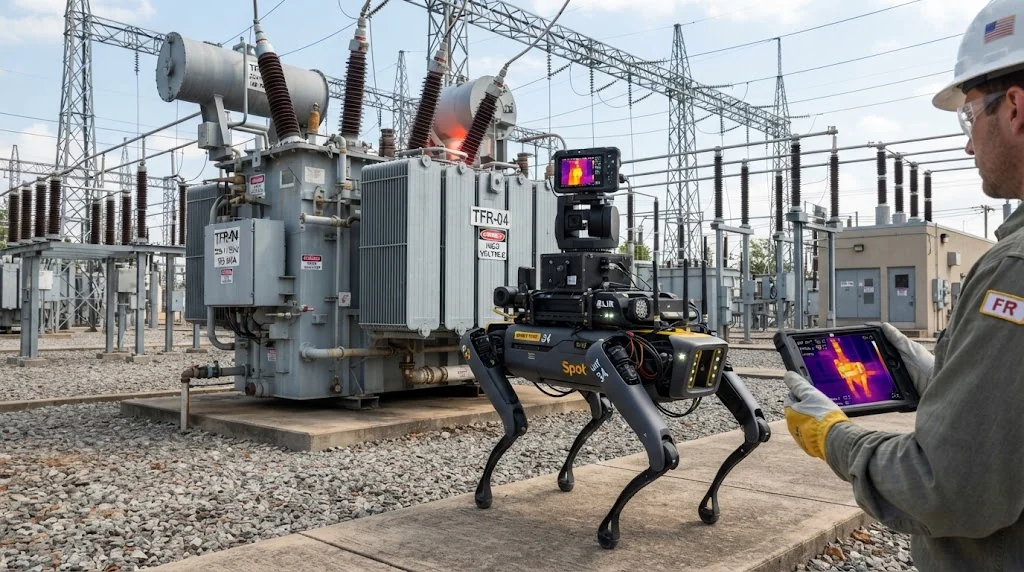
Thermal imaging inspection robots are autonomous mobile robotic platforms equipped with calibrated radiometric infrared sensors designed to scan, measure, and analyze surface temperatures across industrial assets without human intervention. These systems capture calibrated per-pixel temperature values across electrical switchgear, transformers, pumps, and process piping, alerting plant operators to thermal anomalies well before mechanical seizure or electrical failure occurs.
Radiometric Thermography: The science of acquiring and analyzing quantitative thermal data where every individual pixel in an infrared image represents an absolute, calibrated temperature measurement, typically operating in the Long-Wave Infrared (LWIR) band between 7.5 µm and 14 µm.
Standard consumer thermal cameras provide qualitative heat mapping with relative color spectrums. In contrast, enterprise thermal inspection platforms utilize uncooled vanadium oxide (VOx) microbolometer detectors calibrated to industrial metrology standards, delivering measurement accuracy within ±2°C (±3.6°F) or ±2% of the reading across an operating envelope of -20°C to +550°C.
Key radiometric sensor benchmarks required for industrial reliability engineering include:
- Thermal Sensitivity (NETD): ≤ 30 mK to 50 mK at 30°C, capable of isolating sub-degree thermal gradients across phase busbars.
- Spatial Resolution (IFOV): 0.68 to 1.3 mrad, ensuring accurate spot-size measurements from safe standoff distances (5 to 15 meters).
- Radiometric Frame Rate: 25 Hz to 30 Hz for steady point-to-point dynamic path scanning.
- Dynamic Range & Emissivity Adjustment: Automated multi-point emissivity compensation (0.01 to 1.0) paired with background reflected temperature correction conforming to ISO 18434-1 condition monitoring standards.
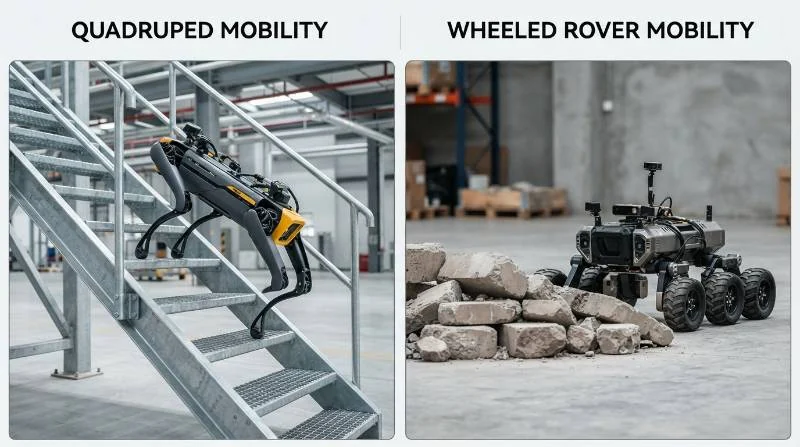
Quadruped Mobility vs. Wheeled Rovers in Multi-Level Industrial Environments
Industrial facilities are engineered for bi-pedal human workers, characterized by 35-degree open-grate metal staircases, vertical curbs, tight pipe racks, and outdoor yards with loose, uncompacted gravel. Traditional wheeled and tracked inspection rovers face severe kinematic limitations in these layouts.
A wheeled rover requires dedicated ramps, struggles on loose ballast switchyards, and cannot navigate multi-story refinery catwalks. When a standard rover hits a 150 mm curb or gets trapped in open drainage grating, inspection routines fail entirely.
Bio-inspired four-legged systems, such as the RZTL-1 industrial inspection robot, solve this mechanical barrier through dynamic multi-contact locomotion. With high-torque joint actuators and adaptive gait control, quadruped robots effortlessly conquer:
- Industrial Catwalks & Stairs: Ascent and descent of standard industrial staircases up to 35° inclination with zero tipping risk.
- Obstacle Clearance: Stepping over structural ground pipes, cable trays, and berms up to 200 mm high.
- Substation Switchyards: Maintaining dynamic balance across loose ballast rock, thick snow, and muddy terrain without wheel slippage.
- Tight Geometry: Zero-radius turning capability inside narrow electrical control rooms and skid-mounted compressor modules.
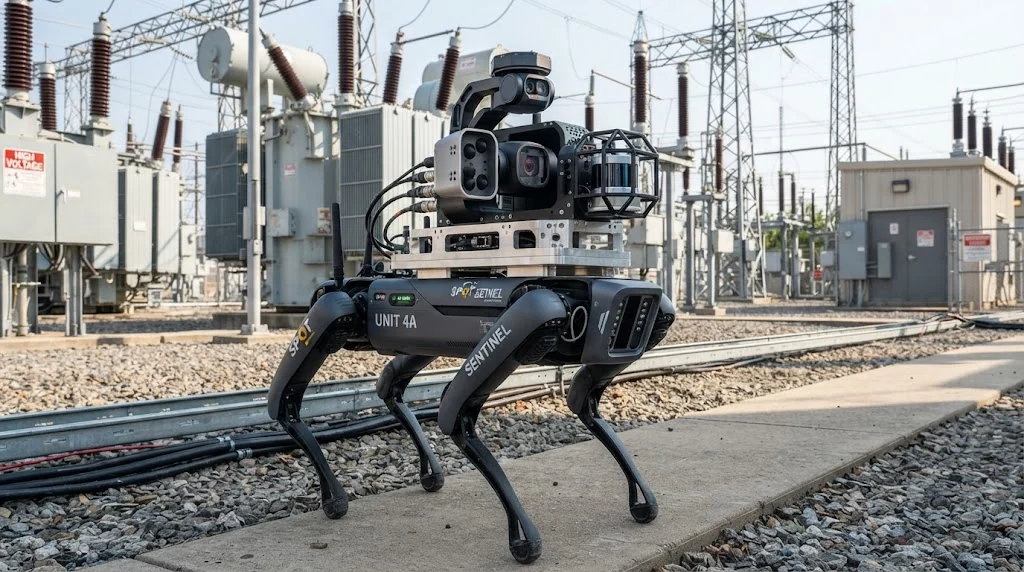
Multi-Sensor Payload Fusion: Dual-Spectrum Thermal, Acoustic & LiDAR
Thermal monitoring alone catches heat anomalies, but true autonomous condition-based maintenance demands multi-layered situational intelligence. Modern quadruped platforms leverage modular pan-tilt-zoom (PTZ) sensor suites that fuse complementary diagnostic streams.
By mounting a stabilized dual-spectrum payload, the robotic system simultaneously captures calibrated LWIR thermography alongside 4K optical zoom footage. This allows maintenance engineers to correlate a 45°C Delta-T hot spot with high-resolution visual evidence of corrosion, loose bolting, or phase discoloration.
Key payload integration modules include:
- Radiometric Pan-Tilt-Zoom Thermal Core: 640×512 resolution thermal sensor with continuous optical/digital zoom and ±2°C absolute accuracy.
- Acoustic Ultrasonic Array: 64 to 128 high-frequency MEMS microphones to locate compressed air leaks, steam trap blow-through, and partial electrical discharge (corona/tracking) before thermal manifestation.
- 3D LiDAR SLAM Navigation: Industrial-grade LiDAR delivering centimeter-accurate spatial positioning via 3D LiDAR SLAM navigation in GPS-denied indoor pump houses and high-voltage yards.
- Optical Gas Imaging (OGI): Filtered narrow-band MWIR cores for detecting fugitive volatile organic compounds (VOCs) and SF6 gas leaks in substation switchgear.
The Autonomous Radiometric Inspection Protocol (ARIP)™
Deploying automated thermography requires disciplined methodology to avoid false-positive alerts caused by ambient solar loading, variable asset loads, and target emissivity drift. Reliability engineering teams implement the Autonomous Radiometric Inspection Protocol (ARIP)™ to govern repeatable robotic scanning.
- Phase 1: 3D Plant Spatial Digitization
The quadruped conducts a comprehensive SLAM mapping run to generate a sub-centimeter 3D point cloud of the facility, locking in safe transit corridors and inspection waypoints. - Phase 2: Radiometric Baseline Calibration & ROI Tagging
Every critical asset (e.g., transformer bushings, disconnect switches, bearing housings) is designated as a fixed Region of Interest (ROI). Surface emissivity, transmission distance, and historical baseline temperatures are assigned according to NFPA 70B electrical maintenance standards. - Phase 3: Autonomous Path Execution & Load Correlation
The platform traverses programmed inspection routes on set shifts, checking SCADA electrical load tables via API to ensure asset thermal measurements occur during peak operating windows. - Phase 4: Real-Time Delta-T Anomaly Triangulation
Edge computing on the robot evaluates Delta-T (temperature difference between phases or against ambient baselines). Deviations above 10°C (moderate concern) or 30°C (critical threat) trigger localized multi-angle diagnostic scans. - Phase 5: Automated CMMS Work Order Dispatch
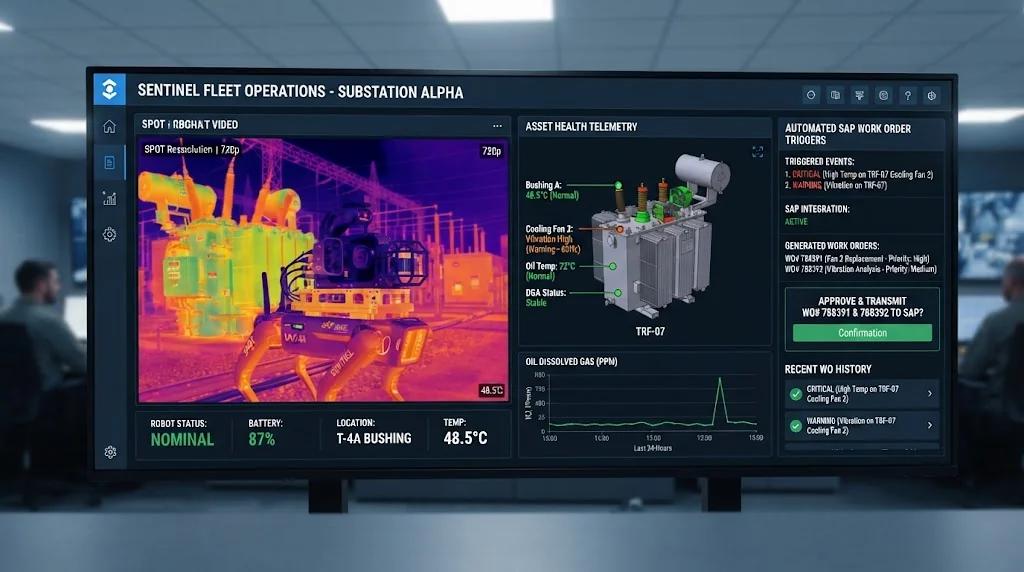
Validated radiometric data, visual photos, and pinpoint coordinate logs are automatically injected into the enterprise maintenance system to dispatch technicians with the correct parts.
Enterprise Maintenance Integration: SCADA, Digital Twins, and Automated Alerting
An autonomous inspection fleet should never operate as an isolated data silo. Enterprise value is unlocked when thermal inspection telemetry flows directly into the plant’s operational technology (OT) and enterprise asset management (EAM) infrastructure.
Our autonomous thermographic inspection solutions bridge the gap between field robotics and central operations through standardized open APIs (MQTT, OPC UA, REST APIs):
- Live SCADA Integration: Radiometric thermal readings feed into historian systems (e.g., OSIsoft PI, Aveva), enabling cross-referencing of surface temperatures against electrical current, motor RPM, and ambient humidity.
- Digital Twin Synchronization: 3D spatial models in Omniverse or Bentley Systems update continuously with real-world thermal point clouds, visualizing thermal degradation over time.
- Automated EAM Workflows: Out-of-spec thermal triggers instantly push automated corrective maintenance work orders into SAP PM or IBM Maximo with high-resolution visual evidence attached.
Industrial Deployment Standards: HazLoc, Ingress Protection, and Self-Charging
Operating autonomous robotics in heavy industrial environments requires strict adherence to environmental durability and explosive atmosphere certifications.
Outdoor power distribution yards and coastal processing plants present brutal environmental conditions, including salt fog, heavy rain, dust storms, and extreme temperatures ranging from -30°C to +55°C. Reliable robotic systems must maintain an IP67 or IP68 ingress protection rating, featuring sealed joint actuators and dry nitrogen-purged sensor housings.
For chemical manufacturing, offshore rigs, and paint processing skids, robots require certified explosion-proof ratings (ATEX Zone 2 / HazLoc Class I, Division 2). This demands intrinsically safe electrical enclosures, non-sparking foot materials, and static-dissipative chassis coatings to prevent ignition of volatile hydrocarbon mixtures.
To achieve true 24/7 continuous autonomous operation, platforms must utilize ruggedized inductive docking stations. When battery levels drop below 20%, the robot self-navigates to the enclosed charging shelter, engages wireless contact-free fast charging, and automatically resumes its scheduled patrol within 45 minutes.
Total Cost of Ownership (TCO) & ROI: Manual vs. Robotic Inspections
Manual thermography is labor-intensive, hazardous, and yields sporadic data. A manual inspection campaign in a medium-sized refinery requires certified Level II thermographers, arc flash personal protective equipment (PPE), and hot-work permits, often taking weeks to inspect several thousand points.
Reviewing our industrial deployment case studies reveals that autonomous quadruped fleets reduce inspection operating expenditures by over 70% while boosting asset scanning frequency from quarterly to multiple times daily.
| Feature / Metric | Manual Handheld Inspection | Wheeled Inspection Rover | Autonomous Quadruped Robot |
|---|---|---|---|
| Inspection Frequency | Monthly / Quarterly | Daily (Single Level) | Continuous (24/7 Multi-Level) |
| Terrain Adaptability | High (Human mobility) | Low (Paved / Flat only) | Exceptional (Stairs, gravel, grating) |
| Personnel Safety Risk | High (Arc flash & HazLoc exposure) | Zero Human Exposure | Zero Human Exposure |
| Data Consistency | Variable (Subjective angles) | High (Fixed angles) | Exact Radiometric Repeatability |
| Typical Payback Window | N/A (Ongoing high OPEX) | 14 – 24 Months | 6 – 12 Months |
Frequently Asked Questions (FAQ)
How long does the battery last during an active thermal inspection patrol?
Standard industrial quadruped platforms deliver between 2 to 4 hours of continuous inspection patrol per charge, depending on payload weight, ambient temperature, and stair-climbing frequency. Paired with an autonomous inductive docking station, the robot returns automatically for a 45-minute rapid recharge, achieving true 24/7 continuous facility coverage.
Can thermal inspection robots withstand high-voltage electromagnetic interference (EMI)?
Yes. Industrial-grade quadrupeds engineered for power transmission utilities undergo strict EMC testing (conforming to IEC 61000-6-2 / IEC 61000-6-4 standards). Shielded internal buses, carbon-composite shielding, and optical encoder isolation protect sensitive navigation and radiometric computing cores in 500kV+ switchyards.
How do weather conditions affect robotic radiometric accuracy?
Rain, heavy fog, and direct solar loading can affect surface radiometric readings. The ARIP™ framework integrates onboard weather station sensors to calculate atmospheric attenuation and compensate for solar reflection. In severe weather, the software automatically tags readings with confidence indexes or reschedules routes to optimal low-solar baseline hours (e.g., dawn or dusk).
What is the typical deployment timeline for a thermal inspection robot fleet?
A standard industrial deployment takes between 2 to 4 weeks. This includes initial 3D LiDAR SLAM mapping, establishing ROI points, configuring SCADA/CMMS API integrations, safety barrier validation, and commissioning the autonomous charging dock.
About the Author: Written by our Senior Industrial Robotics & Predictive Maintenance Specialist, specializing in radiometric thermography, SLAM autonomy in heavy industrial environments, and condition-based monitoring systems for Fortune 500 utilities and energy operators.