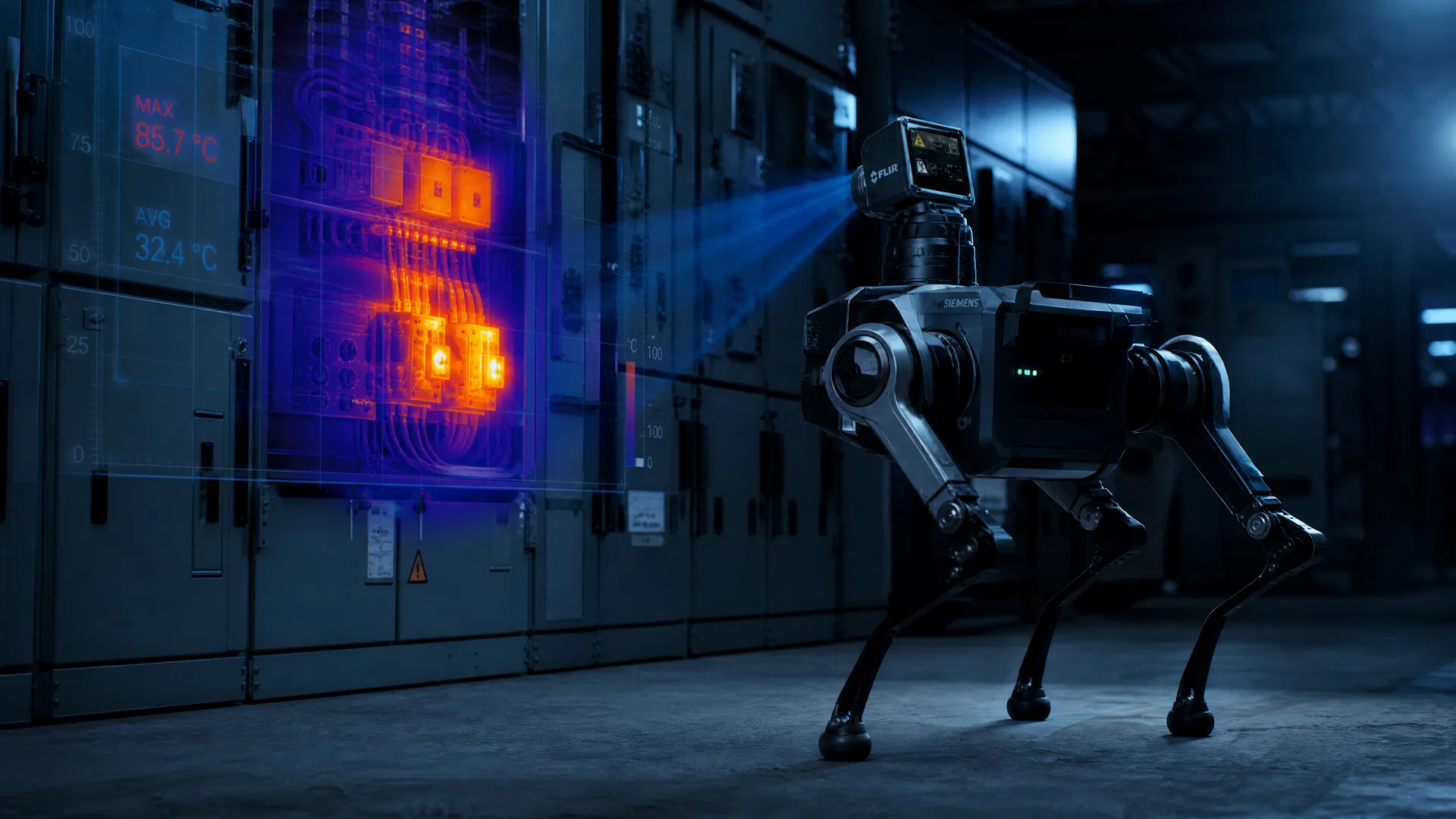
Walk through any large power substation or petrochemical plant with an experienced maintenance engineer, and you’ll notice something: they spend a lot of time squinting at equipment, trying to spot problems that are invisible to the naked eye. Overheating transformer bushings, failing motor bearings, loose electrical connections running hot — these are the faults that cause unplanned shutdowns, and most of them give off heat long before they fail catastrophically.
🔗 Related Products & Resources
- RZTL-1W Quadruped Robot — Dual thermal + visible light camera, IP67, designed for substation inspection
- Power Substation Inspection Solution — End-to-end autonomous patrol for high-voltage facilities
- Case Study: Regional Grid Operator — How thermal imaging cut inspection cycles by 80%
Thermal imaging has been a staple of industrial maintenance for decades. The problem has always been the human carrying the camera. Manual thermal rounds are slow, inconsistent, and — in many facilities — genuinely dangerous. That’s where autonomous inspection robots with integrated thermal cameras are changing the equation.
This guide covers how robotic thermal inspection actually works, what it can and can’t detect, and what you should look for when evaluating platforms for your facility.
Why Thermal Imaging Belongs on an Inspection Robot
A handheld thermal camera is only as good as the person using it, and the route they walk, and how consistently they walk it. In a large facility running three shifts, thermal inspection rounds might happen weekly — or less often if staffing is tight. That’s a lot of time for a developing fault to go undetected.
Autonomous inspection robots solve this problem by running thermal rounds on a fixed schedule, every shift if needed, without fatigue or variation. The robot follows the same path, stops at the same measurement points, and captures thermal data from the same angles every time. That consistency is what makes trend analysis possible: you’re not just looking at a single thermal snapshot, you’re watching how equipment temperature evolves over weeks and months.
There’s also the access question. Many of the highest-risk inspection points in industrial facilities — high-voltage switchgear, transformer banks, overhead cable trays — are in areas that require PPE, permits, or simply aren’t safe for routine human entry. A robot can cover those points continuously without any of that overhead.
How Robotic Thermal Inspection Works
Modern inspection robots designed for industrial use typically carry an uncooled microbolometer thermal camera operating in the 8–14 μm long-wave infrared (LWIR) band. This is the same technology used in handheld thermal imagers, but integrated into a platform that can navigate autonomously and repeat measurements reliably.
The inspection workflow looks like this:
1. Mission Planning and Waypoint Configuration
During initial deployment, the robot maps the facility using LiDAR and builds a 3D model of the inspection environment. Operators then define inspection waypoints — specific positions where the robot stops, orients its thermal camera toward a target, and captures a measurement. Each waypoint stores the exact robot position, camera pan/tilt angle, and the target equipment identifier.
2. Autonomous Patrol and Data Capture
On each inspection round, the robot navigates to each waypoint and captures thermal imagery. The key advantage over manual inspection is repeatability: the robot captures data from the same position and angle every time, which is essential for meaningful temperature trend analysis. Captured images are timestamped, geotagged to the facility map, and linked to the specific asset being monitored.
3. Anomaly Detection and Alerting
Onboard or cloud-based AI compares each thermal capture against historical baselines and configurable temperature thresholds. When a measurement exceeds a threshold — say, a motor bearing running 15°C above its historical average — the system generates an alert with the thermal image, the asset identifier, the measured temperature, and the deviation from baseline. Maintenance teams receive actionable notifications rather than raw data dumps.
4. Integration with Maintenance Systems
Mature inspection robot platforms connect to CMMS (Computerized Maintenance Management Systems) via API, automatically creating work orders when anomalies are detected. This closes the loop between inspection data and maintenance action, and creates an auditable record of every inspection finding.
What Thermal Inspection Robots Can Detect
Thermal imaging is effective for a specific class of faults — those that manifest as abnormal heat signatures. In industrial facilities, this covers a surprisingly wide range of critical equipment:
| Equipment Type | Detectable Fault | Thermal Signature |
|---|---|---|
| Electrical switchgear & panels | Loose connections, overloaded circuits, failing breakers | Localized hot spots on terminals, busbars, or breaker contacts |
| Motors & pumps | Bearing wear, winding insulation breakdown, misalignment | Elevated temperature at bearing housings or motor end caps |
| Transformers | Cooling system failure, winding hot spots, bushing degradation | Asymmetric temperature distribution, hot spots on bushings |
| Cable trays & bus ducts | Overloaded cables, poor terminations, insulation damage | Elevated cable surface temperature, hot spots at junction points |
| Conveyor systems | Bearing failure, belt misalignment, drive motor overload | Hot spots at idler bearings, drive pulleys, motor housings |
| Steam traps & pipework | Failed steam traps (open or closed), insulation gaps | Abnormal temperature differential across trap body or pipe sections |
| Refractory linings | Lining degradation, hot spots indicating structural failure | Elevated external shell temperature at degraded lining locations |
The Limitations You Need to Understand
Thermal imaging is a powerful tool, but it has real limitations that any honest discussion needs to address.
Emissivity matters. Thermal cameras measure surface radiation, not actual temperature. Highly reflective surfaces — polished metal, for example — have low emissivity and can produce misleading readings. Experienced operators know to apply emissivity correction factors or use reference targets, but this requires proper configuration during waypoint setup.
Line of sight is required. Thermal cameras can’t see through enclosures. A motor bearing running hot inside a sealed housing won’t show a clear thermal signature until the heat conducts to the external surface. For some fault types, this means thermal imaging provides early warning but not immediate detection.
Environmental conditions affect readings. Ambient temperature, solar loading, wind, and humidity all influence thermal measurements. Outdoor inspections in direct sunlight are particularly challenging. Robust platforms compensate for this through environmental correction algorithms and by establishing baselines under consistent conditions.
Thermal imaging doesn’t replace all inspection modalities. It’s most powerful when combined with visual inspection, acoustic emission monitoring, and vibration analysis. The best inspection robot platforms support multi-sensor payloads precisely because no single sensing modality covers everything.
Evaluating Thermal Camera Specifications
When comparing inspection robot platforms, thermal camera specifications matter — but not always in the ways vendors emphasize. Here’s what actually affects inspection quality:
Thermal sensitivity (NETD): Expressed in millikelvin (mK), this is the smallest temperature difference the camera can reliably detect. For industrial inspection, look for NETD ≤ 50 mK. Lower is better — it determines whether you can detect subtle early-stage temperature rises before they become serious faults.
Resolution: Higher resolution means more pixels per target, which improves the ability to localize hot spots precisely on complex equipment. A 640×480 detector gives you significantly more detail than a 320×240 unit, particularly when inspecting equipment at distance.
Temperature measurement range: Industrial equipment can run very hot. Make sure the camera’s measurement range covers your actual operating temperatures — for high-temperature process equipment, you may need a camera rated to 1500°C or higher.
Integration with the robot platform: The camera needs to be properly integrated with the robot’s navigation and data management systems, not just bolted on. Look for platforms where thermal data is automatically linked to asset identifiers, timestamped, and stored in a searchable format.
From Reactive to Predictive: The Real Value Proposition
The business case for robotic thermal inspection isn’t really about replacing manual inspection rounds — it’s about enabling a maintenance strategy that manual inspection simply can’t support.
Manual thermal inspection, done well, might give you a snapshot of equipment condition once a week. Robotic thermal inspection can give you that snapshot every shift, building a continuous temperature trend for every monitored asset. That trend data is what enables true predictive maintenance: instead of replacing components on a fixed schedule or waiting for failures, you replace them when the data says they’re approaching end of life.
The economics are compelling. A single unplanned shutdown in a large industrial facility typically costs hundreds of thousands of dollars in lost production, emergency maintenance labor, and expedited parts. If robotic thermal inspection prevents even one such event per year, the ROI calculation becomes straightforward.
Facilities that have deployed autonomous inspection robots with thermal imaging consistently report 40–70% reductions in unplanned downtime and significant improvements in maintenance labor efficiency. The inspection data doesn’t just prevent failures — it helps maintenance teams prioritize their work, focusing attention on assets that actually need it rather than following fixed schedules.
Deployment Considerations for Industrial Facilities
Getting value from robotic thermal inspection requires more than buying the right robot. A few things that experienced deployers consistently emphasize:
Invest in baseline establishment. The anomaly detection algorithms are only as good as the baselines they compare against. Plan for a baseline establishment period of 4–8 weeks after deployment, during which the robot runs its inspection routes under normal operating conditions to build reliable reference data.
Define your alert thresholds carefully. Too sensitive, and you’ll generate false alarms that erode trust in the system. Too loose, and you’ll miss developing faults. Work with your maintenance engineers to set thresholds based on equipment-specific knowledge and manufacturer guidance.
Integrate with your existing CMMS from day one. The inspection data is only valuable if it drives maintenance action. Make sure the robot platform’s API connects to your maintenance management system before go-live, not as an afterthought.
Train your maintenance team on thermal interpretation. Even with AI-assisted anomaly detection, your maintenance engineers need to understand what they’re looking at when they review thermal images. Basic thermal imaging training pays dividends in faster, more confident fault diagnosis.
Conclusion
Robotic thermal inspection isn’t a technology looking for a problem — it’s a direct solution to one of the most persistent challenges in industrial maintenance: getting consistent, high-frequency thermal data from equipment that matters, without putting people at risk or burning maintenance budget on manual rounds.
The facilities getting the most value from these systems are the ones that treat the robot as a data infrastructure investment, not just a gadget. When thermal inspection data flows continuously into your maintenance management system and drives predictive maintenance decisions, the ROI speaks for itself.
If you’re evaluating inspection robot platforms for thermal inspection capability, the questions to ask are: How does the system establish and maintain baselines? How does it handle emissivity variation? And critically — how does inspection data connect to your maintenance workflow? The answers will tell you a lot about whether a vendor understands industrial maintenance or is just selling hardware.
Tagged: