Architecting Autonomous Reliability: Core Substation Inspection Robot Capabilities
Substation inspection robots autonomously audit high-voltage electrical assets using multi-modal payloads, including radiometric thermal infrared sensors, acoustic emission arrays, optical metrology cameras, and gas sniffers. These platforms detect abnormal thermal deltas, partial discharge, analog gauge deviations, and SF6 leaks in real time, transmitting diagnostic data directly to utility SCADA networks.
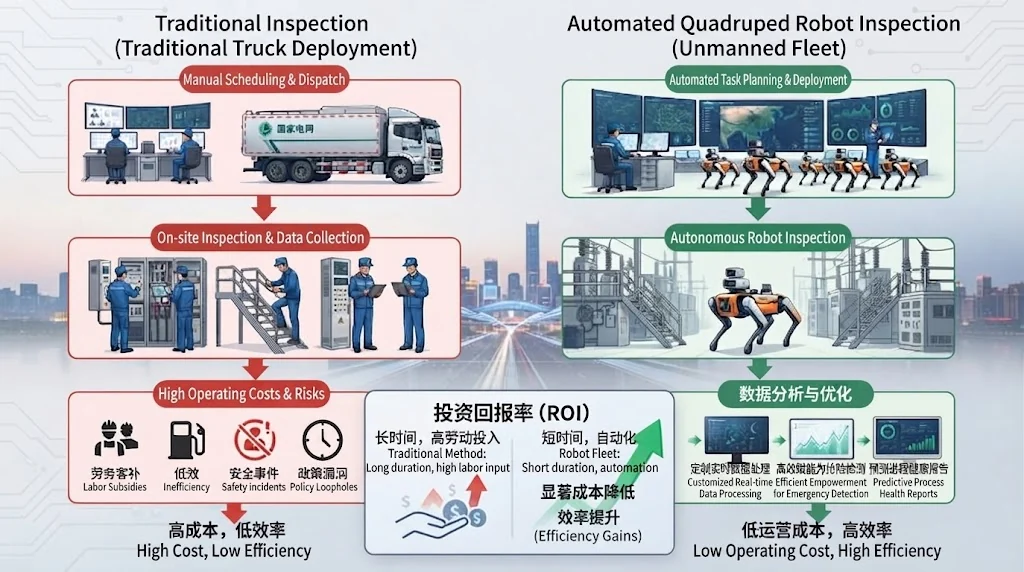
As transmission and distribution grids face increasing load pressures, manual truck-roll inspections are insufficient for mission-critical reliability. High-voltage substations operate with hazardous energization levels, complex gravel yards, and volatile environmental conditions that challenge conventional maintenance teams.
Deploying automated substation inspection solutions bridges the gap between reactive repairs and automated predictive maintenance, ensuring continuous structural and electrical oversight across energized switchyards.
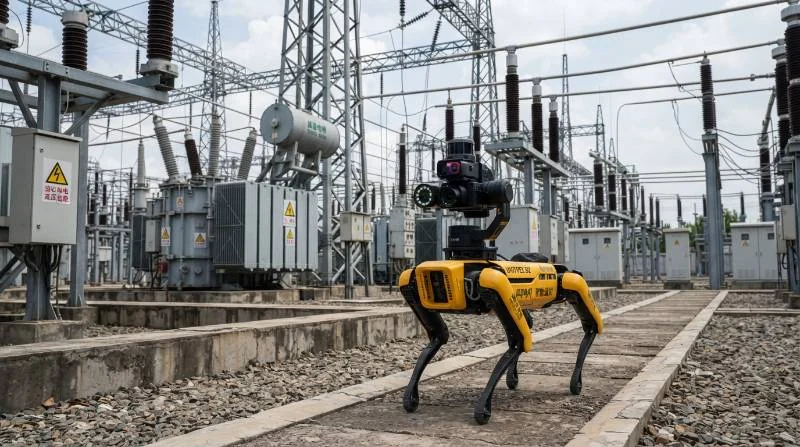
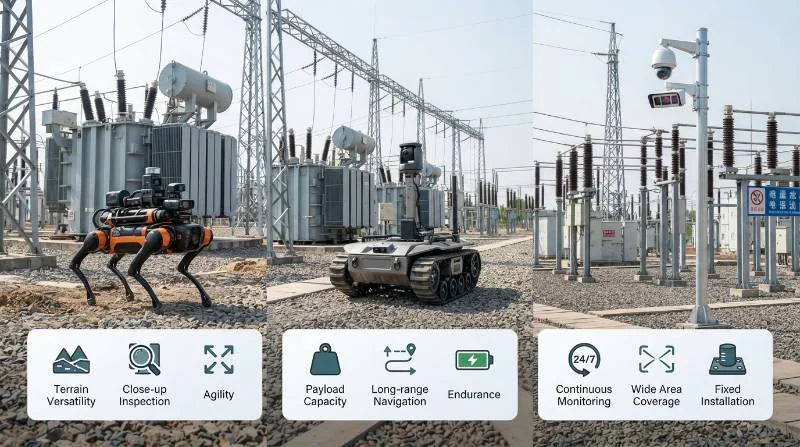
Switchyard Terrain Dynamics: Quadruped Bionic Platforms vs. Wheeled UGVs & Fixed PTZ
Standard switchyard environments present severe locomotion obstacles. Crushed granite rock (ASTM C33 Size #4 or #57 ballast), unpaved ground, elevated concrete cable troughs, drainage gutters, and multi-tier stairwells to control rooms cause wheeled and tracked ground robots to slip, sink, or become immobilized.
Fixed pan-tilt-zoom (PTZ) cameras face persistent line-of-sight obstructions caused by structural steel gantries, transformer radiators, and high-voltage buswork. Quadruped bionic robots overcome these physical limitations through dynamic leg articulation and active center-of-mass balancing.
The RZTL-1 industrial quadruped robot leverages 12 high-torque joint actuators to step over 20-centimeter curbs, traverse loose 4-inch crushed gravel, and ascend industrial stairways at 35-degree inclinations without losing stability or precision calibration.
| Mobility Factor | Quadruped Bionic Robot | Wheeled / Tracked UGV | Fixed PTZ Camera Arrays |
|---|---|---|---|
| Crushed Ballast Gravel | High (Dynamic Foot Placement) | Low (Wheel Sinking / Track Slippage) | N/A (Stationary) |
| Stairs & Cable Troughs | Full Traversal (Up to 35° Stairs) | Impassable (Requires Ramps) | N/A (Stationary) |
| Line-of-Sight Angles | Infinite (Free 6-DOF Positioning) | Limited to Flat Concrete Lanes | Severe Occlusion from Steel Frames |
| Infrastructure Modifications | Zero Facility Changes Required | High (Requires Paved Pathways) | Extensive Cabling & Tower Builds |
Visual Metrology & Computer Vision: Precision Gauge and Structural Asset Auditing
Substation telemetry requires continuous monitoring of non-communicating mechanical gauges and physical switch states. Inspection platforms carry dual-optical payloads with up to 30x optical zoom and high-resolution CMOS sensors to execute visual metrology at standoff distances.
Analog Dial & Digital Display Extraction
Edge-AI models convert analog dial positions into normalized numeric readings. By applying perspective transformation and bounding-box algorithms, robots audit:
- Main transformer oil level gauges and conservator tank sight glasses.
- SF6 gas density indicators and pressure dials across gas-insulated switchgear (GIS) and dead-tank breakers.
- Winding and top-oil temperature indicators (WTI/OTI).
- Digital counter displays on lightning surge arresters and breaker operating mechanisms.
Structural Integrity & Switch-State Verification
Autonomous visual inspection validates disconnector switch blade alignments. Computer vision verifies physical air gaps on open disconnector arms and complete contact engagement on closed positions, preventing partial-contact arcing.
Optical systems also track silica gel desiccant color transitions from blue to pink (indicating moisture saturation in transformer breathers) and detect surface contamination, cracks, or flashover damage on porcelain and composite insulator strings.
Thermographic & Infrared Diagnostics: Early Detection of Electrical Overheating
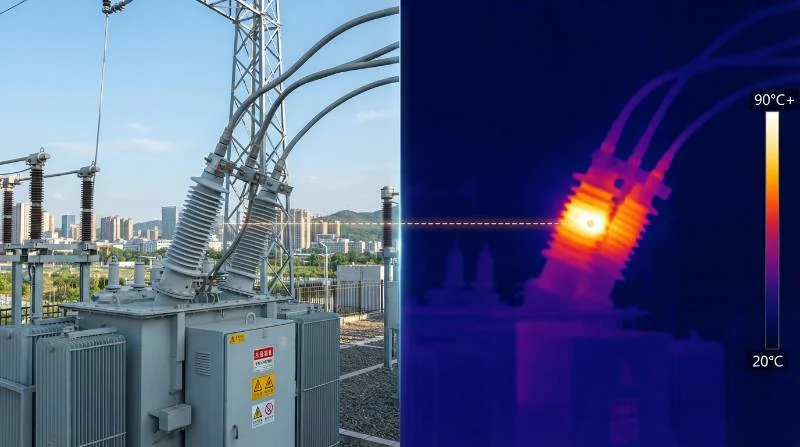
Thermal degradation is the primary indicator of impending equipment failure in high-voltage switchyards. Calibrated long-wave infrared (LWIR) radiometric thermal imaging payloads detect micro-ohm contact resistance increases and thermal overloads before catastrophic flashovers occur.
Standard Delta-T Thresholds (IEEE 437 / IEC 60076): A temperature differential (ΔT) of 1°C to 10°C indicates early contact degradation. A ΔT of 11°C to 30°C requires scheduled intervention, while any ΔT exceeding 30°C demands immediate load reduction or de-energization.
The robotic payload calculates emissivity, ambient humidity, and solar reflection in real time, executing automated delta-T hotspot evaluations across:
- Transformer Bushing Terminals: Spotting internal connector loosening and dielectric fluid breakdown.
- On-Load Tap Changers (OLTC): Identifying internal contact wear, coking, and uneven phase-to-phase current distribution.
- High-Voltage Disconnect Switches: Detecting contact oxidation and jaw spring tension failure.
- Capacitor Banks & Surge Arresters: Pinpointing failed internal resistor elements and uneven thermal profiles.
Acoustic Anomaly & Gas Sensing: Partial Discharge Tracking and SF6 Leak Mapping
Many electrical and insulation anomalies produce acoustic or chemical signatures long before thermal anomalies develop. Multi-modal robots leverage non-visual diagnostic arrays to uncover hidden substation degradation.
Acoustic Beamforming & Partial Discharge (PD) Localization
Integrated ultrasonic acoustic imaging arrays (ranging from 2 kHz to 96 kHz) triangulate high-frequency sound waves generated by corona discharge, surface tracking, and internal void arcing. By overlaying acoustic beamforming heatmaps onto optical video streams, robots locate partial discharge sources within switchgear cubicles and transformer tanks.
Transformer core hum frequency profiles are also analyzed. Fast Fourier Transform (FFT) algorithms process magnetostriction frequencies to identify core clamp loosening, winding deformation, or abnormal harmonic resonance.
SF6 Greenhouse Gas Leak Tracing
Sulfur Hexafluoride (SF6) is an exceptional dielectric insulator with a Global Warming Potential (GWP) 23,500 times higher than CO2. Quadruped platforms equipped with specialized Optical Gas Imaging (OGI) filtered infrared sensors (10.5 μm band) or laser absorption spectrometers isolate minute SF6 emissions from GIS flange gaskets, breaker seals, and expansion joints during standard patrol loops.
High-Voltage Resilience: EMI/EMF Shielding Standards in 500 kV+ Environments
Operating a micro-electronic computing platform within ultra-high-voltage (UHV) switchyards requires robust electromagnetic compatibility (EMC) hardening. Switchgear operations, lightning surges, and continuous high electrostatic fields can disrupt unshielded microcontrollers, induce sensor drift, and scramble communication links.
Engineering Insight: Lab-Verified Switchyard EMC Thresholds
Substation inspection robots deployed in 500 kV to 765 kV yards must pass rigorous electromagnetic immunity testing in compliance with IEC 61000-4-3 and MIL-STD-461G. Robotic enclosures must maintain uninterrupted processing under continuous radiated RF fields up to 30 V/m (80 MHz to 6 GHz) and withstand 10 kV electrostatic discharges.
Industrial quadruped platforms achieve this resilience using aerospace-grade aluminum Faraday chassis enclosures, double-braided EMI shielded internal cabling, optocoupled communication channels, and specialized ground dissipation brushes attached to each foot interface.
The Q-STEP Framework: Standardized Autonomous Quadruped Substation Deployment Protocol
To eliminate deployment friction and avoid utility operational downtime, Intelligent Robot Dog utilizes the proprietary Q-STEP Framework for autonomous fleet integration:
- Quantitative 3D SLAM Mapping: The quadruped traverses the energized switchyard via autonomous LiDAR SLAM navigation, generating a centimeter-accurate 3D point cloud of all busbars, fences, transformers, and safe clearance lanes.
- Sensor Target Threshold Calibration: Engineers define inspection waypoints, associating specific target assets (e.g., Phase A Bushing on XFMR-2) with sensor presets, focal distances, optical zoom levels, and thermal baseline alarms.
- Edge-AI & Telemetry Integration: Onboard edge inference modules are configured to parse video streams, isolate telemetry data, and transmit structured payloads over DNP3, Modbus, or IEC 61850 standard protocols into the utility SCADA or Substation Automation System (SAS).
- Patrol Loop Commissioning: Automated mission schedules are deployed, establishing 24/7 condition checks, emergency ad-hoc dispatch triggers, and return-to-base charging sequences.
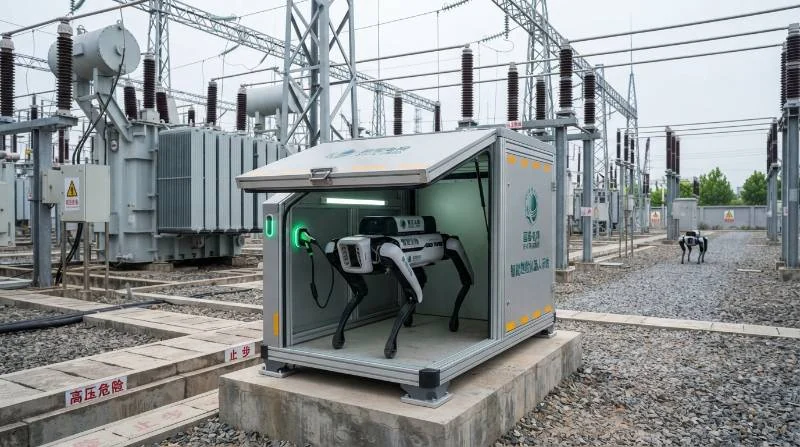
Continuous 24/7 Operations: Weatherproof Smart Docking and Autonomous Recharging
True autonomous reliability requires operational autonomy in extreme environments. Substation inspection robots operate in sub-zero winters, extreme desert heat, driving rain, and dense fog.
IP67/IP68-rated quadruped platforms dock inside fully enclosed, weatherized charging shelters. These smart hubs feature automated environmental control units (HVAC) that regulate ambient temperature, charge high-capacity lithium-iron-phosphate (LiFePO4) or solid-state batteries via high-current conductive contacts, and establish high-speed optical fiber links to offload multi-gigabyte raw sensor logs.
Total Cost of Ownership (TCO) & ROI Modeling for Power Utilities
Deploying autonomous inspection robotics produces clear, measurable capital and operational returns. According to real-world deployment data from power utility inspection case studies, autonomous quadruped platforms reduce manual high-voltage field exposure by over 80% while identifying incipient equipment faults months before critical failures occur.
| Cost Category | Manual Field Crew Inspections | Autonomous Quadruped Patrols | Utility Financial Impact |
|---|---|---|---|
| Routine Truck Rolls | Bi-weekly / Monthly Manual Rounds | Continuous (4–8 Daily Patrols) | 70–85% Reduction in Routine Dispatch OPEX |
| Unplanned Outage Risk | High (Undetected Between Rounds) | Extremely Low (Real-Time Alarms) | Averts $300k–$2.5M in Transformer Replacements |
| Safety & OSHA Exposure | Continuous High-Voltage Yard Exposure | Zero Personnel in Energized Yard | Drastically Reduced Worker Comp & Liability |
| Data Consistency | Subjective Handheld Logs | Calibrated Radiometric Historian | Defensible Regulatory Compliance Records |
Frequently Asked Questions About Substation Inspection Robotics
What minimum approach clearances must inspection robots maintain near energized lines?
Substation inspection robots enforce strict LiDAR-based keep-out geofences aligned with OSHA 1910.269 and IEEE 516 Minimum Approach Distances (MAD). For example, robots maintain at least 10 feet (3.05 m) of physical separation in 230 kV switchyards and 15 feet (4.6 m) in 500 kV switchyards, preventing flashovers during dynamic navigation.
How do autonomous robots ensure cybersecurity within critical grid infrastructure?
Industrial robots comply with IEC 62443 and NERC CIP cybersecurity standards. Data paths utilize hardware-level TPM 2.0 cryptoprocessors, TLS 1.3 encrypted radio links, WPA3-Enterprise telemetry, and zero-trust local network segregation to protect SCADA integrations against unauthorized access.
What is the operational battery runtime on complex gravel terrain?
Navigating loose crushed ballast increases motor current draw compared to smooth flat concrete. High-capacity quadruped platforms deliver 2.5 to 4.5 hours of continuous inspection patrol per charge under full sensor payload loads, returning to their docking station for a complete 60-minute fast recharge.
Can inspection robots operate effectively during complete darkness or adverse weather?
Yes. By utilizing 3D LiDAR SLAM, active infrared thermography, and high-intensity onboard LED spotlight arrays, robots operate without external yard lighting. IP67 weather sealing ensures full functional reliability through heavy rainfall, snow, and wind gusts up to 45 mph.