The Evolution of Physical Security in Mission-Critical Data Centers
Security patrol robots in data centers serve as dynamic cyber-physical nodes that combine autonomous visual surveillance, continuous thermal auditing, and acoustic anomaly detection across dense compute infrastructure. Unlike static security systems or rigid wheeled carts, modern autonomous quadrupeds bridge the operational gap between static physical access control systems (PACS) and human guard patrols in high-density facilities.
Hyperscale and colocation operators manage environments with strict operational metrics. The rapid expansion of high-density AI clusters drawing over 40 kW per rack has intensified physical demands on white space management. Static CCTV cameras suffer from blind zones underneath overhead cable trays, inside narrow containment aisles, and around backup infrastructure.
Simultaneously, manual guard patrols introduce human error, operational fatigue, and high labor turnover. Data center operators require deterministic, audit-ready physical verification that tracks server rack door status, detects sub-degree thermal spikes, and deters unauthorized access without disrupting high-frequency server hardware.
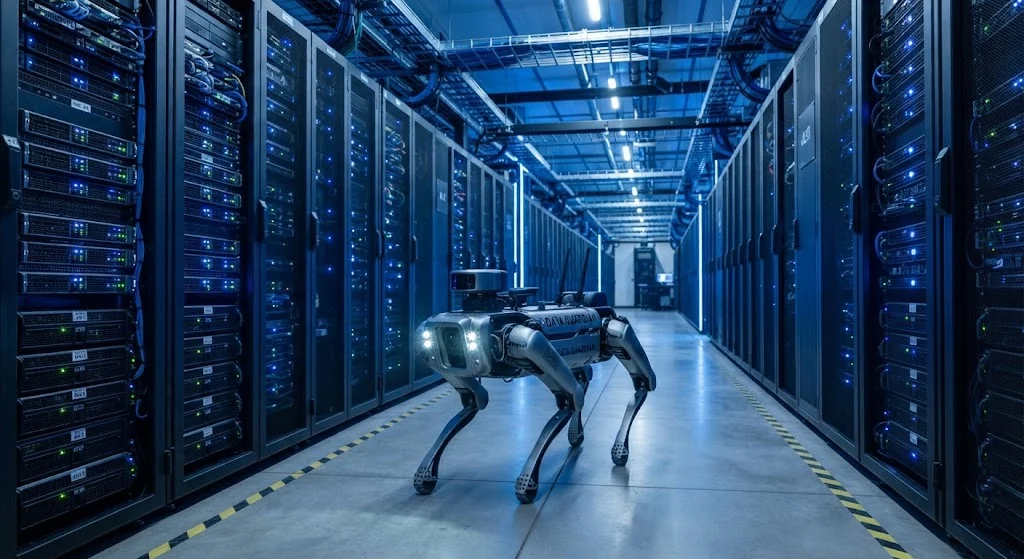
The 4-Layer Data Center Robotic Evaluation Framework
Evaluating autonomous platforms for mission-critical facilities requires a structured approach. Facility directors must move past novelty and evaluate platforms against technical constraints across four functional operational layers.
Data Center Robotic Feasibility Principle: Autonomous patrol systems must deliver verified mobility across uneven raised flooring, non-invasive radiometric diagnostics, zero-trust cybersecurity isolation, and a quantifiable reduction in manned guarding overhead.
- Layer 1: Structural Mobility & Kinematics: Verification of physical negotiation capabilities across perforated raised floor tiles, ramp transitions (up to 35°), cable crossover bridges (up to 150 mm), and narrow containment clearances (aisle width ≥ 0.7 m).
- Layer 2: Environmental & Telemetric Sensing: Continuous data acquisition using calibrated radiometric FLIR thermal imaging, multi-spectrum optical pan-tilt-zoom (PTZ) arrays, ultrasonic acoustic sensors, and air-quality sniffers.
- Layer 3: Cyber-Physical Security & Compliance: Localized edge compute running zero-cloud, on-premise GPS-denied SLAM navigation technology, compliant with ISO/IEC 27001 and SOC 2 Type II physical access logging standards.
- Layer 4: Economic Lifecycle & TCO: Clear amortized hardware and operational cost validation against persistent 24/7 dedicated security guard contracts.
Core Data Center Applications: Where Quadruped Robots Excel
Deploying autonomous security robot solutions transforms passive security rounds into dual-purpose inspection patrols. Rather than functioning solely as perimeter sentries, quadruped units actively audit white space infrastructure and critical power distribution pathways.
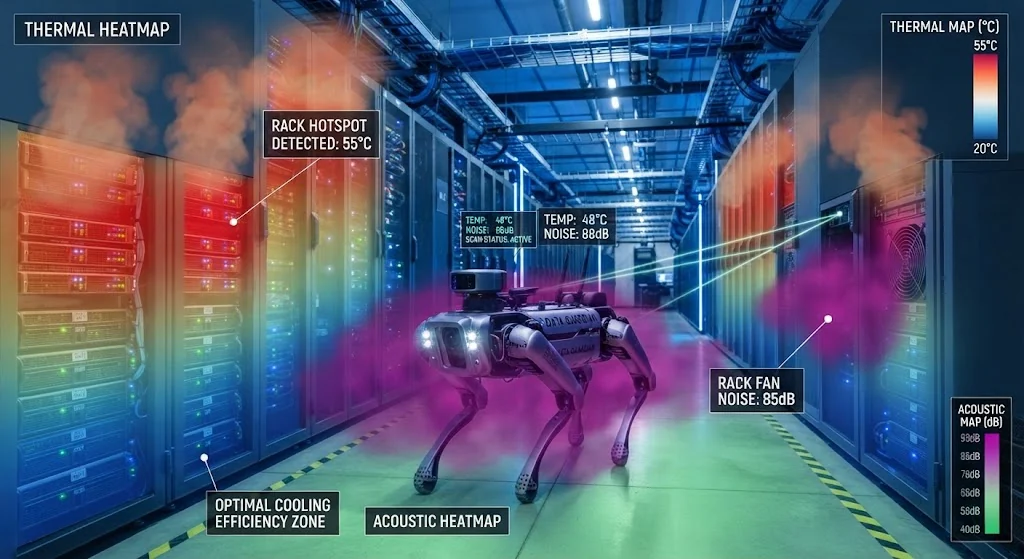
Hot and Cold Containment Aisle Thermal Scanning & PUE Optimization
Cooling infrastructure accounts for up to 40% of total data center power consumption. Robotic patrols equipped with high-resolution radiometric thermal cameras execute automated scans of server rack facades from 0.1 m base plates to 2.2 m top-of-rack (ToR) switches.
The system detects micro-hotspots with a thermal sensitivity of < 0.5 °C (50 mK NETD). By pinpointing localized containment seal breaches, bypass airflow issues, and unseated blanking panels, operators maintain optimal Power Usage Effectiveness (PUE) without entering restricted containment corridors manually.
Acoustic and Vibrational Diagnostics in CRAC Units and Generator Rooms
Critical mechanical infrastructure operates continuously under heavy load. Utilizing an industrial inspection robot dog equipped with ultrasonic acoustic imaging payloads allows early detection of high-frequency noise spikes indicative of bearing wear, pump cavitation, or fan belt slippage in Computer Room Air Conditioner (CRAC) units and chillers.
During routine audits of backup diesel generator rooms, quadrupeds record localized vibration profiles and monitor for fluid leaks, logging time-stamped metrics directly into facility DCIM software to prevent unexpected power-generation outages during utility failures.
Night Shift Security Gap Closure and Two-Factor Escort Verification
Third-party contractor activity and off-hours maintenance present high physical security risks. Autonomous robots solve this by executing scheduled escort rounds, tracking authorized technician badges via high-definition optical cameras, and confirming rack access doors match active change-management tickets.
Any unauthorized opening of a server cabinet door or presence in restricted white space zones triggers instant, low-latency video and telemetry transmission to the master Security Operations Center (SOC).
Quadruped vs. Wheeled Robots: Critical Mobility and Facility Fit
Traditional wheeled Automated Guided Vehicles (AGVs) struggle in environments with elevated physical barriers. Data centers feature raised floor ramps, perforated ventilation tiles with dynamic deflection, surface-mounted cable raceways, and multi-level facility architectures.
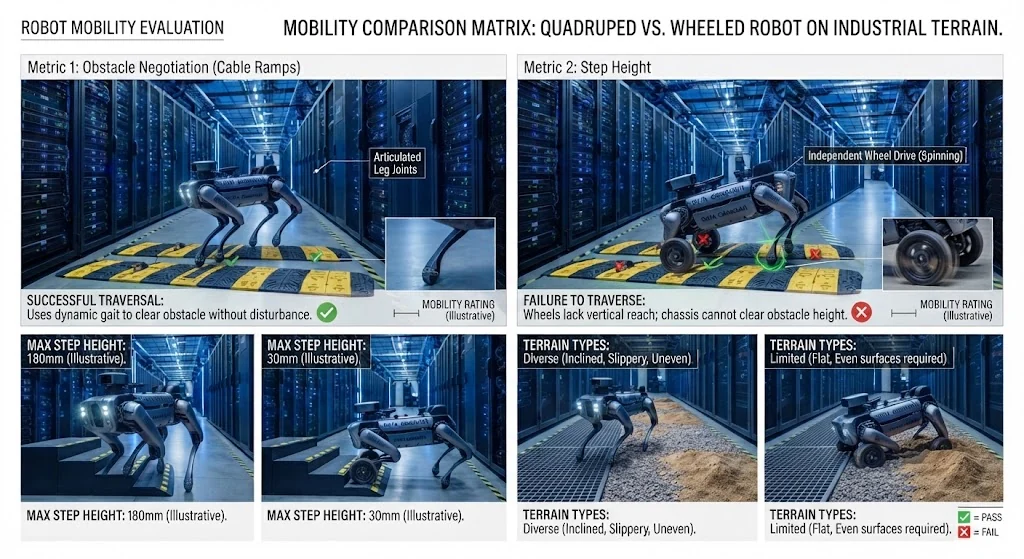
| Mobility Parameter | Legged Quadruped (e.g., RZTL-1) | Wheeled / Tracked AGV | Fixed CCTV / Sensor Grid |
|---|---|---|---|
| Floor Cable Clearance | Steps over obstacles up to 200 mm | Trapped by obstacles > 25 mm | N/A (Stationary) |
| Ramp Incline Capacity | Up to 35° dynamic incline | Limited to ≤ 8° smooth ramps | N/A |
| Turn Radius & Agility | Zero-radius turning on spot | Requires wide turning envelope | Fixed field of view |
| Raised Floor Tile Gaps | Adaptive foot placement across gaps | Risk of wheel entrapment in grates | N/A |
| Multi-Level Stairs | Autonomous stair climbing capability | Strictly single-level / Requires lifts | Independent per floor |
The RZTL-1 industrial quadruped platform uses dynamic active impedance control to adjust joint stiffness instantly. This ensures stability across slick anti-static floor finishes, perforated ventilation grates, and heavy temporary power distribution cables.
Operational Boundaries: Where Robotic Patrols Do Not Fit
Autonomous mobile robots offer broad utility, but they are not universally suited for every area of a data center. Clear operational boundaries prevent mismatched deployments:
- Ultra-Narrow Legacy Aisles (< 0.6 m Width): Containment footprints with less than 0.6 meters of lateral clearance limit leg extension envelopes and prevent safe dynamic bypass.
- Fine-Motor Manual Intervention: Patrol robots excel at inspection, deterrence, and telemetry collection. They do not replace field service engineers for manual server blade swapping, fiber splicing, or patch cabling.
- Static High-Speed Air Plenums: Sub-floor pressurized plenums with continuous cabling arrays restrict robotic traversal and are better monitored via fixed static IoT probes.
- Environments Without Basic Anti-Static Grounding: Facilities lacking baseline ESD static dissipative coatings risk electrostatic build-up, requiring dedicated grounding brush modifications on robotic contact points before operation.
Enterprise Technical Compliance: EMI, ESD, and Cyber-Physical Architecture
Deploying autonomous hardware alongside high-density enterprise compute racks requires strict adherence to physical and electromagnetic standards. Industrial platforms must be thoroughly isolated to protect sensitive data operations.
Engineering Insight: Autonomous quadruped platforms deployed within Tier III/IV data halls must pass strict industrial electromagnetic compatibility testing (CE/FCC EMC Class A) to guarantee zero radiated RF interference across high-speed SFP28/QSFP-DD transceivers.
- Electrostatic Discharge (ESD) Mitigation: Chassis surfaces, carbon-fiber leg assemblies, and silicone foot pads must utilize static-dissipative materials (surface resistivity 106 to 109 Ω/sq) to eliminate static discharge risks near open server racks.
- Local Edge Compute Isolation: SLAM processing, LiDAR point cloud generation, and AI video analytics execute entirely on local onboard GPU compute nodes. Unencrypted visual data is never routed through third-party public cloud environments.
- Fire Safety Compliance: Chassis battery modules utilize certified LiFePO4 or BMS-monitored Lithium-Ion chemistries meeting UL 2272 and NFPA 75 Standard for Fire Protection of IT Equipment.
Total Cost of Ownership (TCO) & Guard Labor Replacement ROI
Physical security management in mission-critical facilities represents a persistent operational expense. Continuous 24/7/365 coverage for a single physical post requires 4.2 full-time equivalent (FTE) security officers, accounting for shift rotations, relief coverage, and supervision.
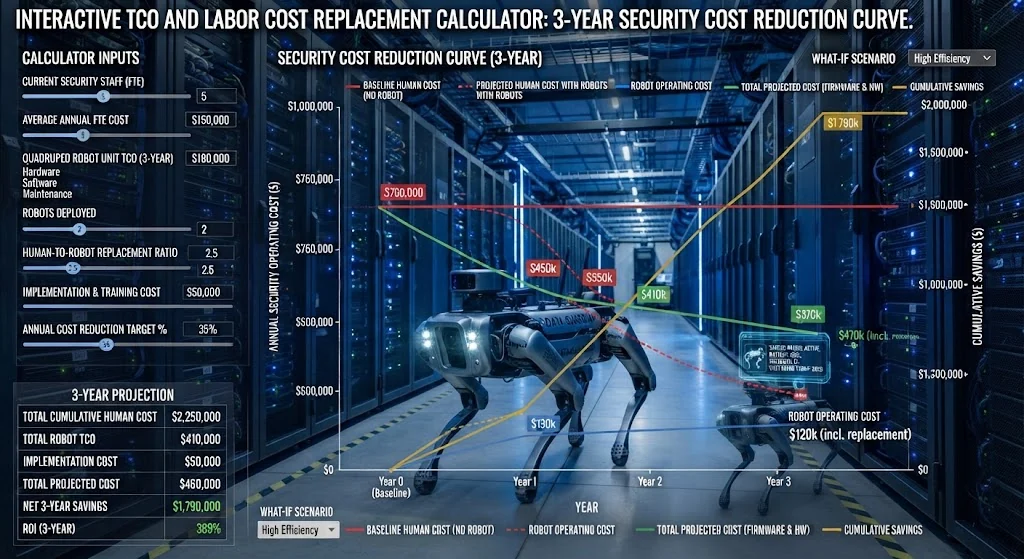
| Cost Category | 24/7 Dedicated Manned Guard Post | Autonomous Quadruped Unit (e.g., RZTL-1) |
|---|---|---|
| Year 1 (Capex / Deployment + Ops) | $180,000 – $240,000 (Wages + Overhead) | $65,000 – $85,000 (Hardware + Dock + Setup) |
| Year 2 (Maintenance + Operations) | $185,000 – $248,000 | $8,000 – $12,000 (SLA & Consumables) |
| Year 3 (Maintenance + Operations) | $192,000 – $255,000 | $8,000 – $12,000 (SLA & Consumables) |
| 3-Year Total Cost | $557,000 – $743,000 | $81,000 – $109,000 |
Replacing or supplementing manual patrols with autonomous quadruped units yields up to 60% overall savings across a standard 3-year hardware lifecycle. The robotic solution also provides continuous thermographic reporting, tamper-proof event logs, and steady operational performance without guard turnover.
Software & VMS Integration: Genetec, Milestone, DCIM, and SIEM
An autonomous robot must integrate cleanly into established operational workflows. Standalone platforms create operational silos that reduce responsiveness.
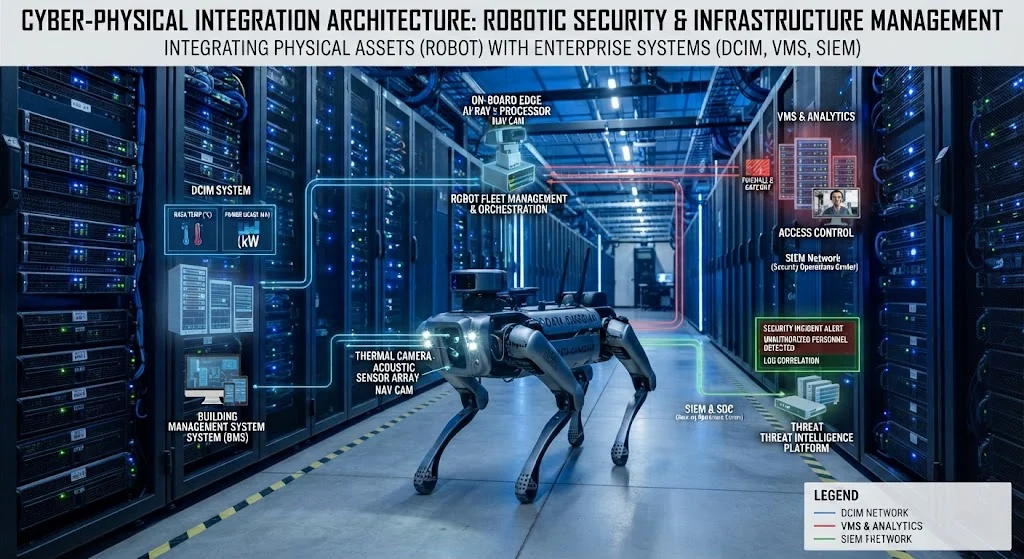
- VMS Video Feed Ingestion: Continuous RTSP and ONVIF Profile S/G/T video streaming links directly into enterprise Video Management Systems (such as Genetec Security Center or Milestone XProtect), treating the robot as a mobile PTZ camera.
- DCIM Telemetry Sync: Environmental telemetry (rack temperatures, localized humidity, ultrasonic decibel spikes) feeds into Data Center Infrastructure Management platforms via REST APIs or MQTT, auto-populating thermal maps.
- SIEM Real-Time Alerting: Unauthorized access detections, open server rack alerts, or thermal anomalies automatically trigger syslog events in SIEM platforms (Splunk, Microsoft Sentinel) for immediate SOC verification.
The 3-Step Action Path to Deploying Autonomous Patrols
Integrating autonomous robotics into mission-critical infrastructure follows a validated, risk-free phased roadmap:
- Feasibility & Clearance Audit: Assess aisle clearances (≥ 0.7 m), floor transition ramps (≤ 35°), cable bridge profiles (≤ 150 mm), and anti-static floor dissipative properties across targeted data halls.
- Digital Twin & Path Simulation: Import facility CAD or BIM floor plans into the fleet management system to simulate coverage loops, verify auto-docking locations, and map visual and thermal sensor coverage.
- On-Site Pilot Validation: Execute a 14-to-30 day live white space pilot to validate edge SLAM localization, verify zero RF interference with compute infrastructure, and benchmark thermal anomaly detection accuracy.
Frequently Asked Questions
Do autonomous patrol robots create RF interference with server racks?
No. Industrial-grade quadruped platforms built for mission-critical facilities are certified to EMC Class A standards, featuring heavy RF shielding around high-frequency motor controllers and compute modules. They operate seamlessly alongside high-density enterprise compute racks, storage arrays, and network switches without introducing signal noise or packet loss.
Are quadruped robot weights safe for raised floor tile load limits?
Yes. Industrial patrol quadrupeds typically weigh between 25 kg and 55 kg, distributed dynamically across four contact points. Standard data center raised floor systems support concentrated point loads of 450 kg (1,000 lbs) to 1,100 kg (2,500 lbs) per tile, meaning robotic foot loads use less than 5% of standard tile load limits.
How does autonomous self-charging function safely in unmanned halls?
The robot uses millimetric visual fiducial markers (AprilTags) combined with local LiDAR positioning to execute autonomous precision docking. Self-aligning floor contact plates activate current flow only after a multi-point handshake is verified by the internal battery management system (BMS), preventing exposed live voltage and eliminating fire risks.
What safety protocols activate if personnel cross paths with the robot?
Quadrupeds maintain a 360° LiDAR and depth-camera safety field. If human personnel, open rack doors, or equipment carts enter the dynamic safety boundary (< 1.0 m), the robot instantly pauses, adjusts its trajectory to bypass the obstruction, or yields right-of-way while logging the event in the central telemetry feed.
Deploy Autonomous Quadruped Patrols in Your Facility
Transition from reactive security checks to continuous cyber-physical auditing with millimeter-accurate SLAM navigation, radiometric thermal scanning, and full VMS/DCIM integration.