Core Definitions & Operational Architecture in Downstream Refining
Modern refinery inspection robots are autonomous, multi-sensor mobile platforms engineered to audit mechanical integrity, monitor thermal dynamics, detect fugitive emissions, and verify instrumentation across hazardous petrochemical environments. By combining non-destructive testing payloads with edge computing, these systems automate standardized asset inspections and feed real-time analytics directly into plant distributed control systems (DCS).

Operating inside a petrochemical refinery requires addressing harsh operating conditions: continuous vibrations, volatile hydrocarbons, corrosive atmospheres, and complex vertical structures. Implementing autonomous industrial inspection solutions establishes an automated telemetry pipeline that bridges physical field equipment with digital asset management frameworks.
Robotic Petrochemical Asset Integrity: The automated execution of non-destructive examination (NDE), thermal profiling, optical gauge digitization, and fugitive gas boundary scanning via autonomous ground or aerial units, aligned with standard process safety protocols like API 570 and API 510.
The operational architecture relies on a decoupled, modular payload bus. The robotic carrier provides mechanical locomotion, power distribution, and base-level obstacle avoidance, while isolated sensor modules handle domain-specific data capture without degrading drivetrain performance.
- Sensor Layer: Radiometric thermal imagers, high-magnification optical pan-tilt-zoom (PTZ) cameras, acoustic leak imagers, and Tunable Diode Laser Absorption Spectroscopy (TDLAS) gas sensors.
- Edge Computing Layer: Industrial micro-servers running convolutional neural networks (CNNs) for dial recognition, rust classification, and thermal threshold evaluation in real time.
- Communications & Transport: Dual-band private 5G, Wi-Fi 6 mesh, and offline onboard logging that synchronizes when establishing high-bandwidth base station links.
- Enterprise Integration: RESTful APIs and OPC-UA interfaces feeding operational databases such as AVEVA PI System and SAP Plant Maintenance (PM).
Mobility Form-Factor Decision Matrix: Quadrupeds vs. Crawlers, Drones, and Wheeled UGVs
Downstream process units are designed for human operators, characterized by steep stairs, elevated catwalks, grated walkways, and tight containment bunds. Evaluating mobile robotics requires matching terrain geometry against drivetrain mechanics.
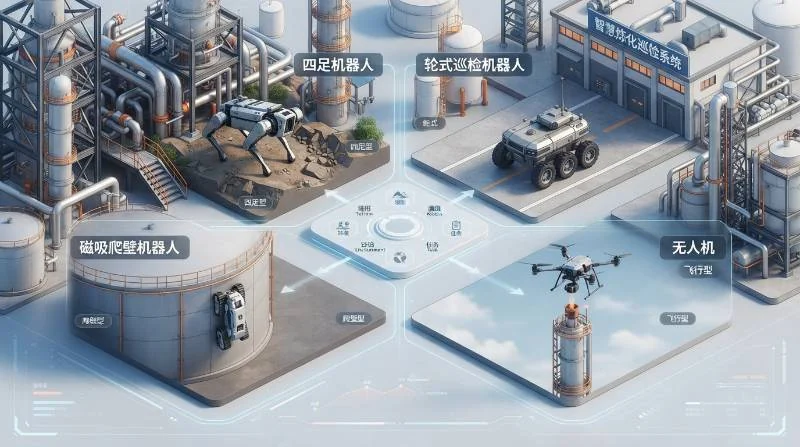
Wheeled unmanned ground vehicles (UGVs) excel on flat asphalt perimeter roads but fail when encountering open-grating multi-level structures. Magnetic crawlers provide specialized vertical vessel adhesion but lack inter-unit transit capability. Aerial drones manage flare stack inspections effectively but suffer from short 20-to-30 minute battery runtimes and dangerous downwash near process piping.
The RZTL-1 industrial quadruped robot overcomes these structural hurdles by using dynamic leg placement. It navigates standard 45-degree refinery industrial staircases, steps over pipe sleeper clearances up to 350 mm, and maintains stable footholds across open steel mesh flooring.
| Locomotion Platform | Multi-Level Stair Incline | Payload Capacity | Continuous Run Time | Hazardous Area Deployment |
|---|---|---|---|---|
| Quadruped (Robot Dog) | Standard Industrial (Up to 45°) | 10 kg – 15 kg dynamic | 120 – 180 min (Hot-swappable) | Optimal (Zone 1/2 Certified) |
| Wheeled / Tracked UGV | Incapable / Max 15° Slopes | 25 kg – 50 kg | 240 – 360 min | Moderate (Flat footprint only) |
| Aerial Drone (UAV) | Full 3D Elevation | 1 kg – 3 kg | 20 – 35 min | Restricted (Ignition risk/air turbulence) |
| Magnetic Wall Crawler | Vertical Ferrous Walls (90°) | 5 kg | Tethered / 120 min | Specialized (Storage tanks only) |
Thermal and Optical Surveillance Capabilities
Downstream visual auditing requires resolving fine mechanical anomalies at standoff distances without manual intervention. Integrated pan-tilt-zoom payloads equipped with 30x or 40x optical zoom allow robotic systems to inspect pipe racks situated 10 to 15 meters above the deck.

Optical systems use localized computer vision models to perform Optical Character Recognition (OCR) and pointer tracking on analog gauges, sight glasses, and valve position indicators. By comparing observed physical needle positions against DCS baseline readings, the system flags drifted pressure transmitters or uncalibrated field instruments instantly.
Engineering Insight: Radiometric thermal payloads calculate absolute temperature profiles on every pixel. By referencing calibration targets, long-wave infrared (LWIR, 7.5–14 µm) sensors identify refractory lining failure inside Fluid Catalytic Cracking Units (FCCU) and delayed cokers long before external hot spots lead to shell breach.
- Electrical Substation Audits: Identifies phase imbalance and loose terminations across motor control centers (MCCs) and high-voltage transformer yards.
- Steam Trap Performance: Detects failed-open or failed-closed steam traps by calculating the Delta-T across upstream and downstream pipe sections.
- Flange Leak Assessment: Surfaces early-stage evaporative cooling footprints and thermal anomalies indicating hydrocarbon micro-channel leaks.
Hazardous Gas Detection and Environmental Sensing
Fugitive hydrocarbon emissions represent both major safety risks and direct commodity loss. Inspection robots integrate Tunable Diode Laser Absorption Spectroscopy (TDLAS) and Optical Gas Imaging (OGI) payloads to quantify and localize fugitive gas plumes in real time.
According to research from the U.S. Department of Energy, industrial facilities lose thousands of barrels of oil equivalent annually to unmonitored fugitive valve and seal emissions. Ground quadrupeds eliminate these blind spots by actively tracing gas concentration gradients back to their origin point.
- TDLAS Laser Sensing: Projects an eye-safe laser column up to 30 meters to detect methane concentrations down to 1 ppm-m, even against vibrating pipe backgrounds.
- Electrochemical Multi-Gas Sniffers: Continuous ambient tracking of Hydrogen Sulfide ($H_2S$), Carbon Monoxide ($CO$), Sulfur Dioxide ($SO_2$), and Lower Explosive Limits (LEL).
- Acoustic Imaging Cameras: Uses 64-to-128 MEMS microphone arrays to isolate ultrasonic frequencies (20 kHz to 100 kHz) caused by pressurized gas and vacuum leaks.
Non-Destructive Testing (NDT) and Structural Integrity Monitoring
Verifying ongoing pipe wall integrity against corrosion under insulation (CUI) and internal sour crude erosion is essential for pipeline safety. Robotic systems automate these non-destructive testing routines according to API 570 / API 510 standards without needing continuous manual staging.
Ground robotics deploy specialized dry-coupled ultrasonic testing (DC-UT) probes via articulated robotic arms. The robot positions the probe against designated Circuit Thickness Measurement Locations (TMLs), recording remaining wall thickness down to $\pm 0.1\text{ mm}$ precision without requiring liquid couplant application.
- 3D LiDAR Point Cloud Auditing: Generates high-resolution spatial maps to identify pipe rack structural sagging, foundation subsidence, and pipe support displacement.
- Pitting & Surface Corrosion Mapping: High-resolution optical photogrammetry algorithms classify ISO 8501-1 rust grades automatically during routine patrols.
- Vibration Analysis: Onboard laser vibrometers record pump and motor bearing frequencies non-contact to identify early cavitation and bearing race defects.
Edge AI & SLAM Navigation in GPS-Denied, RF-Shielded Environments
Downstream processing units present complex localization challenges. Massive structural steel columns, heavy vessels, and thick concrete blast walls degrade satellite GPS signals and create radio-frequency (RF) multipath dead zones.
Robotic systems maintain centimeter-level trajectory tracking through 3D SLAM navigation technology. By fusing 360-degree LiDAR point clouds with high-rate visual-inertial odometry (VIO) and kinematic wheel/leg data, the platform navigates securely through multi-level steel environments without external beacons.
Edge Computation Reliability: Operating under RF interference means inspection platforms must not rely on continuous cloud connections. Inference models for dial state evaluation, thermal segmentation, and dynamic obstacle bypass execute locally on onboard AI processors.
The Autonomous Refinery Integrity Lifecycle (ARIL) Framework
Deploying inspection robots systematically requires a structured operational model. We apply our field-validated, four-phase methodology: The Autonomous Refinery Integrity Lifecycle (ARIL) Framework.
- Phase 1: High-Density Digital Baseline Mapping: The robot records an initial 3D LiDAR and thermal baseline of the target unit, indexing all valve IDs, gauge locations, and thermal limits into a centralized digital twin.
- Phase 2: Autonomous Dynamic Patrol Scheduling: Autonomous routes are scheduled based on process risk profiles (e.g., hourly audits for high-pressure hydrogen compressors; daily audits for remote tank farms).
- Phase 3: Synchronized Multi-Payload Edge Inference: Optical, thermal, acoustic, and gas metrics are processed simultaneously on the edge compute platform, filtering out false positives before transmitting verified anomalies.
- Phase 4: Closed-Loop CMMS & SCADA Ingestion: Actionable alerts trigger automated work orders in enterprise CMMS platforms (such as SAP PM or IBM Maximo), appending historical trend data to eliminate manual data entry.
Hazardous Area Compliance: IECEx, ATEX, and Ingress Protection
Operating mobile robots inside active petrochemical units requires strict adherence to international electrical safety directives. Uncertified electronics introduce ignition risks in environments where flammable vapors are present during regular operation.
Robotic systems must satisfy IECEx and ATEX Zone 1 / Zone 2 (or Class I, Division 1/2 under NEC 500) compliance criteria. This involves using sealed, pressurized enclosures ($Ex\ p$), intrinsically safe low-power control circuitry ($Ex\ i$), and non-sparking mechanical materials across all leg joints and payload mounts.
- Positive Pressure Purge Systems: Lightweight inert gas containment maintains positive internal chassis pressure, preventing external combustible hydrocarbons from reaching power electronics.
- IP67 / IP68 Ruggedization: Complete environmental sealing against heavy rainfall, high-pressure washdown operations, and fine coke dust accumulation.
- Electrostatic Discharge (ESD) Mitigation: Carbon-infused foot pads and conductive chassis coatings eliminate static buildup across plastic and composite components.
Continuous 24/7 Operations: Autonomous Docking & SCADA/Digital Twin Integration
To eliminate manual intervention entirely, robots utilize outdoor-rated autonomous docking stations placed at process unit boundaries. When battery levels reach 15%, the robot returns to the dock, aligns itself via infrared and AprilTag markers, and initiates high-amperage conductive charging.
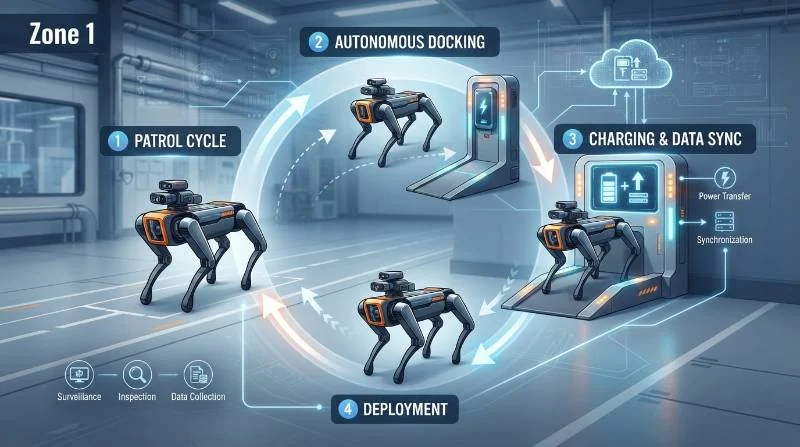
Docked systems offload high-density raw datasets over hardwired Gigabit Ethernet or local high-speed Wi-Fi, updating plant 3D digital twins in real time. For operational field verification, explore our refinery inspection case studies detailing full-scale automated asset management deployments.
- SCADA Integration: Streams live gas concentrations, ambient temperatures, and visual verification feeds directly to the central control room via standard OPC-UA and MQTT protocols.
- Automated Turnaround Validation: Provides continuous spatial and thermal tracking during plant turnarounds (TAR), tracking nitrogen purge cooling and line clearing before operator entry.
Enterprise ROI & Total Cost of Ownership (TCO) Analysis
Deploying autonomous robotic inspection platforms yields clear financial returns by reducing manual routine round hours, preventing unbudgeted downtime, and minimizing environmental emissions fines.
| Operational Metric | Conventional Manual Rounds | Autonomous Quadruped System | Variance / Impact |
|---|---|---|---|
| Operator Exposure in High-Hazard Zones | ~1,800 human hours/year | < 350 human hours/year | 75% – 80% exposure reduction |
| Inspection Frequency per Asset | 1x per 12-hour shift | Continuous (Every 60–90 min) | 8x higher temporal data density |
| Early Minor Leak Detection Time | 24 – 72 hours average | < 30 minutes | Prevents unscheduled shutdown events |
| Scaffolding Costs for Elevated Audits | $120,000 – $250,000 annually | Minimal (Long-range optical/thermal) | 65% direct OPEX savings |
Frequently Asked Questions (FAQ)
Are quadruped inspection robots fully certified for ATEX Zone 1 environments?
Yes. Specialized industrial robot dogs are built with positive-pressure purged chassis and explosion-protected battery enclosures, securing certified compliance for ATEX Zone 1 and IECEx Zone 1 hazardous environments.
Can quadruped robots walk on wet steel gratings and open mesh catwalks?
Industrial quadrupeds utilize custom high-traction rubber and polyurethane composite feet engineered to prevent slipping on wet, oily, or open galvanized steel grating up to 45-degree slope angles.
How difficult is it to change inspection payloads in the field?
Modern platforms feature modular quick-release rails and unified IP67 electrical connectors. Field technicians can swap an optical PTZ payload for a TDLAS gas sniffer or ultrasonic thickness tool in under ten minutes.
What happens if the robot loses wireless communication inside a dense unit?
The platform continues its mission autonomously using onboard 3D SLAM navigation and edge AI processing. If a critical safety fault or physical blockage occurs, it follows an automated return-to-base protocol back to the nearest wireless link.
Automate Your Facility Asset Integrity Inspections
Reduce operator exposure to hazardous zones, eliminate inspection blind spots, and streamline predictive maintenance with our rugged industrial quadruped platforms.