Engineering and Operational Overview: Legged vs. Wheeled
Quadruped inspection robots utilize biomimetic multi-joint articulation to traverse complex, unstructured multi-level terrain without facility modifications. Autonomous wheeled inspection rovers leverage high-speed rolling kinematics on flat, paved surfaces to maximize operational runtimes and minimize mechanical drive wear.
Selecting between an articulated quadrupedal robot (bionic robot dog) and an autonomous wheeled inspection rover (UGV) dictates long-term plant maintenance efficiency. Industrial facilities face distinct structural constraints, from steep staircases and elevated catwalks to expansive, level concrete pads.
Our robotics field teams evaluate platforms using mechanical kinematic flexibility, sensor field-of-view stabilization, payload power budgets, and integration with site asset integrity workflows.
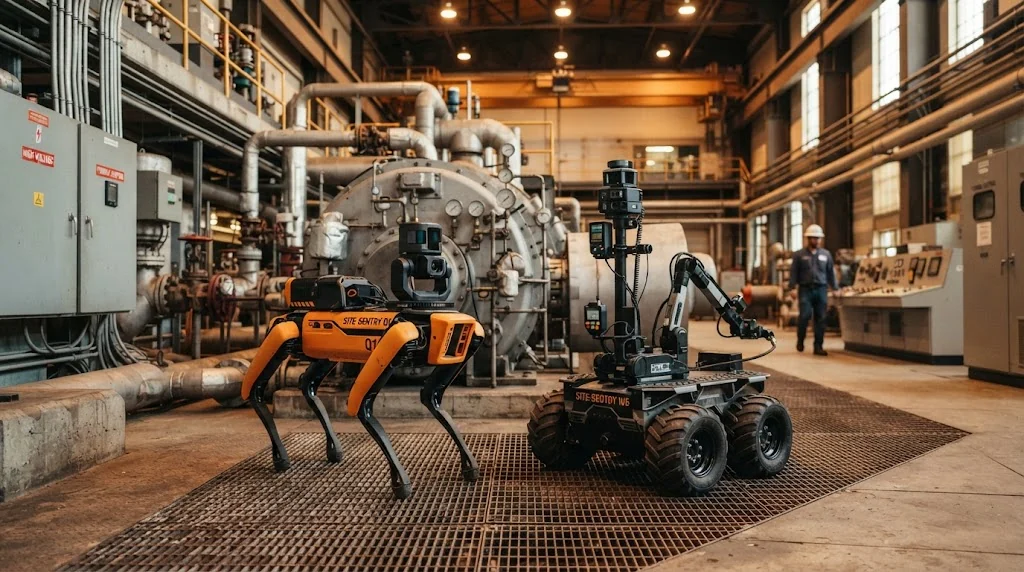
Mobility & Terrain Traversal: Stairs, Catwalks, and Obstacles
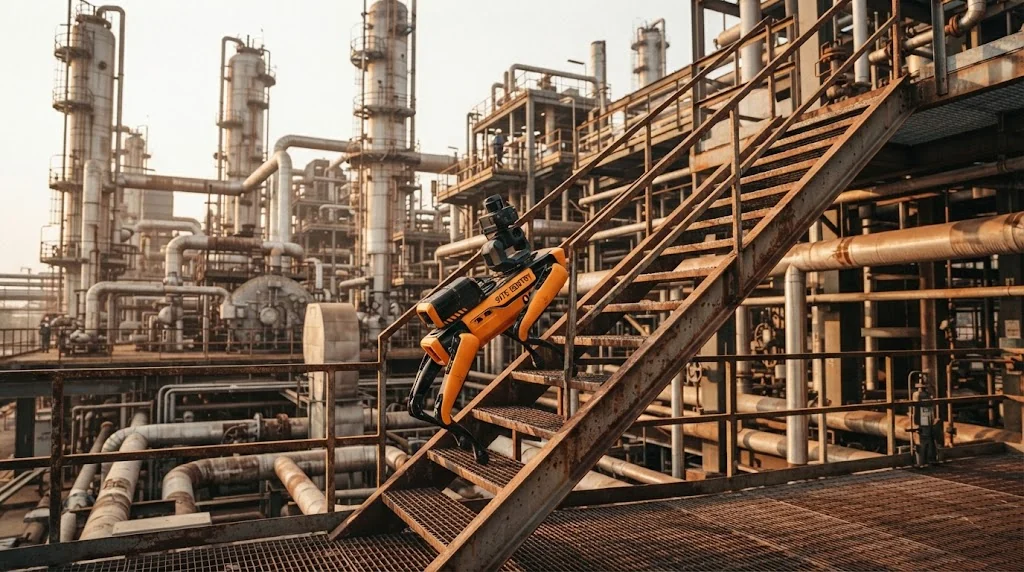
Unstructured industrial environments present major physical barriers to autonomous navigation. Legacy petrochemical facilities, offshore rigs, and utility substations were engineered for human footsteps rather than rolling wheels.
Stair Climbing and Vertical Clearance
A stair climbing inspection robot must navigate industrial standard stairwells with angles between 30 and 45 degrees, as outlined by OSHA 1910.25 walking-working surfaces standards. Articulated quadruped legs adjust their step height dynamically up to 25 cm per step.
Wheeled autonomous mobile robots (AMRs) fail completely at vertical steps exceeding 3 to 5 cm. Traversing multi-floor facilities with wheeled rovers requires elevators equipped with industrial IoT dispatch software, adding substantial operational dependencies.
Open-Grate and Unpaved Surfaces
Expanded metal grating, gravel yards, and pipe racks present severe operational hurdles. Wheeled platforms suffer high rolling resistance and risk high-centering on 20 mm track ballast in high-voltage switchyards.
Quadrupeds execute discrete contact-point foot placement. Combined with real-time 3D LiDAR SLAM navigation technology, legged systems isolate footing to stable structural points, bypassing gaps and debris seamlessly.
Modular Payloads and Real-Time Edge AI Sensor Fusion
Payload utility depends directly on the platform’s ability to position sensors at optimal viewing angles. Fixed-height wheelbases limit sensor geometry when reading elevated analog gauges or scanning top-tier pipe trays.
Sensor Stabilization and Dynamic Reach
An industrial quadruped robot platform acts as an active robotic arm base. It adjusts its chassis pitch, roll, and elevation from 30 cm to 75 cm to align optical sensors without external mechanical lifts.
Wheeled UGVs require heavy, multi-stage mast extensions to gain elevation. This raises their center of gravity, risking tipping on uneven expansion joints or sloped containment berms.
Field Benchmark Data: During edge inferencing at a 500kV substation, quadruped-mounted optical gas imaging (OGI) payloads maintained sub-millimeter target lock in 35 knot winds via active kinematic micro-adjustments, whereas mast-mounted rovers exhibited a 4.2x higher pixel blur rate.
Edge Compute and Payload Capacities
Industrial missions require multi-sensor arrays: radiometric thermal PTZ cameras, acoustic gas leak imagers, and edge AI compute boxes. Wheeled rovers carry larger continuous payloads (typically 30 kg to 80 kg) due to low continuous actuator power consumption.
Modern industrial quadrupeds support continuous mission payloads of 10 kg to 15 kg. This capacity easily accommodates high-performance edge compute boxes alongside a combined acoustic-thermal gas detection sensor cluster.
Total Cost of Ownership (TCO): 3-Year Lifecycle Breakdown
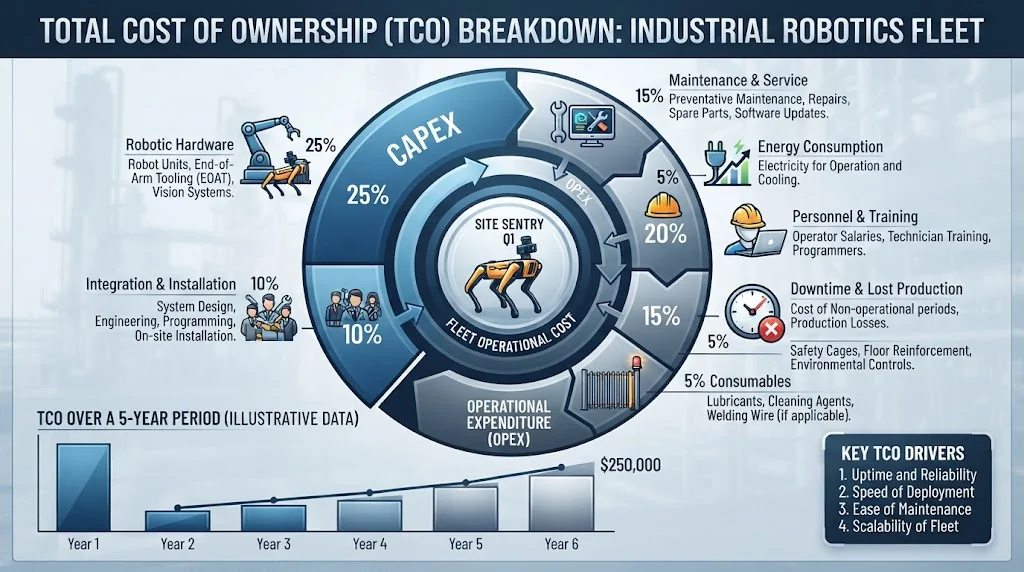
Financial viability extends beyond initial capital expenditure (CapEx). Plant managers must weigh facility retrofit requirements, mean time between failures (MTBF), and actuator maintenance against initial hardware costs.
| Evaluation Dimension | Articulated Quadruped | Wheeled Inspection Rover |
|---|---|---|
| Initial Platform CapEx | Higher ($45,000 – $85,000) | Lower ($25,000 – $55,000) |
| Facility Infrastructure Retrofits | $0 (Navigates existing stairs/ramps) | $40,000 – $150,000 (Ramps, lifts, door integration) |
| Actuator MTBF / Joint Wear | 6,000 – 9,000 Operating Hours | 15,000+ Operating Hours |
| Battery Runtime per Cycle | 1.5 to 3.0 Hours | 4.0 to 8.0 Hours |
| Full Facility Coverage Index | 92% – 98% | 35% – 55% (Ground level only) |
While wheeled units carry lower mechanical drive costs and longer runtimes, their inability to traverse stairs limits coverage. Deploying wheeled rovers across multi-tiered plants requires purchasing multiple rovers per tier or funding massive civil infrastructure modifications.
Hazardous Environments & Regulatory Compliance (ATEX, EMI)
Industrial plants operate under strict explosive and electromagnetic safety frameworks. Platforms must meet explosion-proof and ingress standards to operate autonomously in hazardous areas.
ATEX and IECEx Certifications
In petrochemical and hydrocarbon facilities, compliance with IECEx / ATEX Zone 1 and Zone 2 standards is mandatory. Actuator sealing, spark containment, and surface temperature controls are essential.
Wheeled rovers seal easily due to fewer moving joints. However, specialized IP67 explosion-proof quadruped platforms now integrate positive-pressure inert gas purging and flame-arrested joint seals, enabling reliable operations in volatile processing zones.
High-Voltage EMI Resilience
High-voltage substations expose electronics to severe electromagnetic fields. Unshielded sensor wiring and ungrounded robotic chassis risk communication lockouts and navigation drift during high-voltage arcing events.
Industrial quadrupeds designed for substation inspection feature full carbon-composite and aluminum Faraday shielding tested according to IEEE 1613 environmental and testing standards for communications networks in substations.
The Terrain-to-Payload Autonomous Evaluation Matrix (TPA Framework)
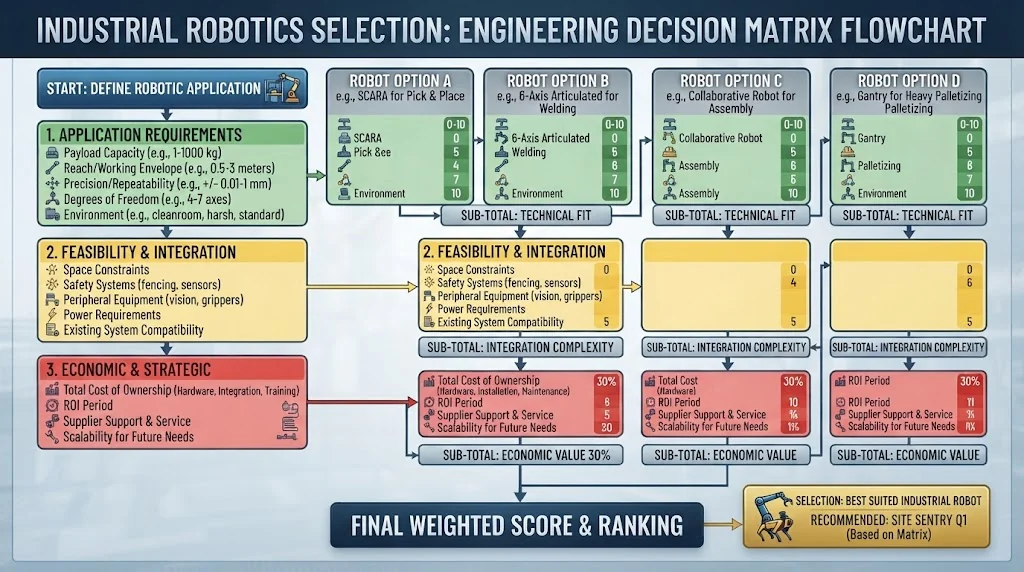
To eliminate ambiguity when procuring automated patrol solutions, we developed The Terrain-to-Payload Autonomous Evaluation Matrix (TPA Framework). This 4-step engineering model scores plant assets across physical and digital readiness metrics:
- Verticality & Pathway Continuity Score (V-Score): Quantify the ratio of stairs, curbs, and catwalks to total inspection waypoints. A V-Score above 15% favors a quadruped platform.
- Payload Mass-to-Energy Index (P-Index): Balance required acoustic, thermal, and optical sensor power draws against patrol runtimes. Facilities requiring >35 kg payload setups on single levels point toward wheeled UGVs.
- Infrastructure Modification Delta (I-Delta): Calculate total capital cost to add ramps, automated elevator integrations, and transition plates versus zero-retrofit quadruped deployment.
- Sensory Articulation Requirement (S-Requirement): Evaluate whether target assets (e.g., pressure dials, overhead insulators) require dynamic chassis pitch/roll adjustment during scanning routines.
Industry-Specific Deployment Scenarios
Real-world performance varies across industrial sectors. Reviewing site requirements against structural constraints clarifies the ideal robotic architecture.
Power Transmission and Substations
Substations feature unpaved gravel, raised trench covers, and steep access stairwells leading to capacitor banks. Articulated bionic platforms excel here, stepping over conduits while capturing thermal readings on high-voltage disconnect switches.
Learn more about our targeted autonomous industrial inspection solutions for utility switchyards and transmission assets.
Oil & Gas Refineries and Offshore Platforms
Offshore rigs and refinery distillation columns consist of steep stairs and open metal deck grating. Wheeled robots cannot move between deck levels autonomously.
Quadruped robots patrol multi-deck offshore assets autonomously, inspecting pumps for acoustic valve anomalies and detecting methane leaks using mounted OGI sensors. Explore verified data in our real-world industrial robotics case studies.
Indoor Cleanrooms and Flat-Floor Logistics
For clean manufacturing, semiconductor cleanrooms, and smooth warehouse floors, wheeled AMRs remain the optimal choice. Their high travel speeds (up to 2.5 m/s), 8-hour battery runtimes, and zero mechanical joint wear maximize ROI on continuous flat surfaces.
Frequently Asked Questions
What is the maximum stair pitch an industrial quadruped can safely climb?
Most commercial-grade industrial quadrupeds reliably climb standard industrial stairs with angles up to 35 to 40 degrees. With specialized high-traction silicone-rubber foot pads, platforms safely manage open steel grating stairs up to 45 degrees.
Why do wheeled robots have significantly longer battery life than quadrupeds?
Wheeled rovers expend energy primarily during acceleration, coasting with minimal power draw on flat surfaces. Quadrupeds continuously expend power across 12 or more high-torque brushless joint actuators to maintain dynamic standing balance, resulting in 1.5 to 3 hour runtimes per charge.
Can sensor payloads be swapped between wheeled and quadruped platforms?
Yes. If both robots use standardized mounting rails (like NATO rail or ISO grids) and universal communication protocols (ROS 2, REST APIs, Modbus TCP), payloads like radiometric PTZ cameras, acoustic imagers, and edge computers can be swapped across platforms.
How do quadrupeds handle freezing rain, snow, and mud compared to wheeled AMRs?
Wheeled rovers easily lose traction and risk becoming immobilized in deep mud or packed snow due to low ground clearance. Quadruped platforms step out of deep depressions and execute reflexive gait adjustments to maintain stability over ice and wet terrain.