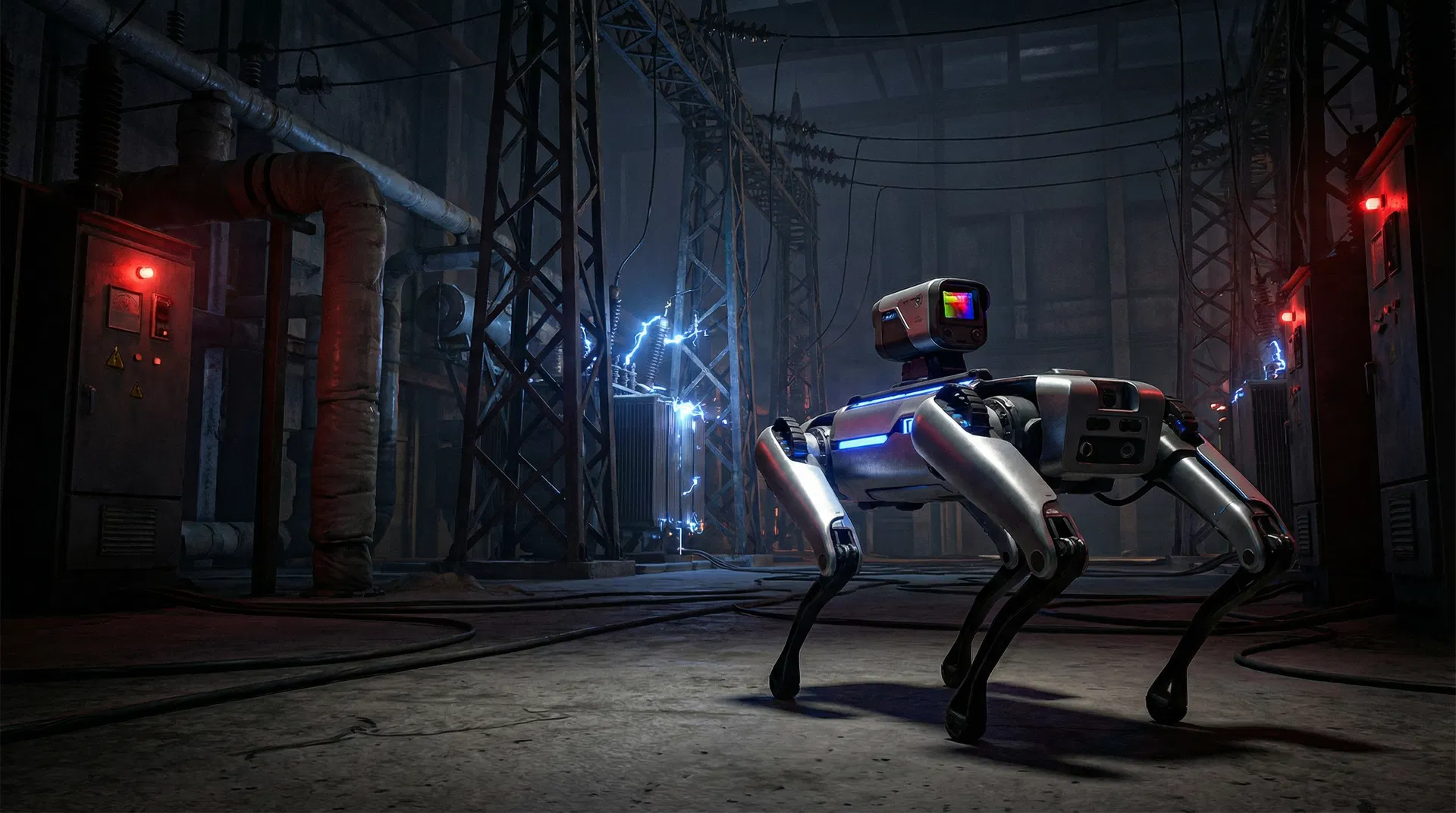
The Platform Decision That Shapes Your Inspection Program
Selecting between a quadruped (legged) robot and a wheeled or tracked robot for industrial inspection is one of the most consequential decisions in an autonomous inspection program. The right choice depends on your facility's terrain, the equipment you need to inspect, and the access constraints your maintenance team faces daily.
This comparison covers the key technical dimensions that matter for industrial inspection applications.
Terrain and Access Capability
The fundamental advantage of quadruped robots is their ability to navigate terrain that is impassable for wheeled or tracked platforms.
| Terrain Type | Quadruped | Wheeled | Tracked |
|---|---|---|---|
| Smooth concrete floors | ✓ Excellent | ✓ Excellent | ✓ Good |
| Gravel / loose aggregate | ✓ Excellent | ✗ Poor | ✓ Good |
| Stairs and steps | ✓ Yes (up to 30 cm) | ✗ No | ✗ No |
| Ramps and slopes | ✓ Up to 45° | ✓ Up to 20° | ✓ Up to 35° |
| Cable trays and grating | ✓ Yes | ✗ No | ✗ No |
| Mud and standing water | ✓ IP67 rated | ✗ Limited | ✓ Limited |
| Narrow corridors (< 60 cm) | ✓ Yes | ✓ Yes | ✗ No |
| Outdoor uneven terrain | ✓ Excellent | ✗ Poor | ✓ Good |
For facilities with mixed terrain — outdoor process areas, cable basements, stairwells, and equipment plinths — quadruped robots provide access that wheeled platforms simply cannot match.
Payload and Sensor Integration
Quadruped robots (TongChui M1, RZTL-1): 15–30 kg payload capacity, modular sensor mounting on all axes, ability to position sensors at variable heights and angles by adjusting body posture.
Wheeled robots: Typically 5–15 kg payload, fixed sensor height, limited ability to position sensors relative to equipment under inspection.
The ability to dynamically adjust body height and orientation is a significant advantage for quadruped robots in inspection applications — particularly for reading instrument gauges, inspecting equipment at varying heights, and positioning thermal cameras at optimal angles.
Speed and Coverage Rate
Wheeled robots have a clear speed advantage on smooth surfaces. A wheeled inspection robot can cover flat floor areas 2–3× faster than a quadruped at equivalent battery consumption.
However, for most industrial inspection applications, coverage rate is not the primary constraint. The inspection program is defined by the equipment to be inspected, not the distance to be covered. A quadruped that can access all required inspection points in one patrol cycle is more valuable than a wheeled robot that covers distance faster but requires manual inspection for inaccessible equipment.
Stability for Precision Inspection
Quadruped robots provide a stable inspection platform even on uneven terrain. The active suspension provided by four independently controlled legs maintains sensor orientation regardless of ground conditions — critical for thermal imaging, gauge reading, and acoustic sensing applications where sensor positioning accuracy directly affects data quality.
Wheeled robots on uneven terrain experience vibration and attitude variation that can degrade sensor data quality, particularly for thermal imaging and acoustic measurements.
Total Cost of Ownership
| Cost Category | Quadruped | Wheeled |
|---|---|---|
| Capital cost | Higher ($80K–$300K) | Lower ($30K–$120K) |
| Maintenance complexity | Higher (leg mechanisms) | Lower |
| Battery life | 2–4 hours | 4–8 hours |
| Terrain coverage | Full facility | Flat areas only |
| Sensor repositioning | Dynamic | Fixed |
When to Choose Each Platform
Choose a quadruped robot when:
- Your facility has stairs, ramps, cable trays, or uneven outdoor terrain
- You need to inspect equipment at varying heights without fixed camera mounts
- Your inspection program requires access to confined or restricted areas
- You operate in outdoor environments with variable ground conditions
Choose a wheeled robot when:
- Your facility is entirely flat, smooth-floored, and purpose-built for wheeled access
- Coverage speed is the primary requirement (large warehouse-style facilities)
- Capital cost is the primary constraint and terrain access is not a limiting factor
- Your inspection program is limited to floor-level equipment
Conclusion
For the majority of industrial inspection applications — power substations, oil refineries, data centers, rail depots, and manufacturing facilities — quadruped robots provide superior access, sensor positioning flexibility, and terrain capability that justifies the higher capital cost. Wheeled robots remain the better choice for purpose-built, flat-floored environments where speed and cost are the primary drivers.
Contact Rongzhitong to discuss which platform configuration is optimal for your specific facility and inspection requirements.
Related Solutions
Explore how SG Trading Asia's quadruped inspection robots are deployed in real-world applications:
- Intelligent Inspection Robot System
- Rail Transit Inspection Robot Solution
- Oil & Gas Inspection Robot Solution
Contact our engineering team to discuss your specific inspection requirements.
Tagged: