The Evolution of Data Center Thermal Monitoring: Static Grids vs. Dynamic 3D Mapping
Mobile robots for thermal inspection in data centers deploy autonomous, agile platforms equipped with radiometric infrared cameras to continuously map server rack temperatures, power distribution units (PDUs), and cooling infrastructure. By eliminating thermal blind spots inherent to fixed sensor networks, these autonomous systems pinpoint localized heat anomalies and airflow imbalances across high-density AI clusters before hardware degradation occurs.
Traditional mission-critical monitoring relies heavily on fixed supervisory control and data acquisition (SCADA) networks or distributed temperature sensors placed along containment walls. While these static probes provide general trends, they fail to detect localized rack-level thermal layering.
Modern high-performance compute (HPC) nodes routinely draw 40 kW to 100 kW per rack. In these dense environments, thermal gradients can spike by 15°C within a single vertical rack unit (RU), hidden directly between static sensor positions.
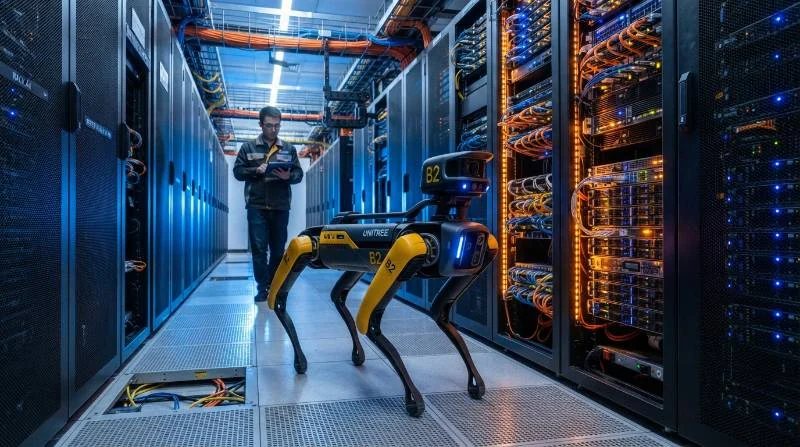
Thermal Stratification: The vertical temperature variation within a server rack enclosure where warm exhaust air recirculates into upper server intakes, violating ASHRAE TC 9.9 Thermal Guidelines without triggering wall-mounted perimeter ambient alarms.
Autonomous mobile inspection solves this by generating continuous, volumetric 3D thermal point clouds. Deploying autonomous thermal inspection solutions enables facility operators to balance supply airflow dynamically, driving down localized Power Usage Effectiveness (PUE) penalties while securing continuous operational uptime.
Quadruped Bionic Robots vs. Wheeled AMRs: Navigating Data Hall Infrastructure
Wheeled Autonomous Mobile Robots (AMRs) struggle in actual white-space environments. Raised floor systems, perforated high-flow airflow grates, seismic thresholds, and dropped cables create substantial navigation hazards for standard caster or driven wheels.
In our field testing across Tier III and Tier IV facilities, wheeled platforms frequently suffer from traction loss when transitioning across 38% open-area perforated tiles. Caster drop-ins lead to stalled patrols and false-positive collision aborts.
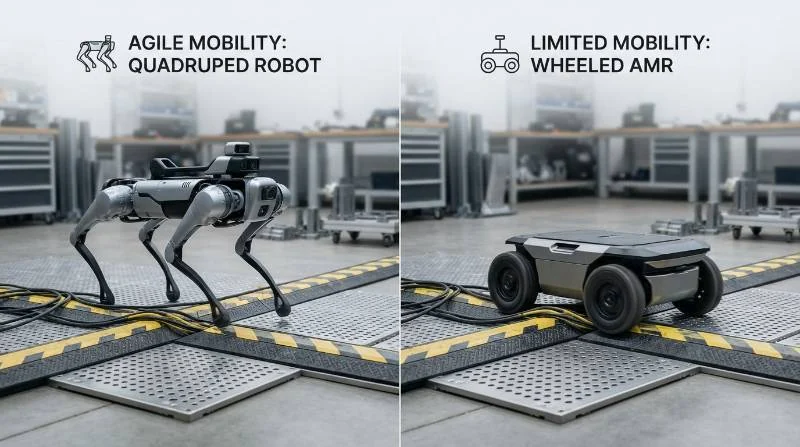
Quadruped platforms utilize dynamically stabilized gait engines. These bionic systems step directly over raised floor seams, cross 50 mm containment door sills, and turn in place within ultra-narrow 800 mm hot aisle containment corridors.
| Mobility & Operational Metric | Wheeled AMRs | Quadruped Robot Dogs |
|---|---|---|
| Perforated Floor Grate Clearance | High vibration, wheel entrapment risk | Adaptive foot placement, zero slip |
| Threshold & Cable Bridge Crossing | Limited to <15 mm vertical rise | Traverses steps up to 180 mm |
| Aisle Turning Radius | Requires 1100 mm sweep area | Zero-radius turning on spot |
| Vertical Sensor Elevation Reach | Fixed mast (top-heavy risk) | Dynamic crouching & standing pitch |
The multi-axis articulation of an industrial quadruped robot dog platform allows inspection payloads to tilt, crouch, and elevate, capturing direct optical and thermal readings from the bottom server chassis up to 52U rack caps.
Advanced Sensor Fusion: Radiometric Thermography, Acoustic Imaging, and Optical Zoom
Precision thermal monitoring demands industrial-grade sensor integration. Consumer-grade or uncalibrated bolometers drift in variable airflow environments, yielding false alarms that disrupt operational teams.
Our standard payload architecture combines an uncooled Long-Wave Infrared (LWIR) radiometric sensor with high thermal sensitivity (Noise Equivalent Temperature Difference, NETD ≤ 30mK at f/1.0). This sensitivity resolves minute temperature shifts across electrical busways, loose terminal lugs, and individual power supply units (PSUs).
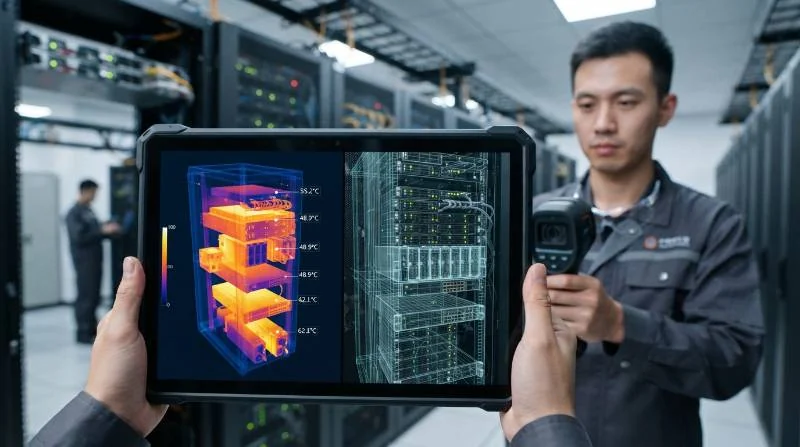
Engineering Insight: Radiometric accuracy relies heavily on real-time reflected temperature compensation. In high-velocity cold aisles, rapid convective heat transfer cools the outer casing of a faulty component. An NETD ≤ 30mK sensor detects sub-surface resistance anomalies that lower-grade sensors miss entirely.
Multi-Modal Inspection Capabilities
- Radiometric Thermography: Full frame pixel-by-pixel temperature telemetry (-20°C to 550°C range) calibrated to identify breaker imbalance and busway hot joints.
- Acoustic Partial Discharge Detection: Ultrasonic microphone arrays operating from 2 kHz to 65 kHz to detect electrical arcing, corona discharge, and pressurized liquid cooling manifold micro-leaks.
- High-Magnification Optical PTZ: 30x optical zoom visual cameras reading analog breaker position flags, physical LED diagnostic status codes, and fiber bend radius violations.
The Intelligent Robot Dog Autonomous Thermal Assurance (ATA) Protocol
To standardize automated inspections, facility engineers deploy structured operational workflows. We utilize the Autonomous Thermal Assurance (ATA) Protocol, a four-stage systematic methodology designed for continuous reliability.
The Four Stages of the ATA Protocol
- Calibrate (Dock-Side Normalization): Prior to dispatch from its induction charging station, the quadruped executes an internal blackbody reference calibration. It reads ambient air intake conditions (dry-bulb temperature, relative humidity) to establish the active thermal baseline.
- Traverse (Precision Route Execution): Navigating via high-resolution LiDAR SLAM, the robot travels down assigned cold and hot aisles at a steady 0.6 m/s. It holds a consistent 1.2-meter standoff distance, collecting continuous 30 Hz thermal video sweeps across every rack face.
- Correlate (Edge Radiometric Analysis): Onboard edge neural processing units (NPUs) process raw thermal feeds in real time. The software registers localized temperatures against predefined ISO/IEC 22237 Data Center Infrastructure threshold envelopes.
- Alert (Automated DCIM Integration): If a ΔT (temperature delta) exceeding >4.5°C across adjacent rack units or a localized component surface temperature >65°C is confirmed, the system immediately dispatches an automated REST API webhook to the central Data Center Infrastructure Management (DCIM) and Building Management System (BMS).
Data Security & Compliance: Air-Gapped SLAM and Zero-Cloud Architecture
Mission-critical facilities cannot tolerate external attack vectors, unauthorized wireless transmissions, or off-site telemetry relays. Commercial off-the-shelf consumer robotics relying on public cloud compute introduce severe security risks.
Intelligent Robot Dog operates on an isolated, local-compute framework utilizing proprietary zero-cloud SLAM navigation technology. All simultaneous localization and mapping (SLAM), point cloud transformations, and AI anomaly classifications happen entirely on the robot’s local edge compute hardware.
Cybersecurity Architecture: Fully compliant with NDAA Section 889 parameters. Features hardware-level radio disabling, encrypted internal NVMe storage (AES-256), and mutual TLS (mTLS) authentication for local on-premise DCIM data pipelines.
Spatial floor plans, server asset tags, and facility thermal profiles never leave your physical perimeter. Autonomous mission scripts run independently even under complete air-gapped network isolation.
Total Cost of Ownership (TCO) & ROI: Mitigating Outage Risks in High-Density Facilities
According to continuous uptime studies, unplanned data center outages cost operators an average of over $9,000 per minute in Tier IV environments. Electrical distribution failure and thermal runaway events account for nearly 40% of all critical site failures.
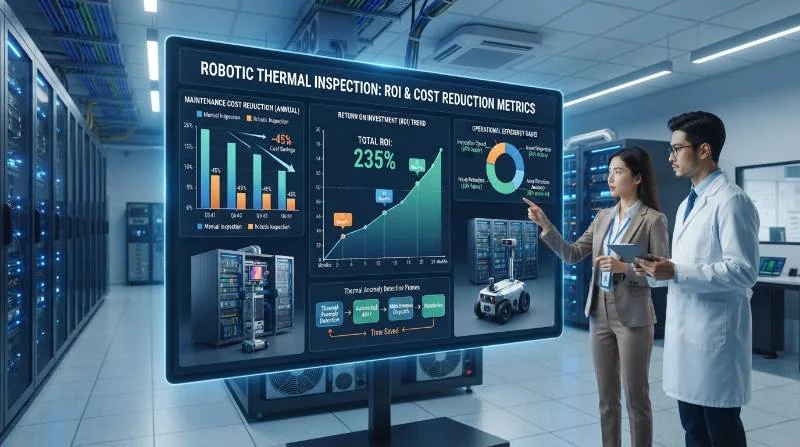
Manual handheld thermography inspections are time-consuming and inconsistent. A single facility technician typically requires 40 hours per month per data hall to manually inspect thousands of rack faces, often skipping elevated upper RUs due to line-of-sight limitations.
Reviewing our mission-critical facility deployment case studies reveals consistent financial returns:
- Labor Redeployment: Reclaims up to 85% of mechanical and electrical engineering (M&E) man-hours previously dedicated to routine manual thermal patrols.
- PUE Trimming: High-granularity thermal mapping enables operators to raise ambient chilled water setpoints by 1.5°C to 2.0°C safely, reducing chiller plant power consumption by 4% to 7% site-wide.
- Early Failure Interception: Detection of early-stage harmonic heating in PDUs and slow coolant weeping in liquid distribution manifolds prevents catastrophic downtime.
Deployment Blueprint: Integrating Intelligent Robot Dogs into Your Facility
Deploying autonomous quadruped inspection systems follows an orderly, non-disruptive implementation model tailored to operational data halls.
Phase 1: Facility Pre-Assessment & Docking Installation
Floor loading capacities are validated against the robot dog’s lightweight 35 kg footprint (exerting dynamic point loads well below standard 500 kg/m² raised floor structural limits). An autonomous low-profile induction charging station is positioned in an equipment corridor or vestibule.
Phase 2: Air-Gapped Spatial Mapping
During an initial supervised walkthrough, the quadruped’s solid-state LiDAR sensors construct a sub-centimeter accurate 3D vector map of all aisles, emergency exits, and containment zones without requiring reflective optical beacons or floor tape markers.
Phase 3: Patrol Automation & System Hookup
Automated patrol intervals are scheduled via local web interface (e.g., executing hourly hot-aisle runs during peak compute loads). Telemetry pipelines are connected directly to your existing DCIM systems via SNMPv3, BACnet/IP, or REST webhooks.
Frequently Asked Questions (FAQ)
Does the robot generate electromagnetic interference (EMI) that affects sensitive servers?
No. Industrial-grade quadruped platforms undergo rigorous EMC/EMI testing compliant with IEC 61000-6-2 (Immunity for Industrial Environments) and IEC 61000-6-4 (Emissions). Actuators, motor controllers, and onboard processing compute units are fully shielded to eliminate RF leakage.
How does the quadruped handle containment doors in hot/cold aisles?
For facilities without automated automated magnetic-latch doors, robots can be scheduled for open-corridor sweeps or integrate directly with automated doorway relay systems using local dry-contact IoT controllers triggered via MQTT commands upon approach.
What is the typical battery runtime and recharging cycle?
A standard industrial mission payload configuration delivers 2.5 to 3.5 hours of continuous active inspection run time. When battery reserve reaches 15%, the robot returns automatically to its docking base, completing a fast charge to 90% in under 50 minutes before resuming scheduled patrol rounds.
Can thermal inspection robots detect liquid cooling leaks inside server chassis?
Yes. Combining high-resolution thermal cameras (which spot localized evaporative cooling thermal signatures) and optical pan-tilt-zoom sensors allows the robot to identify minor coolant line weeping, quick-disconnect fitting drips, and manifold pressure drops well before flood sensors actuate under raised floor tiles.
Automate Your Data Center Thermal Assurance
Eliminate manual inspection overhead, safeguard high-density compute clusters, and ensure 100% facility uptime with autonomous quadruped robotic inspection.