Autonomous Quadruped Robotics in Modern Mining Inspection
Quadruped robotic platforms redefine industrial mining asset inspection by replacing personnel in high-risk, unventilated, and geotechnically unstable zones. Utilizing multi-joint dynamic gait control and high-torque sealed actuators, these bionic platforms navigate severe terrain where wheeled rovers high-center, tracked chassis de-spool, and aerial drones suffer from dust-induced rotor wash and restricted flight durations.
Deploying industrial robotic inspection solutions allows mine operators to enforce rigorous safety protocols while collecting real-time geotechnical, radiometric, and atmospheric telemetry. Standardizing autonomous quadruped routines bridges the gap between surface control rooms and isolated underground declines.
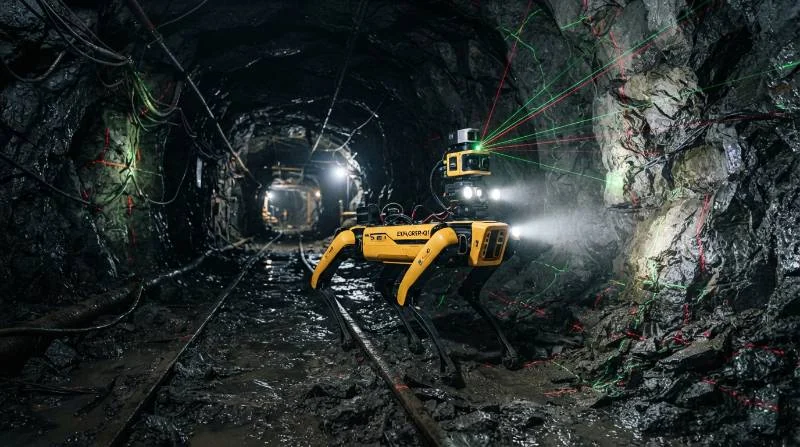
The 4-Dimensional Framework for Subterranean Robotic Mobility
Mining operations require an uncompromising evaluation model to qualify autonomous inspection platforms. We evaluate robotic fleet readiness across four distinct engineering criteria known as the Subterranean Quadruped Autonomy Matrix (SQAM-4D):
Subterranean Quadruped Autonomy Matrix (SQAM-4D): An industrial framework measuring robotic survivability and diagnostic fidelity across four axes: Dynamic Terrain Traversal, Ingress Protection & Intrinsic Safety, GPS-Denied SLAM Drift Convergence, and Sensor Synchronicity.
- Terrain Traversal Capability: Sustained locomotion over slopes ≥35°, traversing 200 mm fragmented muck piles, wet slimes, mud, and water pooling up to 300 mm depth without loss of traction.
- Ingress Protection & Intrinsic Safety: Full IP67 hermetic sealing against heavy mineral dust and pressurized water jets, with compliance roadmaps for the ATEX Directive 2014/34/EU and IECEx Zone 1/Zone 2 explosive atmosphere operations.
- GPS-Denied SLAM Mapping Precision: Real-time drift convergence within ±10 mm absolute spatial accuracy across 1 km continuous subterranean drift sweeps using fused LiDAR-inertial odometry.
- Payload Modularity & Real-Time Compute: Hot-swappable integration of multi-gas analyzers, dual-spectrum radiometric infrared, high-definition zoom optics, and acoustic imagers driven by onboard neural compute engines delivering up to 275 TOPS.
Core Underground and Surface Mining Inspection Tasks
Underground stopes, processing facilities, and overland transport corridors present unique structural and atmospheric failure modes. Quadruped robots execute these critical tasks autonomously to maintain Zero Harm compliance and asset reliability.
1. Post-Blast Re-Entry Air Quality and Gas Concentration Profiling
Blasting sequences generate severe concentrations of carbon monoxide (CO), nitrogen dioxide (NO2), and sulfur dioxide (SO2), alongside lingering methane (CH4) pockets in coal and hard-rock formations. Human re-entry typically requires mandatory clearing delays enforced by statutory Mine Safety and Health Administration (MSHA) standards.
Quadruped robots execute pre-entry reconnaissance directly into unventilated blast headings. Equipped with calibrated optical and electrochemical gas sensors, the robot logs dynamic ppm levels, calculates real-time dispersion gradients, and visualizes safe atmospheric thresholds before human crews enter the heading.
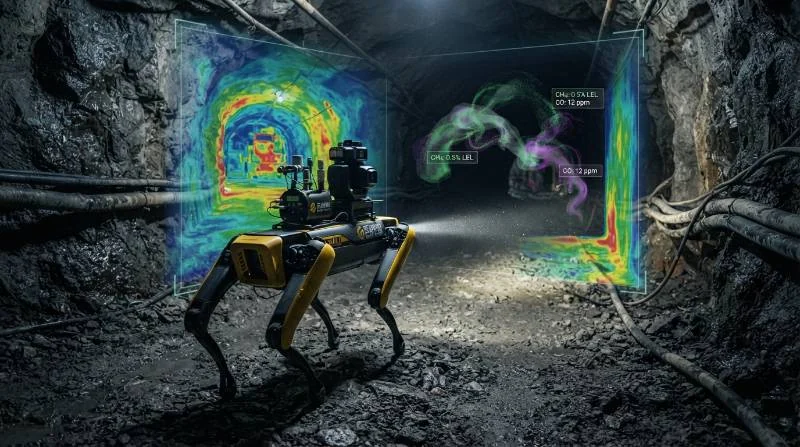
2. Subterranean Void and Unsupported Stope 3D LiDAR Mapping
Unsupported hanging walls and freshly excavated open stopes pose catastrophic rockburst and ground-fall hazards. Traditional cavity monitoring systems (CMS) require manual tripod setup near unsupported browse lines, exposing geotechnical technicians to severe risk.
By leveraging GPS-denied SLAM navigation, quadruped platforms walk directly under unsupported brows into open stopes. Solid-state LiDAR scanners capture sub-centimeter volumetric point clouds, enabling geotechnical engineers to calculate overbreak, underbreak, and rock-mass structural convergence without entering the hazard zone.
3. Overland Conveyor Idler and Bearing Acoustic/Thermal Inspection
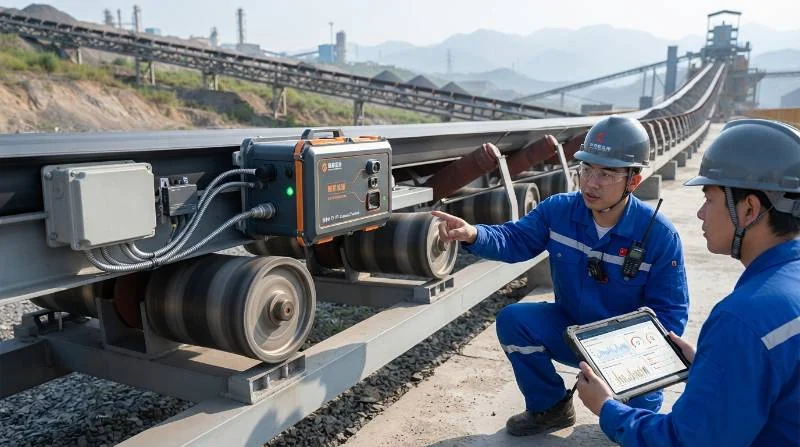
Overland conveyor systems spanning several kilometers house tens of thousands of continuous rotating idlers. A single seized bearing creates friction temperatures exceeding 350 °C, risking catastrophic belt fires and unplanned system downtime costing upwards of $120,000 per hour.
Quadruped robots patrol elevated, confined conveyor walkways autonomously. Radiometric thermal cameras isolate bearing temperature differentials (ΔT ≥ 15 °C over baseline), while ultrasonic acoustic sensors identify high-frequency friction signatures of subsurface spalling long before mechanical seizure occurs.
4. Tailings Dam Structural Integrity and Geotechnical Seepage Audits
Tailings Storage Facilities (TSFs) require continuous embankment monitoring to prevent structural breaching, toe liquefaction, and uncontrolled slimes release. Navigating unpaved, soft crests and high-gradient downstream slopes is challenging for conventional rovers.
Quadruped robots traverse soft tailings crests and riprap berms on scheduled patrol routes. Integrated multispectral and radiometric sensors detect early-stage toe seepage, localized crest settlements, piping, and sinkhole formations, transmitting structured spatial data directly to the mine’s geotechnical monitoring desk.
5. Slurry Pump and Heavy Mill Drive Acoustic Diagnostics
Mineral processing circuits rely on heavy semi-autogenous grinding (SAG) mills, ball mills, and abrasive slurry pumps. Harsh operational noise and airborne slurry make manual condition monitoring hazardous and inconsistent.
Operating the RZTL-1 industrial quadruped around active processing equipment provides automated vibration spectrum capture and acoustic beamforming. The robot detects pump cavitation, pinion gear tooth wear, and motor phase imbalances early, triggering automated work orders in the central CMMS.
Technical Payload Architecture and Modular Sensor Integration
Industrial quadruped robots operate as dynamic edge-compute sensor nodes. The physical chassis provides the stabilization, power rail distribution, and computational backbone necessary to run simultaneous multi-modal inspection suites.
| Payload Module | Sensor Specification | Primary Mining Application | Data Output / Protocol |
|---|---|---|---|
| Radiometric Thermal Gimbal | 640 × 512 px, uncooled VOx microbolometer, ±2 °C accuracy | Conveyor idlers, transformer substations, switchgear | Radiometric RJPEG, Modbus/TCP, RTSP Stream |
| 3D Solid-State LiDAR | 300,000 pts/sec, 360° × 90° FOV, 0.03 m to 100 m range | Cavity monitoring, stope profiling, drift convergence | LAS / E57 Point Cloud, ROS2 PointCloud2 |
| Multi-Gas Sensor Array | Electrochemical + NDIR (CH4, CO, O2, H2S, NO2) | Post-blast re-entry, unventilated drift clearance | Real-time telemetry (PPM), MQTT / JSON |
| Acoustic Ultrasound Imager | 128 MEMS microphones, 2 kHz to 100 kHz range | Compressed air leaks, bearing friction, electrical partial discharge | Acoustic Heat-Map Overlay Video, PNG |
GPS-Denied Subterranean Navigation and Fail-Safe Telemetry
Subsurface mines completely lack Global Navigation Satellite System (GNSS) signals. Operating in zero-light, dust-saturated environments requires robust localization based on multi-sensor fusion algorithms.
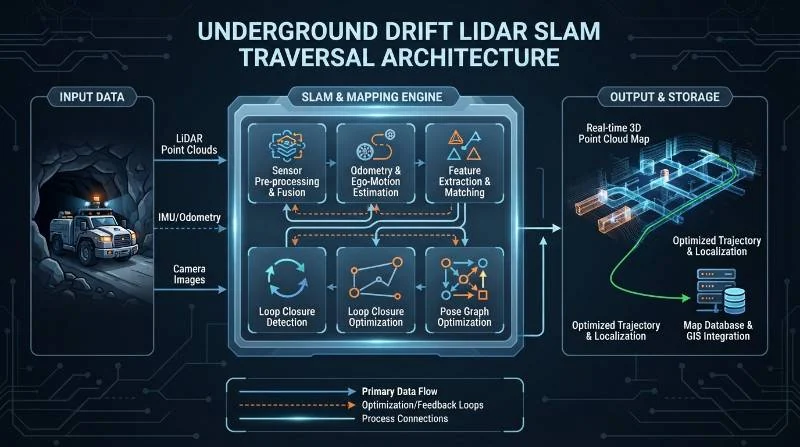
Quadruped platforms merge LiDAR odometry, solid-state Tactical-Grade Inertial Measurement Units (IMU), and leg kinematics. This tight coupling prevents odometry slip on wet clay, slimes, and scree. If underground radio mesh or Wi-Fi coverage drops, the onboard controller executes an autonomous fail-safe sequence: reversing path kinematics to return to the nearest operational network node or charging station.
Engineering Comparison: Quadruped Platforms vs. Wheeled, Tracked, and Aerial Units
Selecting the optimal mobile robotics architecture depends on environmental constraints, dust suspension risks, operational runtime, and mechanical recovery complexity.
| Feature / Metric | Bionic Quadruped Robot | Wheeled / Tracked Rover | Industrial Inspection Drone |
|---|---|---|---|
| Obstacle Clearance | High (Steps over 200 mm rocks, climbs 35° stairs) | Low/Medium (High-centers on 100 mm boulders; track de-spooling) | High (Flies above ground obstacles) |
| Dust Suspension Risk | Negligible (Point contact feet) | Low (Continuous track ground churning) | Severe (Rotor downwash blinds optical/LiDAR sensors) |
| Mission Duration | 120–240 minutes per charge | 90–180 minutes per charge | 15–25 minutes per battery |
| Payload Capacity | Up to 20 kg continuous payload | Up to 30 kg continuous payload | 0.5–2.0 kg payload limit |
| Confined Space Nav | Excellent (Omnidirectional lateral stepping) | Poor (Large skid-steer turning radius) | Moderate (High collision risk in drafts) |
Total Cost of Ownership (TCO), Enterprise CMMS Integration, and ROI
Implementing quadruped robotics is a strategic investment in predictive maintenance and workforce safety. The direct economic returns stem from mitigating major equipment failures and automating regulatory data collection.
Inspection data synchronizes with enterprise asset management platforms such as SAP PM and IBM Maximo via secure OPC UA and REST APIs. When the quadruped detects an anomaly—such as bearing overheating or anomalous stope convergence—the system automatically logs a work order complete with radiometric images, 3D point clouds, and spatial coordinates.
Financial Metric: In typical Tier-1 mining operations, preventing a single unpredicted 6-hour mainline conveyor outage yields a complete return on capital expenditure for a multi-quadruped deployment.
The Intelligent Robot Dog Deployment Protocol: 3-Step Implementation Pathway
To ensure seamless operational integration without disrupting production cycles, we follow a structured deployment model:
- Matrix & Payload Selection: Download the Mining Quadruped Application Matrix to match environmental ratings (IP67, MSHA/ATEX requirements) with custom payload suites.
- Digital Twin & Kinematic Simulation: Submit decline gradient profiles, conveyor layouts, and stope dimensions for digital twin simulation and SLAM route optimization.
- On-Site Proof-of-Concept Validation: Execute an active mine pilot to validate autonomous gait stability, sensor fidelity, and SCADA connectivity.
Engineers can schedule an underground feasibility trial to evaluate autonomous inspection across complex mineral extraction assets.
Frequently Asked Questions (FAQ)
Can quadruped robots operate in explosive underground atmospheres?
Yes. Specialized industrial quadruped platforms are engineered to comply with ATEX Directive 2014/34/EU and IECEx Zone 1 / Zone 2 standards. They feature pressurized enclosures, intrinsically safe low-voltage telemetry circuits, and non-sparking foot pads for use in gassy coal mines and petrochemical environments.
How do quadruped batteries perform in extreme moisture and sub-zero temperatures?
Industrial quadruped robots use sealed, self-heating Lithium-Ion (NMC/LiFePO4) battery packs with internal Battery Management Systems (BMS). These packs maintain continuous thermal equilibrium between -20 °C and +55 °C while upholding IP67 hermetic ingress protection against corrosive mine runoff.
How do quadruped robots maintain communication in complex decline spirals?
Robots utilize Ultra-Wideband (UWB) radios, Leaky Feeder integration, and dynamic mobile ad-hoc networking (MANET). In the event of full signal attenuation, onboard SLAM navigation processes all path planning locally, allowing the robot to finish its inspection sweep and return to the nearest wireless node.
Modernize Your Subsurface Mine Safety and Asset Monitoring
Eliminate hazardous inspection routines and minimize unscheduled downtime with purpose-engineered industrial quadruped platforms. Contact our mining automation engineering team to configure your multi-sensor payload and coordinate an on-site feasibility evaluation.