The Unique Challenge of Rail Transit Inspection
Urban metro systems and intercity railway networks represent some of the most demanding inspection environments in the industrial world. Tunnels stretch for tens of kilometres underground, track geometry must be monitored continuously, and the narrow maintenance windows between service runs leave inspection teams with just hours to cover vast distances. Yet the consequences of missed defects — rail cracks, overhead line faults, drainage blockages, or structural deterioration — can be catastrophic.
Traditional inspection methods rely on a combination of manual walking inspections, track geometry cars, and periodic visual surveys. Each approach has significant limitations: manual inspections are slow, subjective, and expose workers to moving train risk; track geometry cars require dedicated possession windows and cannot capture visual or thermal data; and periodic surveys create dangerous gaps in monitoring frequency.
Why GPS-Denied Navigation Is the Core Technical Challenge
The fundamental challenge that has historically limited robotic inspection in rail transit environments is navigation. Underground tunnels and enclosed rail corridors completely block GPS signals — the technology that most autonomous mobile robots rely on for positioning. Without GPS, a robot cannot know where it is, cannot build a reliable map, and cannot navigate autonomously along a defined inspection route.
This is where LiDAR-based SLAM (Simultaneous Localisation and Mapping) technology becomes essential. Rather than relying on external positioning signals, SLAM-equipped robots build a real-time 3D map of their environment using laser rangefinders, then continuously localise themselves within that map using sensor fusion algorithms. The result is centimetre-accurate positioning that works reliably in any enclosed environment — regardless of GPS availability.
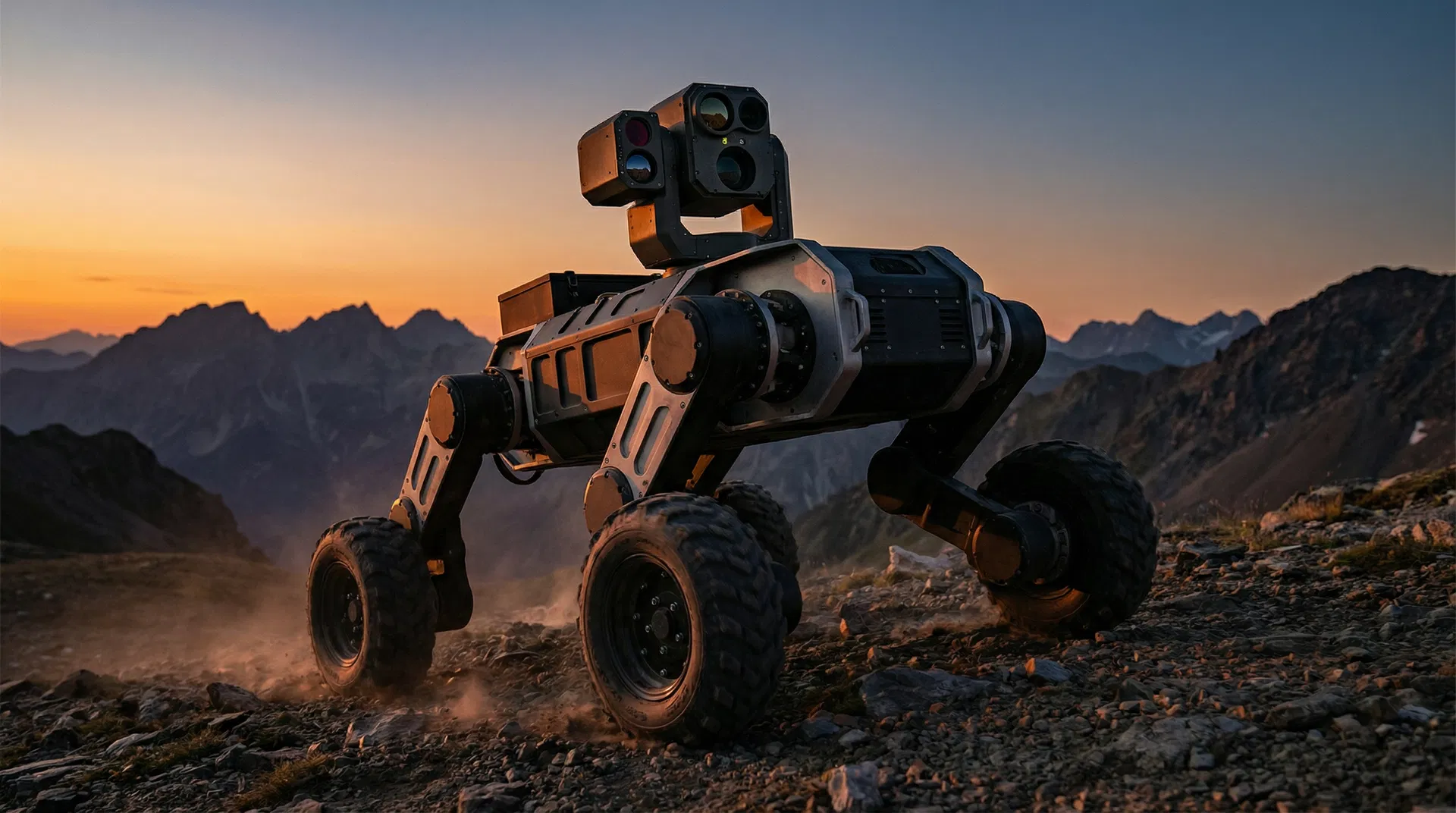
Our quadruped inspection robots use multi-beam 3D LiDAR combined with inertial measurement units (IMU) and wheel odometry to achieve robust SLAM navigation in metro tunnels, railway underpasses, and enclosed station infrastructure. The system handles the specific challenges of tunnel environments: repetitive geometry, varying lighting conditions, and the presence of moving maintenance personnel.
Key Inspection Capabilities for Rail Transit
Track and Infrastructure Geometry Monitoring
The robot’s LiDAR system captures high-density 3D point clouds of track geometry, tunnel walls, and overhead structures during every patrol. AI algorithms compare successive scans to detect geometric deviations — rail wear, ballast settlement, wall crack propagation, and drainage channel blockages — that would be invisible to a walking inspector but clearly visible in 3D data analysis.
Overhead Line and Pantograph Clearance Inspection
Catenary wire sag, stagger deviation, and contact wire height are critical parameters for electrified rail systems. The robot’s upward-facing cameras and LiDAR capture overhead line geometry data during inspection passes, enabling automated comparison against design tolerances without requiring dedicated overhead line inspection vehicles.
Thermal Anomaly Detection in Electrical Equipment
Traction substations, cable ducts, and signalling equipment rooms along the rail corridor are subject to thermal stress from continuous electrical loading. The robot’s thermal imaging camera identifies overheating connections, failing cable insulation, and equipment anomalies during routine patrols — enabling predictive maintenance before failures cause service disruption.
Intrusion and Foreign Object Detection
Unauthorised access to rail infrastructure is a significant safety and security concern. The robot’s AI vision system detects foreign objects on the track, identifies signs of unauthorised entry, and monitors restricted access points during night patrols when human staffing is minimal.
Operational Integration with Rail Maintenance Systems
Effective rail inspection is not just about data collection — it is about integrating inspection findings into maintenance planning workflows. Our cloud inspection platform connects directly with CMMS (Computerised Maintenance Management Systems) used by rail operators, automatically generating structured defect reports with GPS-equivalent coordinates (derived from SLAM positioning), photographic evidence, and severity classifications.
Maintenance teams receive prioritised work orders based on defect severity and location, enabling efficient allocation of the limited maintenance window time available between service runs. The system’s trend analysis capabilities identify slowly developing defects — such as progressive rail wear or gradual structural movement — that would be missed by periodic manual inspection but are clearly visible in continuous robotic monitoring data.
Deployment Case: Urban Metro Tunnel Network
A metropolitan rail authority operating 180 km of underground metro lines deployed our TongChui M1 inspection platform across three lines as part of a maintenance modernisation programme. The deployment replaced nightly manual walking inspections with autonomous robotic patrols during the 3-hour maintenance window between last service and first service.
Key outcomes after 12 months of operation included a 68% reduction in inspection labour hours, a 41% improvement in defect detection rate (driven primarily by the robot’s ability to detect thermal anomalies and geometric deviations invisible to manual inspection), and zero inspection-related safety incidents compared to three minor incidents in the preceding 12-month period. The structured digital inspection records also provided the authority with its first comprehensive longitudinal dataset of tunnel condition, enabling data-driven maintenance planning for the first time.
Conclusion: The Future of Rail Transit Inspection
GPS-denied navigation has historically been the barrier that prevented autonomous robots from entering the rail transit inspection market. LiDAR SLAM technology has definitively solved this problem, enabling quadruped robots to navigate metro tunnels and railway corridors with the same reliability as GPS-guided systems in open environments.
For rail operators facing the dual pressure of increasing inspection requirements and shrinking maintenance windows, autonomous robotic inspection is no longer a future technology — it is a deployable solution available today. The combination of continuous coverage, multi-modal sensing, and structured digital reporting represents a fundamental improvement over manual inspection methods that have remained largely unchanged for decades.
—
## Related Solutions
Explore how SG Trading Asia’s quadruped inspection robots are deployed in real-world applications:
– [Rail Transit Inspection Robot Solution](/solutions/rail-transit-inspection)
– [Intelligent Inspection Robot System](/solutions/inspection)
– [Cloud Robot Management Platform](/solutions/cloud-management)
*[Contact our engineering team](/contact) to discuss your specific inspection requirements.*
Tagged: