The Evolution of Petrochemical Asset Inspection: From Manual Scaffolding to Quadruped Edge AI
Deploying inspection robots in oil and gas facilities transforms static preventative routines into continuous, dynamic asset integrity management. Modern autonomous quadrupeds combine optical gas imaging, thermal radiometric sensors, and acoustic vibration payloads to inspect high-hazard process units without exposing personnel to volatile operating zones.
Traditional non-destructive testing (NDT) across upstream, midstream, and downstream assets relies on manual operator rounds, temporary scaffolding, and rope access teams. According to empirical refinery turnaround benchmarks, erect-and-strike scaffolding operations consume up to 45% of total scheduled maintenance turnaround budgets while introducing fall-from-height hazards.
Our field deployment data shows that adopting autonomous robotic inspection solutions removes human technicians from explosive hydrocarbon environments while boosting data sampling frequency by over 300%.
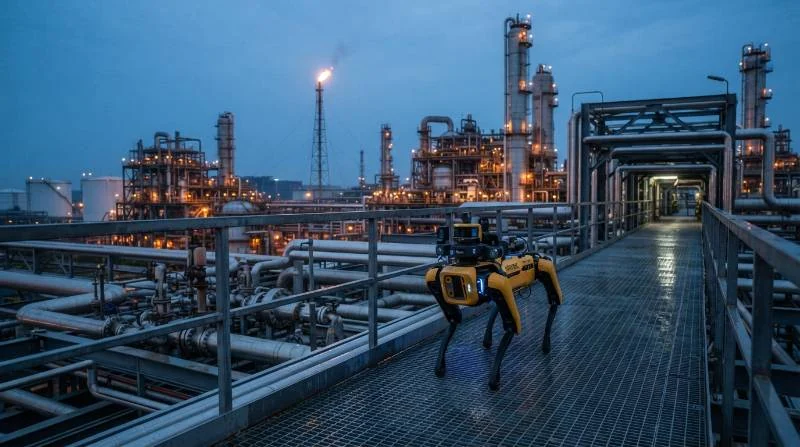
“Autonomous asset monitoring is the systematic execution of unattended, sensor-driven inspection missions using mobile edge platforms to capture, interpret, and stream asset health telemetry directly to enterprise control systems.”
Standard manual inspections according to API 570 piping inspection standards and API 510 pressure vessel codes often produce lagging indicator data due to the intermittent nature of manual rounds. Robotic quadruped platforms capture continuous high-frequency baseline data across multi-tier structures, flagging micro-deviations before they escalate into catastrophic loss of containment (LOC) incidents.
Locomotion Analysis: Quadruped vs. Wheeled vs. Tracked Crawlers in Complex Plants
Petrochemical facilities feature challenging physical terrain: 45-degree open-grate steel staircases, elevated pipe racks, high-profile coamings, curbed containment dikes, and slick hydrocarbon surfaces. Wheeled and tracked mobile robots consistently stall when confronting standard plant infrastructure.
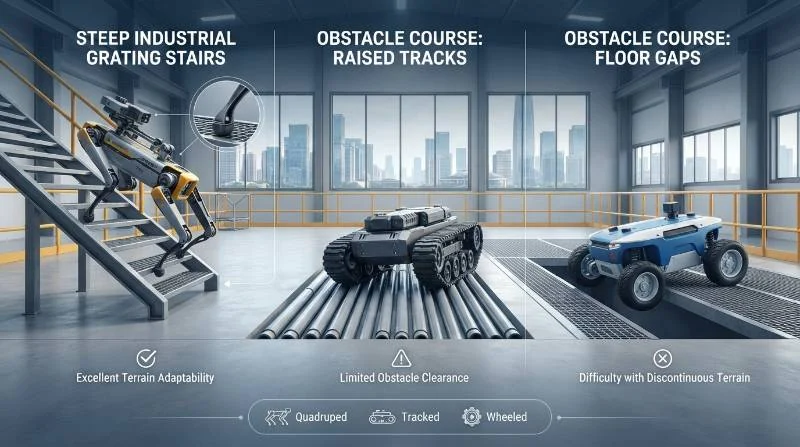
| Terrain & Obstacle Type | Quadruped (Legged AI) | Wheeled UGV | Tracked Crawler |
|---|---|---|---|
| 45° Open-Mesh Steel Stairs | Autonomous Ascent/Descent | Impassable | High Jam Risk (Tread Catch) |
| Expanded Metal Catwalks | Full Dynamic Stability | Stable | Stable |
| Pipe Bundles & Curbing (>15cm) | Step-Over Capable | Impassable Barrier | Limited (Tip-Over Hazard) |
| Gravel, Mud & Sludge Pools | Dynamic Gait Self-Recovery | High Wheel-Spin Entrapment | High Traction |
| Confined Bund Wall Vaults | Omnidirectional In-Place Pivot | Wide Turning Radius | Zero-Radius Skid Steering |
Quadruped robots utilize contact-force feedback loops in each leg actuator, dynamically adjusting joint impedance within milliseconds when stepping across unpredictable surfaces. This mechanical advantage eliminates the single points of physical entrapment common with wheeled and tracked units.
High-Value Petrochemical Use Cases for Autonomous Quadruped Robots
Modern quadruped robotics fulfill multiple inspection disciplines by integrating specialized instrumentation packages on an agile chassis.
Fugitive Methane & Hydrocarbon Emission Detection (OGI & Gas Sniffers)
Fugitive hydrocarbon emissions represent both safety hazards and greenhouse gas compliance liabilities under stringent regulatory frameworks like EPA Quad Ob/Oc standards.
Quadrupeds carry FLIR optical gas imaging (OGI) cooled core cameras paired with Tunable Diode Laser Absorption Spectroscopy (TDLAS) and Photoionization Detectors (PID). These systems detect sub-gram fugitive methane (CH4), volatile organic compounds (VOCs), and toxic hydrogen sulfide (H2S) plumes from up to 25 meters away without placing human operators downwind.
Thermal Thermography and Visual Perimeter Anomaly Patrol
By leveraging 3D LiDAR SLAM navigation, quadrupeds autonomously execute repeatable, sub-centimeter navigation loops around furnace lines, heat exchangers, distillation columns, and cryogenic valves.
Radiometric thermal payloads automatically calculate pixel-level temperature deltas, identifying refractory lining degradation, electrical busbar overheating, steam trap blow-throughs, and storage tank level anomalies. Simultaneous high-magnification Pan-Tilt-Zoom (PTZ) optical cameras capture high-resolution imagery of flange bolts, valve packing seals, and structural corrosion.
Substation, Transformer Gauge Reading, and Confined Space Monitoring
Edge-based computer vision models read legacy analog needle gauges, digital dial displays, and mechanical valve positions. This edge analysis delivers structured telemetry to supervisory systems without requiring expensive sensor retrofits on legacy assets.
For confined space robotics applications, quadrupeds safely execute pre-entry sweeps into inert tanks, catalyst vessels, and drainage sumps. They verify acceptable oxygen (O2), lower explosive limit (LEL), and carbon monoxide (CO) thresholds before maintenance crew entry permits are approved.
Technical Architecture: Modular Payloads, Edge AI, and Mesh Communications
Deploying robotics within petrochemical environments requires rugged mechanical and electrical engineering built for volatile operating conditions.
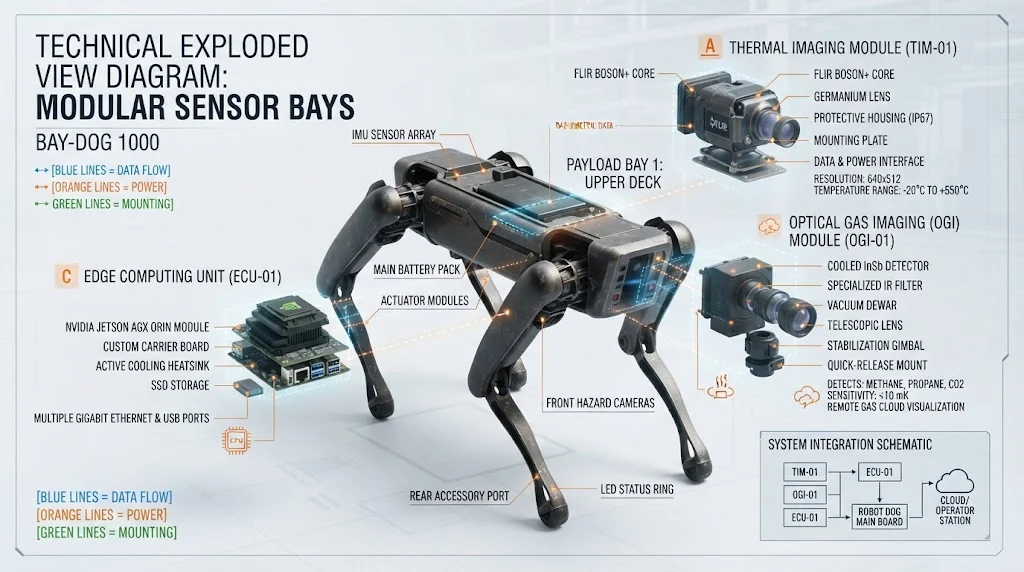
Engineering Insight: Hazardous facility deployments must satisfy the IECEx Standards and the European ATEX Directive (Zone 1/Zone 2) for explosive atmospheres. Equipment utilizes non-sparking sealed joint enclosures, positive-pressure purge systems, and intrinsically safe, power-limited telemetry circuits to prevent ignition of explosive gas-air mixtures.
- Modular Sensor Bays: Hot-swappable mounts accept thermal radiometric payloads, acoustic leak detectors, LiDAR, or OGI units via quick-release locking plates and unified M12 industrial bus connectors.
- Edge AI Computation: Onboard NVIDIA Jetson Orin compute modules process video streams, acoustic signatures, and Point Cloud data locally in real time. This local edge processing avoids latency and reduces bandwidth consumption over plant communications links.
- Mesh Wireless Architecture: In dense steel cracking units where conventional Wi-Fi drops out, quadrupeds use self-healing, Non-Line-of-Sight (NLOS) sub-GHz or private 5G mesh networking. This maintains stable communications with the central control room across obstructed industrial geometries.
The Intelligent Robot Dog 4-Stage O.G.I.-Quad™ Deployment Protocol
To safely scale autonomous robotic operations across complex refineries and offshore platforms, we engineer and execute the four-stage O.G.I.-Quad™ Protocol.
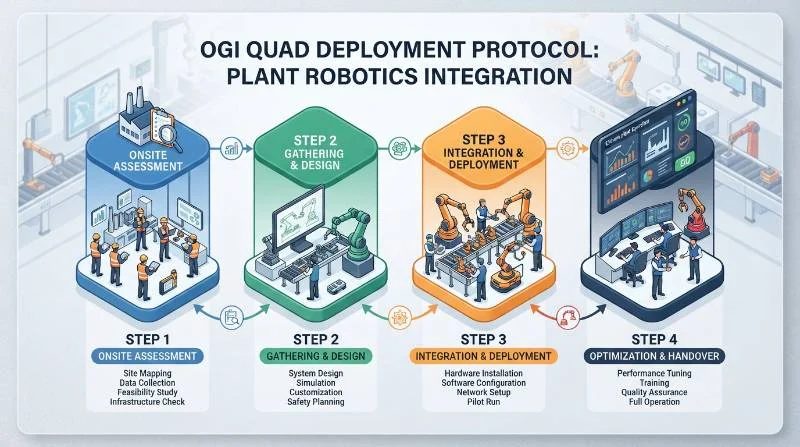
- Stage 1: Optical & Spatial Topography Mapping: Technicians map the operating unit using the robot’s onboard multi-channel 3D LiDAR and visual SLAM sensors. The system constructs a dense, point-accurate digital twin of process lines, stairs, obstacles, and restricted areas.
- Stage 2: Goal-Oriented Sensor Mission Programming: Engineers set precise inspection waypoints with explicit sensor parameters, such as PTZ zoom targets on analog gauges, thermal limits on steam headers, or acoustic sampling points near compressor seals.
- Stage 3: Industrial SCADA & Asset Ecosystem Bridging: The robotics platform connects with the facility’s Supervisory Control and Data Acquisition (SCADA) network, Historians (OSIsoft PI), and Enterprise Asset Management (SAP PM/IBM Maximo) systems using standardized OPC UA and MQTT protocols.
- Stage 4: Quadruped Autonomous Docking & Edge Telemetry: The platform operates fully unattended. It deploys from weather-sealed, explosion-proof autonomous charging docks, completes scheduled inspection sweeps, and uploads processed edge data to plant telemetry servers before recharging.
Economic Value and TCO Framework: Scaffolding vs. Autonomous Quadruped Fleet
Calculating the Total Cost of Ownership (TCO) for robotic inspection highlights significant cost advantages over traditional manual inspection workflows.
| Metric | Manual Inspection & Scaffolding | Autonomous Quadruped System |
|---|---|---|
| Annual Scaffolding & Rope Access Costs | $650,000 – $1,100,000 | $90,000 (Amortized Hardware/Ops) |
| Human Exposure in ATEX/Hazard Zones | 1,800+ Person-Hours/Year | < 150 Person-Hours/Year (-91%) |
| Inspection Frequency | Bi-weekly or Monthly Rounds | Continuous (2-4 Patrols per Day) |
| Mean Time to Anomaly Detection (MTTD) | 14 – 30 Days | < 2 Hours |
| Turnaround Schedule Slippage Risk | High (Scaffold Availability Bottlenecks) | Negligible (Pre-Turnaround Baseline Ready) |
Reviewing our petrochemical facility case studies demonstrates that facilities typically achieve full Capital Expenditure (CAPEX) payback within 9 to 14 months of deployment.
Enterprise Ecosystem Integration: SCADA, Digital Twins, and SAP Plant Maintenance
Mobile inspection robots operate as intelligent, physical edge nodes directly tied into your industrial software architecture.
When an acoustic imaging payload detects early-stage bearing cavitation or an OGI camera senses a methane release, the robot does not simply log the event locally. The onboard system processes the alert, timestamps the GPS/LiDAR coordinates, and generates an automated notification through MQTT or RESTful APIs directly to the distributed control room.
This automated flow populates the asset’s 3D Digital Twin with localized radiometric data while generating maintenance tickets within SAP Plant Maintenance (PM) or IBM Maximo. Maintenance teams receive high-priority alerts with precise anomaly coordinates and diagnostic imagery, enabling rapid targeted remediation.
Intelligent Robot Dog Industrial Platforms for Petrochemical Operations
Intelligent Robot Dog delivers purpose-built quadruped robotic systems designed specifically for demanding petrochemical operations.
- RZTL-1 industrial quadruped: An agile, highly maneuverable platform designed for frequent multi-deck stair climbing, tight bund wall navigation, and automated gauge reading. Features IP67 ingress protection, dynamic balance recovery on slick surfaces, and a 2.5-hour operational runtime per charging cycle.
- Tongchui M1 heavy-duty inspection platform: A heavy-payload industrial quadruped supporting up to 20kg of modular tactical sensors. The platform accommodates multi-sensor payload configurations—including simultaneous OGI cameras, thermal radiometric units, multi-gas sniffer arrays, and 3D LiDAR systems—while operating in demanding outdoor environments.
Frequently Asked Questions About Inspection Robots in Oil & Gas Facilities
Can quadruped robot dogs operate safely within ATEX Zone 1 and Zone 2 areas?
Yes. Industrial quadrupeds configured for hazardous environments utilize pressurized, purged enclosures, non-sparking components, and intrinsically safe electronic sub-assemblies. These engineering controls comply with ATEX Directive 2014/34/EU and IECEx standards for explosive gas atmospheres.
How do inspection robots navigate steel structures where GPS and Wi-Fi are blocked?
Platforms utilize 3D LiDAR SLAM alongside visual odometry to achieve continuous autonomous navigation without GPS. In environments with dense steel framing, quadrupeds use private 5G or self-healing sub-GHz mesh radio networks, allowing them to route video and telemetry around physical RF barriers back to the base station.
What is the operational battery runtime, and how do robots recharge unattended?
Standard industrial quadrupeds provide between 2 and 4 hours of continuous operational runtime per battery cycle, depending on payload configuration and terrain. The systems use self-aligning autonomous docking stations that charge the robot and provide a secure, weather-protected base between scheduled inspection missions.
Can a single robot platform be reconfigured with different sensors?
Yes. The modular tactical payload bays use standardized mechanical brackets, power inputs, and communication interfaces. Operators can swap between thermal imaging heads, OGI cameras, ultrasonic acoustic sensors, and multi-gas sniffers in under fifteen minutes in the field.