The 4-Tier Autonomous Inspection Software Stack
Industrial inspection robot software requirements encompass a dual-layer architectural pipeline: real-time, deterministic low-level motion control coupled with distributed edge computing analytics, integrated seamlessly into centralized asset management environments. Industrial platforms require deterministic middleware to bridge multi-modal perception, autonomous localization, and enterprise condition monitoring without cloud dependency.
Plant reliability teams often assess quadruped and mobile robots by mechanical specs such as payload mass, ingress protection rating, or battery runtime. However, software architecture determines long-term return on investment, operational safety, and system scalability. 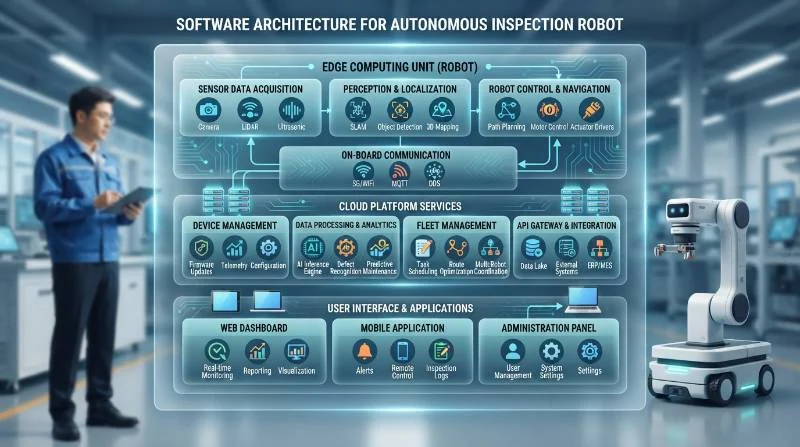
A resilient industrial robotics software stack operates across four distinct abstraction layers, maintaining a clean boundary between deterministic real-time execution and non-deterministic artificial intelligence routines:
- Tier 1: Deterministic Real-Time Control (RTOS Core): Manages motor commutation, dynamic inverse kinematics, balance stabilization, and emergency stop (e-stop) logic. Runs on microcontrollers or hard real-time Linux kernels with execution cycles below 1 millisecond.
- Tier 2: Perception, Localization, and Navigation (ROS 2 / DDS Middleware): Executes multi-sensor registration, 3D point cloud generation, and kinematic path calculation over Data Distribution Service (DDS) communication backbones.
- Tier 3: Onboard Edge AI & Sensor Analytics: Processes high-throughput radiometric thermal imaging, acoustic arrays, and visual feeds locally using containerized neural network inference engines.
- Tier 4: Enterprise Fleet Management & CMMS Ingestion: Coordinates task dispatching, battery health analytics, air-gapped data staging, and bi-directional REST/MQTT integration into enterprise asset ecosystems.
System Architecture Definition: Under the ISO 13374 Condition Monitoring Standard, an industrial inspection software stack must clearly decouple data acquisition (Layer 1) and data manipulation (Layer 2) from state detection (Layer 3) and health assessment (Layer 4) to ensure auditability across mission lifecycles.
Edge Autonomy, SLAM, and Path Planning Protocols
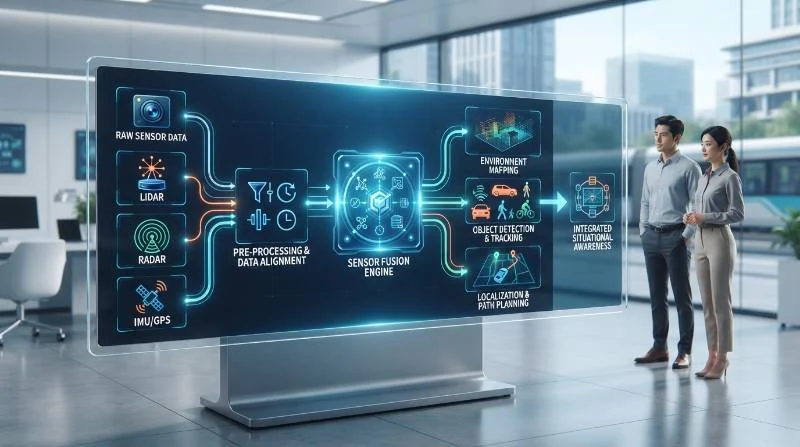
Industrial facilities feature GPS-denied basements, steel-dense turbine halls, and dynamically changing outdoor switchyards. Navigation stacks must rely on advanced 3D SLAM navigation architecture capable of fusing 3D LiDAR, solid-state LiDAR, stereo visual odometry, and industrial-grade Inertial Measurement Units (IMUs).
Standard 2D grid-based navigation methods fail in multi-level industrial complexes. Software stacks must support 3D costmaps that account for overhead piping, uneven grating, stairways, and sudden low-profile obstacles. Dynamic path replanning algorithms must maintain real-time teleoperation latency below 100 milliseconds while executing autonomous obstacle bypass maneuvers locally.
The IRD Edge-to-Enterprise Integration Protocol (E2E-IP)
To establish a repeatable, fault-tolerant standard for industrial inspection deployments, engineering teams follow the IRD Edge-to-Enterprise Integration Protocol (E2E-IP). This four-stage engineering methodology governs how sensory data flows from physical robot interaction to computerized maintenance records.

The E2E-IP framework mitigates edge computing bottlenecks while safeguarding corporate OT/IT network boundaries:
- Phase 1: Local Sensor Sizing & Temporal Alignment: Raw data streams from optical, thermal, acoustic, and environmental payloads are synchronized using Precision Time Protocol (IEEE 1588 PTP) directly at the sensor ingress bus, preventing temporal drift during high-speed gait locomotion.
- Phase 2: Edge Anomaly Triangulation: Onboard inference models cross-reference visual detections with thermal matrix data and vibrational frequencies. An alert is only triggered when multiple modal thresholds confirm asset distress, reducing false alarms by up to 87%.
- Phase 3: Air-Gapped Zero-Trust Data Synchronization: Inspection payloads are indexed, cryptographically signed, and buffered in local encrypted non-volatile storage. Once the unit returns to an authorized dock or localized industrial Wi-Fi zone, encrypted delta synchronization pushes verified packets to internal repositories.
- Phase 4: Programmatic CMMS Work-Order Generation: Normalized asset metadata is matched against facility tag hierarchies. Ingested events automatically generate maintenance work orders without requiring manual technician review.
Platforms like the RZTL-1 industrial quadruped implement the E2E-IP framework natively, maintaining complete edge autonomy across substations and chemical processing units even during total telemetry loss.
Multi-Modal AI Analytics & Sensor Fusion Algorithmic Pipelines
Industrial inspections require concurrent data validation. Deploying single-purpose vision algorithms leads to missed anomalies and higher false-positive rates. Modern autonomous robotic inspection solutions deploy multi-modal sensor fusion pipelines that continuously synthesize visual, acoustic, and thermographic inputs.
Real-Time Radiometric Thermal Matrix Analysis
Basic thermal cameras output simple colorized MP4 video feeds. Industrial software stacks require calibrated radiometric streaming where every individual pixel represents an uncompressed temperature value.
Software requirements for thermal analysis include:
- Dynamic Emissivity Compensation: Dynamic adjustment for surface material properties (e.g., oxidized copper vs. polished stainless steel) and ambient distance profiles.
- Automated Delta-T Calculation: Real-time computation of relative temperature differentials between phase conductors on three-phase electrical switchgear.
- Polygon and Region-of-Interest (ROI) Tracking: Spatial tracking algorithms that lock onto specific transformer bushings or bearing housings despite robot body sway or gait vibration.
Acoustic Anomaly Detection for Rotating Machinery and Gas Leaks
Microphone array payloads process ultrasonic acoustic data (20 kHz to 100 kHz) to localize compressed air leaks, steam trap failures, and partial electrical discharge. The software pipeline must run Delay-and-Sum beamforming algorithms directly on edge compute modules to isolate acoustic source coordinates in high-noise environments.
By mapping acoustic power distributions directly over optical camera feeds, the robot produces visual-acoustic overlays for precise mechanical defect localization.
Edge-to-Cloud Compute Sizing, Hardware Loads, and Bandwidth
Sizing edge compute infrastructure requires balancing deep learning model complexity against thermal dissipation and onboard battery draw. Edge computing hardware must process dense neural networks without throttling in ambient operating environments between -20°C and 55°C.
| Hardware Platform | Target Workload Allocation | Inference Latency | Power Consumption | Operating Mode |
|---|---|---|---|---|
| NVIDIA Jetson AGX Orin Industrial (64GB) | 3D LiDAR SLAM, Multi-camera TensorRT Models, Radiometric Matrix Parsing, Acoustic Beamforming | < 15 ms (FP16/INT8) | 40W – 75W Configurable | Fully Autonomous Air-Gapped Edge |
| NVIDIA Jetson Orin NX (16GB) | Optical Gauge Reading (OCR), Thermal Hotspot Detection, Spatial Costmap Generation | 25 – 40 ms (INT8) | 10W – 25W | Secondary Subsystem / Lightweight Edge |
| x86 Industrial Core (Intel Core i7/i9 Embedded) | ROS 2 Core Navigation, SCADA Node Hosting, Deterministic Inverse Kinematics | N/A (Control Loop) | 35W – 65W | Primary Trajectory & Control Node |
Software architectures should implement bandwidth optimization strategies. Instead of streaming raw video streams over industrial Wi-Fi or private 5G, the system should transmit compressed scalar telemetry (such as gauge values, peak temperatures, and bounding-box coordinates), reserving raw data transfers for scheduled docking synchronization.
Fleet Management, Dispatching, and Autonomous Charging Protocols
Scaling inspection programs from a single proof-of-concept unit to a distributed industrial deployment requires dedicated fleet management software. Centralized orchestration tools manage mission priorities, charging schedules, and dynamic handoffs between mobile units.
Autonomous charging requires software-driven docking algorithms that combine visual AprilTags, LiDAR localization, and infrared homing. The software must calculate millimeter-accurate descent postures to connect with charging contacts under variable ground conditions.
Heavy-duty systems like the Tongchui-M1 heavy-duty inspection platform utilize intelligent power management software that dynamically recalculates return-to-base paths based on real-time payload draw, terrain incline resistance, and ambient wind conditions.
Enterprise Data Pipeline & CMMS/ERP Integration (SAP & IBM Maximo)
Robotic inspection programs often encounter operational friction when data remains trapped within proprietary vendor consoles. Robot software must act as an automated telemetry pipeline directly integrated into existing plant maintenance infrastructure.

Critical enterprise interface protocols include:
- RESTful API and GraphQL Endpoints: Expose structured inspection results, battery health, and spatial logs using standard JSON schemas.
- OPC Unified Architecture (OPC UA): Transmit sensor telemetry directly into Supervisory Control and Data Acquisition (SCADA) and Distributed Control Systems (DCS) for immediate operator visibility.
- Automated Work Order Hooks: Programmatic triggers for SAP Plant Maintenance (SAP PM), IBM Maximo, and Infor EAM. When thermal or acoustic thresholds are breached, the software generates a prioritized maintenance ticket containing captured images, GPS coordinates, and historical trend analysis.
Industrial Cybersecurity & Regulatory Compliance Requirements
Quadruped robots equipped with cameras, thermal imagers, and wireless interfaces represent complex operational technology endpoints. IT and OT security leads must verify that robotic software stacks comply with rigorous industrial cybersecurity frameworks.
Cybersecurity Standard Reference: Systems must meet IEC 62443-4-2 Technical Security Requirements for industrial automation components. Key requirements include Secure Boot, encrypted communications at rest and in transit, and role-based access controls across all node interfaces.
Mandatory security features for industrial robotic software deployments include:
- DDS Security (SROS 2): End-to-end authentication, access control, and cryptographic encryption (AES-GCM-256) across all inter-process and inter-robot communication topics.
- Hardware Security Module (HSM) Integration: Secure on-chip key storage to prevent unauthorized firmware alteration or cryptographic extraction.
- Air-Gapped Operation Readiness: Fully functional mission execution, onboard data logging, and automated fault resolution without outbound internet connectivity.
- NDAA and TAA Compliance: Firmware, operating systems, and neural network libraries verified to contain no prohibited dependencies or unauthorized external call-outs.
Modular Plugin Architectures and Open SDK Sensor Frameworks
Plant monitoring requirements evolve over time. Software built on rigid, closed frameworks creates vendor lock-in and increases maintenance overhead. Enterprise robotics platforms require modular, containerized architectures that support rapid payload reconfiguration.
Modular edge architectures leverage Docker and Kubernetes (K3s) at the edge, abstracting physical sensor hardware through standardized ROS 2 driver nodes or gRPC interfaces. Whether integrating non-destructive testing (NDT) ultrasonic thickness gauges, optical gas imaging (OGI) sensors, or specialized radiation sensors, new hardware modules can be deployed without refactoring low-level locomotion software.
Enterprise Vendor Evaluation Checklist & Hidden Software Costs
When selecting inspection robotics software, enterprise procurement teams must evaluate licensing models, long-term support infrastructure, and ecosystem flexibility alongside baseline functional capabilities.
| Architecture Category | Key Evaluation Criteria | Risk of Non-Compliance |
|---|---|---|
| Autonomy & Navigation | Offline 3D LiDAR SLAM, dynamic obstacle bypass, dynamic stair negotiation | Mission failure in GPS-denied environments; frequent robot standstills |
| Edge AI Processing | Real-time radiometric thermal matrix analytics, edge OCR, acoustic beamforming | Excessive Wi-Fi bandwidth load; high latency in anomaly alerting |
| Integration & CMMS | Native OPC UA, REST APIs, automated SAP PM and IBM Maximo ticketing | Siloed data repositories; labor-intensive manual reporting |
| Security & Compliance | IEC 62443-4-2 alignment, DDS encryption, fully air-gapped deployment | Critical OT network vulnerabilities; denial of operational authorization |
| Licensing Transparency | Perpetual edge licensing, open SDKs, unmetered localized data storage | Unforeseen recurring SaaS fees and costly cloud data egress charges |
Before standardizing on an enterprise inspection fleet, engineering and reliability leaders should consult our robotics software architects to review compute sizing matrices, custom CMMS integrations, and field-proven edge software stacks.
Frequently Asked Questions About Inspection Robot Software Requirements
Can inspection robots navigate and analyze data during complete network blackouts?
Yes. Industrial-grade software architectures run all SLAM localization, path planning, and edge AI inference models (such as thermal hotspot detection and gauge reading) locally on onboard compute hardware. When network connectivity drops, missions proceed uninterrupted, and inspection metadata buffers locally in encrypted storage until docking.
How does robot software prevent false thermal alarms caused by ambient reflections?
Advanced edge software uses multi-frame temporal filtering, emissivity compensation tables, and spatial sensor fusion. Detections are cross-validated across optical visual feeds and historical baseline temperatures for that specific asset tag before an alert is dispatched.
What middleware is standard for industrial inspection robotics?
ROS 2 (Robot Operating System 2) combined with real-time DDS (Data Distribution Service) middleware serves as the industry standard. This architecture ensures high-throughput, deterministic inter-node messaging with robust security extensions (SROS 2) required by enterprise IT/OT policies.
How are legacy analog dials and gauges read without manual software training?
Edge vision pipelines employ specialized gauge-reading neural networks that combine dial-face keypoint detection with pointer angle regression. Models calculate scalar pressure or level readings directly on device without requiring cloud-based inference processing.