Engineering Principles for Industrial Inspection Robot Payload Selection
Selecting the optimal inspection robot payload requires matching sensor fidelity, edge compute throughput, and environmental hardening to the specific physical dynamics of the quadruped platform. Successful integration prevents sensor saturation, eliminates blind spots, and ensures mechanical equilibrium during complex locomotion over industrial terrain.
Industrial asset integrity management demands continuous, high-precision telemetry across power plants, chemical refineries, electrical substations, and manufacturing facilities. Quadruped robots provide unmatched physical mobility across stairs, grated catwalks, and gravel yards, but their operational utility depends entirely on their onboard sensing suite.
Deploying industrial inspection robot dog solutions transforms preventative maintenance into predictive autonomy. Balancing sensor capabilities against physical, electrical, and computational constraints ensures your autonomous asset inspection program yields maximum uptime and actionable operational intelligence.
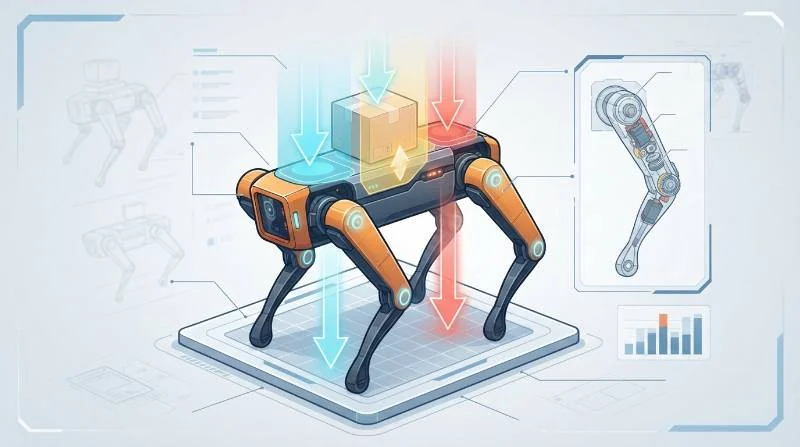
Dynamic Payload Physics: Center-of-Gravity Modeling and Gait Stability
Quadruped robots rely on precise dynamic balance algorithms such as Model Predictive Control (MPC) and Whole-Body Control (WBC). Adding an uncalibrated top-mounted sensor stack dramatically alters the platform’s center of mass and moment of inertia.
When payload weight shifts the center of gravity (CoG) outside the dynamic stability polygon, the quadruped’s joint actuators must consume exponential torque to maintain equilibrium. This reduces slope-climbing capacity, induces joint overheating, and increases the probability of tripping on uneven surfaces.
Dynamic Payload Rule: Total payload mass must never exceed 70% of the platform’s rated maximum payload capacity during continuous dynamic trotting, with the vertical CoG displacement kept within ±45 mm of the platform’s default geometric center.
The total moment of inertia ($I_{total}$) of the robotic platform with payload is calculated as:
$$I_{total} = I_{base} + m_p \cdot d^2 + I_p$$
Where $I_{base}$ is the unladen base inertia tensor, $m_p$ is payload mass, $d$ is the offset distance between the base CoG and payload CoG, and $I_p$ is the payload’s intrinsic inertia. As the distance $d$ increases vertically, dynamic pitch and roll oscillations amplify during high-speed patrol runs.
On agile systems like the RZTL-1 quadruped industrial platform, maintaining a low-profile, symmetric payload profile preserves the robot’s agility across steep stairs and tight utility corridors.
Payload Power Budgets: Calculating Wattage vs. Operational Runtime
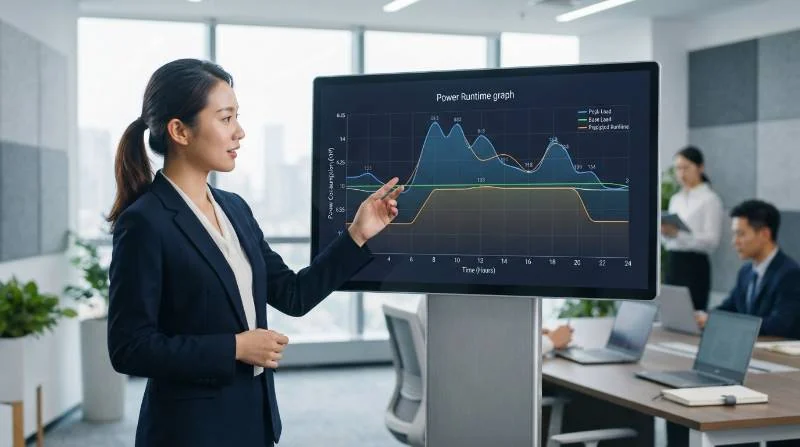
Sensor payloads draw electrical power directly from the robot’s primary DC bus or dedicated auxiliary power regulators. High-draw components such as active 3D LiDARs, edge AI processors, optical gas imagers, and pan-tilt-zoom (PTZ) positioners can reduce mission runtime by 25% to 50% if unmanaged.
Operational patrol duration ($T_{patrol}$) is governed by platform battery chemistry, kinematic mechanical work, and auxiliary payload draw:
$$T_{patrol} = \frac{E_{battery} \times \eta_{discharge}}{P_{locomotion} + P_{sensors} + P_{compute} + P_{aux}}$$
Where $E_{battery}$ is battery capacity in Watt-hours (Wh), $\eta_{discharge}$ is the usable discharge coefficient (typically 0.85 to 0.90 for LiFePO4 or NMC packs), and $P$ represents component power draws in Watts.
| Payload Component | Nominal Voltage | Active Power Draw | Peak Power Draw |
|---|---|---|---|
| Radiometric Thermal Core (Uncooled) | 12V DC | 2.5W – 5.0W | 8.0W (Shutter calibration) |
| Optical Gas Imaging (Cooled OGI Core) | 24V DC | 18.0W – 28.0W | 45.0W (Stirling cooldown) |
| 32-Channel 3D LiDAR Scanner | 12V – 24V DC | 10.0W – 16.0W | 22.0W (Startup motor spin) |
| Dual-Spectrum PTZ Turret (30x Optical) | 24V DC | 15.0W – 35.0W | 60.0W (Pan-tilt acceleration) |
| Edge AI Accelerator (NVIDIA Jetson AGX Orin) | 19V – 24V DC | 30.0W – 50.0W | 65.0W (Max TOPS inference) |
Primary Sensor Modalities for Industrial Asset Inspection
Autonomous inspection demands matching sensing modalities to targeted defect physics. Industrial deployments generally categorize inspection sensors into five core modalities.
Radiometric Thermal Imaging & Dual-Spectrum Inspection
Radiometric thermal cameras capture absolute temperature values across every pixel, making them indispensable for identifying resistive electrical heating, bearing friction, and insulation breakdown.
Specify uncooled vanadium oxide (VOx) microbolometers with a thermal sensitivity (NETD) of < 40 mK at f/1.0. A dual-spectrum configuration pairs the thermal detector with a high-resolution 4K optical sensor, enabling real-time thermal-optical fusion overlays (MSX/dual-view blending) for clear context.
Gas Detection, Optical Gas Imaging (OGI), and Environmental Sniffers
Fugitive emissions and toxic leaks pose severe safety and environmental liabilities. Inspection payloads utilize two complementary detection approaches:
- Optical Gas Imaging (OGI): Narrow-band MWIR (3.2 μm – 3.4 μm) cooled detectors that render volatile organic compounds (VOCs), methane, and sulfur hexafluoride (SF6) visible as real-time smoke plumes.
- Point Gas Detectors (Sniffers): Electrochemical, Photoionization (PID), and Non-Dispersive Infrared (NDIR) sensor arrays that measure exact parts-per-million (ppm) or lower explosive limit (LEL) percentages in ambient air.
Acoustic Imaging and Ultrasound Leak Detection
Acoustic cameras utilize MEMS microphone arrays (typically 64 to 128 channels) to visualize ultrasonic sound waves emitted by pressurized gas leaks, steam trap failures, and high-voltage partial discharge (corona, tracking, and arcing).
Microphone arrays pinpoint high-frequency acoustics (2 kHz to 96 kHz) over long distances, overlaying acoustic heatmaps onto real-time optical video even inside loud industrial generator rooms.
High-Magnification Optical PTZ & Edge AI Gauge Recognition
High-definition pan-tilt-zoom (PTZ) payloads equipped with 30x or 40x optical zoom lenses and low-light starlight sensors read analog pressure dials, oil levels, and switchgear indicator positions from distances of 10 to 50 meters.
Continuous stabilization gimbals decouple camera tracking from quadruped footfalls, maintaining pinpoint optical alignment on millimeter-scale target markers.
3D LiDAR Spatial Mapping & Autonomous Digital Twin Generation
Dense spatial mapping relies on mechanical or solid-state 3D LiDAR scanners generating upwards of 600,000 to 1,500,000 points per second. These sensors enable sub-centimeter point clouds for structural change detection, corrosion volume modeling, and GPS-denied localization.
Integrating 3D LiDAR sensors directly feeds the platform’s real-time LiDAR SLAM navigation algorithms, ensuring reliable path execution inside GPS-denied tunnels, underground utility vaults, and dense steel pipe racks.
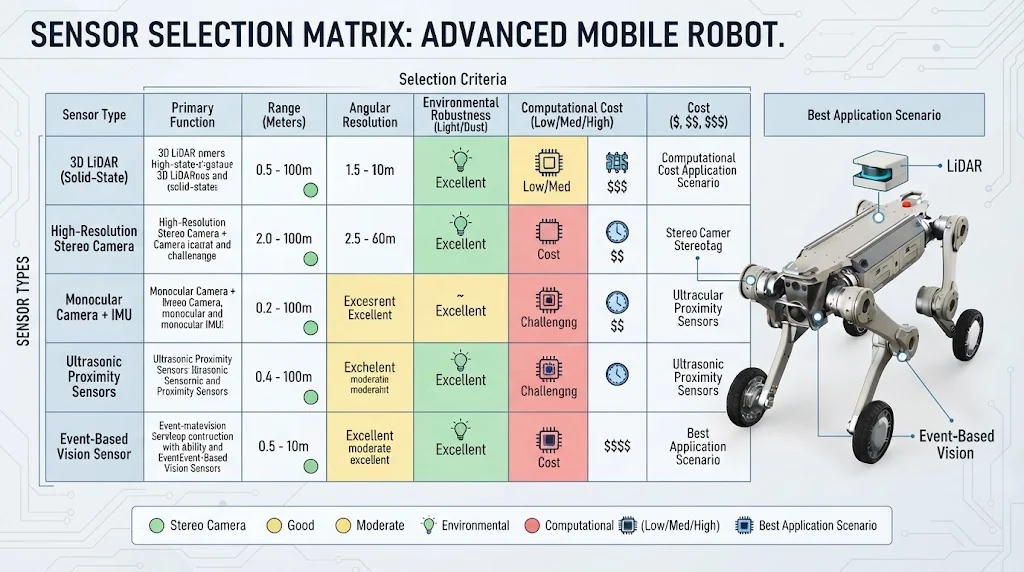
| Modality | Primary Detection Target | Effective Range | Relative Cost |
|---|---|---|---|
| Radiometric Thermal | Overheating busbars, transformers, refractory loss | 1 m – 30 m | Moderate |
| Optical Gas Imaging | CH4, SF6, Refrigerants, VOC leaks | 2 m – 20 m | High to Very High |
| Acoustic Imaging | Compressed air leaks, vacuum leaks, partial discharge | 1 m – 50 m | Moderate to High |
| Optical PTZ (30x-40x) | Analog meters, valve positions, corrosion, crack growth | 5 m – 100 m | Low to Moderate |
| 3D LiDAR SLAM | Spatial geometry, volumetric scan, clearance checks | 0.5 m – 120 m | Moderate to High |
Edge AI Compute Sizing: Local Anomaly Detection Architecture
Transmitting multiple 4K video feeds, raw thermal arrays, and dense 3D point clouds over plant-wide Wi-Fi, 4G/LTE, or private 5G networks quickly causes network bottlenecks. Modern quadruped payload architectures execute computer vision inference directly on the edge.
Industrial edge compute units (such as the NVIDIA Jetson AGX Orin Industrial or Orin NX series) process multi-stream neural network models in real time. Payloads process gauge reading (OCR), thermal thresholding, and object detection locally, uploading only lightweight structured telemetry and exception alerts to SCADA or cloud historians.
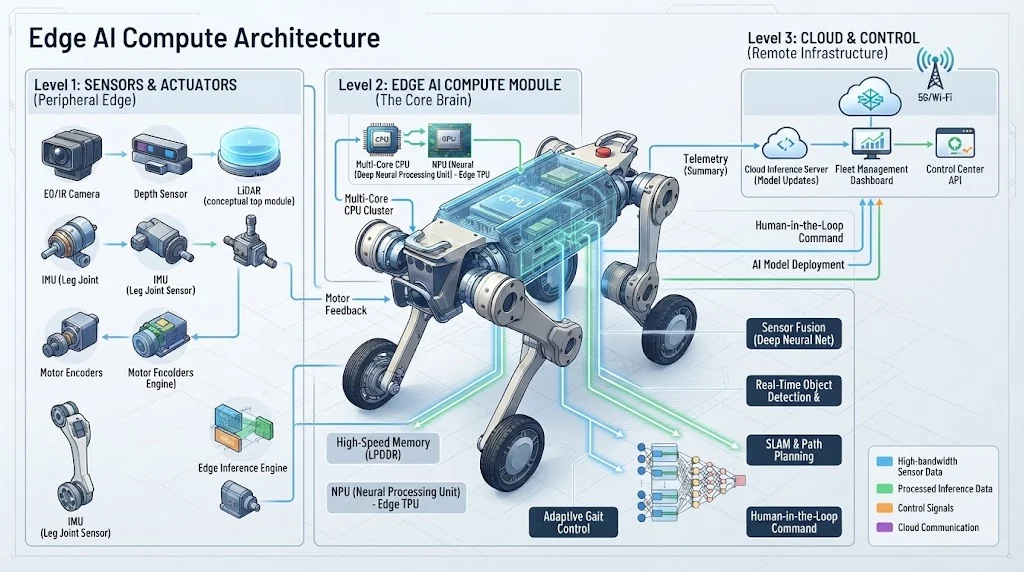
- Inference Capacity: Minimum 70 to 275 TOPS (INT8) compute headroom to run concurrent YOLOv8/v10 defect detectors, DeepStream pipelines, and LiDAR SLAM odometry without frame dropping.
- Thermal Dissipation: Conduction-cooled, fanless IP67 chassis designs prevent internal sensor throttling when operating in ambient environments up to +55°C.
- Data Bus Latency: Gigabit Ethernet (GigE with IEEE 1588 PTP precision time protocol) interfaces ensure millisecond-accurate sensor fusion synchronization.
Mechanical, Electrical, and Protocol Interfaces for Modular Payloads
Payload modularity allows a single quadruped fleet to swap between thermal substation patrols, gas leak localization, and 3D structural surveying within minutes.
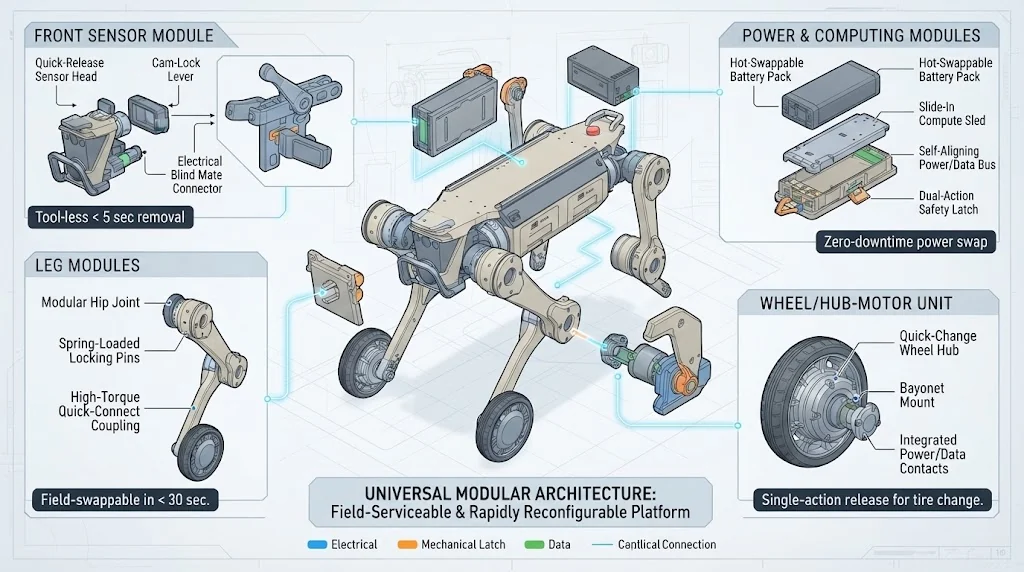
Standardized payload interfaces require integration across three primary engineering layers:
- Mechanical Layer: Quick-release dovetail rails or NATO/Picatinny-style precision clamping plates with locating dowel pins to retain millimetric sensor calibration after field replacement.
- Electrical Layer: Sealed, circular bayonet connectors (e.g., Amphenol PT series or IP68 M12 circular connectors) providing isolated 12V/24V/48V regulated DC power rails.
- Communication & Middleware Layer: Native ROS 2 (Robot Operating System 2) utilizing DDS (Data Distribution Service) middleware, alongside RTSP video streaming, RESTful API hooks, and MQTT bridges for direct SCADA integration.
HazLoc, ATEX, and IECEx Certified Payloads for Dangerous Environments
Deploying quadruped robotic systems into petrochemical refineries, offshore oil platforms, and grain processing facilities requires strict explosion-proof engineering compliance under IEC 60079 series standards and OSHA HazLoc Class I/Div 2 classifications.
Explosion Protection Compliance: Sensor payloads operating in hazardous areas containing flammable vapors, gases, or combustible dusts must be formally certified under ATEX / IECEx Zone 1 (Ex d / Ex ib) or Zone 2 (Ex nA / Ex ic) frameworks.
Payload engineering approaches for hazardous environments include:
- Flameproof / Explosion-Proof Enclosures (Ex d): Heavy cast aluminum or stainless-steel housings engineered to contain any internal electrical explosion without igniting surrounding atmospheric gases.
- Intrinsic Safety (Ex i): Limiting electrical energy, voltage, and thermal dissipation inside sensor circuits below the threshold required to ignite hydrocarbon air mixtures.
- Pressurized Enclosure Systems (Ex p): Purging payload enclosures with positive-pressure inert gas (dry nitrogen or clean compressed air) to prevent toxic and explosive gases from reaching live electronics.
The Intelligent Robot Dog Dynamic Payload Integration Protocol (DPIP)
To eliminate integration failures and optimize field reliability, Intelligent Robot Dog utilizes the Dynamic Payload Integration Protocol (DPIP). This 5-phase engineering protocol guides payload sizing from initial mission scoping through to production deployment.
- Phase 1: Mission Envelope & Metric Definition: Determine required detection distance, asset resolution (spatial and radiometric), and environmental operating boundaries (temperature, dust, IP rating).
- Phase 2: Dynamic Mass & CoG Verification: Validate total payload mass against quadruped dynamic limits; compute vertical and longitudinal CoG offsets to ensure uninterrupted gait control.
- Phase 3: Power Budget & Thermal Sizing: Balance auxiliary wattage against required autonomous patrol mission duration; size passive/active heat sink thermal management.
- Phase 4: Protocol Harmonization: Configure hardware and software interfaces over ROS2/DDS, GigE, and standard fieldbus networks; calibrate edge AI inference pipelines.
- Phase 5: In-Situ Environmental Validation: Execute vibration testing, stair climb stability runs, and sensor noise characterization in active industrial operating conditions.
For heavy multi-sensor payloads—such as combined dual-spectrum PTZ, cooled OGI, and acoustic imagers—the Tongchui-M1 heavy-duty robot dog provides the high-torque payload capacity and battery reserves necessary for continuous industrial patrols.
Industry Use Cases and Mission-Based Payload Configurations
Industrial facilities require mission-specific sensor configurations tailored to their operating environments and failure modes.
Electrical Substation Inspection Suite
- Payload Suite: High-resolution radiometric thermal core (640×512, < 30 mK) + 30x optical zoom PTZ + Acoustic partial discharge sensor.
- Mission Objective: Autonomous identification of transformer phase imbalances, loose insulator bushings, disconnect switch hot spots, and corona discharge.
Petrochemical & Refinery Gas Leak Monitoring
- Payload Suite: Cooled optical gas imaging (OGI) sensor + 4-gas NDIR/PID sniffer array + 360-degree environmental situational camera.
- Mission Objective: Real-time mapping of fugitive hydrocarbon emissions, valve flange leaks, and perimeter safety monitoring.
Mining & Conveyor Gallery Asset Health
- Payload Suite: 3D Solid-State LiDAR + Dual-spectrum thermal/optical camera + Edge AI compute module.
- Mission Objective: Automated detection of idler bearing overheating, conveyor belt misalignment, and volumetric spillage tracking in dusty, low-illumination tunnels.
Review our industrial deployment case studies to see detailed telemetry benchmarks and ROI validation from operational industrial facilities.
Frequently Asked Questions About Inspection Robot Payloads
Can I hot-swap different sensor payloads in the field?
Yes. Systems built with quick-release mechanical mounts, sealed quick-disconnect circular connectors, and dynamic ROS2 driver auto-discovery support field swapping between thermal, acoustic, and gas payloads in under 5 minutes without opening the main chassis.
How does payload weight affect stair-climbing capabilities?
Adding payload raises the platform’s center of gravity. Exceeding recommended mass limits reduces the pitch stability margin, requiring slower gait speeds and shallower step angles to avoid tipping during stair ascent and descent.
Why is edge AI processing preferred over streaming raw video to the cloud?
Industrial sites often have intermittent wireless connectivity and restricted bandwidth. Edge AI processes video and sensor streams locally in real time, transmitting only structured defect alerts and actionable telemetry to prevent network saturation.
What ingress protection rating is required for industrial outdoor inspection?
Payloads deployed in heavy industrial environments should carry a minimum rating of IP66 (dust-tight and protected against high-pressure water jets) or IP67/IP68 for continuous operation across rain, washdown areas, and dusty environments.
Optimize Your Autonomous Inspection Fleet
Need assistance calculating payload power budgets, selecting sensor modalities, or deploying ATEX-compliant inspection platforms? Consult with our robotics integration engineers.