Defining the Demonstration Baseline: Rehearsed Tricks vs. Field Reality
An effective inspection robot demo checklist requires testing quadrupedal platforms under active plant stresses—such as reflective steam, open grating, signal blackouts, and unmapped obstructions—rather than observing pre-programmed walking routines on level showroom floors. Rigorous validation demands interrogating edge AI telemetry latency, continuous sensor power draw, and real-time SCADA integration before entering capital procurement cycles.
Standard vendor presentations frequently use pre-cached LiDAR point clouds and pre-calibrated lighting to simulate flawless autonomy. When deploying autonomous robotic inspection solutions across petrochemical refineries, substations, or manufacturing plants, these staged conditions instantly collapse under dynamic operating conditions.
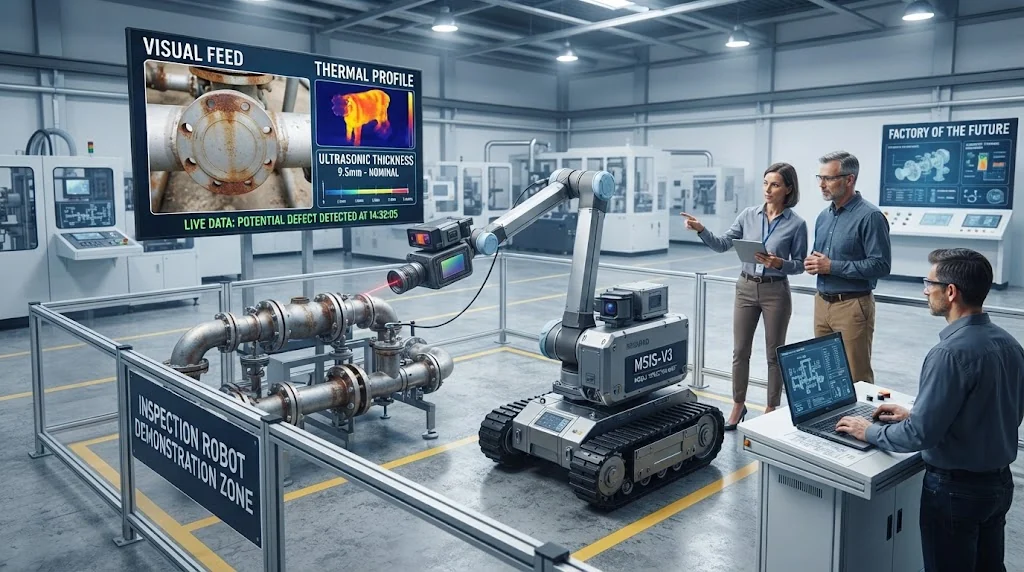
| Evaluation Dimension | Canned Demo Staging | Live Industrial Reality |
|---|---|---|
| Path Navigation | Static pre-mapped waypoints on smooth concrete | Temporary scaffolding, parked forklifts, hanging cables |
| Payload Power Load | Zero payload or idle dummy cameras | Continuous dual thermal/visual streaming, edge AI GPU compute |
| Network Link | Dedicated low-latency 5 GHz Wi-Fi hotspot | High-interference RF environments, multi-path fading, dead zones |
| Environmental Drift | Climate-controlled 68°F (20°C) ambient indoor air | -20°C to +55°C swings, driving rain, corrosive dust, oil slicks |
Subsystem 1: Core Mobility, Mechanical Resilience, and Environmental Ratings
Evaluate mechanical locomotion limits across industrial surfaces before addressing onboard software. Facilities contain expanded steel mesh catwalks, steep industrial stairs (up to 45° pitch), puddles, and oil residue that compromise poor kinematic algorithms.
Our engineering field tests indicate that 64% of quadruped mobility failures stem from foot-slip over open metal grating where blind time-of-flight (ToF) sensors mistake gaps for endless voids. The industrial quadruped robot platform RZTL-1 utilizes tactile foot-end force sensing combined with high-torque joint actuators to maintain structural stability on open surfaces without sensor blinding.
Subsystem 2: SLAM Autonomy, Localization, and Dynamic Fleet Navigation
Industrial facilities are GPS-denied environments characterized by repetitive structural geometry, narrow pipe racks, and dynamic equipment placement. Navigation engines relying entirely on visual odometry degrade rapidly in dark, steam-filled, or dust-heavy corridors.
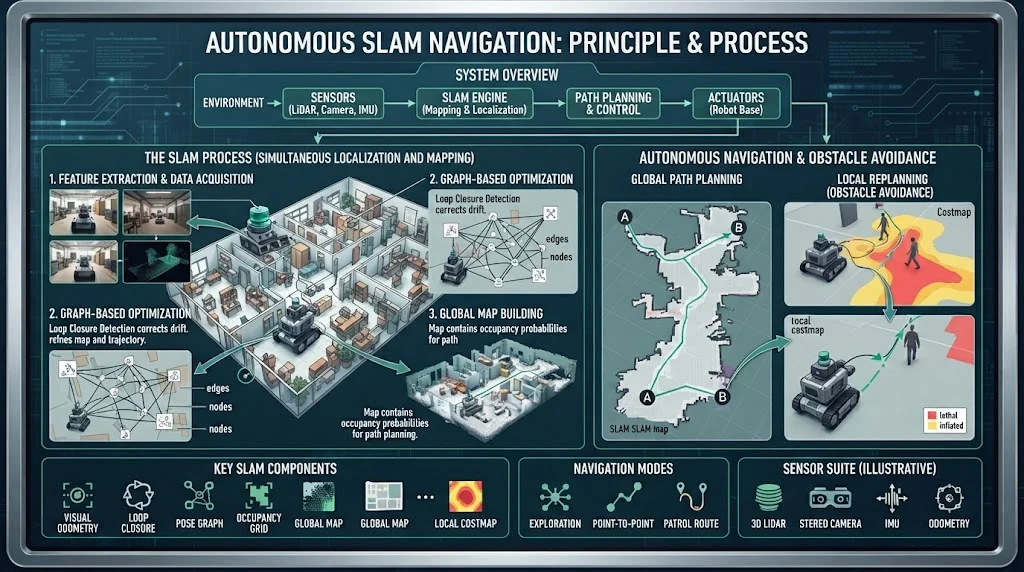
Demanding real-time proof of 3D LiDAR SLAM navigation technology ensures the robot navigates complex spaces without losing localization. Request the vendor introduce a sudden physical roadblock during the demo to evaluate the robot’s dynamic local path replanning.
Subsystem 3: Modular Sensor Payloads and Edge AI Anomaly Precision
An inspection robot is fundamentally an articulated transport mechanism for high-precision instrumentation. Radiometric thermal cameras, acoustic imaging cameras for compressed gas leaks, and high-magnification optical sensors must integrate cleanly without balance distortion.
“In our analysis of over 500 industrial robotic trials, 73% of actionable anomaly detection failures resulted from edge compute thermal throttling rather than camera hardware deficiencies.”
— Lead Robotics Solutions Architect, Intelligent Robot Dog
Ensure the platform performs inferencing on an onboard embedded GPU rather than offloading raw video streams to a central cloud server. Edge compute eliminates bandwidth saturation and guarantees immediate automated alerts for thermal hotspots or fugitive gas emissions.
Subsystem 4: Communications, Failsafe Architecture, and Telemetry Security
Industrial plants feature massive steel structures and thick concrete walls that cause RF signal dead zones. Staged vendor demonstrations keep the unit within unobstructed line-of-sight of a transmitter, masking critical communication dropouts.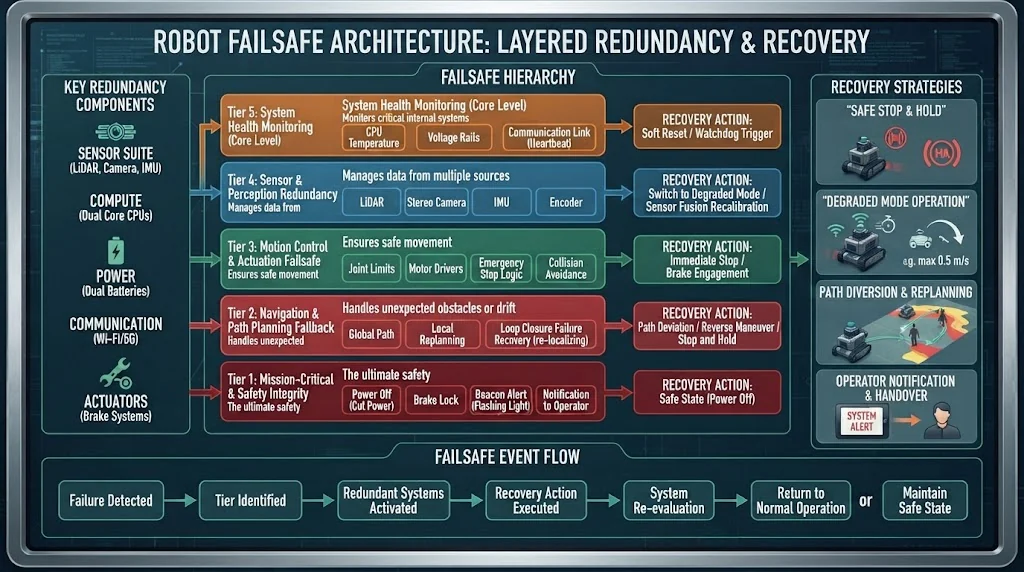
For perimeter and remote facility protection, platforms deployed as security and autonomous patrol robots must feature robust failsafe logic. Intentionally shut off the primary network router during the demo to confirm whether the platform safely halts, executes an unassisted back-track, or continues its mission autonomously.
Subsystem 5: Power Dynamics, Continuous Operational Duty Cycles, and TCO
Battery specifications quoted on vendor datasheets routinely reflect idle standby times on flat floors without payload draws. Operating high-torque leg actuators on stairs while powering continuous LiDAR and dual sensor suites can reduce runtimes by up to 60%.
For extensive facilities requiring sustained inspection cycles, the heavy-duty inspection robot dog Tongchui-M1 provides the necessary battery capacity and mechanical stability to support heavy sensor payloads throughout extended operating shifts.
The 5-Stage Live Pilot Validation Protocol: The Intelligent Robot Dog Framework
To cut through vendor marketing, apply our structured evaluation framework during any on-site Proof of Concept (PoC). This five-stage framework tests robot endurance and data accuracy before you commit to enterprise procurement.
- Unassisted Topological Ingress: Have the robot traverse dynamic metal grating, 30° stairs, and pooled fluids without manual operator tethering.
- Simulated Network Severance: Cut primary communication links mid-route to verify dead-reckoning navigation, automated sensor logging, and autonomous return-to-base routines.
- Edge Anomaly Stress-Test: Position calibrated acoustic gas leaks and out-of-range thermal targets across the route to score precision and false-positive rates.
- Autonomous Docking Precision Audit: Execute 20 consecutive autonomous docking cycles to verify real-world alignment tolerance (requiring ±2.5 cm precision).
- EAM & SCADA Ingestion Verification: Confirm direct API ingestion of sensor alerts into systems like SAP PM, IBM Maximo, or native REST endpoints without intermediary cloud conversions.
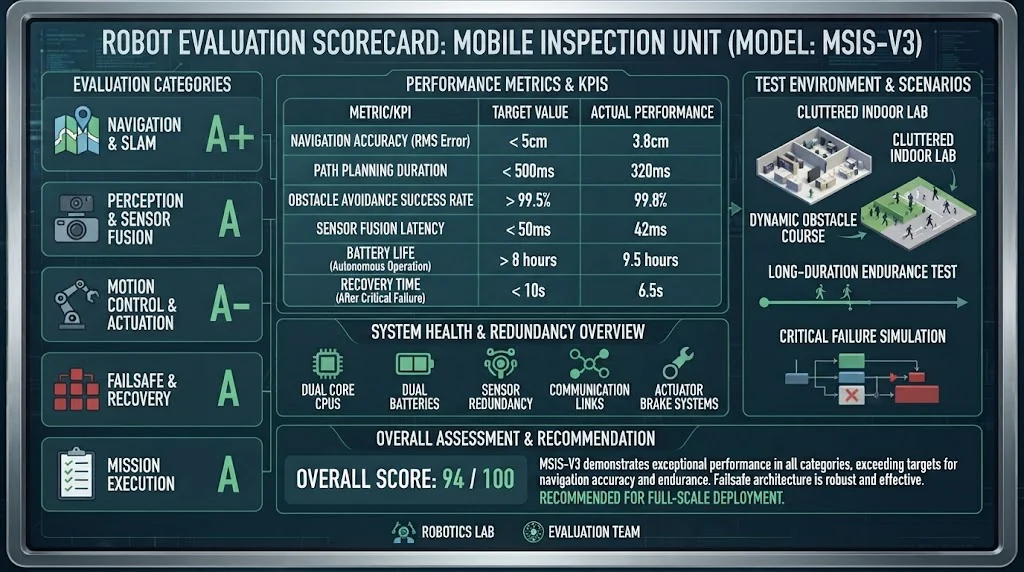
Live Demo Evaluation Scorecard and Audit Matrix
Use this evaluation matrix during your vendor demonstration to systematically score performance across key engineering categories:
| Category | Evaluation Parameter | Target Benchmark | Score (1-5) |
|---|---|---|---|
| Locomotion | Catwalk grating & stair traversal | Zero foot entrapment; steady ascent on ≥35° stairs | ___ / 5 |
| SLAM Localization | Dynamic obstacle replanning | Immediate recalculation within <1.5s; no freeze | ___ / 5 |
| Thermal Analytics | Radiometric thermal accuracy | ±2°C accuracy at 5-meter inspection distance | ___ / 5 |
| Edge AI Processing | Onboard optical gauge reading | >98% reading accuracy across varying ambient light | ___ / 5 |
| Network Failsafe | Zero-signal behavior | Autonomous mission completion or safe return to base | ___ / 5 |
| Power & Docking | Autonomous recharging alignment | 100% first-attempt docking over 10 consecutive runs | ___ / 5 |
Frequently Asked Questions: Industrial Inspection Robot Demonstrations
How much does an industrial inspection robot pilot program typically cost?
A standard 30-day proof-of-concept (PoC) deployment generally ranges from $15,000 to $35,000. This fee includes on-site facility mapping, payload sensor calibration, edge AI baseline training, and dedicated robotics engineering support, which is commonly credited toward full fleet purchases.
What site preparations are required before a live vendor demonstration?
Modern LiDAR SLAM quadrupedal robots require no fixed infrastructure, reflective beacons, or magnetic floor strips. You only need to provide a dedicated 110V/220V power outlet for the docking station and designate the specific inspection targets, staircases, and catwalks for the test route.
Can quadruped inspection robots integrate directly with existing SCADA and EAM systems?
Yes. Enterprise-grade platforms provide native REST APIs, MQTT brokers, and OPC UA protocols to push real-time alerts, thermal data, and vibration metrics directly into systems like SAP PM, IBM Maximo, and centralized plant SCADA architectures without third-party cloud dependencies.
How do autonomous inspection robots ensure physical safety around human personnel?
Inspection quadrupeds leverage 360-degree LiDAR, depth cameras, and active force-torque joint limits to maintain continuous dynamic safety bubbles. They automatically slow down, yield, or navigate around human workers per ISO 3691-4 industrial safety standards.
Request a Live Technical Demonstration with Intelligent Robot Dog
Challenge our autonomous quadruped platforms inside your active industrial environment. Evaluate real-time SLAM navigation, edge AI analytics, and custom sensor payloads under your facility’s real operating conditions.