What Is an Industrial Inspection Robot RFP? Definition, Core Goals, and Market Context
An industrial inspection robot Request for Proposal (RFP) is a formal procurement document that outlines technical, environmental, software, and operational requirements for deploying autonomous robotic platforms in enterprise facilities. It enables engineering and procurement teams to systematically evaluate vendor hardware resilience, payload integration, edge computing, and supervisory software compatibility.
Modern industrial facilities—ranging from high-voltage substations to chemical processing units—require zero-downtime operations. Deploying autonomous quadrupedal systems eliminates human exposure to hazardous environments while executing repeatable, non-destructive testing (NDT) routines.
Industrial Inspection Robot RFP: A structured procurement instrument defining dynamic mobility thresholds, sensor payload accuracy, edge AI compute constraints, and operational telemetry architectures to validate autonomous robotic inspection systems against enterprise plant standards.
Deploying advanced industrial robot dog solutions requires evaluating mechanical kinematics alongside enterprise data pipelines. A flawed procurement document leads to pilot purgatory, where systems fail basic locomotion hurdles or cannot ingest telemetry into legacy operational technology (OT) networks.
Defining the Operational Scope: Environmental Hazards, Terrain, and Autonomy Levels
Your technical requirements must map directly to facility topography and hazardous conditions. Specify clear environmental constraints to filter out lightweight, consumer-derived platforms incapable of surviving continuous industrial shifts.
Specify the exact stair angles, grating types, and obstacle dimensions the platform must traverse autonomously:
- Industrial Stair Climbing: Minimum continuous slope negotiation up to 35° (40° preferred) on open metal mesh or grated industrial stairwells.
- Obstacle Clearance: Dynamic step-over capability for pipes, conduits, and curbs up to 200 mm in height.
- Passageway Constriction: Operational navigation through narrow corridors with dynamic turn radii under 1.2 meters.
- Environmental Hardening: Ingress protection rated to minimum IP67 according to IEC 60529, ensuring complete resistance to dust ingress and dynamic water jets.
- Hazardous Atmosphere Rating: Zone classification according to ATEX Directive 2014/34/EU or IECEx standards for explosive gas/vapor atmospheres (Zone 1/21 or Zone 2/22 compliance).
Define operational autonomy according to established robotics levels, moving from teleoperated routines to fully untethered, event-triggered anomaly patrols.
Hardware Architecture and Modular Payload Specifications
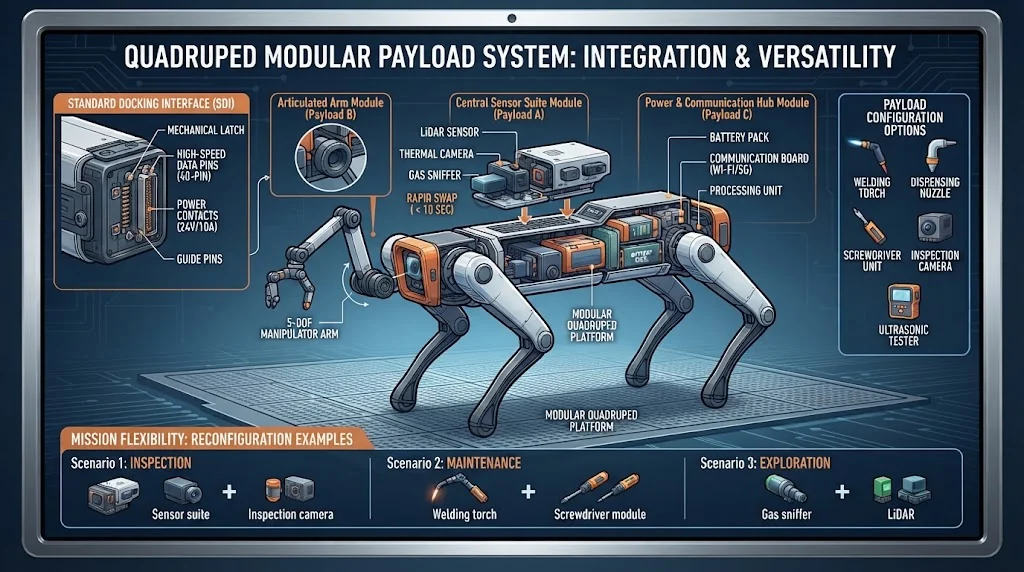
Hardware durability and modular payload integration dictate long-term system utility. The chassis must provide dedicated mechanical mounting rails, clean regulated DC power taps, and high-bandwidth bus connections for sensory add-ons.
Deploying the RZTL-1 industrial quadruped robot demonstrates the necessity of high torque-density joint actuators and quick-release modular mounting rails. Industrial payloads must operate synchronously without degrading dynamic balance.
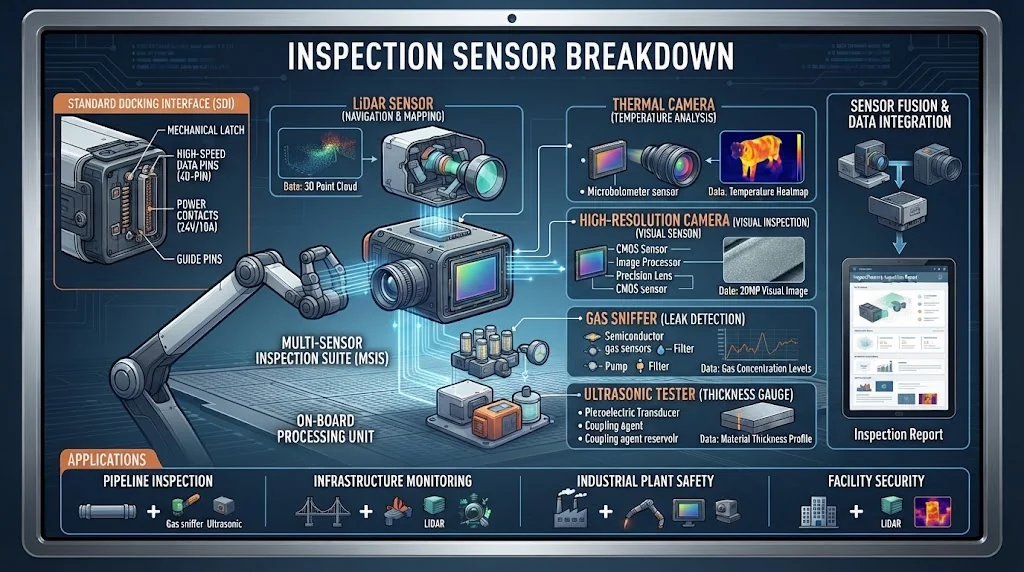
| Payload Category | Minimum Engineering Parameter | Operational Target |
|---|---|---|
| Radiometric Thermal Imaging | 640×512 uncooled VOX microbolometer, ±2°C accuracy | Continuous electrical switchgear and transformer thermal delta tracking |
| Optical Visual PTZ | 4K resolution, 30x optical zoom, continuous 360° pan | Analog gauge reading, corrosion detection, crack width analysis |
| Acoustic Leak Imaging | 64-128 MEMS microphone array (2 kHz – 96 kHz bandwidth) | Compressed air and industrial gas leak localization under loud ambient noise |
| Gas Sniffer / Detection | Multi-gas electrochemical & NDIR (CH4, H2S, CO, VOCs) | PPM-level fugitive emission tracking and safety boundary verification |
| Autonomous Docking | Conformal contact, auto-charging station, <90 min fast-charge | 24/7 continuous autonomous inspection cycle execution |
Payload communication must support high-speed Ethernet (GigE) and RS-485 interfaces natively, preventing latency during high-resolution multi-modal sensor capture.
Software, Edge Computing, and Offline Navigation Capabilities
Autonomous operation in industrial assets cannot rely on continuous cloud connectivity or consumer-grade GPS. Heavy steel structures, subterranean tunnels, and high-voltage EMF create GPS-denied environments that disable standard navigation systems.
Industrial RFPs must mandate robust offline 3D LiDAR SLAM navigation. The platform must maintain precise sub-centimeter localization using solid-state LiDAR and visual-inertial odometry (VIO) without active Wi-Fi or cellular connections.
Mandate that path-planning algorithms dynamically avoid dynamic obstacles (personnel, forklifts, transient tooling) and automatically execute return-to-base failsafes when battery drops below critical operational thresholds.
Enterprise Integration: SCADA, VMS, EAM, and Cybersecurity Compliance
An inspection robot must act as an edge sensor node within the enterprise OT and IT ecosystem. Data isolation leads to operational failure.
For demanding heavy-industrial facilities, platforms like the heavy-duty inspection quadruped integrate directly with industrial automation networks via open, standardized protocols.

- Industrial Telemetry: Native protocol support for OPC-UA, MQTT (Sparkplug B), and Modbus TCP for direct SCADA and DCS tag ingestion.
- Enterprise Asset Management (EAM): Automated REST API webhooks driving work order generation in SAP PM, IBM Maximo, or Infor EAM upon anomaly detection.
- Video Management Systems (VMS): RTSP, ONVIF Profile S/G/T compliance for direct live stream ingestion into platforms like Milestone XProtect and Genetec Security Center.
- Cybersecurity Benchmarks: Strict alignment with ISA/IEC 62443 Industrial Network and System Security standards. The system must support hardware TPM 2.0 modules, end-to-end TLS 1.3 encryption, role-based access control (RBAC), and 802.1X enterprise network authentication.
The Intelligent Robot Dog 4-Tier Industrial RFP Evaluation Protocol
Evaluating multi-vendor proposals requires a structured, weighted scoring mechanism that balances chassis dynamics, onboard intelligence, and enterprise integration capabilities.
| Evaluation Tier | Weight | Key Technical Verification Criteria |
|---|---|---|
| Tier 1: Dynamic Mechanical Capability | 30% | Stair climbing dynamics, IP67 ingress rating, payload capacity under load (≥10 kg continuous), thermal operating envelope (-20°C to +55°C). |
| Tier 2: Edge Autonomous Intelligence | 25% | Offline 3D LiDAR SLAM, GPS-denied localization accuracy (±1 cm), real-time on-chassis edge AI inference, dynamic obstacle bypass. |
| Tier 3: Enterprise Interoperability & Security | 25% | OPC-UA/MQTT integration, SCADA/EAM APIs, IEC 62443 compliance, hardware root of trust (TPM 2.0), zero-trust network support. |
| Tier 4: Lifecycle Support & TCO | 20% | 5-year TCO, SLA terms, mean time between failures (MTBF ≥ 5,000 hrs), spare parts availability, vendor technical training. |
Total Cost of Ownership (TCO) Model and Proof of Concept (PoC) Milestones
Procurement teams must look past the initial capital expenditure (CapEx) to model the complete 5-year Total Cost of Ownership. Unclear maintenance models and recurring proprietary software licenses quickly inflate operational expenditure (OpEx).
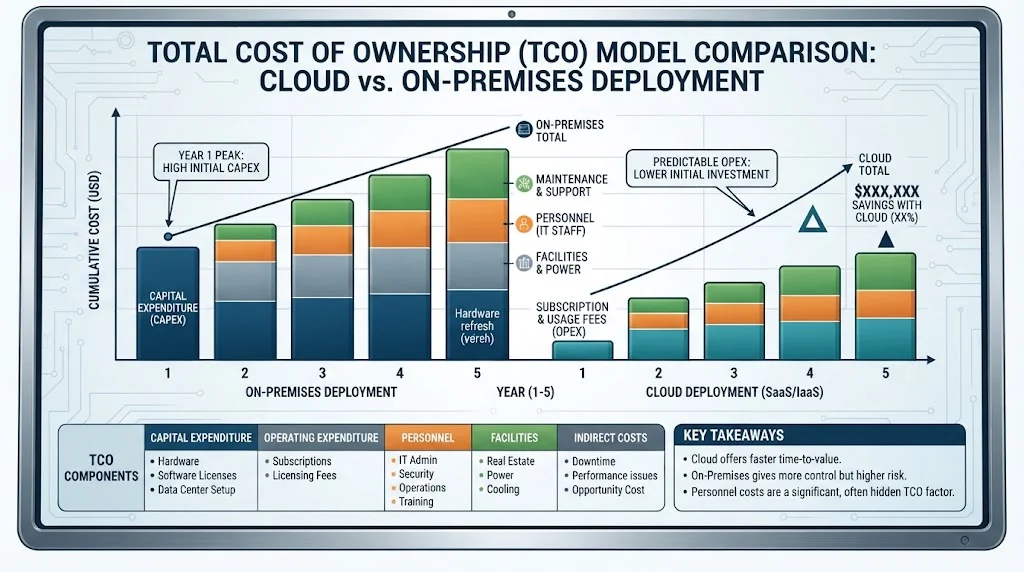
Your RFP should mandate a strict breakdown across three direct cost centers:
- Direct Capital Costs: Base quadruped chassis, modular sensor packages, enterprise docking stations, spare hot-swap batteries, and transport enclosures.
- Software and Integration Costs: Fleet management server licenses, on-chassis edge AI inference seats, SCADA connector middleware, and API provisioning.
- Sustaining Engineering and Support: Level 1–3 SLA support, firmware patching, scheduled joint/actuator servicing intervals, and guaranteed local spare parts holding.
Before executing full-scale commercial procurement, mandate a structured 30-day Proof of Concept (PoC) on-site. Define binary success criteria: 99% autonomous route completion over 50 consecutive runs, accurate gauge reading across variable lighting, and zero unhandled system freezes in high-EMF zones. You can request an industrial robot RFP consultation to establish standard testing procedures tailored to your facility topology.
Downloadable Industrial Inspection Robot RFP Template & SOW Checklist
Use the functional requirements template below as a structured foundation for drafting your enterprise procurement specification.
Frequently Asked Questions (FAQ)
What is the typical procurement timeline for an industrial inspection robot?
A standard procurement cycle spans 3 to 6 months. This includes 4 weeks for RFP release and vendor response, 4 weeks for technical scoring and vendor downselection, 4 weeks for on-site Proof of Concept (PoC) validation, and 4 to 8 weeks for enterprise IT/OT cybersecurity audits, commercial negotiation, and deployment.
Why is offline SLAM critical in an inspection robot RFP?
Industrial environments like substations, processing plants, and boiler houses contain dense structural steel, subterranean corridors, and electromagnetic interference that block GPS signals and cause wireless dropouts. Offline 3D LiDAR SLAM enables the quadruped to localize, navigate, and execute inspection missions reliably without relying on persistent Wi-Fi or cellular networks.
How do we prevent vendor lock-in when purchasing inspection robots?
Ensure your RFP specifies open REST APIs, standard industrial communication protocols (such as OPC-UA and MQTT), modular payload mounting rails, and universal sensor interfaces (GigE/USB/RS-485). Avoid proprietary systems that restrict sensor integrations or force telemetry through proprietary closed-cloud platforms.
What cybersecurity standards must an industrial inspection robot meet?
The RFP should require alignment with ISA/IEC 62443-4-1 and 62443-4-2 industrial cybersecurity standards. Mandatory specifications must include encrypted telemetry (TLS 1.3), hardware-based root of trust (TPM 2.0), role-based access control (RBAC), signed firmware verification, and full support for on-premises fleet management servers.
Accelerate Your Industrial Inspection Automation
Deploy ruggedized, enterprise-ready quadruped platforms engineered for autonomous offline inspection, edge analytics, and zero-trust OT integration.