Core Robotic Hardware Specifications: Mobility, Ingress & Power Architecture
An industrial inspection robot procurement checklist serves as a rigorous engineering benchmark to evaluate mobile platforms against harsh industrial operating realities. Selecting the right hardware prevents multi-million dollar operational halts, verifies structural durability under severe environmental stress, and ensures uncompromised safety across high-voltage and chemical environments.
Plant environments quickly destroy consumer-grade and light-industrial robotics. Industrial sites demand verified physical durability, sustained runtime, and autonomous self-charging capabilities.
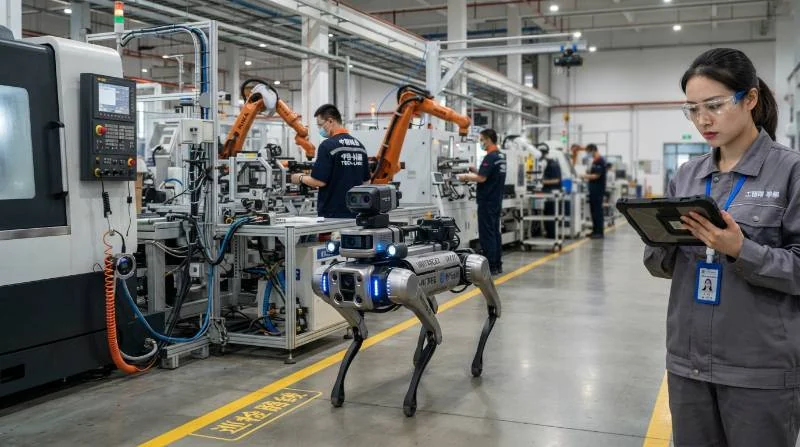
Mobility Envelope & Ingress Protection
Wheeled and tracked platforms frequently fail in environments featuring open-grate flooring, steep staircases, and irregular terrain. Legged systems navigate complex geometry, but their torque density and ingress protection determine real-world survivability.
- Ingress Protection: Mandate an IP67 ingress protection rating for units operating around water washdowns, heavy particulate concentrations, or outdoor utility yards. IP66 serves as the baseline for covered process floors.
- Stair & Terrain Clearance: Verify mechanical capability to climb standard industrial stairs (typically 30° to 45° incline, step heights up to 22 cm) and traverse standard steel grating without foot entrapment.
- Thermal Range: Verify operational limits from -20°C to 55°C (-4°F to 131°F) with internal thermal management systems that protect battery chemistry and logic boards.
Platforms like the heavy-duty inspection robot RZTL-1 utilize ruggedized joints and sealed housing architectures engineered for extreme chemical plants and power distribution yards.
Standard Compliance Benchmark: Platforms should align with ISO 10218 and ANSI/RIA R15.06 requirements for industrial robot safety integration, ensuring fail-safe kinematics around plant personnel.
Power Subsystems & Duty Cycle Management
A mobile robot is only as valuable as its continuous availability. Maintenance teams should evaluate systems based on practical duty cycle ratios.
- Runtime Under Nominal Payload: Calculate operational duration with a 50% to 75% load rather than unladen bench tests. Standard operational endurance should range between 90 to 150 minutes per charge cycle.
- Autonomous Docking: Look for self-aligning contact or inductive docking docks capable of high-amperage rapid charging without manual alignment.
- Mean Time Between Failures (MTBF): Target joint actuator and compute-module MTBF ratings above 5,000 continuous runtime hours.
Sensor Suite & Modular Inspection Payloads: Optical, Thermal, and Acoustic
Quadruped platforms act as autonomous sensor carriers. Payload modularity dictates whether a robot serves a single function or acts as a versatile multi-parameter condition-monitoring tool.
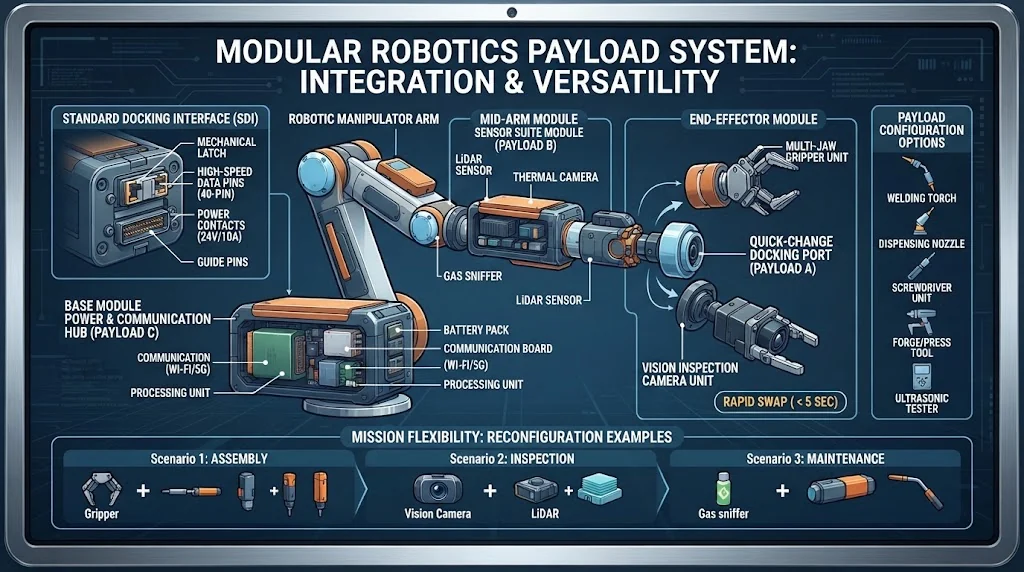
The industrial quadruped Tongchui-M1 demonstrates this versatility by utilizing standardized quick-release mounts for mechanical integration and high-bandwidth bus routing.
| Payload Type | Key Technical Metrics | Target Industrial Application |
|---|---|---|
| Dual-Spectrum PTZ Optical | 30x–40x optical zoom, 4K resolution, 0.01 lux low-light performance | Analog gauge reading, structural crack analysis, valve position checks |
| Radiometric Thermal Camera | 640×512 uncooled microbolometer, ±2°C accuracy, NETD <40mK | Transformer hotspot detection, bearing overheating, steam trap audits |
| Acoustic Imaging Payload | 64–128 MEMS microphone array, 2 kHz to 65 kHz frequency range | Compressed air leak localization, partial discharge detection in switchgear |
| Optical Gas Imaging (OGI) | Cooled MWIR detector (3.2–3.4 µm band), EPA OOOOa compliance support | Fugitive VOC and hydrocarbon emission detection (petrochemical & LNG) |
| Non-Destructive Testing (NDT) | Ultrasonic thickness gauges, eddy current sensors via integrated robotic arm | Pipe wall thickness degradation, pressure vessel integrity scans |
Verify that the robotic platform provides dedicated auxiliary power rails (12V/24V/48V DC) and synchronized Ethernet/CAN-bus ports to accommodate multi-sensor payloads without degrading battery stability.
Autonomous Navigation, Edge AI, and Enterprise Systems Integration
Hardware without intelligent navigation and enterprise software integration creates data silos and operational friction. Reliable industrial robotics operate autonomously within dense, metal-heavy, GPS-denied environments.
SLAM & Navigation in GPS-Denied Environments
Plants built with heavy steel framing distort standard magnetic fields and block satellite positioning. Advanced platforms utilize multi-modal spatial mapping:
- 3D LiDAR + Visual SLAM: Combining 360-degree LiDAR with stereo depth cameras delivers centimeter-level localization precision. Explore our detailed breakdown of LiDAR and visual SLAM navigation technology to understand multi-sensor fusion.
- Dynamic Obstacle Avoidance: The platform must identify temporary obstructions (forklifts, maintenance ladders, scaffolding) and dynamically calculate detour paths without operator intervention.
- Offline Mission Execution: The robot must execute full patrol routes, run analytics, and log alerts locally when network connectivity (Wi-Fi/Private 5G) drops.
Edge AI Inference & SCADA/CMMS Connectivity
Streaming gigabytes of raw 4K video and radiometric streams to cloud servers consumes expensive industrial bandwidth and creates latency bottlenecks. Modern systems run computer vision models locally on integrated AI edge accelerators.
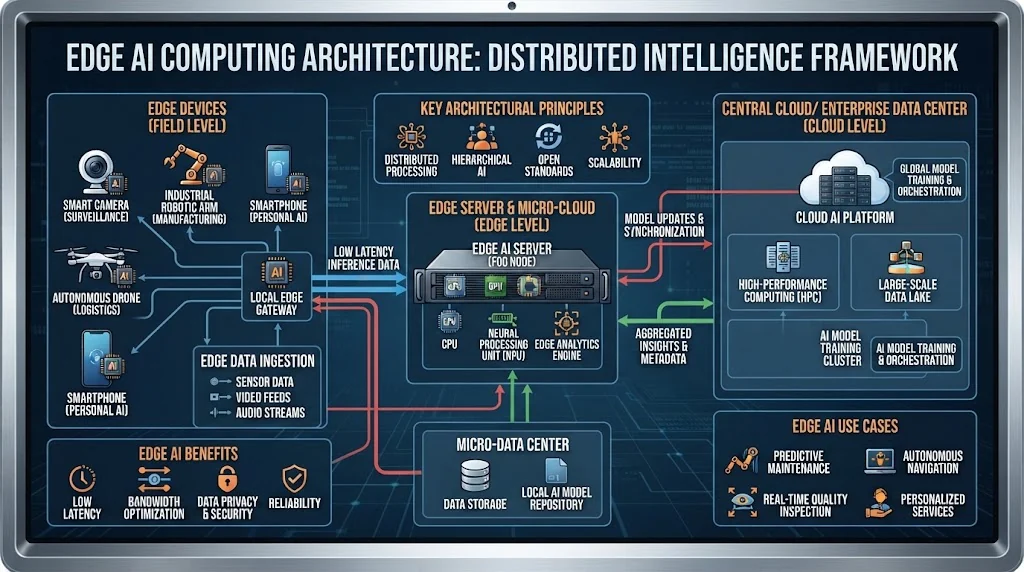
- Automated Analog/Digital Gauge Digitization: Onboard models read analog needle dials, digital seven-segment displays, and liquid level sight glasses, converting visual patterns into discrete numerical telemetry.
- API Integration with SCADA & CMMS: The robotics platform must expose RESTful APIs, MQTT, or OPC UA endpoints to stream condition alerts directly into platforms like SAP PM, IBM Maximo, or Aveva PI System.
- Automated Work-Order Generation: When a thermal anomaly crosses defined thresholds, the system should trigger an immediate work ticket inside the CMMS with the exact GPS coordinate, radiometric image, and delta-T measurement.
The Intelligent Robot Dog 5-Stage Deployment Protocol
To de-risk capital equipment investments, our solutions engineering team developed a structured deployment lifecycle: The Intelligent Robot Dog 5-Stage Deployment Protocol. This framework guides engineering teams from initial facility audits through full fleet integration.
The Intelligent Robot Dog 5-Stage Deployment Protocol: A standardized enterprise framework designed to validate robotic terrain traversal, payload sensor accuracy, edge inference reliability, and plant CMMS data pipelines before full-scale rollouts.
- Stage 1: Environmental Hazard & Kinematic Mapping: Assess physical facility conditions, measuring maximum stair angles, open grating spacing, chemical atmospheres (requiring ATEX/IECEx assessment), and RF coverage dead zones.
- Stage 2: Modular Sensor & Ingress Payload Configuration: Specify the exact sensor matrix (radiometric thermal, high-zoom visual, acoustic, or OGI gas sensors) based on critical failure modes (FMEA) identified by plant reliability engineers.
- Stage 3: Edge Inference & SCADA Integration: Configure local edge computing nodes, calibrate gauge reading neural networks, and map OPC UA/MQTT data pipelines to the central control room.
- Stage 4: On-Site Proof of Concept (PoC) Validation: Deploy platforms within an active operational unit for 30 days to validate inspection repeatability, self-docking reliability, and thermal hotspot detection accuracy.
- Stage 5: Fleet Orchestration Scaling: Connect multiple autonomous units to centralized fleet management software, enabling coordinated, round-the-clock plant monitoring with centralized health dashboards.
Discover how our autonomous industrial inspection solutions streamline and accelerate each phase of this deployment protocol.
Total Cost of Ownership (TCO), Vendor SLAs, and Procurement Models
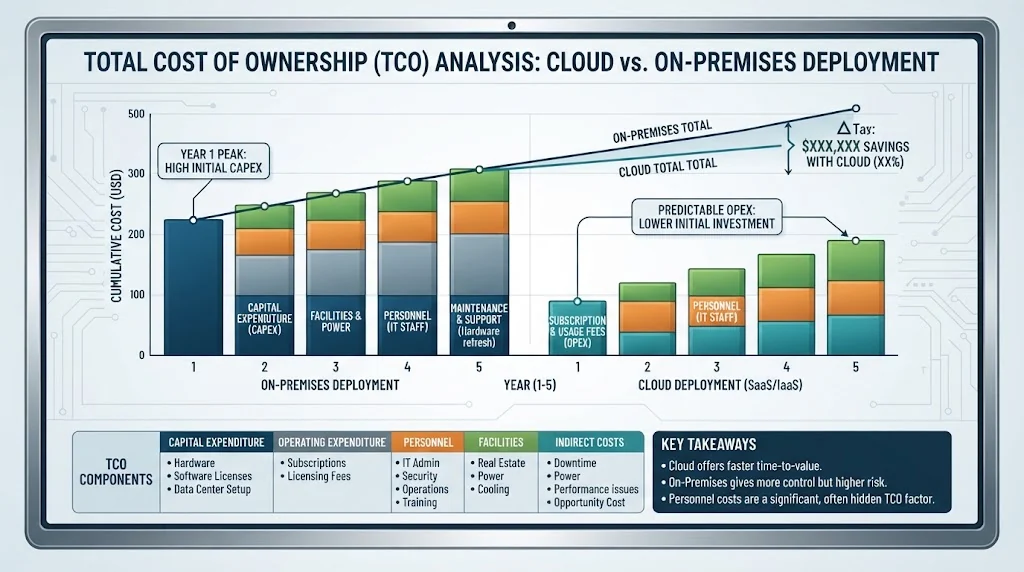
Evaluating an enterprise quadruped robot requires analyzing long-term lifecycle costs beyond initial hardware pricing. Maintenance teams must balance upfront capital expenditure against ongoing operational support.
CapEx Purchase vs. Robotics-as-a-Service (RaaS)
- CapEx Model: Direct asset purchase. Best suited for organizations with established internal automation teams, available capital budgets, and multi-year asset amortization frameworks.
- RaaS (Robotics-as-a-Service): Subscription-based model combining hardware, sensor packages, software upgrades, autonomous docking infrastructure, and maintenance coverage under an operational expense (OpEx) model. This eliminates technological obsolescence risks and lowers initial capital hurdles.
Critical SLA and Support Verification
Review vendor service level agreements (SLAs) using these core requirements:
- Component Replacement Turnaround: Contractual guarantees for replacement actuator modules, battery packs, and compute units delivered within 48 to 72 hours.
- Software & Firmware Updates: Regular, over-the-air updates for SLAM navigation algorithms, security patches, and edge AI vision models.
- Cybersecurity Compliance: End-to-end encryption (AES-256) for data transmission, SOC 2 compliance, and secure local-only operation without mandatory external cloud connections.
Ready to evaluate hardware configurations and operational numbers for your facility? Request an industrial inspection robot quote from our engineering team.
Interactive Enterprise RFQ Procurement Checklist
Use this technical checklist during vendor Request for Proposal (RFP) and Request for Quote (RFQ) evaluations.
| Evaluation Domain | Target Specification | Vendor Compliance Target |
|---|---|---|
| Mechanical Mobility | Continuous stair climbing (>35°), open steel grating negotiation | Pass / Fail Verification |
| Environmental Ingress | IP66 (standard) / IP67 (washdown/outdoor rated) | Lab Test Certificate Required |
| Payload Modularity | ≥ 5 kg payload capacity with universal bus interface (Ethernet/CAN/12-24V) | Hardware Interface Documentation |
| Thermal Imaging Precision | Radiometric FLIR/equivalent sensor (≥640×512, ±2°C accuracy) | Sensor Calibration Certificate |
| Edge AI Processing | Onboard inference for gauge reading, oil leak detection, thermal delta alerts | Benchmark Latency <200ms |
| SCADA / CMMS Integration | Native OPC UA, MQTT, and REST API support for SAP/Maximo work-order triggering | Integration Architecture Diagram |
| Autonomous Power Architecture | Self-docking charging station with autonomous alignment and rapid charging | Docking Success Rate ≥99.5% |
| Safety Standards | ISO 10218, ANSI/RIA R15.06, CE Machinery Directive compliance | Third-Party Declaration of Conformity |
Frequently Asked Questions (FAQ)
Are industrial inspection robot dogs certified for explosive atmospheres (ATEX / IECEx)?
Standard industrial quadruped platforms are built with IP66/IP67 sealed enclosures, which allow operation near Class I, Division 2 / Zone 2 environments. Full explosion-proof certification (ATEX Zone 1 / IECEx Zone 0/1) requires positive-pressure purged enclosures, specialized intrinsically safe electronics, and non-sparking joint materials.
What happens if the robot loses Wi-Fi or 5G connectivity during an autonomous inspection mission?
Industrial quadruped platforms run SLAM localization, path calculation, and edge AI inferencing locally on internal processors. When network connectivity drops, the robot continues its scheduled route, saves thermal and acoustic inspection data locally, and uploads encrypted reports once it reconnects or docks at its charging station.
How long does it typically take to integrate robot inspection telemetry into our existing CMMS or SCADA systems?
Standard deployments using open protocols like MQTT or OPC UA typically require 2 to 4 weeks for complete field testing. Custom enterprise integrations—such as bi-directional work-order generation inside SAP PM or IBM Maximo—generally require 4 to 8 weeks depending on internal IT approval and network security workflows.
What ongoing maintenance do industrial quadruped robots require?
Routine maintenance includes cleaning sensor lenses, inspecting joint seal wear, checking foot tread integrity every 500 runtime hours, and running automated battery calibration cycles every quarter. Modular joint motors can be replaced in the field within 30 to 45 minutes using standard tools.
Upgrade Your Plant Inspection Operations
Contact our robotics solution architects to review your facility blueprints, match required sensor payloads, and build a tailored deployment roadmap.