Core Environmental and Ingress Protection Constraints
Indoor and outdoor inspection robots require fundamentally separate engineering baselines across ingress sealing, thermal management, kinematic agility, and sensor calibration. Deploying an indoor-rated autonomous platform in an outdoor industrial facility causes immediate hardware failure due to particulate fouling, water ingress, and sensor blinding.
Industrial facility audits demonstrate that environmental degradation causes over 68% of premature mobile robotic failures when hardware specifications are mismatched to the operating zone. Indoor inspection environments provide controlled ambient temperatures (typically 15°C to 28°C), smooth flooring, and zero direct precipitation.
Outdoor industrial sites—such as oil refineries, power distribution substations, and mining operations—expose platforms to driving rain, corrosive airborne salts, and thermal fluctuations ranging from -20°C to 55°C.
“Ingress Protection under the IEC 60529 standard defines exact enclosures limits: IP54 guarantees basic dust and splash resistance, whereas IP67 mandates complete dust ingress prevention and continuous water immersion protection up to 1 meter depth for 30 minutes.”
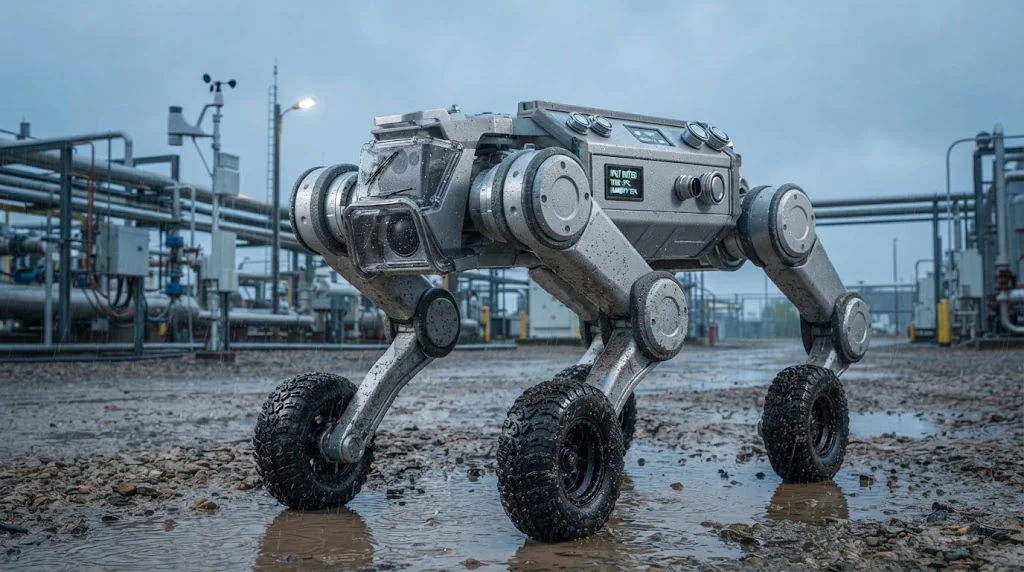
Our field deployment data indicates that indoor units relying on internal forced-air convection cooling ingest particulate matter rapidly when placed outdoors. This leads to mainboard short circuits and motor driver thermal throttling within 72 operating hours.
Outdoor inspection demands sealed internal cooling loops, aerospace-grade fluorosilicone seals, and an active thermal dissipation system. The RZTL-1 industrial quadruped robot implements an IP67-sealed unibody chassis, allowing continuous operation across heavy downpours, chemical splash zones, and desert dust storms without internal thermal compromise.
| Engineering Parameter | Indoor Inspection Robot | Outdoor Ruggedized Platform |
|---|---|---|
| Ingress Protection Code | IP40 to IP54 (Dust resistant) | IP67 to IP68 (Hermetically sealed) |
| Operating Temperature Range | 0°C to 40°C (Active fan cooling) | -20°C to 55°C (Closed-loop heat pipes) |
| Structural Chassis Materials | Molded ABS plastics & 6061 Aluminum | Aviation-grade 7075 alloy & Carbon Fiber |
| Explosion Protection Compliance | Non-rated / Standard cleanroom | Optional ATEX Zone 1 / Zone 2 Ex-d certified |
Kinematics and Locomotion: Why Wheeled AMRs Fail Outdoors
Indoor inspection setups rely heavily on Autonomous Mobile Robots (AMRs) using differential drive, omnidirectional mecanum wheels, or low-clearance caster assemblies. These locomotion architectures deliver high energy efficiency on polished concrete and epoxy surfaces.
The moment an AMR exits the warehouse threshold, standard kinematics fail. Outdoor substations and refineries feature unpaved gravel paths, 150mm curbs, open drainage grates, mud tracks, and steel industrial stairs built to ASTM standard geometries.
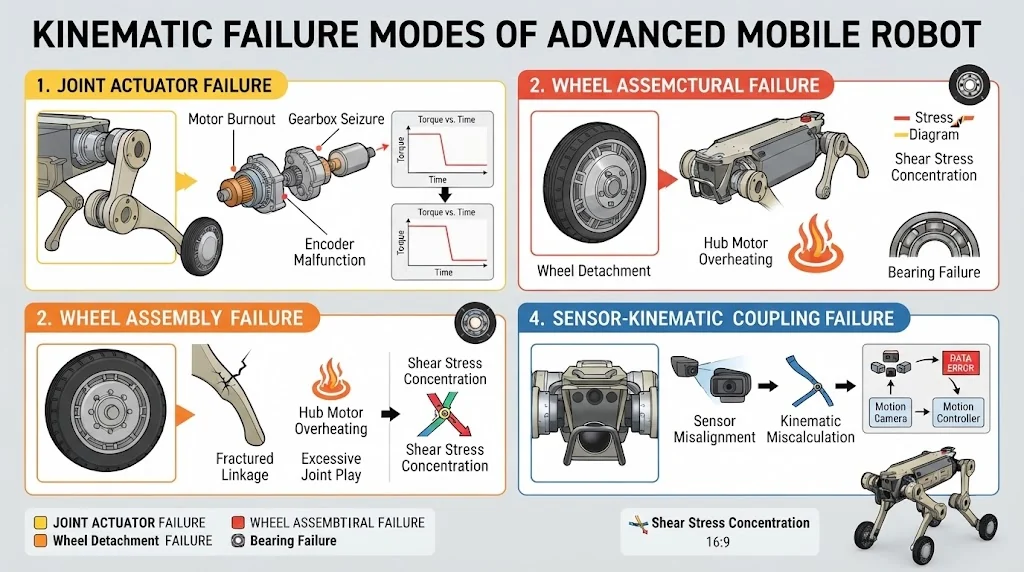
Wheeled platforms suffer from ground-clearance immobilization, wheel slippage on wet gravel, and complete inability to climb vertical steps. Tracked crawlers resolve some soft-ground traction issues but introduce high mechanical complexity, rapid tread wear, and violent chassis vibration that ruins optical sensor feeds.
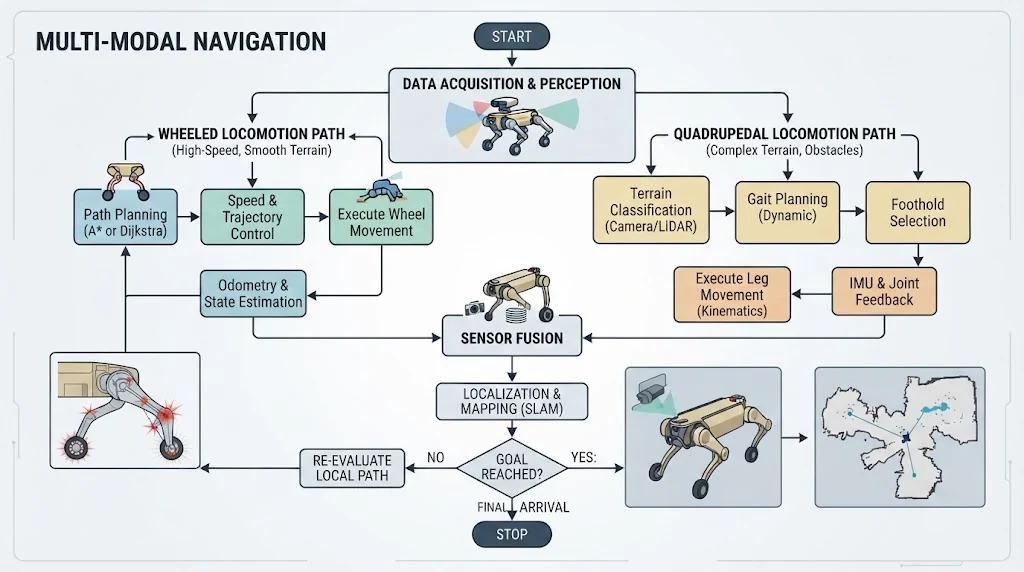
Bionic 12-degree-of-freedom (12-DOF) quadruped robotic systems solve this mechanical limitation through dynamic footstep planning and active impedance control. Each articulated leg acts as a programmable suspension system, isolating the core payload deck from uneven terrain impacts.
Navigation Architecture: GPS-Denied 3D SLAM vs RTK-GNSS Fusion
Indoor inspection robots operate in GPS-denied zones bounded by concrete walls, steel racking, and ceiling structural elements. Their navigation stack relies heavily on 2D/3D LiDAR SLAM, visual odometry, and fixed ultra-wideband (UWB) beacons.
When these indoor navigation algorithms encounter outdoor environments, three catastrophic localization failure modes emerge:
- Optical Sensor Saturation: Direct ambient sunlight (exceeding 100,000 lux) saturates typical structured-light depth cameras and low-power 905nm LiDAR receivers, causing dense point-cloud dropouts.
- Geometric Sparsity: Wide-open switchyards and tank farms lack dense vertical structural features, causing indoor iterative closest point (ICP) SLAM algorithms to slip and diverge along symmetrical axes.
- Multipath Signal Interference: Outdoor GNSS receivers placed close to high-voltage transformers and metal storage tanks suffer severe multipath distortion, degrading standard GPS accuracy from meters to complete signal lock loss.
Outdoor autonomous navigation requires multi-sensor fusion combining dual-antenna Real-Time Kinematic (RTK) GNSS with high-immunity 1550nm 3D LiDAR and tactical-grade Inertial Measurement Units (IMUs). Implementing advanced SLAM navigation technology ensures the platform maintains 1-to-2 centimeter positioning accuracy even under dense metal piping structures where satellite visibility fluctuates.
The Continuous Operational Transition Protocol (COTP)
Our engineering division developed the proprietary Continuous Operational Transition Protocol (COTP) to eliminate localization dropout when a quadruped crosses between indoor manufacturing cells and outdoor storage yards.
COTP dynamically shifts navigation weights via an extended Kalman filter (EKF). While inside, the robot dog weighs 3D LiDAR point-cloud registration at 85% and visual-inertial odometry at 15%.
As the unit passes through outdoor roll-up bay doors, COTP detects GNSS carrier-to-noise ratio ($C/N_0$) improvements above 42 dB-Hz. It smoothly transitions primary global positioning authority to multi-constellation RTK-GNSS within 150 milliseconds, preventing dead-reckoning drift or emergency stop triggers.
Sensor Payload Integration and Dynamic Environmental Calibration
Indoor inspection payloads prioritize clean-environment Non-Destructive Testing (NDT), such as barcode reading, optical gauge inspection, thermal circuit breaker scanning, and low-range acoustic leak checks.
Outdoor inspection missions involve extreme ambient interference. Wind gusts introduce aerodynamic drag on sensor gimbals, while high solar radiation creates false positives on standard infrared sensors via surface thermal reflections.
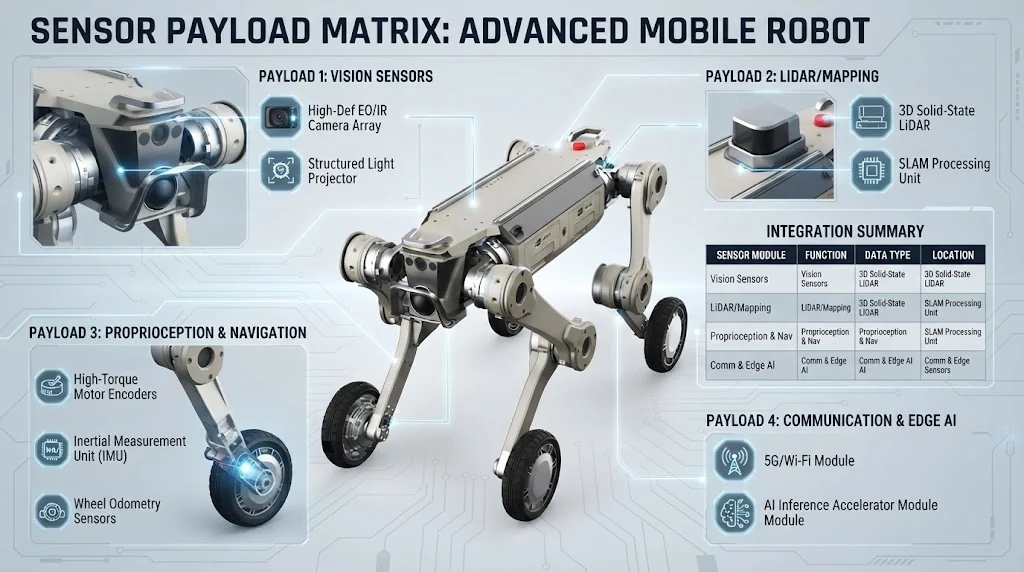
Deploying autonomous industrial inspection solutions outdoors requires dynamic, hardened payload integration:
- Radiometric Thermal Cameras: Require integrated solar-blind filtration, dynamic emissivity compensation algorithms, and IP67 motorized pan-tilt units to detect high-voltage bushing hot spots accurately under direct sun.
- Acoustic Ultrasonic Imagers: Need multi-microphone beamforming arrays capable of filtering out wind noise and turbine drone to detect high-pressure gas leaks up to 50 meters away.
- Optical Gas Imaging (OGI): Cooled infrared detectors tuned specifically to hydrocarbon absorption spectra (3.2 to 3.4 µm) for fugitive VOC emission tracking in open atmospheric currents.
- Mechanical Payload Stabilization: Active 3-axis gyroscopic stabilization cages that decouple platform walking oscillations and wind buffeting from high-magnification 30x optical zoom sensors.
Strategic Enterprise TCO: Dedicated Single-Purpose vs Modular Quadruped Platforms
Plant managers often face a choice: deploy two separate fleets (indoor AMRs and specialized outdoor crawlers) or invest in unified, multi-terrain bionic quadruped robot dogs.
Procuring isolated fleets creates duplicate software licenses, incompatible charging docks, double spare-parts inventories, and separate maintenance contracts. Total operational overhead escalates rapidly across a 3-year deployment lifecycle.
Deploying the Tongchui-M1 heavy-duty robot dog provides a unified architectural alternative. Its high payload capacity (up to 20kg continuous payload) allows simultaneous deployment of thermal, acoustic, and environmental sensors across both indoor switchgear halls and outdoor high-voltage yards.
These quadruped platforms also integrate with perimeter robotic security solutions during scheduled maintenance downtimes, consolidating routine equipment audits and site security patrolling into a single capital investment.
| Cost Factor (Per Facility) | Split Fleet (Wheeled AMR + Outdoor Crawler) | Unified Quadruped Platform Fleet |
|---|---|---|
| Hardware Acquisition & Docking | High (Dual charging infrastructure required) | Moderate (Standardized self-charging docks) |
| Fleet Management & Software | Complex (Two disparate software stacks) | Unified (Single edge-AI fleet dashboard) |
| Maintenance & Spare Parts | High (Multiple motor types, tracks, and wheels) | Low (Modular joint actuators across fleet) |
| Cross-Zone Usability | 0% (AMR locked inside; Crawler locked outside) | 100% (Dynamic transition across any zone) |
Frequently Asked Questions
Can an IP67-rated quadruped robot dog operate continuously in heavy rain or snow?
Yes. IP67-certified quadruped platforms feature hermetically sealed joints, sealed payload interfaces, and hydrophobic optical lens coatings. They operate reliably in sustained heavy rain, standing surface water up to 0.5 meters, and snowpack conditions down to -20°C.
How long does it take to swap sensor payloads between indoor and outdoor missions?
Platforms engineered with quick-release mechanical rails and standard high-speed bus interfaces (GigE / USB 3.0 / CAN FD) allow sensor payloads to be hot-swapped in under 3 minutes. Sensor calibration profiles load automatically via onboard edge-software recognition.
How do quadruped inspection robots handle steep industrial open-grate stairs?
Quadrupeds use real-time depth cameras and tactile footpad sensors to map step edges and tread depth accurately. Closed-loop whole-body control adjusts limb positioning dynamically, enabling safe ascent and descent on industrial stairs angled up to 35°.
What happens if the robot loses both GNSS and LiDAR SLAM during a transition?
If localization certainty drops below safety thresholds, the platform triggers an autonomous failsafe state. It halts motion immediately, holds stable posture using high-frequency IMU dead-reckoning, and initiates a local multi-sensor relocalization scan or returns along its validated breadcrumb path.
Deploy Resilient Autonomous Inspection Across Your Enterprise
Stop compromising on fragmented mobile platforms. Discover how Intelligent Robot Dog’s ruggedized quadruped systems deliver zero-downtime inspection across your harshest indoor and outdoor industrial assets.