
Fundamentals of IECEx Standards in Industrial Quadruped Robotics
An IECEx certification scope for inspection robots defines the exact operational boundaries, protection concepts, mechanical friction thresholds, and environmental limits under which an autonomous machine can safely operate in explosive atmospheres. Unlike stationary transmitters or static field sensors, mobile quadrupedal robots introduce dynamic mechanical friction, high-capacity chemical batteries, and variable RF radiation, requiring certification under both the IEC 60079 electrical and ISO 80079 non-electrical standards.
Industrial processing facilities—such as offshore oil platforms, natural gas liquefaction terminals, petrochemical refineries, and hydrogen production plants—contain classified hazardous locations where flammable gases, mists, or combustible dusts mix with air. Deploying robotic industrial inspection solutions eliminates the need to place human personnel into these high-risk zones, but it introduces an active mechatronic ignition source if the platform is not certified correctly.
IECEx System Definition: The International Electrotechnical Commission System for Certification to Standards Relating to Equipment for Use in Explosive Atmospheres (IECEx) provides a globally harmonized verification framework confirming equipment complies with rigorous international explosion-protection engineering standards.
Engineers often confuse regional regulatory compliance with international technical standards. While the European Union enforces the mandatory ATEX Directive 2014/34/EU and North America relies on NFPA 70 (NEC Articles 500-506), the IECEx system acts as the technical baseline. In fact, modern ATEX and UKEX type-examination certificates directly cite the underlying IEC 60079 harmonized test reports.
| Certification System | Governing Framework | Zonal Classification Covered | Mandatory Scope for Robotics |
|---|---|---|---|
| IECEx | IEC International Standards | Zone 0, Zone 1, Zone 2 (Gases) / Zone 20, 21, 22 (Dusts) | Full mechatronics (IEC 60079-0, ISO 80079-36/37) |
| ATEX | EU Directive 2014/34/EU | Category 1G/1D, Category 2G/2D, Category 3G/3D | Electrical chassis + Non-electrical kinetic components |
| NEC / CEC | NFPA 70 Articles 500-506 / CSA C22.1 | Class I/II/III, Div 1 & Div 2 or Zone 0/1/2 | Thermal dissipation, battery sealing, enclosure arc suppression |
Deconstructing the Ex Robot Nameplate: Markings, Groups, and EPLs
Reading an inspection robot’s Ex nameplate requires breaking down alphanumeric strings that specify exactly where the machine can step, patrol, and record data. Missing a single character code can lead to placing an unrated robot in a hydrogen-rich atmosphere, risking catastrophe.
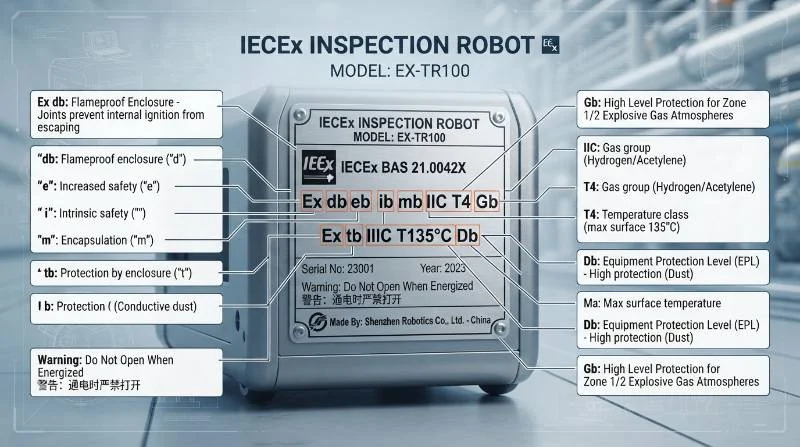
A standard explosion-proof quadruped robot certificate marking typically reads as follows: Ex db eb ib mb IIC T4 Gb / Ex tb IIIC T135°C Db IP67. Every segment governs a distinct engineering boundary:
- Ex Protection Concepts:
- db (Flameproof Enclosure – IEC 60079-1): Applied to main computing cores, battery housings, and heavy joint actuators. Internal explosions are contained without propagating to the surrounding atmosphere.
- eb (Increased Safety – IEC 60079-7): Applied to brushless DC motor terminal blocks and external wiring harnesses, preventing arcs, sparks, and excessive surface temperatures.
- ib (Intrinsic Safety – IEC 60079-11): Used for tactical sensor payloads, camera links, gas sensor heads, and LiDAR systems. Electrical energy is strictly limited below ignition thresholds under normal and single-fault conditions.
- mb (Encapsulation – IEC 60079-18): Applied to onboard DC-DC power converters and BMS circuitry, sealing potential spark sources in chemically inert resin.
- Gas and Dust Groups:
- Group IIA: Propane, methane, and standard industrial solvents (least easily ignited).
- Group IIB: Ethylene, town gas, and general refinery process gases.
- Group IIC: Hydrogen, acetylene, and carbon disulfide (most easily ignited; requires minimal ignition energy < 20 microjoules).
- Group IIIA / IIIB / IIIC: Combustible flyings, non-conductive dusts, and conductive dusts (e.g., carbon black, fine aluminum powder).
- Temperature Classes (T-Class): Defines the maximum outer surface temperature under worst-case overload conditions.
- T4 (≤ 135°C): The industry standard for heavy-duty inspection quadrupeds carrying computing payloads and high-torque servomotors.
- T6 (≤ 85°C): Required in plants handling chemicals with ultra-low auto-ignition temperatures (e.g., ethyl ether).
- Equipment Protection Level (EPL):
- Gb: High protection level for explosive gas atmospheres (Zone 1 deployment; also permitted in Zone 2).
- Db: High protection level for combustible dust atmospheres (Zone 21 deployment; also permitted in Zone 22).
Engineering Insight: In our compliance evaluations across refinery environments, specifying a robot rated only for Group IIB rather than Group IIC (or IIB+H2) prevents the unit from inspecting reformer units and battery rooms where hydrogen gas accumulation occurs. Always verify that the certified gas group matches your worst-case localized gas release scenario.
Mechanical Compliance and Dynamic Friction: ISO/IEC 80079-36 and 80079-37
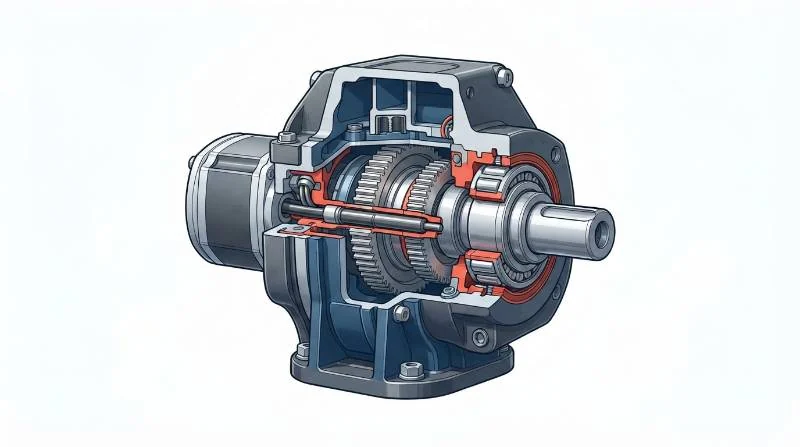
Static electrical equipment does not have moving legs, planetary gear assemblies, or rubberized foot pads striking metal grating. For legged quadruped inspection robots, mechanical safety is governed by ISO 80079-36 (non-electrical equipment basic requirements) and ISO 80079-37 (non-electrical protection types: constructional safety “c”, control of ignition sources “b”, liquid immersion “k”).
When an autonomous robot climbs open galvanized steel stairways in a chemical processing plant, mechanical friction and impact can generate mechanical hot spots or ignition sparks. Certifying a quadruped under ISO 80079 requires three engineering safeguards:
- Constructional Safety (Ex h “c”): Precision cycloidal and planetary reduction gears must be engineered with continuous lubrication channels and dynamic radial seals (IP67/IP68) that prevent lubricant loss and metal-to-metal dry contact friction exceeding the T4 (135°C) threshold.
- Electrostatic Dissipation (ESD): Dynamic foot pads, carbon fiber leg fairings, and outer chassis panels must have a surface resistivity of less than 1 gigaohm (10^9 Ω) at 50% relative humidity, preventing static charge accumulation that could discharge in Zone 1.
- Dynamic Seal Thermal Dissipation: High-speed output shafts driving hip and knee joints generate localized friction heat. Thermal finite element analysis (FEA) must prove that seal surface temperatures remain safe during continuous maximum-load trotting.
Modular Sensor Payloads and Certificate Validity
One of the most frequent compliance failures in robotics deployments occurs when end users bolt third-party, off-the-shelf sensors onto an Ex-certified base robot. Doing so instantly invalidates the robot’s IECEx Certificate of Conformity (CoC).
An autonomous inspection robot platform is certified as a unified mechatronic assembly. Adding an uncertified thermal imaging camera, pan-tilt-zoom (PTZ) optical gimbal, acoustic ultrasound imager, or optical gas imaging (OGI) sniffer bypasses the platform’s galvanic isolation and thermal profile.
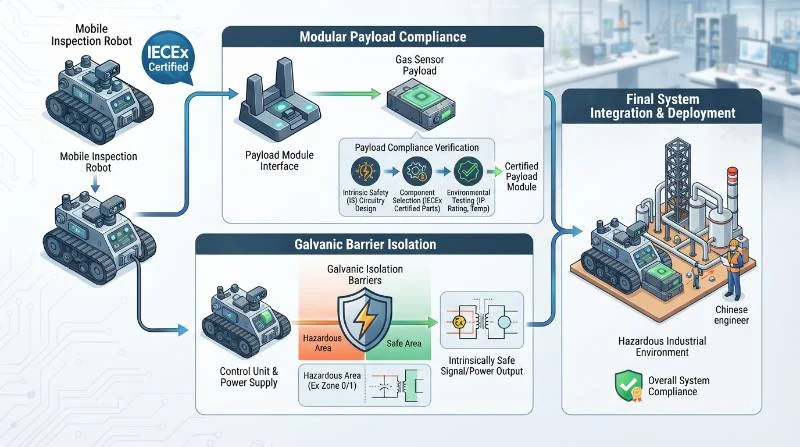
To safely expand payload capabilities without voiding the robot’s master certificate, robotics manufacturers use two primary integration architectures:
- Unified Schedule Certification: The auxiliary payload is explicitly listed as an approved modular sub-assembly on the base robot’s IECEx CoC schedule of equipment. The test laboratory has evaluated the combined power draw, thermal dissipation, and structural connection.
- Intrinsically Safe Galvanic Barrier Isolation (Ex ib / Ex ia): The base robot chassis provides an external auxiliary payload port equipped with certified galvanic isolators and Zener barriers. This limits total auxiliary circuit power to intrinsically safe levels (voltage Uo, current Io, and capacitance Co limits), allowing pre-certified intrinsically safe sensors to connect directly.
Battery Management, Thermal Envelopes, and In-Zone Autonomous Docking
High-energy-density lithium-ion and lithium iron phosphate (LiFePO4) battery packs represent the largest stored energy hazard onboard an inspection robot. In an explosive atmosphere, an internal short circuit or thermal runaway event could breach standard containment and trigger a catastrophic explosion.
IEC 60079-0 and IEC 60079-7 mandate strict construction standards for battery enclosures in mobile hazardous area machinery:
- Dual-Fault BMS Architecture: The robotic Battery Management System (BMS) must feature redundant, hardware-isolated monitoring circuits that independently disconnect charging/discharging loops if pack temperature, individual cell voltage, or discharge current exceed certified safe thresholds.
- Flameproof / Pressurized Containment: The battery cell array must reside in an Ex db flameproof enclosure designed to withstand internal overpressure, or an Ex p pressurized system purged with inert gas (e.g., nitrogen).
- Autonomous In-Zone Docking: Autonomous charging within classified Zone 1 or Zone 2 areas requires specialized physical interfaces. Open copper charging pins are strictly prohibited. Charging must use either certified flameproof magnetic-contact couplers with mechanical interlocking switches or high-efficiency resonant inductive wireless charging encapsulated in Ex mb epoxy resins.
Combined with autonomous SLAM navigation in industrial facilities, these certified docking systems allow inspection robots to execute 24/7 continuous patrol routines without human intervention or the need to travel back to unclassified safe zones for recharging.
The Intelligent Robot Dog Ex-Robotics Compliance Protocol (ERCP)
To streamline the deployment of quadrupedal robots in explosive environments, Intelligent Robot Dog utilizes a specialized four-stage engineering and risk-mitigation framework known as the Ex-Robotics Compliance Protocol (ERCP). This methodology ensures complete regulatory alignment throughout the robot’s operating lifecycle.
- Stage 1: Zonal & Chemical Substance Profiling
Site safety engineers determine exact zonal classifications (Zone 1 vs Zone 2), identify all chemical groups present (Group IIA, IIB, IIC), and verify ambient temperature extremes (-20°C to +55°C). The robot platform’s certificate scope is verified against plant-specific flashpoints and auto-ignition temperatures. - Stage 2: Kinetic & Electrostatic Ignition Mitigation
The platform undergoes verification for dynamic non-electrical friction hazards. Technicians verify ESD conductivity on foot pads and ensure that mechanical impact points feature non-sparking bronze or high-grade anti-static composite shields, meeting ISO 80079-36 standards for hazardous environment emergency response. - Stage 3: Galvanic & Payload Boundary Isolation
Modular payload assemblies—including optical zoom modules, acoustic listening devices, and OGI thermal sensors—are matched with certified galvanic barriers or installed within flameproof enclosures. All data connections interface through optocouplers or certified bus bridges. - Stage 4: Real-Time SCADA/CMMS Telemetry Handshake
The robot’s internal safety diagnostics (internal enclosure pressure, BMS cell temperatures, joint friction alerts, and gas sensor feedback) integrate directly into the facility’s Distributed Control System (DCS) or SCADA network. If internal parameters deviate from certified safety limits, the robot automatically initiates an emergency safe-state shutdown.
Procurement Checklist: Verifying Official IECEx Certificates and Maintenance Lifecycles
When procuring an explosion-proof inspection robot, safety directors and engineering procurement teams must look beyond vendor marketing claims. Genuine compliance requires strict document validation and structured maintenance procedures.
Use the following checklist to audit any inspection robot before purchase and field deployment:
- Verify the IECEx Certificate Online: Request the official Certificate of Conformity number (e.g.,
IECEx BAS 24.0042X). Enter this number directly into the official IECEx online database (www.iecex.com). Ensure the certificate status is marked as “Current” and not “Suspended” or “Cancelled”. - Inspect the Specific Conditions of Use (The “X” Suffix): If the certificate number ends with an “X”, open the certificate schedule. Read the specific operational conditions. Common requirements include mandatory anti-static cleaning procedures, specific ambient operating limits, or limitations on physical impact risks.
- Audit the “Schedule of Limitations” for Payloads (The “U” Suffix): Component certificates ending in “U” are incomplete sub-assemblies. A robot cannot be deployed under a “U” certificate alone; it requires an overarching equipment certificate (“X” or standard CoC).
- Examine Ingress Protection (IP) Gaskets and O-Rings: Maintenance plans must specify periodic inspection intervals for all silicone, Viton, or fluorosilicone enclosure seals. Damaged seals forfeit the IP66/IP67/IP68 rating, which voids the dust protection (Ex tb) and flameproof containment.
- Establish a Certified Refurbishment Protocol: Repairing flameproof joint faces (flanged, spigoted, or threaded flame paths) must strictly follow IEC 60079-19 standards. Never allow uncertified technicians to grind, drill, or machine any part of an explosion-proof robot chassis.
Frequently Asked Questions (FAQ)
Can I add custom sensors to an IECEx certified robot dog?
You cannot add uncertified or third-party sensors directly to an IECEx certified robot without invalidating the Certificate of Conformity (CoC). Custom sensors must either be pre-approved as modular options within the manufacturer’s official certificate schedule or connected via certified intrinsically safe (Ex ib / Ex ia) galvanic barrier interfaces.
What is the difference between a Zone 1 and Zone 2 inspection robot?
A Zone 1 robot (Equipment Protection Level Gb) is certified to operate safely in environments where explosive gas atmospheres are likely to occur during normal, day-to-day operations. A Zone 2 robot (Equipment Protection Level Gc) is only certified for areas where explosive atmospheres are not likely to occur during normal operation, and if they do occur, will persist for only a short period. Zone 1 robots feature significantly higher safety redundancy and protection mechanisms.
How do I verify if a robotics vendor’s IECEx Certificate is legitimate?
Request the complete IECEx Certificate of Conformity (CoC) document from the vendor. Visit the official international IECEx database at www.iecex.com and query the certificate reference code. Confirm that the exact robot model name, manufacturer details, protection marking string, and payload configurations match the vendor’s physical nameplate and technical datasheet.
Why do quadruped robot legs require non-electrical mechanical certification?
Quadruped robots rely on high-speed rotating joints, cycloidal gearboxes, bearings, and high-traction foot treads. Under heavy payloads or continuous patrol cycles, dry friction, seal wear, or mechanical impacts against metal decking can generate hot surfaces and mechanical sparks. ISO 80079-36 and ISO 80079-37 certify that these mechanical systems cannot produce ignition temperatures exceeding the rated T-Class.
Deploy Certified Autonomous Inspection Robots in Your Facility
Eliminate dangerous manual inspection rounds across Zone 1 and Zone 2 hazardous process plants. Speak with an Intelligent Robot Dog safety compliance specialist to evaluate your facility’s operational classification and configure your explosion-proof inspection platform.