Strategic Imperatives for Industrial Inspection Robotics
To choose the right industrial inspection robot, engineering teams must systematically evaluate four core parameters: operational terrain traversability, payload sensor compatibility, autonomous edge compute capabilities, and explosion-proof environmental certifications. Selecting a platform tailored to your facility’s physical layout and diagnostic requirements directly cuts unplanned downtime while eliminating personnel exposure to high-risk environments.
Industrial Inspection Robot: An autonomous or semi-autonomous mobile robotic platform equipped with multi-modal sensor arrays and edge processing, engineered to collect Non-Destructive Testing (NDT) data, evaluate structural integrity, and identify mechanical or thermal anomalies in industrial environments.
According to benchmarking data across global processing plants, shifting from manual inspections to continuous autonomous surveillance decreases overall maintenance overhead by up to 30% and reduces critical machinery downtime by nearly 45%. Asset-intensive industries—ranging from offshore petrochemical platforms to high-voltage electrical substations—require high inspection frequency to catch micro-anomalies before they escalate into catastrophic failures.
Deploying advanced autonomous industrial inspection solutions bridges the gap between periodic human walk-throughs and fixed online monitoring instrumentation, creating a resilient baseline for asset integrity management.
Locomotion & Mechanical Mobility: Quadruped vs. Wheeled vs. Tracked
Locomotion dictates where an inspection system can physically operate. Industrial facilities feature hostile architecture: vertical ladders, 45-degree open-grate stairs, sunken pipe trenches, gravel yards, and elevated walkways with puddle accumulations.
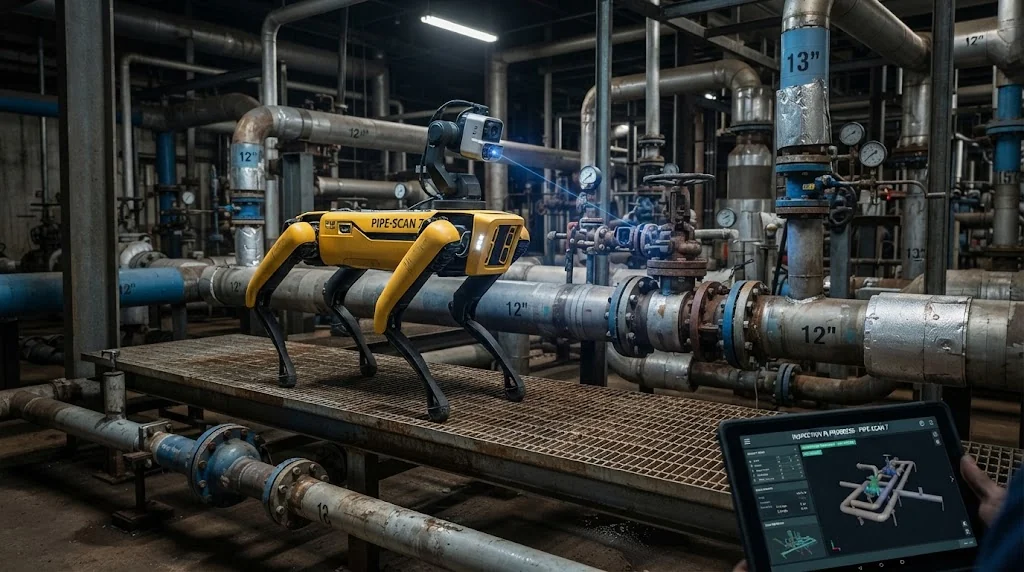
Wheeled Autonomous Mobile Robots (AMRs) offer high energy efficiency and rapid transit speeds on flat, polished concrete surfaces. However, a single 150mm curb, an unmanaged cable bundle, or standard steep industrial stairs will stop a wheeled AMR completely. Tracked robots handle gravel and mud effectively but introduce severe mechanical vibration, high track wear on concrete, and significant risk of slipping on wet steel diamond plating.
Quadruped robotic platforms bridge this operational gap. Through dynamic gait stabilization, a quadruped adjusts foot placement at millisecond intervals to counter sudden slips, climb steep industrial staircases, step over pipe clusters up to 300mm high, and traverse loose ballast.
| Feature / Capability | Wheeled AMRs | Tracked Crawlers | Bionic Quadruped Dogs |
|---|---|---|---|
| Stair Climbing (>30°) | Incapable | Moderate (High Slip Risk) | Exceptional (Omnidirectional) |
| Open Steel Grating Navigation | Prone to Caster Jamming | Acceptable (Causes Wear) | High (Point-Foot Precision) |
| Obstacle Clearance | < 50 mm | Up to 150 mm | Up to 300 mm+ |
| Energy Efficiency | Very High | Moderate | High (Active Power Distribution) |
For operations involving complex architectural layers and multi-deck structures, the RZTL-1 industrial quadruped robot delivers the agile omnidirectional mobility required to safely navigate tight process areas.
Environmental Ruggedness, Ingress Protection, and Explosion-Proof Compliance
Industrial deployment environments subject robotics to severe physical stresses. Plant operators must verify physical ratings before procurement.
Ingress Protection (IP Ratings): Standard dry indoor facilities may only require IP54 protection, but primary process plants demand IP67 ingress protection. An IP67 certification guarantees full protection against fine particulate dust (essential in cement and mining facilities) and continuous immersion in water up to 1 meter for 30 minutes, ensuring resilience against heavy rain and plant washdown procedures.
Thermal Operating Envelopes: High-altitude switchyards and desert flare stacks exhibit extreme temperatures. Select robotics engineered with active liquid cooling, structural aluminum heat dissipation channels, and integrated self-heating battery modules to maintain operations from -20°C up to 55°C without thermal throttling.
Hazardous Zone Approvals: Operating within petrochemical facilities, hydrogen production units, and grain silos requires adherence to strict explosion-proof safety standards, governed internationally by IECEx certification standards and within Europe by the ATEX Directive (2014/34/EU). Units must feature non-sparking chassis materials, intrinsically safe low-power sensor lines, and pressurized inert-gas enclosures for Zone 1 / Class 1 Division 1 areas, or non-incendive designs for Zone 2 / Class 1 Division 2 operating zones.
Modular Tactical Payloads: Mapping Sensors to Equipment Anomalies
The robot chassis serves as the mobility vector; diagnostic value depends entirely on its onboard sensing suite. Fixed payload designs restrict long-term utility. Modern inspection platforms require modular sensor payloads with plug-and-play mechanical rails and dynamic bus interfaces (GigE Vision, RS-485, USB 3.1, and CAN bus).
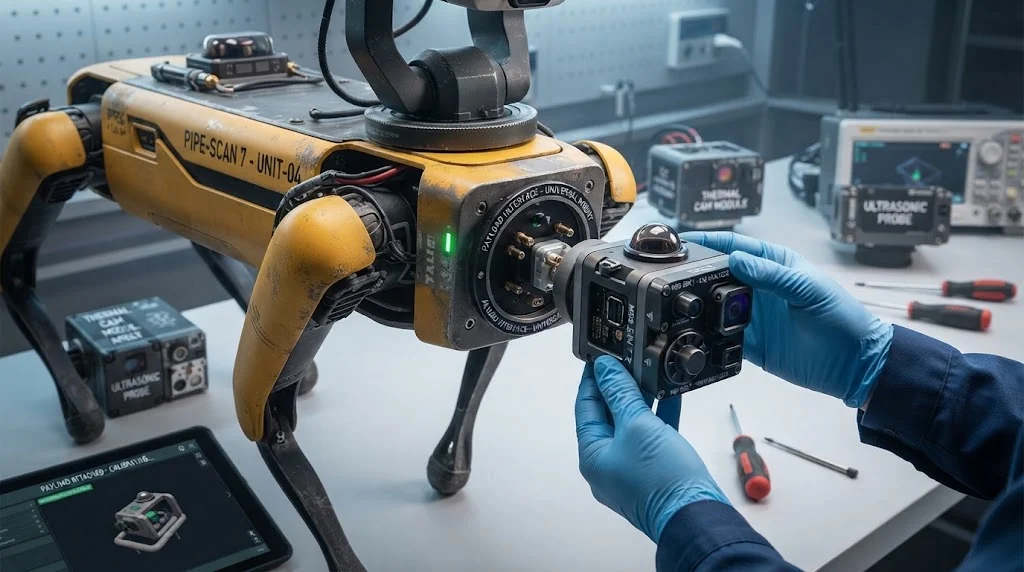
- Dual-Spectrum Optical and Radiometric Thermal Arrays: High-resolution optical zoom (30x–40x optical) visualizes surface corrosion, pinhole cracks, and physical valve positions from safe standoff distances. Uncooled LWIR microbolometer thermal cameras (±2°C accuracy) detect electrical hot spots, bearing overheating, and fluid levels in insulated vessels.
- Acoustic Ultrasound Gas & Partial Discharge Imagers: MEMS microphone arrays localize compressed air leaks, fugitive gas releases, and electrical corona discharge frequencies (2 kHz to 96 kHz) in loud production bays.
- Multi-Gas Sniffer Detection: Integrated environmental sensors capture parts-per-million (PPM) concentrations of Volatile Organic Compounds (VOCs), Hydrogen Sulfide (H₂S), Carbon Monoxide (CO), and Methane (CH₄).
- Robotic Articulated Manipulators: Adding a multi-axis arm allows the platform to swipe access badges, flip circuit breakers, turn stiff ball valves, and place ultrasonic thickness probes directly onto pipe walls.
For high-payload operational profiles requiring multi-sensor payloads alongside heavy robotic manipulation arms, the Tongchui-M1 heavy-duty inspection platform supports dynamic payload capacities up to 20 kg without degrading gait stability.
Autonomous Navigation, SLAM, and GPS-Denied Localization
Outdoor RTK-GPS offers centimeter-level accuracy in open fields, but it fails in industrial canyons, turbine basements, and offshore jacket decks. Robust inspection platforms rely on hybrid sensor fusion to sustain accurate localization.
Industrial navigation combines multi-channel LiDAR with visual-inertial odometry (VIO) using high-precision IMUs. This allows the platform to build an accurate point-cloud representation of its surroundings in real time while tracking its trajectory through dead-reckoning.
Leveraging high-precision 3D LiDAR and SLAM navigation technology enables reliable autonomous waypoint navigation throughout complex, GPS-denied process labyrinths. Real-time local path planning detects dynamic obstacles—such as maintenance cherry-pickers or transient contractors—and plots collision-free bypass paths within 200 milliseconds.
Edge AI Inferencing and Industrial IT/OT SCADA Integration
Relying on high-bandwidth wireless streams back to cloud servers for image classification introduces latency, data transfer costs, and vulnerability to network drops. Modern inspection platforms execute edge computing AI detection directly on local neural processing hardware (100–275 TOPS compute envelopes).
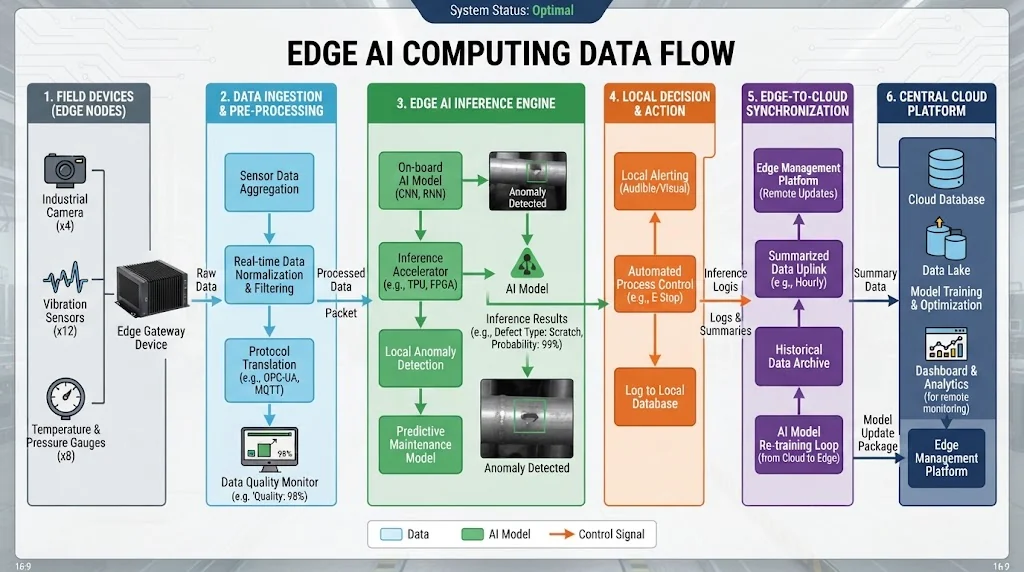
Onboard edge AI models read analog gauges (needle indicators, digital segment LCDs, and magnetic level gauges) with over 99.2% accuracy. They also automate thermal segmentation to flag anomalies against dynamic operational thresholds.
Diagnostic metadata integrates seamlessly into IT/OT ecosystems. Standardized REST APIs, MQTT messaging brokers, and OPC UA pipelines feed structured telemetry directly into plant Supervisory Control and Data Acquisition (SCADA) systems, Distributed Control Systems (DCS), and Computerized Maintenance Management Systems (CMMS) like SAP PM or IBM Maximo.
The QUAD-Spec Protocol: The 4-Step Selection Methodology
Engineering procurement teams should apply the structured QUAD-Spec Protocol to simplify evaluation, avoid costly mismatches, and accelerate deployment.
- Quantitative Environment Mapping: Document plant physical constraints. Measure maximum step risers, grating pitch, minimum aisle widths, ambient thermal swings, explosive gas classifications, and RF connectivity dead zones.
- Utility & Payload Architecture: Define the physical failure modes to monitor. Match diagnostic targets to payload weights, optical zoom metrics, acoustic frequency detection bands, and power draw budgets.
- Autonomous Compute Profiling: Balance onboard Edge AI model inferencing with off-robot communication bandwidth. Verify that the robot’s onboard system can run CV inference locally when operating offline.
- Deployment TCO Validation: Calculate total infrastructure additions—including autonomous recharging base stations, network access points, cyber-secure docking stations, and annual maintenance agreements.
Total Cost of Ownership (TCO) and ROI Modeling: CAPEX vs. OPEX
While an industrial inspection robot requires an upfront CAPEX investment, a complete Total Cost of Ownership (TCO) evaluation shows rapid capital recovery compared to manual inspections.
Beyond direct labor optimization, the true economic return lies in avoiding catastrophic outages. For example, catching a step-up transformer bearing failure 48 hours early avoids unplanned power generation trips that can cost upwards of $350,000 per day.
Specialized Industrial Applications: Emergency Response and Hazard Patrol
Autonomous inspection robots also serve as essential first-response units during sudden industrial anomalies, such as toxic gas releases, containment breaches, or fire alarms.
During an incident, human safety protocols restrict personnel from entering the blast radius. An operator can immediately dispatch an explosion-proof quadruped into the hot zone. The robot enters the danger area, tracks the chemical plume, reads pressure transmitters, and relays live radiometric feeds back to the incident command bunker.
Discover how integrated robotic platforms are configured for firefighting and hazardous emergency response missions to protect human crews during catastrophic plant events.
Frequently Asked Questions (FAQs)
What is the typical battery runtime for an industrial inspection quadruped?
Under continuous walking with a full sensor payload, industrial quadrupeds provide 1.5 to 3.5 hours of active operation per charge. When paired with an autonomous self-charging dock, the robot returns automatically to charge at a 1C/2C rate, achieving 24/7 round-the-clock patrol availability.
How is operational data secured during transmission?
Enterprise-grade platforms employ AES-256 end-to-end data encryption for internal bus networks and outbound communication streams. Robotics can run isolated on local Private 5G or Wi-Fi 6 mesh networks without requiring external cloud connections, ensuring zero unauthorized data egress.
How long does an on-site pilot Proof of Concept (PoC) take to deploy?
A standard onsite PoC typically takes 2 to 4 business days. This involves generating the facility’s 3D LiDAR SLAM map, setting critical inspection waypoints, training edge AI models on site-specific gauges, and verifying baseline SCADA API data flows.
Upgrade Your Plant’s Predictive Maintenance Capabilities
Consult directly with our systems engineers to assess facility drawings, payload requirements, and find the optimal inspection platform for your facility.