The 4-Pillar Mobile Gas Evaluation Standard
Mobile robotic hydrogen sulfide (H2S) monitoring demands matching robotic traverse speed with dynamic sensor cell response times to prevent dangerous spatial detection errors. Deploying autonomous industrial inspection robots allows petrochemical facilities to reliably identify micro-leaks, localize fugitive emissions, and eliminate human entry into lethal, IDLH-level environments.
Industrial operators cannot treat a mobile gas detection payload like a standard stationary detector. Fixed points monitor stationary diffusion volumes, whereas a moving platform introduces dynamic airflow, rapid pressure differentials, and continuous physical vibration. Evaluating mobile systems requires a clear engineering framework across four core criteria:
- Dynamic Response Latency (t90 ≤ 15 s at 1.0 m/s): Sensor cells must react rapidly enough to register localized micro-plumes before the platform traverses past the leak origin.
- Environmental Ingress & Ruggedness (IP67 + ATEX/IECEx): Payloads must endure corrosive sour environments, heavy rain, and hydrocarbon vapors without signal degradation or ignition hazards.
- Cross-Sensitivity Rejection Ratio: The system must suppress false positives triggered by co-existing refinery gases such as sulfur dioxide (SO2), mercaptans, and carbon monoxide (CO).
- Real-Time Spatial Heatmapping Integration: Gas telemetry must feed directly into the robot’s SLAM navigation stack to bind parts-per-million (ppm) readings with centimeter-accurate 3D coordinates.
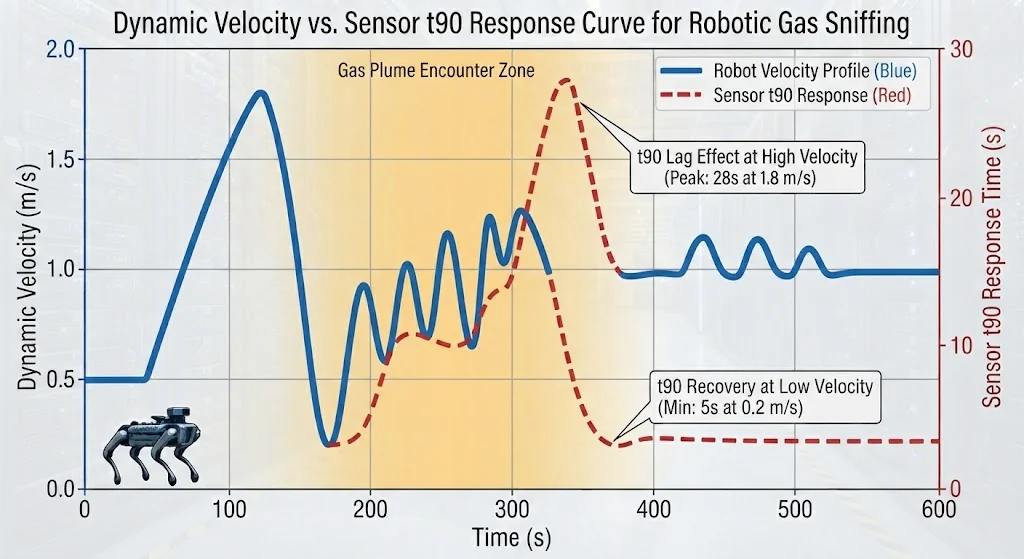
Sensor Detection Physics: Electrochemical vs. MOS vs. Optical NDIR
Selecting the correct sensor transducer dictates detection limits, payload power consumption, and mechanical layout on the quadruped chassis. Three primary sensing principles dominate industrial toxic gas monitoring.
1. Electrochemical (EC) Sensing Cells
Electrochemical cells operate through the chemical oxidation of H2S at a sensing electrode, generating a current directly proportional to gas concentration: H2S + 4H2O → H2SO4 + 8H+ + 8e–. These sensors deliver high resolution (down to 0.1 ppm) and ultra-low power consumption (under 5 mA at 3.3 V), making them the primary choice for industrial quadrupeds.
2. Metal Oxide Semiconductors (MOS)
MOS sensors measure the electrical resistance change across a heated tin dioxide (SnO2) crystal lattice when exposed to reducing gases. While mechanically resilient with long operational lifespans (up to 10 years), their high power draw (200 mW to 800 mW per bead) and significant baseline drift under varying humidity make them secondary options for mobile robotics.
3. Optical and Spectroscopic Detectors (NDIR & TDLAS)
Tunable Diode Laser Absorption Spectroscopy (TDLAS) and Non-Dispersive Infrared (NDIR) sensors measure light absorption at targeted infrared absorption bands (such as 1.57 μm for H2S). They eliminate chemical consumption and sensor poisoning risks, offering instantaneous optical response times (t90 < 2 s). However, high payload weight (over 1.5 kg) and power consumption restrict their deployment to heavy-payload quadruped variants.
| Sensor Technology | Measurement Range | Resolution | Dynamic Response (t90) | Power Draw | Payload Weight |
|---|---|---|---|---|---|
| Dual Electrochemical (EC) | 0 to 200 ppm | 0.1 ppm | 8 to 12 s (pumped) | < 0.1 W | 250 g to 450 g |
| Metal Oxide (MOS) | 1 to 500 ppm | 1.0 ppm | 15 to 30 s | 0.8 W to 1.5 W | 350 g |
| Open-Path TDLAS | 0 to 500 ppm·m | 1.0 ppm·m | < 2 s | 8 W to 15 W | 1,800 g |
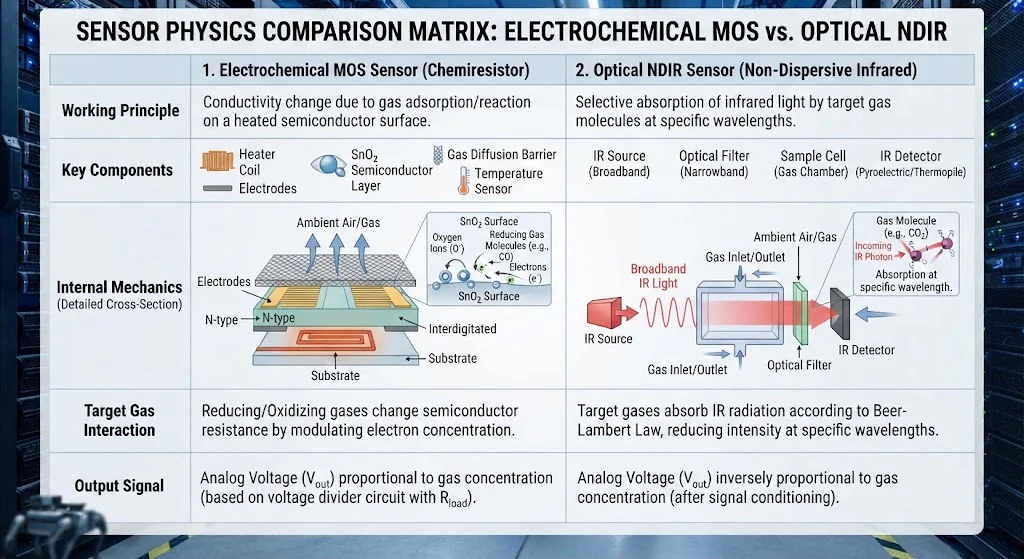
Dynamic Sampling Calculations: Robot Transit Velocity vs. Sensor t90 Latency
Operating a mobile gas sniffer introduces spatial smearing if the platform’s transit speed exceeds the gas intake and cell reaction capability. Passive diffusion caps sampling rates; mobile robots require active micro-aspiration pumps delivering a stable intake flow (Qintake ≥ 500 mL/min).
Dynamic localization error (Δx) is defined by the robot’s traverse speed (vrobot), pneumatic transport tube delay (ttransport), and sensor cell reaction latency (t90):
Dynamic Localization Error Equation:
Δx = vrobot × (ttransport + t90)
Where: ttransport = (Ltube × π × r2) / Qpump
For example, with a 0.5 m intake tube (r = 2 mm) and a pump flow rate of 500 mL/min, pneumatic transport delay ttransport equals 0.75 s. If the electrochemical sensor exhibits a t90 of 12 s and the quadruped traverses at 1.2 m/s, the spatial error reaches:
Δx = 1.2 m/s × (0.75 s + 12 s) = 15.3 meters.
In a dense valve manifold farm, a 15-meter spatial error causes the operator to flag the incorrect pipe rack. Quadruped patrol algorithms must dynamically throttle forward velocity to between 0.3 m/s and 0.6 m/s upon detecting any concentration exceeding baseline levels (> 1.0 ppm).
Environmental Operating Boundaries and Cross-Sensitivity Suppression
Petrochemical operating envelopes range from sub-zero winter turnarounds to desert heat. Extreme conditions induce severe baseline drift and electrolyte dehydration in electrochemical cells.
Thermal and Humidity Compensation
Standard electrochemical cells exhibit temperature dependencies governed by the Arrhenius equation, shifting baseline zero-readings by up to 0.2 ppm/°C outside the 20 °C reference point. Industrial payloads must incorporate active internal temperature (PT100/PT1000) and relative humidity sensors. Onboard firmware applies continuous polynomial correction across the operational range of -20 °C to +50 °C.
Chemical Cross-Sensitivity Suppression
Sour gas processing plants contain multi-component hydrocarbon atmospheres. Unfiltered electrochemical electrodes cross-react with other reducing compounds:
- Sulfur Dioxide (SO2): Induces negative baseline shifts if untreated. Integrated internal chemical filter membranes block SO2 transmission up to 50 ppm.
- Mercaptans (Methyl/Ethyl Mercaptan): Generate positive false-positive spikes. Dual-electrode differential arrays separate H2S oxidation potential from high-molecular-weight thiols.
- Carbon Monoxide (CO): Addressed using specialized four-electrode auxiliary compensating cells that subtract ambient CO background interference.
Compliance with OSHA 29 CFR 1910.1000 Table Z-2 (Acceptable Ceiling Concentration of 20 ppm) and NIOSH IDLH Limits (100 ppm) mandates absolute zero-drift stability below 0.5 ppm.
Mechanical & Electrical Integration on Industrial Quadruped Platforms
Integrating hazardous gas sensing modules onto quadruped platforms like the RZTL-1 hazardous environment robot dog requires careful electrical and mechanical isolation.
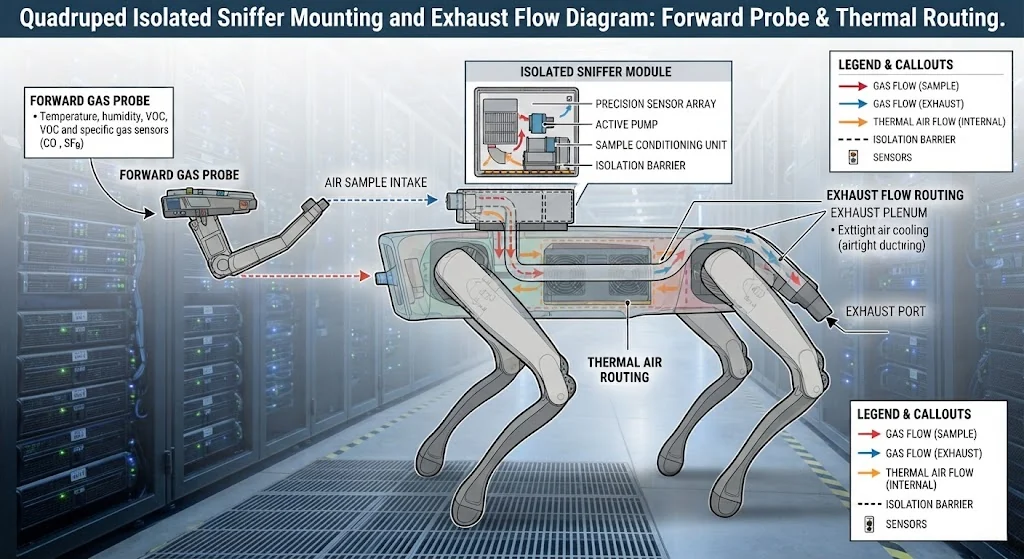
Intake Placement and Exhaust Isolation
The sniffer intake probe must extend beyond the robot’s front chassis plane. Mounting the intake near the internal electronic cooling fan exhausts introduces artificial dilution from platform heat rejection, skewing readings by up to 40%.
Vibration Damping and Ingress Sealing
Legged locomotion produces cyclic dynamic impacts (1.5g to 3.0g peak shock loads). Gas sensing assemblies must integrate tuned silicone vibration isolators (Shore 40A durometer) to prevent mechanical stress on ceramic sensor pinouts. Payloads require full IP67 ingress sealing, utilizing hydrophobic PTFE membranes (0.2 μm pore size) over gas sampling ports to block driving rain and steam-clean jets.
Benchmark Deployment: Sour Gas Manifold Perimeter Tracking
In our petrochemical field testing across sour gas extraction manifolds, industrial quadruped platforms are subjected to high-vibration gravel beds, standing water pools, and heavy pipe-rack infrastructure where human entry requires continuous supplied-air respirators.
Testing deployed the Intelligent Robot Dog platform equipped with a dual-redundant pumped electrochemical cell (0 to 200 ppm range, 0.1 ppm resolution, t90 < 12 s) running continuous dynamic bump testing before and after each 45-minute autonomous mission.
- Ground-Hugging Plume Tracking: Because H2S is heavier than air (vapor density = 1.19 relative to air = 1.0), the gas pools in low elevations, trench drains, and gravel foundations. The quadruped platform sampled continuously at 0.4 m elevation, detecting a 3.4 ppm flange weep 18 minutes before elevated fixed optical sensors registered any concentration.
- Dynamic Calibration Retention: Sensor baseline stability maintained ±0.2 ppm deviation across an 8-hour continuous patrol cycle spanning 4 °C morning fog to 34 °C direct midday sunlight.
Autonomous Safety Interlocks, IDLH Escalation, and 3D ROS2 Heatmapping
Mobile toxic gas detection requires closed-loop integration with the platform’s navigation stack. Using SLAM navigation and real-time mapping, gas concentration values are published via a dedicated Robot Operating System (ROS 2) telemetry node (`/gas/h2s/concentration`).
When integrated into emergency response robotics solutions, the system enforces strict hierarchical autonomous safety interlocks:
- Level 1 (OSHA PEL 10 ppm): Platform slows velocity to 0.3 m/s, begins local spiral plume sampling, and transmits high-priority telemetry alerts over 4G/5G/LoRa mesh networks.
- Level 2 (OSHA Ceiling 20 ppm): Activates visual strobe beacon, initiates localized 360-degree PTZ optical gas imaging (OGI) snapshot, and notifies the central control room (DCS).
- Level 3 (NIOSH IDLH 100 ppm): Triggers immediate automated retreat logic. The robot aborts forward motion and backtracks along its mapped SLAM trajectory to a safe perimeter, eliminating the risk of electronic stranding in lethal gas concentrations.
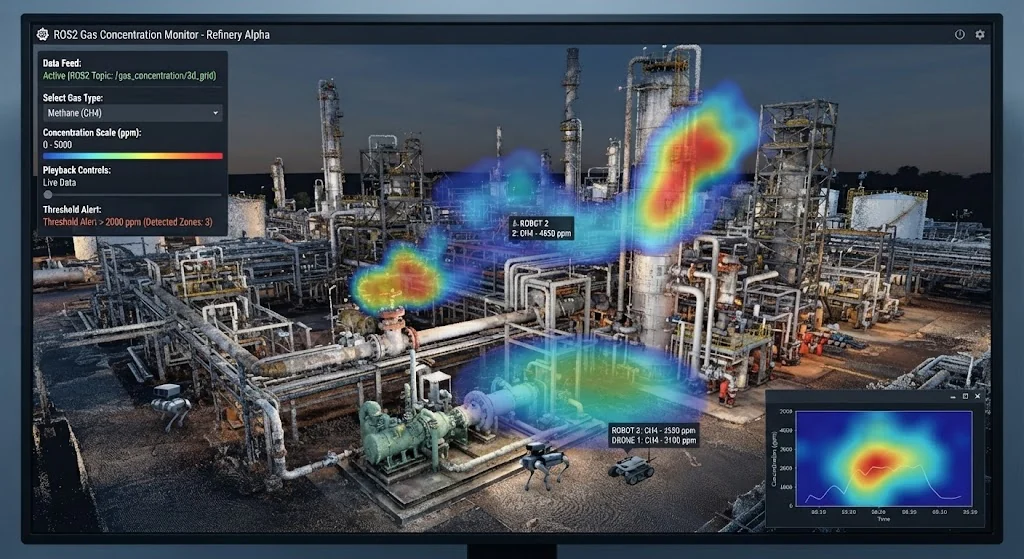
Comparative Analysis: Quadruped Robots vs. Fixed Detectors vs. Aerial Drones
Plant safety directors evaluate mobile robotics against legacy fixed gas grids and aerial unmanned aerial vehicles (UAVs). Each technology serves specific structural domains, but ground quadrupeds solve key blind spots.
| Inspection Parameter | Fixed Detection Grid | Aerial Drones (UAVs) | Quadruped Robot Dogs |
|---|---|---|---|
| Sampling Elevation | Fixed (typically 1.5 m to 3.0 m) | Above structure (> 5.0 m) | Ground-breathing (0.3 m to 0.8 m) |
| Plume Aerodynamics | Undisturbed natural diffusion | Severe rotor downwash dispersal | Zero downwash; clean intake flow |
| Spatial Blind Spots | High (unmonitored zones between sensors) | Medium (cannot enter indoor pipe racks) | None (dynamic 3D autonomous patrol) |
| Continuous Run Time | 24/7 continuous wired power | 20 to 35 minutes per battery | 2 to 4 hours (automated docking ready) |
| Relative TCO | High cabling & installation capex | High pilot licensing & maintenance | Low (autonomous multi-mission fleet) |
Because H2S is denser than air, aerial drones routinely blow away low-lying gas plumes due to propeller downwash velocities exceeding 10 m/s. Quadrupeds maintain steady ground-level intake without disturbing natural plume accumulation.
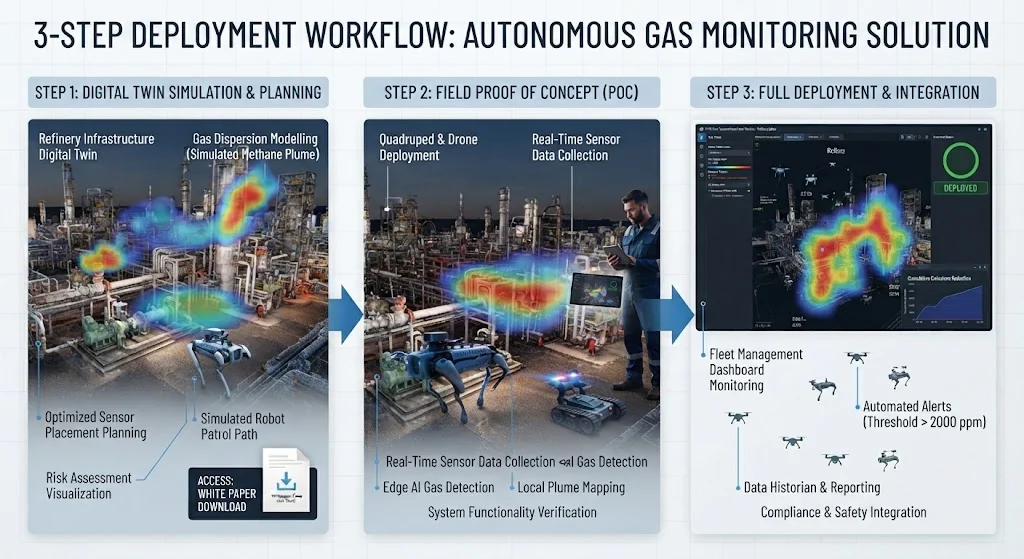
The 3-Step Low-Threshold Action Path for Industrial Operators
Deploying mobile hazardous gas detection requires an engineered validation workflow to guarantee site integration, regulatory adherence, and telemetry reliability.
- Step 1: Download the Hazardous Gas Detection Architecture Whitepaper: Review detailed circuit diagrams, ATEX integration requirements, and dynamic plume localization algorithms.
- Step 2: Submit Site Layouts for Digital Twin Inspection Modeling: Provide your unit CAD files or GIS maps to simulate patrol routes, optimize transit velocities, and map hazardous coverage zones.
- Step 3: Schedule a Live Autonomous Proof-of-Concept: Validate ground-truth sniffing performance and plant DCS Modbus/OPC-UA data exchange under real-world operating conditions.
Consult with our custom robotics payload integration team to configure dual-gas or multi-gas monitoring systems tailored to your plant safety thresholds.
Frequently Asked Questions (FAQ)
Are quadruped robot dogs certified for ATEX Zone 1 / Zone 2 hazardous areas?
Specialized industrial quadruped configurations are engineered to meet ATEX Zone 2 (Ex ec / Ex ic) and Zone 1 (Ex d / Ex ib) explosion-proof requirements. This includes sealed brushless motor enclosures, intrinsically safe payload power distribution, non-sparking foot materials, and positive-pressure purged electronics bays.
How is mobile sensor bump testing conducted in autonomous fleets?
Autonomous docking stations can be fitted with automated bump-test manifolds. When the robot returns to dock, an automated valve releases a 5-second certified test gas burst (e.g., 25 ppm H2S in nitrogen) to verify sensor responsiveness, log response latency, and clear zero-point calibrations before authorizing the next patrol mission.
Does running a continuous aspiration pump significantly degrade robot battery run time?
No. Micro-diaphragm aspiration pumps draw approximately 1.2 W to 2.5 W of continuous electrical power. Given that an industrial quadruped battery bank operates between 600 Wh and 1200 Wh, the gas sniffer payload accounts for less than 0.3% of total vehicle energy consumption.
How do mobile gas concentration readings integrate into existing plant SCADA/DCS systems?
Mobile quadruped base stations translate ROS 2 JSON gas telemetry packets into standard industrial automation protocols, including Modbus TCP, OPC-UA, and MQTT. Readings appear on control room consoles with dynamic geographic coordinates just like standard fixed-detector points.
Upgrade Your Hazardous Gas Monitoring Infrastructure
Eliminate human entry risks and bridge stationary detection blind spots with custom quadruped robotics payloads.