Explosion-Proof vs. Intrinsically Safe Robots: The Core Distinction
Explosion-proof robots rely on heavy mechanical containment (such as flameproof Ex d enclosures) designed to withstand an internal gas ignition and prevent flames from escaping into the surrounding volatile atmosphere. In contrast, intrinsically safe robots (Ex i) operate by restricting internal electrical energy and thermal output below the exact ignition thresholds of specific flammable gases, completely eliminating spark generation at the circuit level.
Choosing between these two protection concepts defines how mobile autonomous systems operate within energy-dense industrial processing facilities. While static sensors frequently leverage low-voltage intrinsic safety, mobile robotic systems present distinct mechanical and electrical power demands.

IEC 60079-0 Definition: Explosion protection encompasses engineering techniques applied to equipment to prevent it from igniting surrounding explosive gas, vapor, mist, or combustible dust atmospheres during normal operation or anticipated electrical faults.
In practice, modern hazardous area autonomous patrol units rarely rely on a single isolation technique. Instead, advanced engineering teams apply these methods selectively across the powertrain, compute core, and sensor suite.
Core Regulatory Standards: ATEX, IECEx, and NEC Class/Division Frameworks
Deploying automated inspection assets across processing plants requires strict alignment with regional safety directives. In the European Union, the legal baseline is the ATEX Directive 2014/34/EU, while global markets frequently mandate testing under the international IECEx System via the IEC 60079 series.
North American installations operate under the National Electrical Code (NEC Articles 500-505) published by the NFPA, alongside product testing to standards such as the UL 913 Standard for intrinsically safe apparatus.
| Atmosphere Presence | ATEX / IECEx Zone | NEC 500 Model | Applicable Robotics Protection |
|---|---|---|---|
| Continuous (>1,000 hrs/yr) | Zone 0 (Gas) / Zone 20 (Dust) | Class I, Division 1 | Ex ia (Pure Intrinsic Safety only) |
| Occasional (10–1,000 hrs/yr) | Zone 1 (Gas) / Zone 21 (Dust) | Class I, Division 1 | Ex d, Ex pxb, Ex ib, Hybrid Enclosures |
| Abnormal (<10 hrs/yr) | Zone 2 (Gas) / Zone 22 (Dust) | Class I, Division 2 | Ex ec, Ex pzc, Ex ic, Sealed Enclosures |
Temperature Classification (T-Classes)
Containment alone is insufficient. If the chassis or motor surfaces exceed the auto-ignition temperature of atmospheric gases, an explosion will occur outside the robot without any direct spark.
- T1 (450°C) / T2 (300°C): Common for simple methane or light hydrocarbon utility rooms.
- T3 (200°C) / T4 (135°C): The required baseline for Class I Division 1 Groups A-D refining units processing gasoline, diesel, hexane, and ethylene.
- T5 (100°C) / T6 (85°C): Demanded in high-risk zones containing carbon disulfide or specialized chemical compounds.
The “Mobile Robot Paradox”: Why Pure Intrinsic Safety Fails for Quadrupeds
In our manufacturing experience and dynamometer stress testing, agile locomotion reveals a fundamental physical constraint: dynamic quadruped movement requires rapid current surges that violate pure Ex i circuit limits.
Under the Ex i Intrinsic Safety standard (IEC 60079-11), total circuit power is strictly governed by ignition curves. For Group IIC gases (such as hydrogen and acetylene), allowable spark energy cannot exceed 20 to 40 microjoules (µJ), capping electrical power at roughly 1.5 to 2.0 Watts under typical industrial voltages.
Engineering Insight — Actuator Surge Dynamics: A 50 kg legged robot traversing industrial stairs draws between 600W and 1,200W of continuous baseline power, spiking past 3,200W during dynamic stabilization maneuvers. This is three orders of magnitude above maximum Ex ia/ib thresholds.
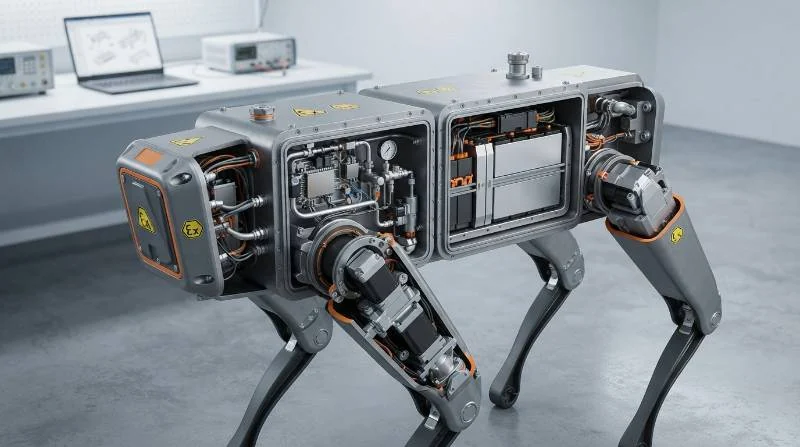
Consequently, an ATEX Zone 1 robot cannot operate as a purely intrinsically safe device. High-performance models like the RZTL-1 explosion-proof robot combine specialized flameproof enclosures with positive-pressure containment for dynamic mobility.
Technical Comparison: Flameproof Containment (Ex d) vs. Purged Pressurization (Ex p)
Robotic structural engineers deploy two primary containment strategies to safely handle high-power battery and powertrain components in explosive environments.
1. Flameproof Enclosures (Ex d / Explosion-Proof)
Ex d enclosures assume volatile gas will enter the device and ignite. Precision-machined flame paths cool hot expanding gases before they can vent into the ambient plant environment, preventing external ignition.
- Advantage: Operates autonomously without continuous protective gas supply bottles.
- Limitation: Heavy cast aluminum or stainless steel shells increase structural payload mass and reduce operational runtime.
2. Pressurized Purging Systems (Ex p)
Ex p systems maintain an internal overpressure of inert gas (such as dry instrument nitrogen or clean compressed air) relative to the external atmosphere. This positive pressure physically prevents external hydrocarbon gases from penetrating the chassis.
- Advantage: Uses lightweight polymer or thin-wall composite shells to optimize agility and battery endurance.
- Limitation: Requires pressure regulators and fail-safe interlocks that cut power if internal differential pressure drops below 50 Pascals.
| Design Metric | Ex d Flameproof Containment | Ex p Pressurized Enclosure |
|---|---|---|
| Chassis Weight Impact | High (+15 kg to +30 kg) | Moderate (+3 kg to +8 kg) |
| Field Serviceability | Simple mechanical access (requires torque spec) | Requires purge pre-cycle verification |
| Dynamic Seal Wear | Critical flame gap tolerances (<0.15 mm) | Tolerates slight leakage via active top-up |
Battery Safety, Thermal Runaway Mitigation, and Ingress Engineering
High-capacity Lithium Iron Phosphate (LiFePO4) or Nickel Manganese Cobalt (NMC) power packs present severe fire and explosion risks if subjected to internal cell shorts or mechanical puncture.
Deploying an industrial inspection robot dog in hydrocarbon environments requires multi-tiered safety hardware built directly into the battery pack.

Battery Protection Architecture
- Hermetic Cell Potting: Encapsulating battery cells within non-conductive, thermally conductive silicone elastomers blocks internal arc propagation.
- Sintered Metal Flame Arrestors: Stainless steel mesh vents equalize internal gas expansion while cooling vent plumes below the ignition point of external ethylene or propane vapors.
- Multi-Channel BMS Isolation: Triple-redundant voltage, current, and temperature monitoring circuits instantly disconnect the main bus contactors within 12 milliseconds of an anomaly.
- Environmental Ingress Sealing: Achieving an IP67 ingress protection rating safeguards sensitive drive electronics from corrosive salt spray, petrochemical washdowns, and microfine conductive dusts.
Modular Tactical Payloads: Integrating Sensors, Optical PTZ, and LiDAR
A mobile robot delivers value through its sensor suite. Equipping an autonomous platform for hazardous inspections requires isolating high-voltage computing hardware from external sensing interfaces.
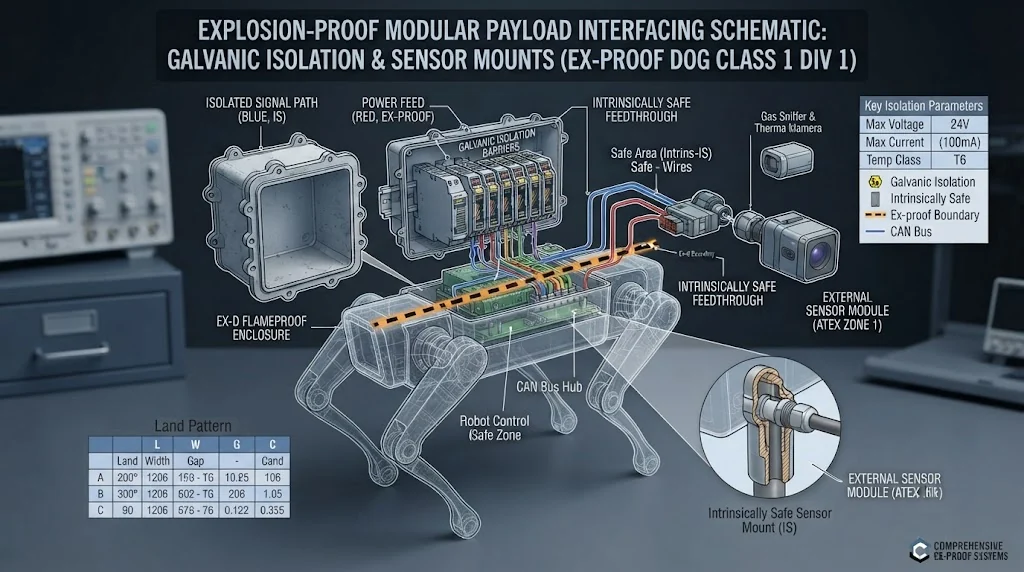
Sensor integration combines explosion-proof core computing with intrinsically safe heads via certified galvanic isolation barriers:
- Optical & Radiometric Thermal PTZ: Housed in Ex d enclosures with anti-reflective sapphire glass viewports, delivering continuous surface temperature metrics.
- Tunable Diode Laser Gas Analyzers: Utilizes intrinsically safe (Ex ia/ib) optical emission heads to detect sub-ppm methane plumes without open sparks.
- Explosion-Proof LiDAR & Vision: Sealed within purged housings to feed the autonomous SLAM navigation technology, allowing real-time mapping without relying on facility GPS infrastructure.
The Intelligent Robot Dog Hybrid Hazardous-Zone Architecture Framework (H²-ZAF)
To eliminate the trade-offs between intrinsic safety power limits and flameproof weight penalties, our engineering team developed the Hybrid Hazardous-Zone Architecture Framework (H²-ZAF). This methodology governs our hardware isolation and autonomous patrol logic.
Tier 1: Heavy Powertrain & Battery Isolation (Ex d / Ex p)
High-torque brushless DC motors, dynamic joint servos, and primary lithium battery systems are sealed inside cast aluminum Ex d sub-chassis or positive-pressure compartments. This ensures high-power locomotion remains completely isolated from ambient air.
Tier 2: Low-Voltage Telemetry & Payload Isolation (Ex i)
External gas sniffers, ultrasonic acoustic microphones, and emergency stop circuits run through Zener barriers, restricting operational loop energy below 1.2 Watts. Payload swaps do not compromise main chassis integrity.
Tier 3: Autonomous Dynamic Thermal Throttling
Onboard edge AI monitors internal and skin temperatures across all twelve robotic joints. If localized surface readings approach 120°C in a T4-rated environment (135°C limit), the robot adjusts its gait velocity and computational load, keeping skin temperatures safely within compliance margins.
Industrial Deployment: Offshore Platforms, Chemical Facilities, and Emergency Response
Transitioning from human inspection teams to autonomous quadruped robotics yields measurable safety and operational improvements across upstream and downstream facilities.
In volatile environments, manual inspections require hot work permits, specialized PPE, and gas monitoring escorts. Integrating specialized emergency response robotics allows operators to assess gas leaks, fire risks, and pressure excursions before dispatching human crews.
Operational Data Point: Reviewing real-world petrochemical case studies shows that facility-wide autonomous robotic patrols lower human hazardous-area exposure hours by up to 78% while identifying fugitive methane leaks 4.2 times faster than manual rounds.
| Cost & Safety Vector | Manual Human Rounds | H²-ZAF Quadruped Robot Fleet |
|---|---|---|
| Annual Inspection Labor | $420,000 (Multi-shift staffing) | $65,000 (Supervisory oversight) |
| Permit-to-Work Delays | 2 to 4 hours per inspection cycle | Zero (Pre-cleared autonomous missions) |
| OSHA / EHS Risk Profile | High (H2S exposure, fall risks) | Near Zero (Unmanned perimeter operation) |
Frequently Asked Questions
Can a quadruped robot dog receive full Zone 1 certification?
Yes. Quadruped robots achieve Zone 1 compliance by leveraging hybrid protection (Ex d flameproof containment or Ex p pressurization) for actuators and batteries alongside Ex i intrinsically safe sensors, fully tested under IEC 60079 standards.
Can robot batteries be hot-swapped inside hazardous plant areas?
No. Opening an Ex d or Ex p enclosure within a live Zone 1 or Zone 2 area violates certification unless the area has been declassified using strict hot-work permit sniffing protocols. Certified robots typically return to non-hazardous dock shelters or use inductive charging systems.
How often must explosion-proof robots undergo physical re-certification?
Flamepath tolerances, seal integrity, and pressure relief systems require formal visual checks every 6 months and a certified tear-down inspection every 24 to 36 months, in accordance with IEC 60079-17 guidelines.
How do robotic platforms handle electrostatic discharge risks?
Chassis skins and external fairings are fabricated from carbon-loaded dissipative polymers or grounded aluminum alloys with a surface resistivity below 1 gigaohm (10^9 Ω), preventing electrostatic charge accumulation.