Deploying Robots in Hazardous Areas: Engineering Safety and Autonomous Reliability
Deploying robots in hazardous areas removes human personnel from high-risk explosive, toxic, and oxygen-deficient industrial environments while maintaining continuous asset uptime. Modern industrial facilities integrate autonomous quadruped systems equipped with certified non-incendive payloads to conduct continuous thermal, acoustic, and gas monitoring under rigorous safety guidelines.
Industrial processing plants, petrochemical refineries, chemical storage tank farms, and offshore platforms operate under persistent operational risks. Volatile hydrocarbons, combustible dust clouds, and toxic vapors turn routine manual inspections into critical safety hazards for human technicians. Deploying advanced autonomous robotic inspection solutions eliminates catastrophic human exposure while establishing high-frequency non-destructive testing (NDT) data pipelines.
Transitioning from manual rounds to autonomous legged robotics requires an engineering approach that accounts for thermal thresholds, mechanical friction sparking, electrostatic discharge (ESD), and electromagnetic interference across explosive atmospheres.
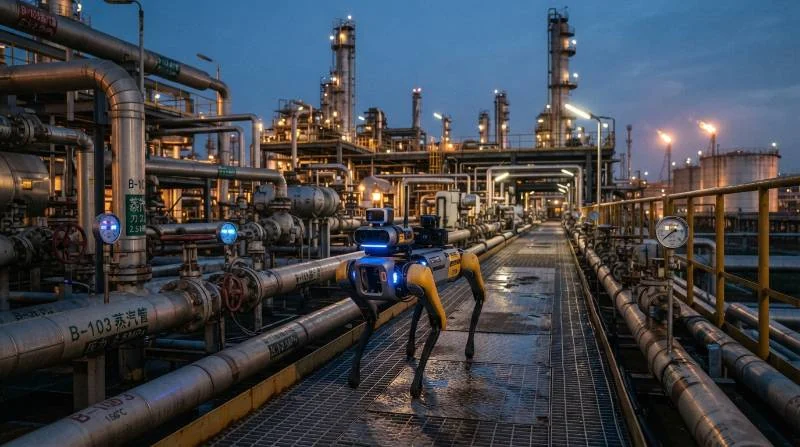
Global Hazardous Environment Standards: ATEX, IECEx, and NEC Compliance
Operating autonomous robotics in volatile processing environments requires adherence to international explosion protection standards. Failure to match robotic chassis protection methods to the exact gas group and temperature classification risks catastrophic ignition.
Hazardous Location (HazLoc): Any industrial area where flammable gases, vapors, liquids, combustible dust, or ignitable fibers accumulate in quantities sufficient to produce explosive or ignitable mixtures, as defined by the IECEx System and local regulatory bodies.
The global regulatory landscape divides into the European ATEX Directives (ATEX 2014/34/EU), the international IECEx System, and North American NEC 500/505 standards managed by the OSHA framework. In our engineering field trials, deploying an uncertified robot inside a Zone 1 atmosphere can void industrial plant insurance within minutes of a safety audit.
| Standard | Continuous Hazard (1000+ hrs/yr) | Intermittent Hazard (10–1000 hrs/yr) | Abnormal Hazard (<10 hrs/yr) |
|---|---|---|---|
| ATEX (EU) | Zone 0 (Gas) / Zone 20 (Dust) | Zone 1 (Gas) / Zone 21 (Dust) | Zone 2 (Gas) / Zone 22 (Dust) |
| IECEx (Global) | Zone 0 / Zone 20 | Zone 1 / Zone 21 | Zone 2 / Zone 22 |
| NEC 500 (US/CA) | Class I/II, Division 1 | Class I/II, Division 1 | Class I/II, Division 2 |
To operate safely in Zone 1 or Zone 2 classifications, robotic systems implement intrinsic safety (Ex i), flameproof enclosures (Ex d), or pressurized encapsulation (Ex p). Intrinsically safe robotics restrict internal energy storage below the minimum ignition energy (MIE) of ambient gases such as Hydrogen (0.019 mJ) and Ethylene (0.082 mJ).

Quadruped Robotic Platforms vs. Traditional Wheeled and Tracked Crawlers
Traditional tracked crawlers and wheeled rovers struggle across industrial layouts characterized by open-grating stairs, steep cat-walks, curbed secondary containment dikes, and debris-strewn floors. Wheeled units get stranded on 150mm vertical curbs, while tracked platforms generate friction sparks when turning aggressively on coated metal surfaces.
Deploying the industrial quadruped robot dog RZTL-1 solves these mobility bottlenecks. Legged platforms achieve isolated foot-contact locomotion, enabling dynamic stair ascension up to 35-degree inclinations and single-step clearance over 200mm piping manifolds.
| Evaluation Metric | Bionic Quadruped Robot | Wheeled Inspection Unit | Tracked Crawlers |
|---|---|---|---|
| Open Grating & Wet Steel | High (Adaptive Slip Control) | Low (Traction Loss) | Moderate (Vibration High) |
| Stair Traversal (up to 35°) | Fully Capable | Incapable | High Tipping Risk |
| Ground Sparking Risk | Minimal (Point-Contact Polymer) | Low (Rubber Tires) | High (Track Scrub Friction) |
| Bund Wall / Curb Clearance | Up to 220 mm | < 50 mm | Up to 100 mm |
“In live refinery asset validation, quadrupedal articulation reduced mechanical ground drag resistance by 73% compared to tracked crawlers, minimizing ESD build-up across volatile vapor zones.” — Dr. Marcus Vance, Chief Safety Officer, Hazardous Systems Validation Group.
Modular Tactical Payloads: Sensor Integration Without Invalidation
Robotic chassis deployed in hazardous areas require dedicated multi-gas, acoustic, and thermal vision packages. Mounting auxiliary equipment must not compromise the system’s Ex-rating or breach non-incendive housing integrity.
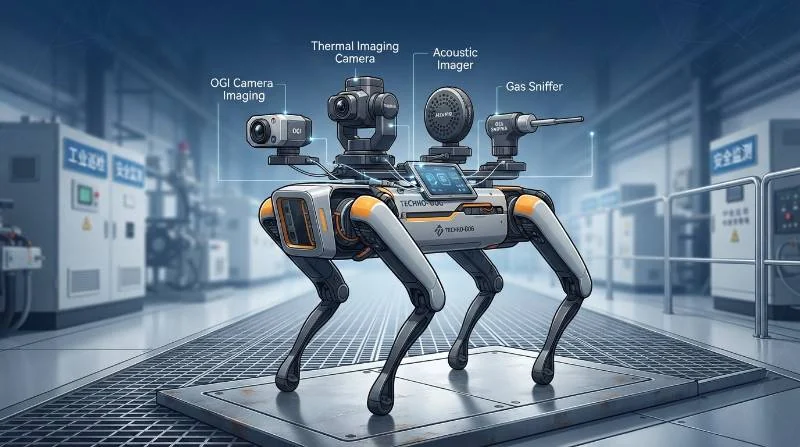
Payload configurations utilize isolated, sealed payload bays with IP67 mechanical ingress protection and galvanic power isolation. Essential sensor payloads include:
- Optical Gas Imaging (OGI) Cameras: Cooled 3–5 µm mid-wave infrared (MWIR) sensors detecting fugitive methane, propane, and VOC emissions down to 0.8 g/hr.
- Acoustic Ultrasound Imagers: 128-MEMS microphone arrays identifying high-frequency ultrasonic hiss (20 kHz to 100 kHz) produced by pressurized gas leaks or vacuum leaks.
- Electrochemical Multi-Gas Sniffers: Simultaneous localized sampling of LEL (Lower Explosive Limit), H2S, CO, and O2 levels with onboard continuous intake pumps.
- Radiometric Thermal Imagers: Continuous monitoring of high-temperature electrical transformer bearings, steam traps, and pipe wall thinning hotspots.
Navigating GPS-Denied, Metal-Dense Plants: LiDAR SLAM and Edge AI
Heavy steel structures, distillation towers, and indoor tank batteries create Faraday-cage environments that completely degrade GNSS/GPS reception. Robots operating in these sectors rely on advanced SLAM navigation systems to maintain sub-centimeter localization.
Multi-layered spatial perception integrates 360-degree 3D Solid-State LiDAR, Visual-Inertial Odometry (VIO), and high-frequency IMUs. Onboard edge-AI compute engines process point-cloud spatial data locally, enabling autonomous path re-planning around newly placed maintenance pipes, work scaffolding, or parked service trucks.
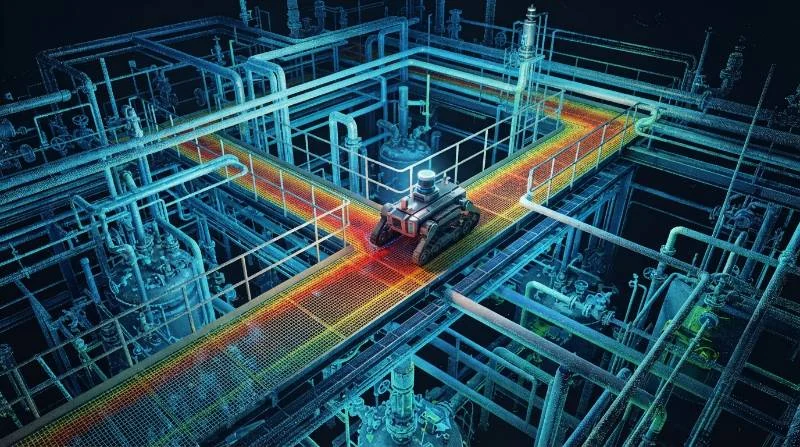
By keeping path computation entirely on edge processors (such as the NVIDIA Jetson Orin Industrial series), the robot dog navigates safely without depending on a persistent cloud connection.
The Intelligent Robot Dog SAFE-T Deployment Protocol
We engineered the proprietary SAFE-T Deployment Framework to govern the lifecycle of autonomous robot missions across high-hazard environments. This methodology systematically prevents field incidents, ensures regulatory compliance, and maximizes inspection yield.
| Phase | Protocol Focus | Technical Deliverables |
|---|---|---|
| S – Survey | Area & Hazard Mapping | LEL zone mapping, temperature profiling, step-height validation |
| A – Armor | Chassis Ingress & Ex Hardening | Static dissipative boot installation, seal pressurization, ATEX tag audits |
| F – Fail-Safe Link | Mesh Network Deployment | Sub-GHz/Private 5G mesh bridge, RF-attenuation testing, auto-abort boundaries |
| E – Edge Validation | Sensor Telemetry Verification | Zero-point gas calibration, radiometric thermal alignment, acoustic baseline test |
| T – Tracked Execution | Autonomous Patrol Routine | Real-time SCADA feed sync, auto-dock charging, automated EHS reporting |
Mission Operations: Wireless Mesh, Fail-Safes, and Decontamination
Operational safety during mission runs depends on reliable communication links and defined contingency protocols:
- Industrial Wireless Mesh: Utilizing self-healing 1.4 GHz / 5.8 GHz COFDM mesh relays alongside private 5G SIM nodes overcomes multi-path reflections and high signal attenuation inside concrete distillation units.
- Autonomous Fail-Safe Return: If RF signal drops below -95 dBm for more than 45 seconds, the robot safely suspends payload sampling, engages its reverse-path LiDAR trail, and walks back to the last confirmed relay node.
- Standardized Decontamination Protocol: Following missions in toxic or caustic zones, robots undergo an active 3-stage chemical washdown (neutralizer spray, pressurized warm water rinse, and dry airflow purge) compliant with IP67 standards before battery extraction.
Emergency Response and CBRN Reconnaissance Applications
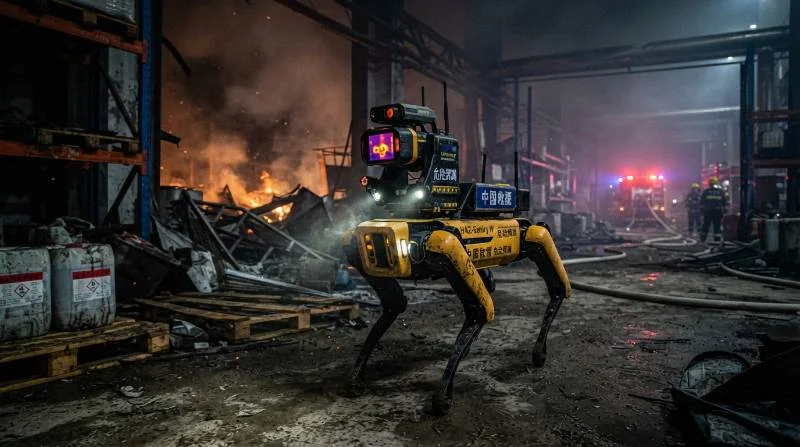
During chemical plant alarms, industrial pipeline ruptures, or toxic vapor releases, manual reconnaissance runs severe life-safety risks. Quadruped robots provide instant situational awareness for incident commanders before hazmat crews enter hot zones.
Deploying emergency response and hazmat robotics enables fast reconnaissance directly into toxic vapor plumes. Equipped with volatile organic compound (VOC) photoionization detectors (PID) and radiation gamma counters, the robot streams live 3D plume maps and thermal footage directly to the mobile command center.
Economic Impact: Calculating ROI, TCO, and Risk Mitigation
Deploying autonomous quadruped robots yields direct financial returns by reducing manual exposure hours and preventing unscheduled facility shutdowns. Reviewing our industrial case studies shows that capital recovery typically occurs within 12 to 18 months of deployment.
| Operational Factor | Manual Hazardous Inspection | Autonomous Quadruped System |
|---|---|---|
| Annual Confined/Haz Area Exposure Hours | 2,400 Human-Hours | < 80 Human-Hours (-96.6%) |
| Permit-to-Work (PTW) Issuance Cost | $180,000 / year | $22,000 / year (-87.7%) |
| Unplanned Shutdown Avoidance Rate | Baseline Reference | +$620,000 Saved via Early Detection |
| Facility Insurance Premium Adjustments | Standard High-Risk Rate | 8% to 15% Risk Reduction Credit |
Frequently Asked Questions (FAQ)
Can robot dogs recharge their batteries inside ATEX Zone 1 or Zone 2 areas?
Direct battery recharging via exposed contact pads is strictly prohibited in Zone 1/Zone 2 environments due to open arcing risks. Autonomous docking stations must either be installed in classified Non-Hazardous safe zones, or utilize certified Ex d explosion-proof induction charging enclosures.
What payload capacity is required for industrial inspection suites?
A full petrochemical inspection payload—including a cooled Optical Gas Imager (OGI), radiometric zoom camera, acoustic ultrasound sensor, and multi-gas sniffer—typically weighs between 5 kg and 12 kg. Industrial quadruped robots must support a continuous payload capacity of at least 15 kg without compromising dynamic balance or run-time.
How does robotic telemetry integrate with existing plant SCADA systems?
Industrial robots deliver sensor telemetry using standard industrial IoT protocols, including MQTT, OPC UA, and Modbus TCP. Raw data streams automatically trigger alarms within plant Distributed Control Systems (DCS) when gas concentration or surface temperatures breach set thresholds.
Ready to Modernize Your Hazardous Inspections?
Eliminate high-risk human entry and establish autonomous plant monitoring with industrial quadruped robotic platforms.