Understanding Data Center Inspection Robots: Core Architecture and Market Metrics
Data center inspection robots are autonomous robotic systems engineered to patrol server rooms, containment aisles, and electrical distribution zones to detect environmental, thermal, and mechanical anomalies. Equipped with multi-spectral sensors, LiDAR navigation, and edge computing, these platforms replace periodic manual audits with continuous, sub-millimeter telemetry.
Modern hyperscale and colocation facilities run continuous high-density compute loads. Operating high-density server racks requires strict adherence to ASHRAE TC 9.9 thermal guidelines to avoid hardware degradation and maintain strict facility uptime SLAs.
Traditional human walkthroughs introduce environmental contamination, door cycling, and intermittent sampling gaps. Facilities leveraging autonomous industrial inspection solutions capture granular real-time telemetry across three spatial axes without human intervention.

“Continuous automated telemetry represents the single greatest shift in mission-critical reliability since the inception of dynamic thermal management. Real-time sub-surface hotspot discovery saves millions in unplanned downtime.”
Recent infrastructure studies show that undetected micro-anomalies in power distribution units (PDUs) and server chassis fans account for over 38% of Tier-III and Tier-IV facility outages. Automated quadruped deployments reduce mean time to detect (MTTD) thermal deviations from 48 hours down to under 90 seconds.
Quadruped Bionic Platforms vs. Wheeled AMRs in White Space Environments
Legacy automated guided vehicles (AGVs) and wheeled Autonomous Mobile Robots (AMRs) struggle within high-density white space. White space environments present operational obstacles: ramps connecting raised floors, perforated airflow grates, loose cabling bridges, and tight containment doors.
Deploying the RZTL-1 quadruped robot platform resolves these physical bottlenecks through dynamic bionic locomotion. Four articulated limbs dynamically compensate for surface irregularities, preventing chassis vibration and high-frequency structural feedback into sensitive spinning disks or optical transceivers.

| Evaluation Parameter | Wheeled / Tracked AMRs | Quadruped Robotic Platforms |
|---|---|---|
| Raised Floor Ramp Traversal | Limited (High risk of bottoming out >8° incline) | Seamless adaptive climbing up to 30° incline |
| Perforated & Grated Floor Tiles | Wheel entrapment; high-frequency jitter | Multi-point ground contact; zero tile snagging |
| Aisle Turning Radius | Requires 1.2m+ clearance for zero-radius turns | True zero-radius omnidirectional pivoting (<0.8m) |
| Cable Bridge Obstacle Clearance | Stops completely at 25mm cable protectors | Steps cleanly over obstacles up to 180mm height |
In hot and cold aisle containment systems, space is at a premium. Legged robots adjust their stance height to inspect the lowest PDU breakers or raise their payload mast to assess top-of-rack (ToR) network switches.
Multi-Sensor Payload Diagnostics: Thermal, Acoustic, and Optical Telemetry
Robotic reliability stems directly from sensor payload integration. Quadruped units carry modular sensory suites that simultaneously ingest radiometric thermal signatures, ultrasonic frequencies, and optical telemetry.
Radiometric Thermal Profiling
Calibrated long-wave infrared (LWIR) cameras identify thermal stratification across server faceplates. Using dynamic threshold monitoring, the robot maps surface temperature differentials against the cooling baseline to flag airflow blockages or failing chassis blowers.
Acoustic Anomaly Detection
Acoustic ultrasound sensor arrays listen for bearing degradation in fan assemblies and partial electrical discharge in medium-to-low voltage switchgear. Acoustic sensors identify abnormal friction spikes up to three weeks before thermal runaways manifest.
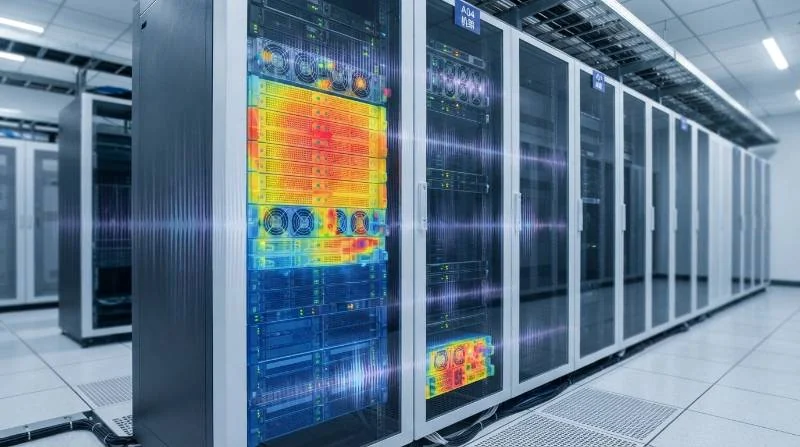
Computer Vision for LED & Port Status
High-resolution optical zoom lenses feed real-time computer vision models trained to parse LED indicator codes across major OEM servers. Amber warning lights, unseated fiber connections, and rack latch status are cataloged and mapped directly to rack unit (U) locations.
The Autonomous White-Space Telemetry Protocol (AWTP)
To standardize robotic operations across high-density facilities, Intelligent Robot Dog developed the Autonomous White-Space Telemetry Protocol (AWTP). This four-stage operational framework provides systematic anomaly detection without interfering with white-space operations.
- Non-Invasive Spatial Mapping: The robot traverses white space corridors to establish sub-centimeter point clouds using 3D solid-state LiDAR, tagging each physical rack asset by exact GPS-denied coordinates.
- Multi-Spectrum Baseline Calibration: Baseline thermal, acoustic, and RF profiles are recorded during steady-state IT operations, setting dynamic alerting envelopes aligned with ASHRAE envelope class A1/A2 limits.
- Continuous Predictive Traversal: The quadruped runs autonomous patrol schedules dynamically prioritized by workload spikes, rack power draws, or external BMS alarm triggers.
- Automated AIOps Telemetry Dispatch: Real-time edge inference processes raw sensor frames on-device, dispatching structured JSON alerts and work orders directly into DCIM suites without cloud latency.
Autonomous Navigation, Docking, and Facility Integration
Server rooms challenge traditional optical navigation. Uniform server rack rows, repetitive geometric textures, mirror-finish floor coatings, and variable lighting confuse conventional vision SLAM systems.
Advanced deployments utilize dual 3D LiDAR SLAM navigation technology paired with downward-facing visual-inertial odometry. This sensor fusion creates sub-millimeter localization stability without placing physical visual markers (AprilTags) on customer rack cabinets.
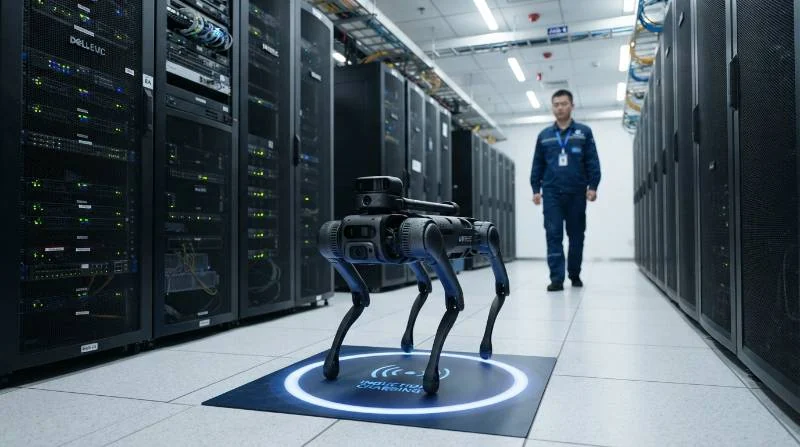
Automated facility integration requires friction-free passage through containment zones. Quadruped platforms integrate with automated door controllers over secure protocols (BACnet/IP or MQTT), enabling the platform to navigate between hot/cold containment aisles and airlocks seamlessly.
When battery reserves drop below 20%, the platform navigates to an autonomous wireless induction docking pad. Recharging is completed without exposed contact pins, eliminating sparking risks in high-airflow environments.
Air-Gapped Security Architecture and Zero-Cloud-Egress Edge AI
Data security is non-negotiable within critical enterprise infrastructure. Colocation and enterprise operators require zero data leakage to external networks, ensuring adherence to SOC 2 Type II, ISO 27001, and FedRAMP compliance standards.
Industrial quadruped architectures resolve this by handling all inference locally via onboard neural processing units (NPUs). Image segmentation, acoustic analysis, and optical character recognition run directly on the robot hardware.
- Zero-Cloud Egress: Video feeds, thermal heatmaps, and spatial maps never leave the facility’s local perimeter.
- Role-Based Access Control (RBAC): Localized 802.1X enterprise Wi-Fi or private 5G connectivity with end-to-end mTLS encryption.
- Hardened OS Kernel: Read-only root filesystems and signed firmware updates protect physical robotic nodes from unauthorized modification.
DCIM, BMS, and AIOps Predictive Maintenance Integration
Robotic telemetry must integrate seamlessly with existing enterprise systems. Modern quadruped systems bridge directly into Data Center Infrastructure Management (DCIM) and Building Management Systems (BMS) via bi-directional REST APIs, gRPC, and MQTT brokers.
When the robot detects a thermal hotspot on a distribution breaker, it creates an incident ticket in systems like ServiceNow or Jira, attaching the radiometric image, exact coordinates, and severity level. Review real-world configurations in our enterprise robotics deployment case studies.
This automated flow populates real-time digital twins. Rather than relying on stationary sensors spaced every 10 meters, facility engineers access a continuous 3D thermal and acoustic point cloud of the entire white space.
TCO Analysis and ROI Modeling: The Economics of Robotic Inspection
Calculating the Total Cost of Ownership (TCO) and return on investment for quadruped robotics involves quantifying avoided downtime, reduced human contamination, and optimized cooling power consumption.
| Cost / Value Category | Manual Technician Audits | Autonomous Quadruped Fleet |
|---|---|---|
| Annual Labor Allocation (Audits & Logging) | $180,000 (2 FTEs dedicated part-time) | $15,000 (Supervisory review only) |
| Unplanned Outage Risk Factor (Annualized) | $320,000 (Based on Uptime Institute metrics) | $45,000 (Early micro-fault detection) |
| Cooling Inefficiency (Over-cooling buffer) | $75,000 (Conservative thermal setpoints) | $18,000 (Aggressive setpoint tuning) |
| Hardware & Maintenance Amortization | $0 | $42,000 |
| Net Annualized Operational Cost | $575,000 | $120,000 |
Across a standard 10MW footprint, robotic inspection fleets deliver capital payback within 9 to 14 months, primarily driven by cooling efficiency gains and the prevention of catastrophic breaker trips.
Enterprise Platforms: Deploying RZTL-1 and Tongchui-M1 in Critical Facilities
Different facilities require specialized mechanical solutions. Intelligent Robot Dog manufactures tailored enterprise quadruped platforms engineered specifically for critical infrastructure environments.
RZTL-1: High-Density White Space Specialist
The RZTL-1 is purpose-built for indoor data hall operations. Its ultra-compact chassis, low electromagnetic interference (EMI) profile, and whisper-quiet acoustic signature make it ideal for narrow containment aisles.
- Integrated FLIR radiometric thermal imager with ±1°C accuracy.
- Dual 3D LiDAR sensors for continuous localization in reflective environments.
- Over 2.5 hours of continuous patrol runtime per charge cycle.
Tongchui-M1: Heavy-Duty Switchyard and Substation Platform
Critical facility resilience extends beyond the white space. The heavy-duty Tongchui-M1 robot dog is built to patrol outdoor transformer yards, chiller plants, and medium-voltage substations under adverse weather conditions (IP67-rated).
- 30x optical zoom PTZ camera for high-voltage insulator and bushing inspection.
- Acoustic ultrasound array for corona discharge and transformer hum analysis.
- All-weather operational rating ranging from -20°C to +55°C.
Frequently Asked Questions (FAQ)
Will the robot dog interfere with sensitive server equipment or storage arrays?
No. Industrial quadruped inspection robots designed for data halls meet strict FCC Class A and CE EMC compliance standards. Brushless motor drivers and internal compute architectures are shielded to prevent electromagnetic emissions that could impact magnetic drives or transceivers.
How do inspection robots handle 24/7 continuous facility patrols?
Inspection robots utilize autonomous docking stations. An RZTL-1 runs a 90-minute patrol route, returns to its inductive dock for 45 minutes of fast charging, and resumes inspections, maintaining true 24/7 facility monitoring without human intervention.
Can quadruped robots damage raised floor tiles or perforated airflow grates?
No. Quadruped platforms distribute their load across four soft-compound rubber footpads. The point load exerted by a 25kg quadruped is lower than that of a standard data center technician standing or rolling a loaded server cart.
How does the robotic platform interact with gaseous fire suppression systems?
Robotic systems interface with the building fire alarm system (FAS). Upon activation of early-warning smoke detection (VESDA) or pre-discharge alarms, the robot docks safely outside the affected zone and transmits real-time optical and thermal visual feeds to emergency responders.
Upgrade Your Critical Facility with Autonomous Quadruped Inspection
Eliminate manual audit blind spots and protect your uptime SLAs. Schedule a custom technical demonstration with our engineering team to evaluate the RZTL-1 and Tongchui-M1 platforms in your facility.