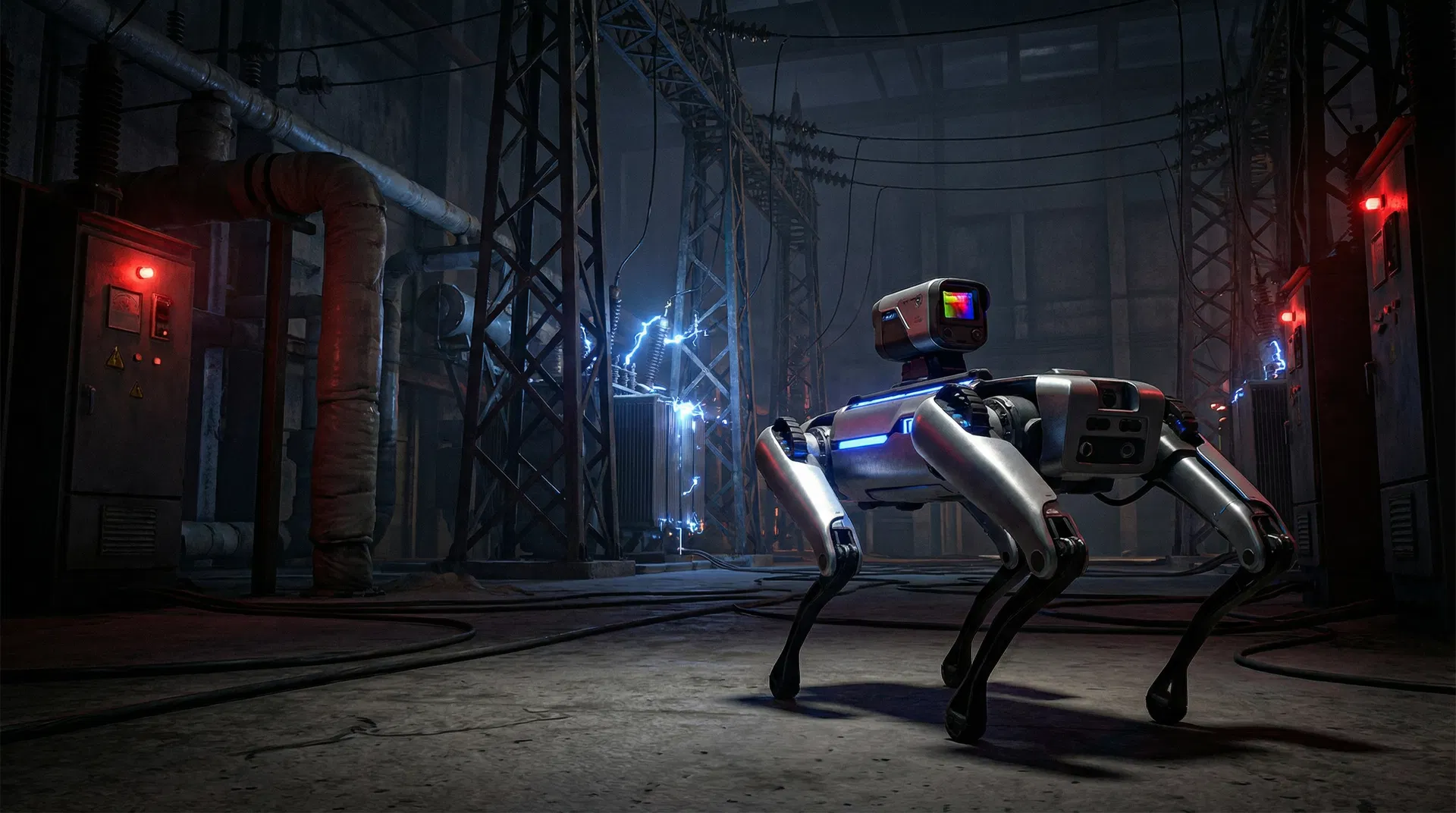
The Data Center Inspection Paradox
Data centers are among the most inspection-intensive facilities in modern infrastructure. The density of critical equipment — servers, networking hardware, cooling systems, power distribution units, and UPS systems — combined with the financial consequences of unplanned downtime creates an imperative for frequent, thorough inspection. Yet the same characteristics that make data centers critical make them difficult to inspect safely.
Human inspection in live data center environments introduces risks that operators work hard to manage. Electrostatic discharge from personnel can damage sensitive electronic components. Physical contact with cable management systems can disrupt network connectivity. The thermal environment in high-density server aisles creates heat stress risks for inspection personnel. And the simple act of moving through a densely populated server room creates opportunities for accidental contact with equipment that can cause costly incidents.
The result is a tension between inspection necessity and inspection risk that most data center operators manage by accepting lower inspection frequency than their equipment criticality would warrant. Critical infrastructure is inspected less often than it should be, not because operators are complacent, but because the cost and risk of inspection itself is a constraint.
What Autonomous Robots Change About Data Center Inspection
Autonomous quadruped robots address the data center inspection paradox by separating the inspection function from the human presence risk. A robot equipped with appropriate sensors can perform the same inspection tasks as a human technician — visual equipment checks, thermal imaging, environmental monitoring — without the ESD risk, physical contact risk, or heat stress risk associated with human entry.
The operational implications are significant. Inspection frequency can increase from weekly or monthly cycles to daily or even continuous monitoring, without proportional increases in operational cost or risk. The robot’s consistent patrol routes and structured data collection provide a level of inspection repeatability that human inspection programs rarely achieve. And the elimination of human entry requirements simplifies access management and reduces the operational overhead associated with coordinating inspection activities with data center operations teams.
For hyperscale and colocation data centers, where inspection programs must cover hundreds of thousands of square feet of floor space across multiple halls, the scalability of robot-based inspection is particularly valuable. A fleet of autonomous robots can maintain continuous coverage of an entire facility, with centralized management and unified data collection across all inspection activities.
Thermal Monitoring: The Core Value Proposition
In data center environments, thermal monitoring is the inspection capability with the highest direct value. Server hardware failures are frequently preceded by thermal anomalies — hot spots in server racks, cooling airflow disruptions, and thermal runaway in battery systems — that are detectable before they escalate to equipment failures or fire events.
The dual-spectrum imaging systems integrated into Rongzhitong’s inspection platforms provide simultaneous visible-light and thermal infrared imaging across the full patrol route. In data center deployments, this capability enables continuous monitoring of server rack thermal profiles, identification of hot spots that indicate cooling system underperformance or equipment malfunction, and early detection of battery thermal events in UPS systems.
AI-powered thermal analysis algorithms, trained on data center-specific thermal baseline data, automatically identify temperature deviations that warrant engineering review. The system can be configured with equipment-specific alert thresholds — for example, triggering an alert when any rack position exceeds a defined temperature differential from its baseline — and can correlate thermal anomalies with specific equipment locations for rapid maintenance dispatch.
Environmental Monitoring: Beyond Temperature
While thermal monitoring is the primary inspection value driver in data centers, comprehensive autonomous inspection also addresses other environmental parameters that affect equipment reliability and facility safety. Humidity monitoring is critical in data center environments, where both high humidity (condensation risk) and low humidity (ESD risk) can cause equipment damage. Particulate monitoring identifies air filtration system degradation before it affects equipment reliability. And water leak detection in raised floor environments can prevent catastrophic damage from cooling system failures.
The Rongzhitong inspection platform supports integration of multi-parameter environmental sensor arrays, allowing a single patrol to collect temperature, humidity, particulate, and gas concentration data simultaneously. This comprehensive environmental monitoring capability provides data center operations teams with a continuous, spatially resolved view of facility environmental conditions — a significant improvement over the point measurements provided by fixed sensor networks.
Integration with DCIM and BMS Systems
The value of autonomous inspection data is maximized when it is integrated with existing data center management systems. The Rongzhitong Cloud Management Platform provides API-level integration with Data Center Infrastructure Management (DCIM) systems and Building Management Systems (BMS), allowing inspection data to be correlated with existing equipment monitoring data for comprehensive facility health assessment.
This integration enables use cases that are not possible with either inspection data or infrastructure monitoring data alone. For example, correlating robot-detected thermal anomalies with DCIM power consumption data can identify equipment that is consuming more power than expected for its thermal output — an indicator of cooling inefficiency or equipment degradation. Correlating environmental monitoring data with BMS cooling system status can identify cooling system underperformance before it affects equipment temperatures.
Deployment Considerations for Data Center Environments
Successful deployment of autonomous inspection robots in data center environments requires attention to several facility-specific considerations. The robot platform must be designed for low-emission operation — minimizing particulate generation, electromagnetic interference, and acoustic noise that could affect sensitive equipment or operations personnel. Navigation system design must account for the highly structured, GPS-denied environment of a data center, with reliable performance in the narrow aisles between server racks.
The Rongzhitong platform’s navigation suite uses LiDAR-based SLAM mapping combined with visual re-localization to maintain accurate positioning in data center environments, including in the challenging hot-aisle/cold-aisle configurations used in high-density deployments. The platform’s compact dimensions (63 × 36 cm footprint for the ZSL-1W) allow navigation in standard 600mm aisle configurations without requiring facility modifications.
Charging infrastructure integration is a practical consideration for continuous monitoring deployments. The platform’s autonomous charging capability allows robots to return to charging stations between patrol cycles, maintaining continuous coverage without operator intervention. For 24/7 monitoring applications, multiple robots can be deployed in a coordinated fleet configuration, with the Cloud Management Platform managing patrol schedules to ensure continuous coverage while individual robots charge.
—
## Related Solutions
Explore how SG Trading Asia’s quadruped inspection robots are deployed in real-world applications:
– [Data Center Inspection Robot Solution](/solutions/data-center-inspection)
– [Intelligent Inspection Robot System](/solutions/inspection)
– [Cloud Robot Management Platform](/solutions/cloud-management)
*[Contact our engineering team](/contact) to discuss your specific inspection requirements.*
Tagged: