What are Modern Confined Space Inspection Robots? Definition and Key Metrics
Confined space inspection robots are specialized robotic platforms engineered to enter, navigate, and evaluate enclosed industrial environments without risking human personnel. These autonomous and remote-controlled systems conduct Remote Visual Inspection (RVI) and Non-Destructive Testing (NDT) across storage tanks, pressure vessels, pipelines, and culverts under hazardous conditions.
Regulatory Definition: Under OSHA 29 CFR 1910.146, a permit-required confined space contains or has the potential to contain a hazardous atmosphere, engulfment hazards, or internal configurations capable of trapping or asphyxiating an entrant.
Deploying industrial inspection robot dog solutions eliminates the need to issue human entry permits for routine and emergency structural evaluations. These platforms must comply with strict engineering benchmarks before industrial deployment:
- Atmospheric Ingress Protection: Minimum IP67 certification for dust-tight operation and temporary liquid submersion up to 1 meter.
- Explosion-Proof Ratings: Compliance with ATEX and IECEx Zone 1/Zone 2 or Class I, Division 1/2 classifications for flammable vapor environments.
- Dimensional Profile: Ability to navigate standard API 650/653 inspection manways ranging between 450 mm (18 in) and 600 mm (24 in) in diameter.
- Thermal Operating Envelope: Continuous operational stability across internal temperature gradients from -20°C to +55°C (-4°F to 131°F).
Core Operational Capabilities of Next-Generation Inspection Robots
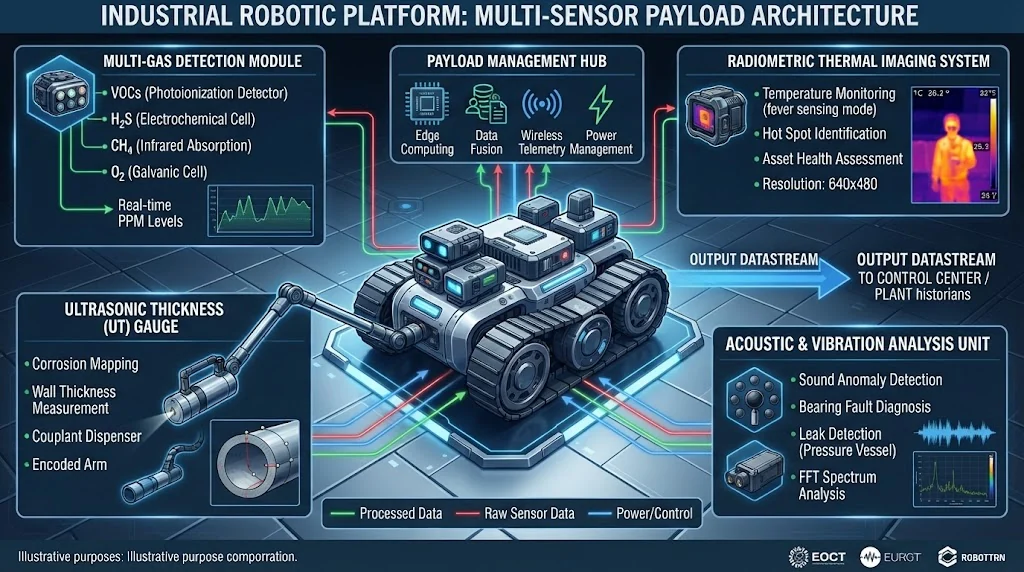
Modern confined space robotics integrate advanced edge processors, computer vision algorithms, and multi-sensor payloads directly onto agile mobile bodies.
Real-Time Volatile Atmospheric and Multi-Gas Monitoring
Robots serve as first-in atmospheric scouts. Integrated multi-gas analyzers detect oxygen depletion, Lower Explosive Limits (LEL), hydrogen sulfide (H2S), carbon monoxide (CO), and volatile organic compounds (VOCs) at parts-per-million (ppm) resolutions.
Telemetry feeds stream environmental data back to surface command consoles in real time, preventing asset re-ignition and securing safety perimeters during emergency response and hazard robotics deployments.
Optical Pan-Tilt-Zoom (PTZ) and Radiometric Thermal Imaging
Visual evaluation relies on high-resolution cameras paired with high-lumen, anti-glare LED illumination arrays delivering up to 12,000 lumens. Optical zoom systems exceeding 30x enable close-up weld inspection and pitting quantification from standoff distances of 5 to 15 meters.
Radiometric thermal cameras identify sub-surface anomalies, refractory lining degradation, sediment deposition levels, and localized stress heating with a thermal sensitivity of ≤40 mK.
Autonomous Navigation via LiDAR SLAM in Signal-Denied Spaces
Confined industrial assets act as Faraday cages, blocking GPS and wireless communications. Robotic units utilize 3D multi-line LiDAR combined with Visual Inertial Odometry (VIO) to execute Simultaneous Localization and Mapping (SLAM).
Leveraging autonomous SLAM navigation technology, the platform builds high-density spatial point clouds with sub-centimeter positional accuracy, navigating complex piping lattices and internal baffles autonomously.

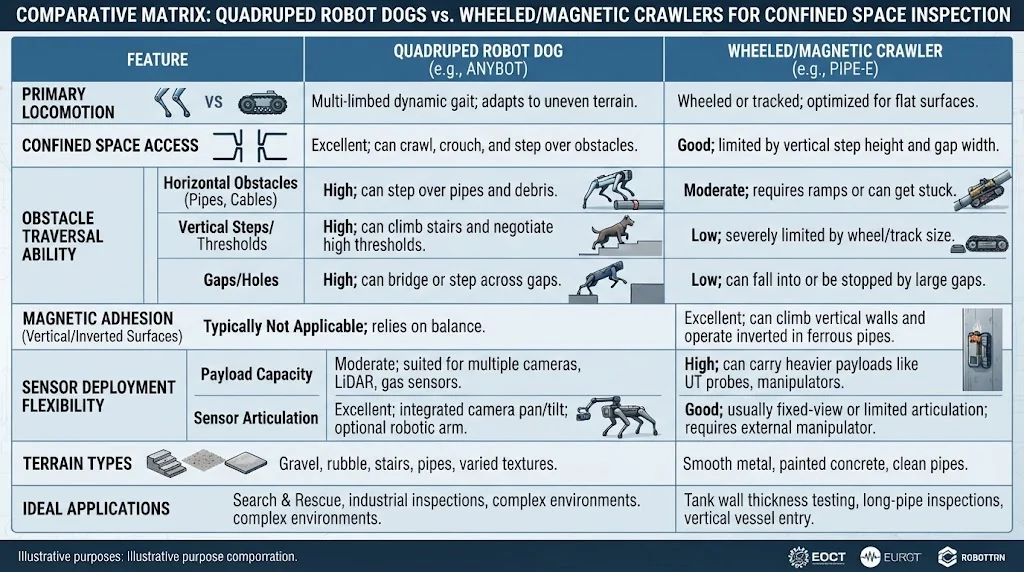
Platform Comparison: Agile Quadruped Robot Dogs vs. Traditional Wheel and Track Crawlers
Wheeled and magnetic crawlers have served industrial NDT for decades. However, rigid drivetrains struggle in unpaved, sludge-filled, or structurally obstructed enclosures.
Legged quadruped systems utilize bio-inspired dynamic gait control to traverse debris, navigate internal tank sumps, cross structural stiffeners, and climb internal staircases where standard wheeled platforms lose traction or flip.
| Operational Metric | Wheeled / Tracked Crawlers | Magnetic Wall Crawlers | Intelligent Quadruped (e.g., RZTL-1) |
|---|---|---|---|
| Sludge & Sediment Tolerance | Poor; high risk of track slippage & entrapment | Zero; requires clean, bare metal surface | High; dynamic leg elevation steps through sludge up to 180 mm |
| Obstacle Traversal | Limited to ≤50 mm obstacles | None; stopped by weld beads & plate steps | Traverses steps, pipes, and curbs up to 220 mm |
| Payload Adaptability | Fixed sensor mounts, low reconfigurability | Dedicated single NDT transducer array | Multi-mission modular rail (gas, thermal, UT, optical) |
| Multi-Level Mobility | Incapable of climbing internal stairs | Vertical surface only; cannot change planes | Climbs 35° industrial staircases and multi-tier grating |
The RZTL-1 industrial quadruped robot delivers self-righting recovery capabilities. If tipped over by liquid surges or debris inside an enclosure, it reorients its chassis autonomously within 3.2 seconds, preventing stranded-asset recovery incidents.
The Intelligent Robot Dog 4-Stage Zero-Entry CSE Deployment Protocol
To ensure repeatable safety and structural data fidelity, we execute the Intelligent Robot Dog 4-Stage Zero-Entry CSE Deployment Protocol across industrial asset turnarounds:
- Stage 1: Atmospheric Pre-Clearing & Staging
Deploy the robot via mechanical tether or crane hoist through the primary manway. Conduct continuous LEL, O2, and toxic gas sniffing across lower, middle, and upper strata before opening full containment. - Stage 2: Autonomous Volumetric SLAM Mapping
Execute an initial 3D LiDAR sweep to establish volumetric point clouds, identify internal structural collapses, locate sediment beds, and set autonomous escape routes. - Stage 3: Targeted Multi-Sensor NDT & Thermography
Direct the platform along automated inspection corridors to run radiometric thermal imaging, weld acoustic leak screening, and remote thickness gauging. - Stage 4: Edge Extraction & AIMS Digital Twin Ingestion
Offload encrypted inspection logs directly into your Asset Integrity Management System (AIMS) for baseline comparison against API 510/653 inspection records.
Physical Boundaries and Engineering Limitations: Where Robots Cannot Replace Technicians
While confined space inspection robots transform data acquisition, engineering integrity requires an objective assessment of what current robotics cannot perform.
- Severe Sub-400mm Manway Restrictions: Large quadruped systems cannot enter narrow nozzles under 16 inches (400 mm). Very small pipe runs still require micro-snake robots or fiberscopes.
- Abrasive Surface Preparation for NDT: Robots cannot carry high-pressure grit-blasting equipment into confined zones to clean heavy scale or marine growth down to bare metal for spot ultrasonic probes.
- Tactical Mechanical Repairs: Robots excel at diagnosis, but they cannot perform structural hot work, plate gouging, refractory patch application, or valve replacements.
- Complex Discretionary NDT Judgment: Interpreting ambiguous eddy current signals or determining the metallurgical root cause of stress-corrosion cracking still requires Level III NDT engineer evaluation.
Safety ROI, Compliance Standards, and Enterprise Digital Twin Integration
Replacing standard permit-required entries with autonomous robotic platforms yields direct financial and operational returns across capital-intensive facilities.
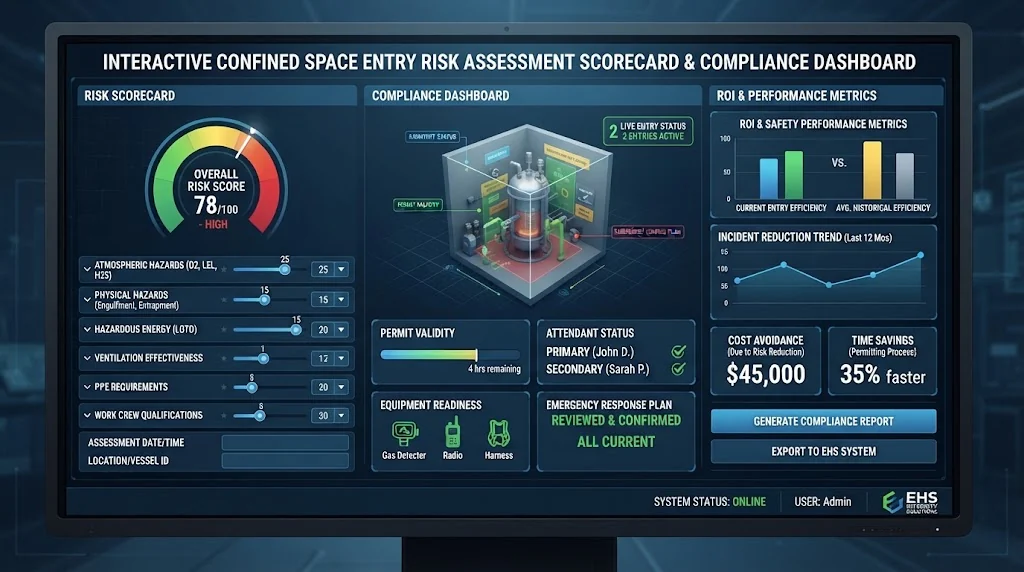
| Operational Metric | Manual Human CSE | Robotic Zero-Entry Deployment |
|---|---|---|
| Scaffolding & Ventilation Setup | 24 – 72 Hours | 0 – 2 Hours |
| Permit & Rescue Team Overhead | $4,500 – $12,000 per shift | $0 (Standard standby technician only) |
| Turnaround Asset Downtime | Baseline (100%) | Reduced by 55% to 65% |
| Data Integration Fidelity | Manual inspection logs & photos | Sub-cm 3D Digital Twin point cloud |
For large-scale facilities managing high-payload applications, pairing autonomous scanning with the heavy-duty quadruped robot dog platform enables high-torque transit through severe debris while carrying multi-spectral sensor clusters.
Frequently Asked Questions About Confined Space Inspection Robots
Can inspection robots operate completely untethered inside steel vessels?
Yes. By utilizing onboard 3D LiDAR SLAM, edge processing, and visual-inertial odometry, autonomous quadrupeds operate without active tether cables or external RF communication links inside fully enclosed steel assets.
What happens if an inspection robot runs out of battery inside a confined asset?
Industrial platforms feature configurable low-voltage failsafe protocols. When the battery charge reaches 15%, the autonomous system aborts its mission and navigates back to the primary ingress point using its reverse point-cloud path.
Are quadruped robots certified for explosive ATEX Zone 1 environments?
Select specialized industrial platforms are certified for ATEX/IECEx Zone 1 and Zone 2 environments. They utilize pressurized enclosures, non-sparking titanium alloy footpads, and intrinsically safe electrical buses.
How do robotic inspection point clouds export to engineering software?
Data exports in standardized formats (LAS, E57, PLY) that integrate directly into Bentley, Autodesk Navisworks, AVEVA, or proprietary Asset Integrity Management Systems for automated corrosion-rate modeling.
Upgrade Your Asset Integrity Management with Zero-Entry Robotics
Eliminate human entry hazards, cut asset turnaround schedules, and digitize your confined space inspection data with our industrial quadruped solutions.