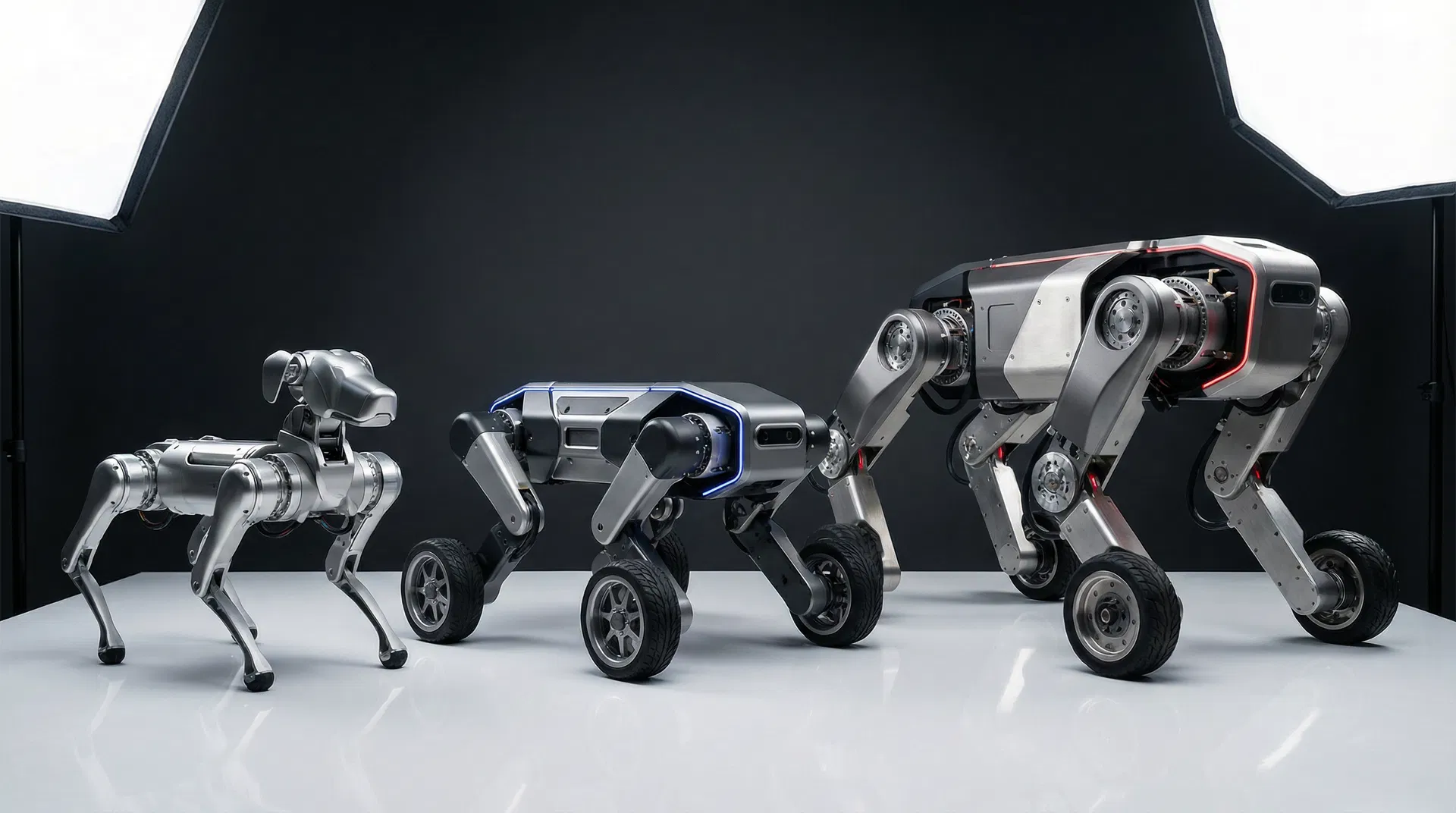
The Growing Market for Spot Alternatives
Boston Dynamics Spot pioneered the commercial quadruped robot market and established the benchmark against which all legged inspection robots are evaluated. However, as the market has matured, industrial operators are increasingly evaluating alternative platforms — driven by total cost of ownership, payload requirements, local support infrastructure, and OEM/ODM customization needs.
This guide provides a structured framework for evaluating Spot alternatives for industrial inspection applications.
Why Operators Evaluate Alternatives
Total Cost of Ownership: Spot's base platform price (approximately $75,000 USD) plus payload costs, software licensing, and annual support contracts can result in a 5-year TCO exceeding $200,000 per robot. For operators deploying multiple units across large facilities, this creates significant budget pressure.
Payload Capacity: Spot's 14 kg payload capacity is sufficient for most inspection sensor packages, but operators requiring heavy thermal cameras, multi-gas sensor arrays, or combined inspection and manipulation payloads may need platforms with higher payload ratings.
Local Support and Service: Boston Dynamics' global service network, while growing, is less extensive than established industrial automation vendors in Asia, the Middle East, and parts of Europe. Local service response time is a critical factor for industrial operators who cannot tolerate extended robot downtime.
OEM/ODM Flexibility: Industrial operators with specific integration requirements — custom sensor packages, proprietary communication protocols, specialized payload mounting — often find that OEM/ODM-oriented manufacturers offer greater customization flexibility than Spot's more standardized platform.
Evaluation Framework: Key Dimensions
1. Terrain Capability
The terrain capability of a quadruped robot determines which inspection points it can access. Key metrics:
- Maximum slope angle (Spot: 30°; competitive platforms: 35–45°)
- Step height capability (Spot: 30 cm; competitive: 20–35 cm)
- IP rating for outdoor/wet environments (Spot: IP54; competitive: IP65–IP67)
- Operating temperature range (Spot: -20°C to 45°C; competitive: -20°C to 55°C)
2. Payload and Sensor Integration
- Maximum payload (Spot: 14 kg; competitive: 15–30 kg)
- Payload mounting interface (Spot: proprietary; competitive: standard or custom)
- Power delivery to payload (Spot: 150W; competitive: 100–300W)
- Communication interfaces (Spot: Ethernet, WiFi; competitive: varies)
3. Software and Integration
- Autonomous navigation capability (SLAM, waypoint patrol, obstacle avoidance)
- Cloud platform and fleet management
- API availability for custom integration
- CMMS/EAM integration support
4. Support and Service
- Local service network coverage
- Response time SLA for critical failures
- Spare parts availability and lead times
- Training and operator certification programs
5. Total Cost of Ownership (5-Year)
| Cost Category | Spot (est.) | Rongzhitong (est.) |
|---|---|---|
| Base platform | $75,000 | $45,000–$85,000 |
| Standard inspection payload | $25,000 | $15,000–$30,000 |
| Software/cloud (annual) | $12,000 | $8,000–$15,000 |
| Support contract (annual) | $15,000 | $8,000–$12,000 |
| 5-Year TCO | ~$235,000 | ~$140,000–$200,000 |
Estimates based on published pricing and industry benchmarks. Contact vendors for site-specific quotations.
6. OEM/ODM and Customization
For operators with specific integration requirements, the ability to customize the robot platform is a significant differentiator. Key questions:
- Can the chassis be modified for specific payload mounting requirements?
- Is the software stack open for custom integration?
- Does the manufacturer offer white-label or OEM variants?
- What is the minimum order quantity for customized variants?
The Rongzhitong Value Proposition
Rongzhitong Robotics positions its TongChui M1 and RZTL-1 platforms as industrial-grade Spot alternatives with three key differentiators:
Higher payload capacity: The TongChui M1 supports 30 kg payload — more than double Spot's 14 kg — enabling heavier sensor packages, combined inspection and manipulation payloads, and future-proofing against sensor technology evolution.
OEM/ODM flexibility: Rongzhitong's manufacturing background means the platform can be customized for specific integration requirements, with white-label options for system integrators and OEM partners.
Regional support infrastructure: With manufacturing and support operations in China and growing international service partnerships, Rongzhitong provides competitive response times for Asia-Pacific and Middle East deployments.
How to Structure Your Evaluation
-
Define your inspection requirements: Which equipment needs to be inspected? What sensors are required? What terrain must the robot navigate?
-
Establish your TCO budget: What is the 5-year budget per robot? How many units do you need?
-
Assess your support requirements: What response time SLA do you need? Do you have in-house robotics expertise?
-
Request demonstrations: Require each vendor to demonstrate the robot in conditions representative of your facility — including the most challenging terrain and access scenarios.
-
Evaluate the software ecosystem: The robot platform is only as valuable as the software that manages it. Evaluate the cloud platform, API capabilities, and CMMS integration before committing.
Conclusion
Boston Dynamics Spot remains an excellent platform for many industrial inspection applications. However, the market now offers credible alternatives that may better fit specific operator requirements — particularly for high-payload applications, OEM/ODM customization needs, and deployments where regional support infrastructure is a priority.
Contact Rongzhitong for a detailed platform comparison and site-specific ROI assessment.
Related Solutions
Explore how SG Trading Asia's quadruped inspection robots are deployed in real-world applications:
- Intelligent Inspection Robot System
- Power Substation Inspection Solution
- OEM/ODM Partnership Services
Contact our engineering team to discuss your specific inspection requirements.
Tagged: