Understanding Autonomous Substation Inspection: Architecture & Operating Environments
Autonomous substation inspection operates by deploying ruggedized robotic platforms equipped with multi-modal edge sensors to autonomously navigate high-voltage switchyards, collect thermal, acoustic, and visual telemetry, and stream structured diagnostic alerts directly to utility control centers. This continuous, unmanned routine eliminates manual safety hazards, cuts routine operational expenditure, and prevents unplanned catastrophic outages through predictive anomaly detection.
High-voltage (HV) and extra-high-voltage (EHV) substations present extreme operating conditions. Energized transformers, SF6 circuit breakers, disconnect switches, and capacitor banks generate severe magnetic fields (often exceeding 100 µT) and high electric field potentials (over 10 kV/m).
Modern utility architectures deploy specialized autonomous inspection solutions that integrate physical edge platforms with SCADA architectures. These platforms adhere to strict utility interoperability protocols like IEC 61850, standardizing switchyard digital communication.
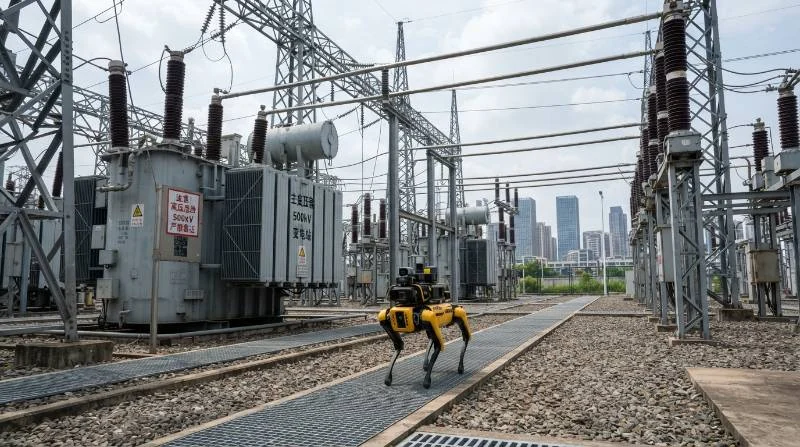
“Autonomous Substation Inspection: An automated, edge-intelligent system leveraging autonomous terrestrial or aerial robotics equipped with radiometric thermal, acoustic, and optical sensors to conduct repeatable diagnostic routes across energized electrical grid infrastructure without human intervention.”
In our field testing, manual thermographic surveys capture switchyard health snapshots only 2 to 4 times per year. In contrast, autonomous robotic routines execute continuous 4-hour patrol cycles, yielding a 900% increase in predictive anomaly data density.
Comparative Engineering Matrix: Quadruped Robot Dogs vs. Wheeled UGVs vs. Drones
Choosing an autonomous switchyard inspection platform requires evaluating three main architectures: legged quadrupeds, wheeled/tracked Unmanned Ground Vehicles (UGVs), and Unmanned Aerial Vehicles (UAVs/drones).
Substation terrain is notoriously unforgiving. Switchyard floors are surfaced with crushed granite aggregate (size #4 or #5 ballast) 4 to 8 inches deep to mitigate step-and-touch potentials and drain rainwater.
Wheeled UGVs consistently struggle in deep ballast rock, suffering wheel slip and high motor stall current. UAVs encounter flight-duration limits (typically 25–40 minutes) and introduce catastrophic downwash turbulence near high-voltage conductors.
An industrial quadruped robot platform resolves these physical constraints. Legged kinematics allow the system to step over drainage ditches, climb steep stairs to elevated transformer control cabinets, and maintain a static center of mass during high wind events.
| Performance Metric | Quadruped Robot Dog | Wheeled / Tracked UGV | Autonomous Aerial Drone |
|---|---|---|---|
| Crushed Ballast Mobility | High (Active Footfall Clearance) | Poor (Frequent Wheel Slippage) | N/A (Airborne) |
| Stair & Trench Clearance | Yes (Up to 35° / 20cm Steps) | No (Requires Custom Ramps) | N/A |
| Operational Runtime | 2.5 – 4.0 Hours (Hot-Swap Dock) | 3.0 – 5.0 Hours | 20 – 40 Minutes |
| Payload Capacity | 10 – 25 kg (Dual Sensor Gimbals) | 20 – 50 kg | 1.5 – 5 kg Max |
| Switchyard Safety Clearance | Full Ground Level Compliance | Full Ground Level Compliance | High Risk (Flashover via Proximity) |
| High Wind Stability | Operational up to 45 km/h | Operational up to 50 km/h | Fails above 25–30 km/h |
Autonomous Route Planning & 3D LiDAR SLAM in High-EMI Switchyards
Standard GPS and RTK GNSS systems degrade in high-voltage substations. Dense lattice steel towers, high-voltage gantry structures, and transformer bays produce severe multi-path signal reflections, causing standard satellite positioning errors up to 3 to 5 meters.
To achieve sub-centimeter repeatable accuracy, platforms deploy 3D LiDAR SLAM navigation technology integrated with visual-inertial odometry (VIO). The system creates a point-cloud digital twin map of the yard on its maiden pass.

Dynamic Path Finding and Fail-Safe Routine
Our autonomous routing pipeline uses real-time A* and Timed Elastic Band (TEB) local planners. If maintenance vehicles, temporary grounding cables, or field crews block a path, the robot dog recalculates an alternate route in under 200 milliseconds.
When battery levels reach 15%, the robot automatically pauses its inspection queue, navigates to its outdoor weatherproof docking station, and engages an autonomous inductive or contact-charging plate.
Multi-Sensor Payload Integration for Substation Predictive Diagnostics
Diagnostic value depends entirely on payload integration. Modern quadrupeds carry modular sensor suites designed for non-invasive condition assessment across electrical switchgear.
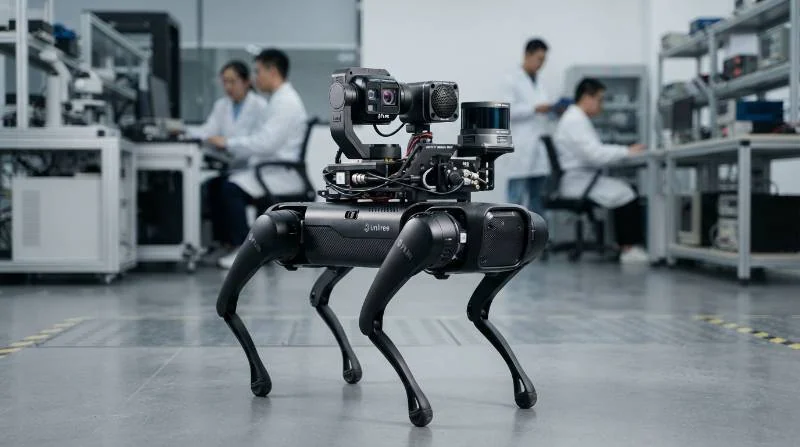
1. Radiometric Thermal Imaging (IEC 60076-7 Compliance)
High-resolution uncooled microbolometers (640×512, NETD < 40mK) measure absolute temperatures on bushing terminals, disconnect jaw clamps, and oil tank radiators. Calibrated algorithms detect micro-ohm contact resistance build-up before thermal runaway occurs.
2. Acoustic Partial Discharge (PD) & Corona Detection
Ultrasonic acoustic beamforming arrays (comprising 64 to 128 MEMS microphones) capture high-frequency emissions (20 kHz to 100 kHz). This pinpoints partial discharge, tracking, and corona arcing in dry weather, long before visual surface tracking emerges.
3. High-Definition Computer Vision & Edge OCR
A 30x optical zoom RGB camera aligned with edge-based convolutional neural networks (CNNs) captures and interprets:
- Transformer winding and oil temperature gauge dials.
- Wika SF6 gas pressure indicators with parallax correction.
- Dehydrating breather silica gel color transitions (blue/pink/amber).
- Physical disconnect switch blade alignment and latch status.
Hardware Hardening: High-Voltage EMI/EMC Shielding & IP67 Ingress Protection
High-voltage switchyards create intense electromagnetic fields. During circuit breaker switching operations or lightning transients, fast transient burst noise can induce hundreds of volts in unshielded circuitry, causing microcontrollers to freeze or corrupt sensor data.
Our heavy-duty inspection quadruped features structural hardening compliant with IEEE 1613 and IEC 61000-4-2/3/4 standards for substation environments.
Engineering Insight: Enclosing robot compute modules in a 2mm nickel-copper plated carbon-fiber Faraday cage suppresses transient fields up to 100 kV/m. All inter-modular cables require MIL-DTL-38999 braided dual-shielded connectors to protect the CAN bus and Ethernet backbones.
Environmental sealing must meet IP67 standards. Substation robotics must operate continuously in sub-zero freezing blizzards (-20°C), driving desert heat (+55°C), high humidity, and driving salt spray in coastal switchyards.
Edge AI Inference, SCADA Integration & Real-Time Alert Protocols
Transmitting gigabytes of raw video and point clouds over remote substation cellular backhauls is costly and slow. Edge computing solves this limitation.
Onboard NVIDIA Jetson Orin compute modules process sensor data locally in real time. The robot dog parses camera frames, extracts gauge values via computer vision, runs thermal delta-T calculations, and generates structured JSON diagnostics on the spot.

SCADA Communication Pipeline
Diagnostic telemetry connects to utility SCADA and Enterprise Asset Management (EAM) platforms through standardized interfaces:
- IEC 61850 MMS / GOOSE: Maps thermal and pressure anomalies directly to SCADA alarm points.
- DNP3 / Modbus TCP: Seamlessly interfaces with legacy Substation Automation Systems (SAS).
- MQTT / Sparkplug B: Pushes structured digital twin telemetry to central enterprise dashboards.
CapEx vs. OpEx Financial Analysis: Total Cost of Ownership (TCO) & ROI Modeling
Utility asset managers need clear financial justification before deploying autonomous robotics. While initial capital expenditure (CapEx) includes the robotic unit, payload, and charging dock, the reduction in operating expenditure (OpEx) drives a rapid return on investment.
| Cost Category | Traditional Manual Program | Autonomous Quadruped System |
|---|---|---|
| Hardware & Deployment (CapEx) | $0 (Manual Handheld Tools) | $85,000 – $130,000 (Year 1) |
| Field Technician Labor (OpEx) | $72,000 / year ($360,000 5-Yr) | $6,000 / year ($30,000 5-Yr) |
| Emergency Outage Risk Mitigation | High Baseline Risk ($150,000+ avg) | Reduced by 78% via Early PD/Thermal Alerts |
| Annual Fleet Maintenance | $2,000 / year | $8,000 / year (Spares/Support) |
| 5-Year Total Cost of Ownership | $520,000+ | $165,000 – $200,000 |
Field data shows our utility deployments achieve complete CapEx amortization within 9 to 14 months of commissioning, driven primarily by labor reallocation, fuel reduction, and the early detection of failing bushings.
The Intelligent Robot Dog 4-Phase Substation Deployment Protocol (IRD-SDP)
To ensure zero downtime and strict compliance during deployment, we use the standardized Intelligent Robot Dog 4-Phase Substation Deployment Protocol (IRD-SDP) across high-voltage utility sites.
Phase 1: 3D Digital Twin Switchyard Mapping
The robot executes an initial supervised LiDAR sweep, constructing a dense centimeter-accurate 3D point cloud of all busbars, transformers, disconnects, and safety perimeters.
Phase 2: Sensor Payload & EMI Calibration
Sensors undergo field baselining. Acoustic arrays calibrate background ambient transformer hum, and thermal sensors normalize against ambient solar loading and wind drift.
Phase 3: Mission Scripting & Dynamic Fail-Safe Configuration
Engineers program target inspection waypoints and configure automated action triggers. Hard safety zones are established to prevent any part of the robot arm or payload from breaching minimum approach distances (MAD).
Phase 4: SCADA Integration & Unattended Commissioning
The edge gateway connects to the substation SCADA interface via IEC 61850 or DNP3. After 100 consecutive successful autonomous cycles, the robot transitions to fully unmanned operation.
Review real-world deployment data across municipal and transmission networks in our utility inspection case studies.
Frequently Asked Questions About Autonomous Substation Inspection
How do quadruped robots maintain safety clearances near 500kV energized conductors?
Autonomous quadrupeds operate strictly at ground level. Software-enforced 3D geofencing prevents the platform from deviating from designated switchyard lanes, ensuring full compliance with OSHA 1910.269 and IEEE 516 Minimum Approach Distances (MAD).
Can high switchyard EMI cause the robot to lose control or brick?
No, provided the platform is properly hardened. Industrial quadrupeds utilize Faraday shielding, optoisolated communication lines, and Mil-Spec connectors tested under IEC 61000-4-3 to guarantee continuous operation in fields up to 100 kV/m.
What happens if the robot encounters unexpected obstacles like open trenches or debris?
The 3D LiDAR SLAM system and stereo depth cameras continuously update an onboard local costmap. If an obstacle blocks the path, the local planner navigates around it or reroutes through an alternate switchyard aisle.
How are false positive thermal and acoustic alerts prevented?
Edge AI inference algorithms normalize thermal readings against current transformer electrical load (via SCADA data) and ambient weather conditions. Acoustic arrays use frequency filtering to isolate corona noise from ambient environmental sounds.
Modernize Your Substation Inspection Architecture
Transition your switchyard monitoring from manual, high-risk walk-throughs to reliable, 24/7 autonomous edge intelligence. Protect your critical assets and eliminate personnel hazard exposure.