
Navigating Explosive Environments: The Imperative for ATEX Inspection Robots
ATEX inspection robots are explosion-proof, autonomous mobile platforms engineered to operate safely within certified hazardous zones without triggering ignition of flammable gases, mists, or dusts. Deploying these units allows plant operators to automate continuous condition monitoring, isolate gas leaks, and audit structural integrity while removing personnel from hazardous environments.
In upstream offshore rigs, midstream processing terminals, and downstream petrochemical refineries, volatile hydrocarbons represent an ever-present combustion hazard. Manual inspection routines subject human operators to toxic exposure, volatile atmospheric shifts, and physically punishing terrain.
Integrating certified autonomous industrial inspection solutions transforms asset reliability strategies. Rather than relying on intermittent manual walk-downs, facilities deploy rugged robotic systems that capture synchronized acoustic, thermal, and visual telemetry across operating assets.
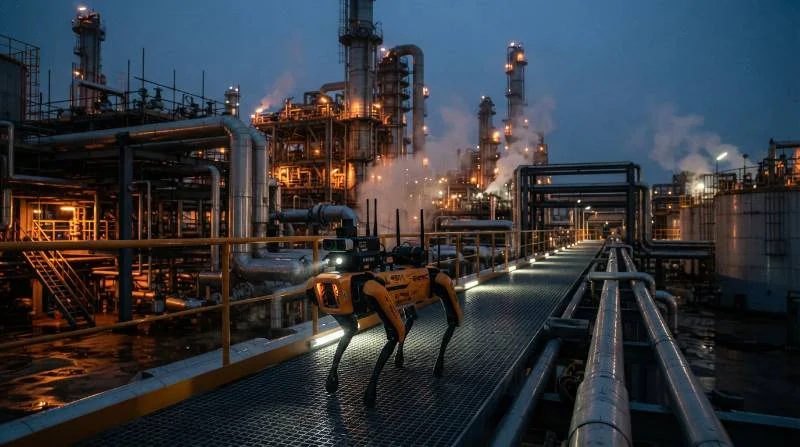
Understanding Hazardous Area Standards: ATEX & IECEx Zone Classifications
Hazardous operating zones are strictly classified by regulatory bodies to quantify the duration and frequency of explosive atmospheric conditions. Engineering teams evaluating mobile robotics must cross-reference mechanical certifications against the specific gas groups and Equipment Protection Levels (EPL) present across their process units.
ATEX Directive 2014/34/EU & IECEx System Definition: International statutory frameworks governing equipment intended for use in potentially explosive atmospheres. Certification mandates that mechanical, thermal, and electrical components cannot produce electrical arcs, friction sparks, or surface temperatures capable of igniting designated air-gas mixtures under specified operating tolerances.
In our field safety validation trials across downstream facilities, equipment compliance hinges on matching robotic hardware to explicit zone classifications:
- Zone 0 / Division 1 (Continuous): Explosive atmospheres present continuously or for long periods (>1,000 hours/year). Primarily restricted to vessel interiors.
- Zone 1 / Division 1 (Intermittent): Flammable gases or vapors likely to occur during normal operations (10 to 1,000 hours/year). Demands Category 2G / EPL Gb robotics.
- Zone 2 / Division 2 (Abnormal): Explosive atmospheres not likely to occur in normal operation, and if they do, will persist for a short duration only (<10 hours/year). Category 3G / EPL Gc compliant.
| ATEX / IECEx Zone | Atmosphere Presence | Robotic Protection Level | Gas Group Compatibility | Max Surface Temp (T-Class) |
|---|---|---|---|---|
| Zone 1 (Gas) | Likely in normal operation | Ex d / Ex ib / Ex px (EPL Gb) | IIA, IIB, IIB+H2 | T4 (≤135°C / 275°F) |
| Zone 2 (Gas) | Unlikely; short duration only | Ex ec / Ex ic / Ex nA (EPL Gc) | IIA, IIB, IIC | T3/T4 (≤200°C / ≤135°C) |
| Zone 21 (Dust) | Likely combustible dust clouds | Ex tb (EPL Db) | IIIA, IIIB, IIIC | T120°C |
Key Engineering Verification Criteria for Explosion-Proof Robotics
Procurement teams must audit physical robotic architecture against harmonized engineering standards, specifically the IEC 60079 series for explosive atmospheres. Superficial modifications to commercial off-the-shelf (COTS) robots do not meet plant safety mandates.
- Flameproof Enclosures (Ex d): Heavy-duty motor driver housings engineered to contain an internal explosion without propagating flames into the surrounding plant atmosphere.
- Intrinsic Safety (Ex i): Sensor circuitry and communication buses engineered to limit electrical and thermal energy below the ignition threshold of volatile air-gas mixtures.
- Pressurized Enclosures (Ex p): Purged positive-pressure internal cavities that prevent combustible external vapors from contacting internal electronics.
- Electrostatic Charge Dissipation: Anti-static carbon-infused chassis polymers and conductive elastomer foot pads maintaining surface resistance below 1.0 Gigaohm (10^9 Ω) to prevent static discharge.
- Ingress Protection: Minimum IP67 sealing to prevent high-pressure washdown ingress, toxic dust buildup, and fine moisture infiltration into powertrain joints.
Quadruped Legged Agility vs. Wheeled and Tracked Inspection Platforms
Industrial brownfield environments were built for human workers, featuring steep access stairs, open-grid steel decking, narrow valve aisles, and floor-level pipe bundles. While wheeled rovers and tracked crawlers have historical utility, their locomotion creates severe operational bottlenecks in multi-tier units.
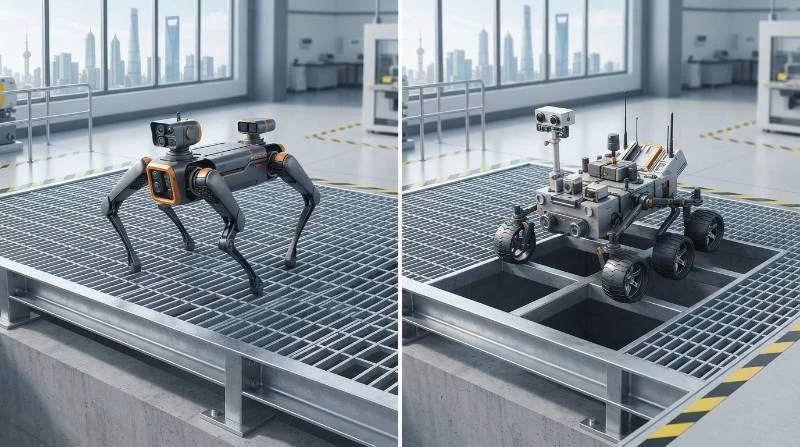
Empirical testing across heavy processing sites demonstrates that wheeled platforms frequently high-center on 150mm curbs or slip across slick diamond-plate surfaces. Tracked systems face severe track-shedding risks on open metal grating and generate dangerous high-friction surface temperatures during sharp pivot turns.
The RZTL-1 industrial quadruped platform addresses these terrain constraints through dynamic bionic gaits. By leveraging discrete foot placement rather than continuous surface contact, legged systems isolate footholds on structural beams and step directly over obstacles up to 350mm tall.
| Mobility Attribute | Bionic Quadruped Robot | Wheeled Inspection Rover | Tracked Crawler Platform |
|---|---|---|---|
| Open-Mesh Grating Navigation | High (Dynamic gait adjustment) | Low (Prone to vibration, wheel-trapping) | Moderate (High wear, track snagging) |
| 45° Industrial Stair Ascent | Full autonomous traversal | Incapable (Requires lifts/ramps) | Limited (High risk of tipping on open risers) |
| Frictional Ignition Risk | Negligible (Rolling-point foot strike) | Low | High during zero-radius skid steering |
| Obstacle Step-Over Height | Up to 350 mm (13.7 in) | < 50 mm (2.0 in) | Up to 150 mm (5.9 in) |
Modular Multi-Sensor Payload Ecosystems for Hazardous Facility Monitoring
An autonomous robot’s operational value relies directly on its sensor intelligence. Modern explosion-proof quadruped platforms employ quick-release, intrinsically safe sensor bays that let maintenance teams tailor payloads to specific inspection campaigns.
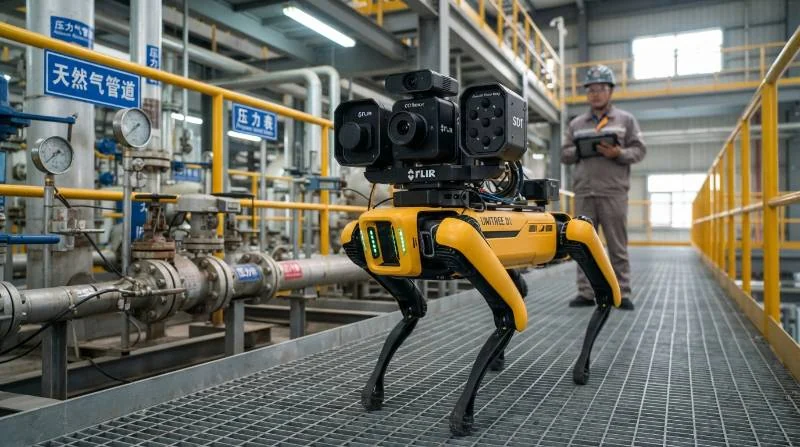
A comprehensive predictive maintenance (PdM) sensor suite integrates multiple detection modalities:
- Optical Gas Imaging (OGI): Cooled or uncooled MWIR/LWIR cameras calibrated to visualize fugitive methane, propane, butane, and SF6 emissions invisible to standard optics.
- Ultrasonic Acoustic Imagers: High-bandwidth acoustic arrays (2 kHz to 96 kHz) that triangulate high-pressure air, gas, and vacuum leaks by pinpointing turbulence sound signatures.
- Radiometric Thermal Cameras: Calibrated focal plane arrays measuring component surface temperatures to detect bearing overheating, steam trap blow-through, and refractory insulation breakdown.
- Electrochemical Multi-Gas Sniffers: Continuous atmospheric monitoring measuring Lower Explosive Limit (LEL) percentages, hydrogen sulfide (H2S), carbon monoxide (CO), and volatile organic compounds (VOCs).
- High-Resolution Optical Pan-Tilt-Zoom (PTZ): 30x optical zoom sensors paired with neural networks to read analog pressure dials, verify valve alignment, and detect pipe corrosion.
On-Robot Edge-AI and SLAM Navigation: Zero-Latency Autonomous Operation
Refineries and offshore platforms represent extreme radio-frequency (RF) multipath environments. Dense structural steel columns, metal grating, and reinforced containment walls frequently attenuate 5G, Wi-Fi 6, and wireless mesh networks, making continuous cloud-tethered teleoperation unreliable.
Modern ATEX quadrupeds bypass connectivity dropouts through advanced SLAM navigation technology. Multi-channel 3D LiDAR, stereoscopic depth cameras, and solid-state inertial measurement units (IMUs) run real-time point-cloud registration on board the robot.
Dedicated low-power Neural Processing Units (NPUs) analyze sensory payloads locally:
- Real-Time Dial Parsing: On-device computer vision models segment pointer needles on analog pressure and temperature gauges, reporting values directly via MQTT/OPC-UA.
- Immediate Anomaly Triangulation: When an OGI or acoustic sensor flags an anomalous gas plume, the edge processor calculates the source coordinates and reroutes the robot closer for secondary confirmation.
- Dynamic Obstacle Clearance: Temporary scaffolding, parked utility trucks, and maintenance hoses are dynamically remapped into the navigation graph without human intervention.
The Intelligent Robot Dog SAFE-Quad Protocol for Hazardous Deployments
Deploying autonomous quadruped robots into operating chemical and oil assets requires structured change management. In our field deployments, we implement the SAFE-Quad Protocol to guide plant engineering teams from initial hazardous area verification to fully automated operations.
- Survey & Zone Mapping: Plant safety teams audit facility layout, verifying zoning classifications (Zone 1 vs. Zone 2), gas groups, and hot-work permits. High-density LiDAR sweeps build baseline 3D digital twins.
- Autonomous Baseline Calibration: The robotic quadruped walks defined patrol routes under supervised teleoperation. Sensor payloads capture baseline thermography, nominal acoustic signatures, and normal gauge positions across all operating assets.
- Fail-Safe Integration & Telemetry: Autonomous fallbacks are verified against industrial communications protocols. Plant safety loops are programmed so the robot automatically returns to docking or enters safe de-energization if LEL thresholds exceed 10%.
- EAM & Digital Twin Synchronization: Inspection telemetry connects directly into enterprise asset management (EAM) platforms (SAP PM, Maximo) to trigger maintenance work orders automatically upon verified anomaly detection.
High-Impact Industrial Use Cases: Offshore Platforms, Refineries, and Chemical Plants
ATEX inspection robots are proven across critical infrastructure, taking over dangerous inspection tasks in the harshest industrial settings.
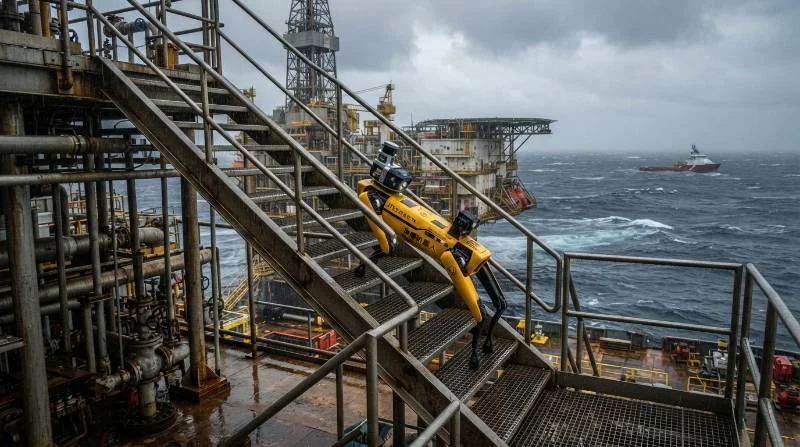
Documented applications demonstrate dramatic safety and efficiency gains across three main operating environments:
- Offshore Topsides & Wellhead Decks: Conducting unmanned deck patrols during severe marine weather. The robot checks flange integrity, monitors hydrocarbon separators, and validates choke valve positions without exposing crew members to offshore hazards.
- Refinery Rotating Equipment Monitoring: High-frequency patrols around hydrocarbon pumps and compressor stations. Acoustic payloads detect cavitation and high-frequency bearing wear well before catastrophic seal failure occurs.
- Toxic Storage Tank Farms: Patrolling tank perimeter bunds and floating-roof seals to detect volatile organic compound (VOC) emissions, as highlighted in our enterprise robotics case studies.
- Hazardous First Response Support: Acting as rapid scouts for emergency crews, as deployed in specialized emergency response and firefighting robotics configurations, measuring ambient toxicity and temperature before human firefighters enter.
TCO and Financial Analysis: Autonomous Quadrupeds vs. Fixed Sensor Grids
Plant operators frequently weigh mobile robotic inspection against broad fixed IoT sensor arrays. While fixed point sensors provide continuous sampling at a single location, instrumenting an entire refinery with thousands of certified Ex-rated transmitters creates massive capital expenses.
| Cost Driver | Autonomous ATEX Quadruped | Fixed Ex IoT Sensor Grid (500 Points) |
|---|---|---|
| Initial Capital Outlay | Moderate (Platform + Payloads + Dock) | Very High (Transmitters + Conduit + I/O Modules) |
| Installation & Cabling Labor | Low (Docking station tie-in only) | Extreme (Hot work permits, cable trays, scaffolding) |
| Coverage Flexibility | High (Dynamic route reconfiguration) | Static (Blind spots remain unmonitored) |
| Maintenance Overhead | Centralized (Single unit servicing) | Decentralized (500 battery/sensor recalibrations) |
According to field data published by the Occupational Safety and Health Administration (OSHA) on industrial exposure mitigation, automating hazardous field walk-downs reduces high-risk human exposure hours by up to 85%. This significant reduction in high-risk hours directly lowers insurance premiums and administrative Permit-to-Work (PTW) overhead.
Frequently Asked Questions About ATEX Inspection Robots
How do ATEX inspection robots handle battery charging in hazardous zones?
Robotic charging stations in classified areas use Ex d flameproof enclosures or Ex p pressurized purging systems. Alternatively, robots are programmed to navigate back to non-classified Safe Areas (unclassified zones) to dock on inductive, non-sparking contact pads.
Can standard inspection payloads be mounted on an ATEX robot dog?
No. Every sensor payload, bracket, cable gland, and connector must carry independent ATEX/IECEx certification matching or exceeding the robot’s overall zone rating (e.g., Ex ia or Ex d for Zone 1). Adding uncertified third-party payloads voids the machine’s safety compliance certification.
What fail-safe behaviors occur if the robot encounters high gas concentrations?
When onboard LEL sniffers detect gas concentrations exceeding pre-set site safety thresholds (typically 10% to 20% LEL), the robot automatically logs the telemetry, broadcasts an emergency alert, and executes a planned retreat path away from the leak source.
Does steel open-mesh grating disrupt quadruped robot stability?
Industrial bionic quadrupeds use specialized foot pads engineered with conductive elastomers and cross-grooved profiles. Integrated force-torque sensors on each joint detect foot slippage within 10 milliseconds, adjusting leg stance dynamically to maintain stability across open steel grating.
Automate Your Hazardous Area Inspections
Upgrade your plant safety, eliminate human exposure in hazardous units, and modernize predictive maintenance with certified autonomous quadruped robotics.