The First-Response Intelligence Gap
Industrial fire events present emergency responders with a fundamental intelligence problem: the information most needed to make effective response decisions — the location and extent of the fire, the presence of hazardous materials, the structural integrity of the affected area — is available only in the most dangerous part of the incident scene. Human reconnaissance in the initial phase of a fire event requires personnel to enter environments where conditions may be rapidly deteriorating, creating risk for responders before the situation is adequately understood.
This intelligence gap has real consequences for response effectiveness. Without accurate information about fire location and spread, incident commanders must make deployment decisions based on incomplete data. Without real-time gas concentration data, responders cannot accurately assess the risk of explosion or toxic exposure. Without thermal imaging of the affected structure, the risk of structural collapse cannot be reliably assessed. The result is that initial response decisions are often more conservative than necessary — or, in some cases, not conservative enough.
Autonomous robots equipped with appropriate sensors can address this intelligence gap directly, providing incident commanders with real-time data from the hazard zone without requiring human entry. This capability does not replace human firefighters — it provides the information that allows human responders to operate more effectively and safely.
Thermal Imaging in Fire Environments
Thermal imaging is the most valuable sensor capability for fire emergency response applications. In a fire environment, thermal cameras provide information that is not available through any other means: the location of the fire front, the thermal gradient across structural elements, the presence of hot spots that indicate fire spread through concealed pathways, and the location of personnel who may be trapped in the affected area.
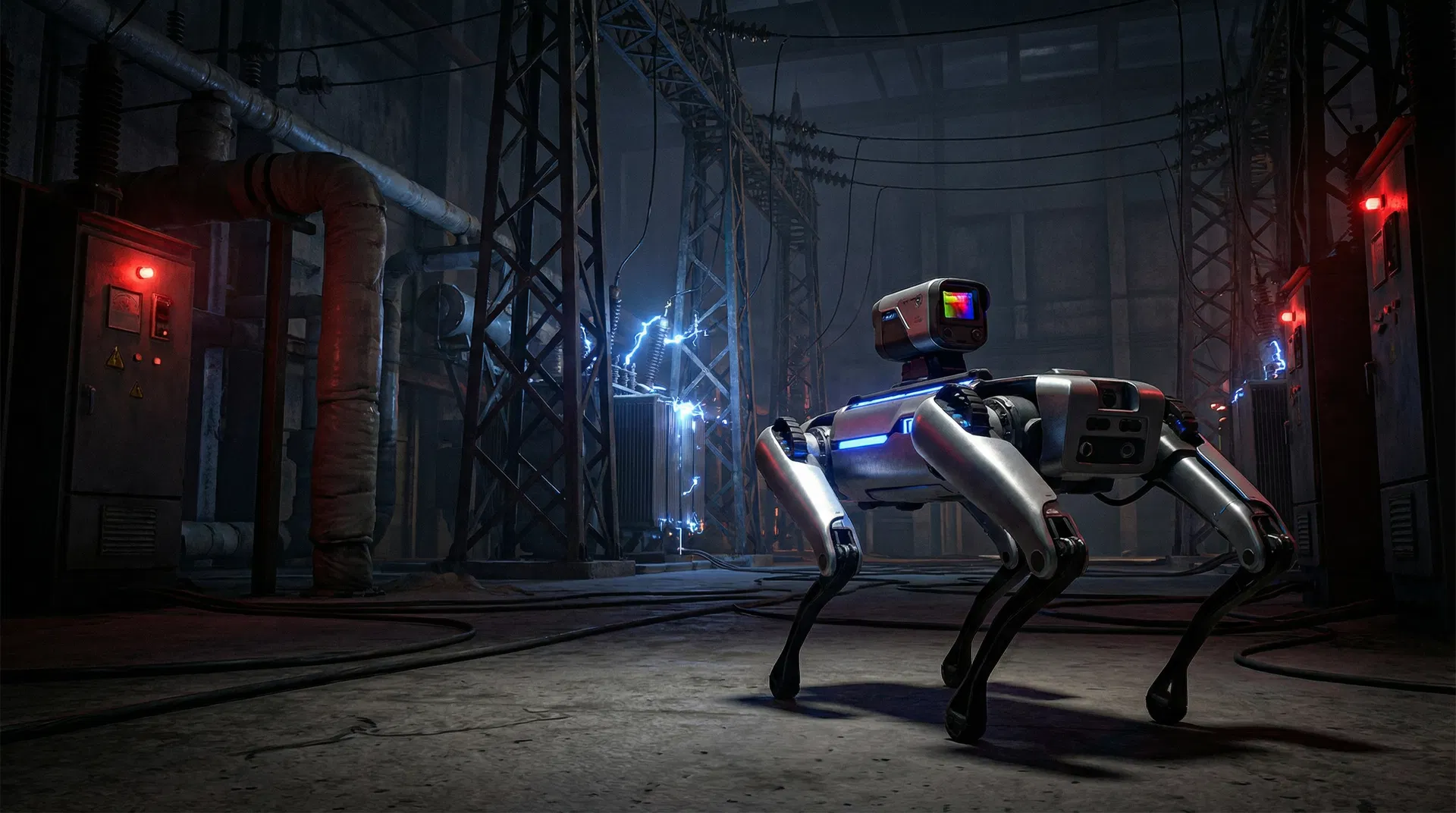
The Rongzhitong RZT-M1 Fire platform integrates a high-sensitivity thermal infrared camera with a 320×240 pixel resolution and a temperature measurement range of -20°C to 550°C — sufficient to characterize fire environments across the full range of industrial fire scenarios. The camera’s automatic hot-spot detection and tracking capability allows the system to maintain focus on the highest-temperature areas of the scene, providing incident commanders with continuous situational awareness of fire development.
In smoke-filled environments where visible-light cameras provide little useful information, thermal imaging maintains full effectiveness. The thermal camera’s ability to see through smoke is a critical operational advantage in fire scenarios, allowing the robot to navigate and collect data in conditions that would severely limit human visibility.
Gas Detection for Hazardous Atmosphere Assessment
Industrial fire events frequently involve hazardous materials — either as the fuel for the fire or as products of combustion from burning process equipment and building materials. Real-time gas concentration data from the incident scene is essential for assessing explosion risk, identifying toxic exposure hazards, and determining the appropriate level of respiratory protection for response personnel.
The RZT-M1 Fire platform’s gas detection suite includes sensors for oxygen concentration, carbon monoxide, hydrogen sulfide, and combustible gases (LEL measurement), providing comprehensive coverage of the most common hazardous atmosphere conditions in industrial fire scenarios. Sensor readings are transmitted in real-time to the incident command post, allowing safety officers to make informed decisions about personnel deployment and protective equipment requirements.
The integration of gas detection with thermal imaging and visual cameras provides incident commanders with a multi-dimensional picture of the hazard environment. Correlating gas concentration data with thermal imaging allows the identification of areas where combustible gas concentrations are elevated in proximity to ignition sources — a critical input for explosion risk assessment.
Structural Assessment and Navigation in Fire Environments
Beyond sensor data collection, the ability of a quadruped robot to navigate in fire-affected environments provides operational capabilities that wheeled platforms cannot match. Industrial fire scenes frequently involve debris, damaged flooring, and structural elements that have been compromised by heat or fire suppression activities. The quadruped’s legged locomotion allows navigation over obstacles and through debris fields that would stop wheeled or tracked platforms.
The RZT-M1 Fire platform’s navigation system uses LiDAR-based mapping combined with visual odometry to maintain positioning in GPS-denied, smoke-filled environments. The system can build a real-time map of the affected area as it navigates, providing incident commanders with a continuously updated floor plan that shows the robot’s path, the location of detected hazards, and the thermal profile of the environment.
This mapping capability is particularly valuable for search and rescue coordination. In scenarios where personnel may be trapped in the affected area, the robot’s real-time map provides a systematic record of areas that have been surveyed, helping incident commanders coordinate search efforts and avoid duplicating coverage in areas that have already been assessed.
Communication and Command Integration
The operational value of a fire reconnaissance robot depends critically on its ability to transmit data reliably from the hazard zone to the incident command post. Industrial fire environments are challenging for wireless communication: metal structures attenuate radio signals, fire suppression activities can disrupt communication infrastructure, and the dynamic nature of fire events means that communication paths that are available at the start of an incident may be blocked as the situation develops.
The RZT-M1 Fire platform uses a multi-band wireless communication system with automatic frequency selection and mesh networking capability, allowing the robot to maintain communication with the incident command post even in environments with significant radio frequency interference. For extended-range deployments, the platform supports integration with portable repeater systems that can be deployed at the perimeter of the hazard zone to extend communication range.
Data from the robot’s sensors is transmitted to the Rongzhitong Cloud Management Platform, which provides incident commanders with a real-time dashboard showing sensor readings, robot position, and thermal imaging data. The platform’s alert management system automatically flags readings that exceed configured thresholds, ensuring that critical information reaches decision-makers without requiring continuous manual monitoring of sensor data streams.
Training and Integration with Emergency Response Programs
Effective deployment of fire reconnaissance robots requires integration with existing emergency response programs and training for the personnel who will operate the system during incidents. The RZT-M1 Fire platform is designed for operation by personnel with standard emergency response training, with an intuitive control interface that can be operated effectively under the stress conditions of an active incident.
Rongzhitong’s implementation methodology for fire emergency response applications includes tabletop exercises and live deployment drills that integrate the robot into existing incident command structures. These exercises allow response teams to develop the operational procedures and decision-making frameworks needed to use robot reconnaissance data effectively in real incidents, before they face the time pressure and stress of an actual emergency.
The goal of these training programs is not to make firefighters into robot operators — it is to make incident commanders effective users of the additional situational awareness that robot reconnaissance provides. When used correctly, fire reconnaissance robots extend the information available to incident commanders without adding operational complexity to the response effort.
—
## Related Solutions
Explore how SG Trading Asia’s quadruped inspection robots are deployed in real-world applications:
– [Firefighting Robot Solution](/solutions/firefighting)
– [Oil & Gas Inspection Robot Solution](/solutions/oil-gas-inspection)
– [Industrial Park Security Robot Solution](/solutions/industrial-patrol)
*[Contact our engineering team](/contact) to discuss your specific inspection requirements.*
Tagged: