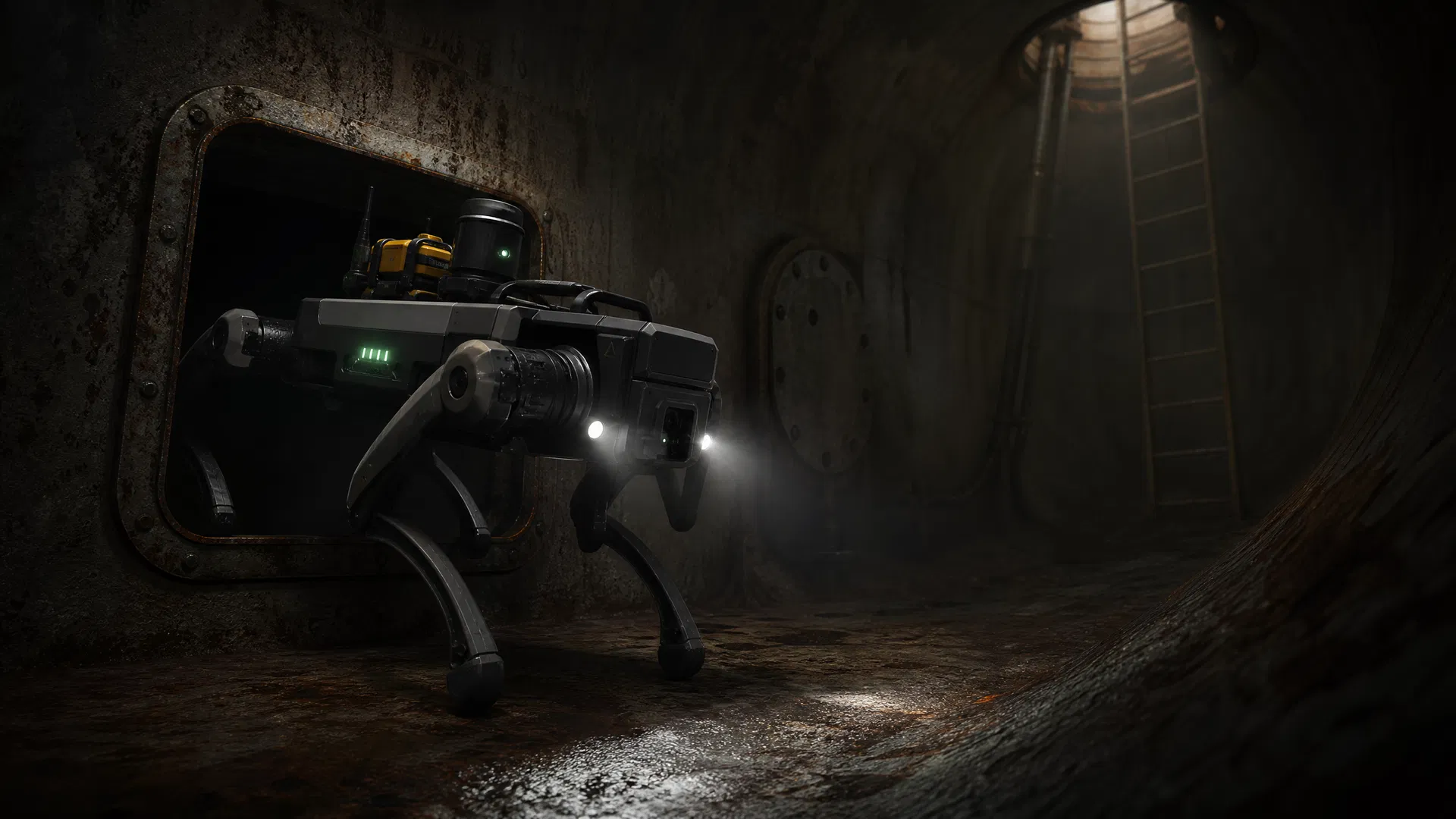
In 2023, the U.S. Bureau of Labor Statistics recorded 136 confined space fatalities in American workplaces alone. That number has remained stubbornly consistent for years, despite decades of regulatory effort, improved PPE, and better training programs. The reason is simple: confined spaces are inherently dangerous, and the only way to eliminate the risk entirely is to keep people out of them.
🔗 Related Products & Resources
- RZTL-1 Quadruped Robot — Compact form factor ideal for confined space entry, IP67 rated
- Chemical Plant Inspection Solution — Gas detection and thermal monitoring in hazardous zones
- ATEX Explosion-Proof Robots — Certified for Zone 1 & Zone 2 explosive atmospheres
- Case Study: Water Treatment Plant — Confined space inspection without human entry
That’s not a radical idea — it’s the direction industrial safety standards have been moving for years. OSHA’s confined space regulations, the UK’s Confined Spaces Regulations 1997, and equivalent frameworks across the EU and Middle East all establish a clear hierarchy: eliminate the hazard, then substitute, then control. Sending an autonomous robot into a confined space instead of a person is the most direct application of that hierarchy.
This article is written for HSE managers, facility operations teams, and maintenance engineers who are responsible for confined space inspection programs and are evaluating whether robotic inspection can improve both safety outcomes and operational efficiency.
What Makes Confined Space Inspection So Difficult
The regulatory definition of a confined space varies slightly by jurisdiction, but the core characteristics are consistent: a space large enough for a person to enter and perform work, with limited means of entry and exit, and not designed for continuous human occupancy. In industrial facilities, this covers an enormous range of assets: storage tanks, pressure vessels, boilers, silos, sewers, tunnels, utility vaults, ship holds, and more.
The hazards that make these spaces dangerous fall into a few categories:
Atmospheric hazards are the most immediately lethal. Oxygen deficiency (below 19.5%), oxygen enrichment (above 23.5%), flammable gas accumulation, and toxic gas presence — particularly hydrogen sulfide (H₂S) and carbon monoxide (CO) — can incapacitate or kill within seconds of exposure. These hazards are invisible and odorless at dangerous concentrations. H₂S, for example, paralyzes the olfactory nerve at high concentrations, meaning workers lose their ability to smell it precisely when it’s most dangerous.
Physical hazards include engulfment risks (grain, sand, liquid), mechanical hazards from equipment that may activate unexpectedly, thermal hazards from steam or hot surfaces, and the ever-present risk that a worker who becomes incapacitated cannot self-rescue and may be difficult to extract.
Operational overhead is substantial even when entries go safely. A permit-required confined space entry under OSHA standards requires a written permit, atmospheric testing, continuous atmospheric monitoring, an attendant stationed outside, rescue equipment on standby, and documented procedures. For routine inspection tasks, this overhead often exceeds the time spent doing the actual inspection.
Where Robots Change the Risk Profile
An inspection robot doesn’t breathe. It doesn’t need oxygen, isn’t affected by H₂S or CO, and doesn’t require rescue if something goes wrong. From a pure hazard elimination standpoint, replacing a human inspector with a robot in an atmospheric hazard environment is the most direct risk reduction available.
But the benefits extend beyond the obvious. Consider what a typical confined space inspection program looks like in a water treatment facility with dozens of tanks, sumps, and vaults requiring regular inspection:
Each entry requires a permit, atmospheric testing, an attendant, and rescue standby — typically 2–4 people involved for each entry, even if the inspection itself takes 20 minutes. Multiply that across a large facility with weekly or monthly inspection requirements, and the labor cost is substantial. More importantly, the frequency of inspection is constrained by that overhead: facilities often inspect less frequently than they should because the entry process is so resource-intensive.
A robot changes that calculus entirely. Once the robot is deployed in a confined space, it can conduct inspection rounds continuously or on any schedule the operator defines, without permits, without attendants, and without rescue standby. The inspection frequency that was previously limited by human entry overhead can increase dramatically — which means problems get detected earlier.
Technical Requirements for Confined Space Robots
Not every inspection robot is suitable for confined space deployment. The environment imposes specific technical requirements that significantly narrow the field of viable platforms.
Atmospheric Monitoring Integration
A robot operating in a potentially hazardous atmosphere needs to carry the sensors that would otherwise be worn by a human inspector. At minimum, this means O₂, LEL (lower explosive limit for combustible gases), CO, and H₂S sensors. The robot’s data management system should log atmospheric readings continuously and trigger alerts if readings approach hazardous thresholds — providing the same safety monitoring function as a human attendant, but from a safe location outside the space.
Explosion-Proof Design for Classified Areas
If the confined space contains or may contain flammable atmospheres, the robot must be rated for operation in that environment. In most jurisdictions, this means ATEX certification (in Europe and the Middle East) or IECEx certification (internationally recognized). These certifications verify that the robot’s electrical systems cannot ignite a flammable atmosphere under normal operation or in the event of a fault. This is non-negotiable for confined spaces in oil and gas, chemical processing, and wastewater treatment facilities.
Mobility in Constrained Environments
Confined spaces are rarely flat, open, and well-lit. They typically involve irregular surfaces, obstacles, limited headroom, and poor lighting. Quadruped robots have a significant advantage here over wheeled platforms: their leg-based locomotion allows them to step over obstacles, navigate uneven surfaces, and maintain stability on wet or slippery floors. The ability to traverse a confined space without getting stuck is a basic operational requirement that many wheeled robots fail to meet in real-world conditions.
Tether vs. Autonomous Operation
Some confined space robots operate on a tether, which provides a physical retrieval mechanism if the robot becomes stuck or loses power. Others operate autonomously with onboard batteries and wireless communication. The right choice depends on the specific confined space: tethered operation is appropriate for long, narrow spaces like pipes or tunnels where the tether doesn’t create entanglement risks, while autonomous operation is better suited for larger spaces where a tether would restrict mobility.
Communication in Signal-Attenuated Environments
Metal-walled tanks and underground vaults attenuate wireless signals significantly. Robots intended for confined space use need communication systems designed for these environments — typically using mesh radio networks, leaky feeder cables, or tether-based data connections rather than standard Wi-Fi.
Regulatory Compliance Considerations
Using a robot for confined space inspection doesn’t eliminate regulatory requirements — it changes them. Understanding how your jurisdiction’s regulations apply to robotic inspection is important before deployment.
| Jurisdiction | Key Regulation | Robotic Inspection Implication |
|---|---|---|
| United States | OSHA 29 CFR 1910.146 | Robot entry may qualify as non-permit required if atmospheric hazards are continuously monitored and no human entry occurs. Consult OSHA guidance for specific scenarios. |
| European Union | Directive 1999/92/EC (ATEX) | Robots operating in Zone 1/2 or Zone 21/22 areas must carry appropriate ATEX certification. Equipment category must match zone classification. |
| United Kingdom | Confined Spaces Regulations 1997 | Robotic inspection supports the “avoid entry” principle. Documentation of robot inspection records may satisfy inspection record requirements. |
| Middle East (GCC) | Various national standards, often aligned with OSHA/IECEx | IECEx certification is widely accepted. Saudi Aramco and ADNOC have specific vendor qualification requirements for equipment used in their facilities. |
| Australia | Safe Work Australia Model Code of Practice | Robotic inspection supports elimination/substitution hierarchy. State-specific regulations may apply. |
The practical implication in most jurisdictions is that robotic inspection of a confined space — where no human enters — significantly reduces or eliminates the permit-required entry process. This is both a safety benefit and an operational efficiency gain.
Application: Water and Wastewater Facilities
Water and wastewater treatment facilities are among the highest-risk environments for confined space fatalities, and among the most compelling use cases for robotic inspection. The combination of H₂S generation from biological processes, oxygen displacement from decomposition gases, and the sheer number of confined spaces in a typical facility creates a persistent, high-frequency hazard.
A large water treatment facility might have dozens of clarifiers, digesters, wet wells, pump stations, and valve vaults requiring regular inspection. Each one is a potential confined space entry. Robotic inspection platforms deployed in these environments have demonstrated the ability to conduct inspection rounds that previously required multiple human entries, reducing confined space entry frequency by 60–80% while increasing inspection frequency.
The atmospheric monitoring data collected by the robot also provides continuous visibility into gas conditions in spaces that were previously only monitored at the time of entry — a significant improvement in the facility’s overall hazard awareness.
Practical Steps for Implementing Robotic Confined Space Inspection
For facilities considering robotic confined space inspection, a phased implementation approach works well:
Phase 1: Hazard and access assessment. Inventory your confined spaces, classify them by hazard type and severity, and assess the physical access constraints of each space. This determines which spaces are candidates for robotic inspection and what technical specifications the robot needs to meet.
Phase 2: Regulatory review. Work with your HSE team and legal counsel to understand how robotic inspection affects your permit-required entry program under applicable regulations. In most cases, this will result in a revised procedure that reduces or eliminates human entries for routine inspection tasks.
Phase 3: Platform selection and pilot. Select a robot platform that meets the technical requirements identified in Phase 1, with particular attention to ATEX/IECEx certification if applicable. Run a pilot deployment in a representative confined space to validate performance before broader rollout.
Phase 4: Integration and training. Connect the robot’s data output to your maintenance management system and train your maintenance team on reviewing and acting on robot inspection data. Update your confined space entry procedures to reflect the new inspection workflow.
Conclusion
Confined space inspection is one of the clearest cases where robotic technology directly addresses a well-defined safety problem. The hazards are real, the regulatory framework is clear, and the operational overhead of human entry is substantial. Robots don’t eliminate confined spaces from industrial facilities, but they can eliminate the need to send people into them for routine inspection — and that’s a meaningful safety improvement.
The technology has matured to the point where deployment is practical for most industrial facilities. The remaining barriers are mostly organizational: updating procedures, training teams, and integrating robot data into existing maintenance workflows. For HSE managers who have spent years managing confined space entry programs, the prospect of significantly reducing that risk is worth the implementation effort.
Tagged: