The Evolution of Industrial Inspection: Why Quadruped Bionic Platforms Lead
Industrial inspection robot use cases have expanded from static monitoring rigs to autonomous quadruped platforms capable of dynamic asset validation across non-linear environments. These bionic systems eliminate human exposure to lethal hazards while automating thermal, acoustic, and visual telemetry capture across heavy industrial assets.
Traditional Autonomous Mobile Robots (AMRs) rely on wheels or continuous tracks. While efficient across flat warehouse concrete, they routinely stall on steel open-mesh grating, steep staircases, curb obstacles, and outdoor gravel switchyards.
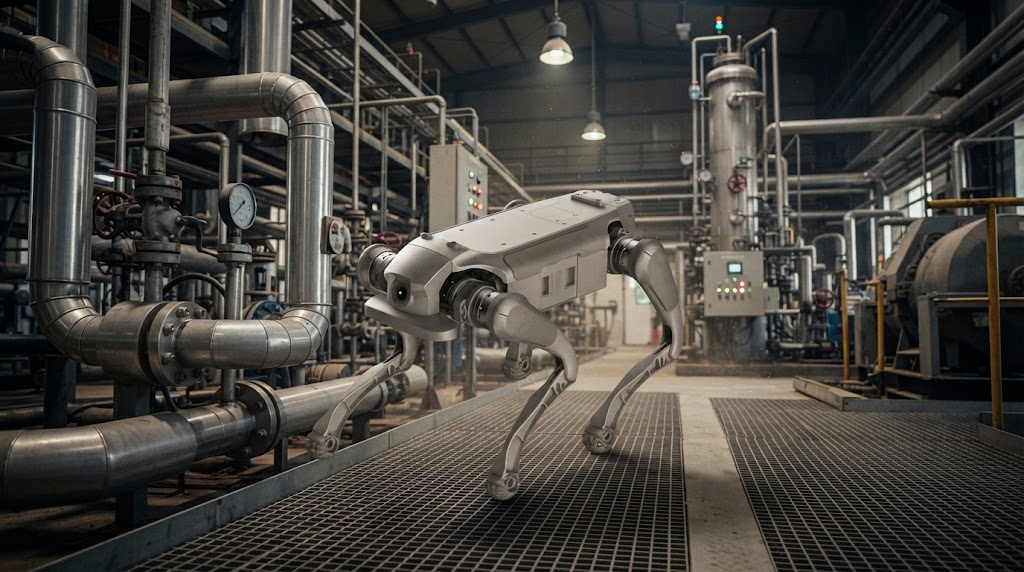
Legged robotic platforms mimic biological kinodynamics. By using multi-joint articulation and advanced SLAM navigation technology, bionic platforms traverse 35-degree industrial stairs, cross 20-centimeter trenches, and self-recover from slips on oil-slicked surfaces.
| Mobility Platform | Terrain Clearance | Stair Negotiation | Payload Agility | Unstructured Surface Capability |
|---|---|---|---|---|
| Quadruped Robot Dog | High (Omnidirectional) | Standard & Spiral Grated Stairs | Dynamic Balancing (up to 85 kg) | Gravel, Mud, Grating, Pipe Obstacles |
| Wheeled AMR | Low (< 50 mm) | Incapable (Ramps Only) | High Static Payload | Polished Flat Concrete Only |
| Tracked Crawler | Medium | Limited (High Tread Wear) | High Static Payload | High Tractive Dirt, Zero Lateral Agility |
| Fixed Optical Mounts | None (Stationary) | Incapable | Single-Axis Pan-Tilt | Prone to Line-of-Sight Occlusion |
Non-Destructive Testing (NDT): An analytical inspection technique used by robotic sensor suites to evaluate the structural integrity and properties of materials or components without causing permanent mechanical damage.
Power Generation, Substations, and Utilities Infrastructure
Utility-scale power networks face significant operational challenges from high-voltage electromagnetic interference (EMI) and extreme weather. Autonomous industrial inspection robot solutions address these issues by conducting round-the-clock rounds across live switchyards and remote generation assets.
1. High-Voltage Switchyard Thermal Hotspot Inspections
Transformers, disconnect switches, and busbars develop loose terminations and contact degradation over time. Quadruped robots equipped with calibrated radiometrics capture high-resolution thermal images, detecting anomalies above baseline tolerances to prevent catastrophic arc flash explosions.
2. Acoustic Corona and Partial Discharge Tracking
Insulator string flashovers and high-voltage partial discharge emit high-frequency acoustic signals before visible thermal signatures appear. Acoustic imaging payloads locate ultrasonic emissions between 20 kHz and 100 kHz, overlaying an acoustic heatmap directly onto optical feeds in real time.
3. Automated Analog Gauge and Valve Position OCR
Legacy substations maintain thousands of mechanical dials, oil level sight glasses, and SF6 pressure indicators lacking SCADA wiring. Onboard edge AI optical character recognition (OCR) transcribes analog dial values and breaker open/close indicator states into central time-series databases.
4. Remote Solar Farm and Wind Turbine Base Audits
Autonomous robot dogs patrol utility-scale photovoltaic tracker rows to detect micro-cracked panels, failing string inverters, and cracked foundation bolting on wind turbine base skirts without requiring full-time on-site field staff.
Oil, Gas, and Petrochemical Asset Integrity
Refineries, LNG terminals, and offshore drilling platforms operate under strict explosive atmosphere standards. Deploying robotic inspection platforms mitigates volatile organic compound (VOC) exposure and ensures alignment with OSHA safety mandates and IECEx certification standards.
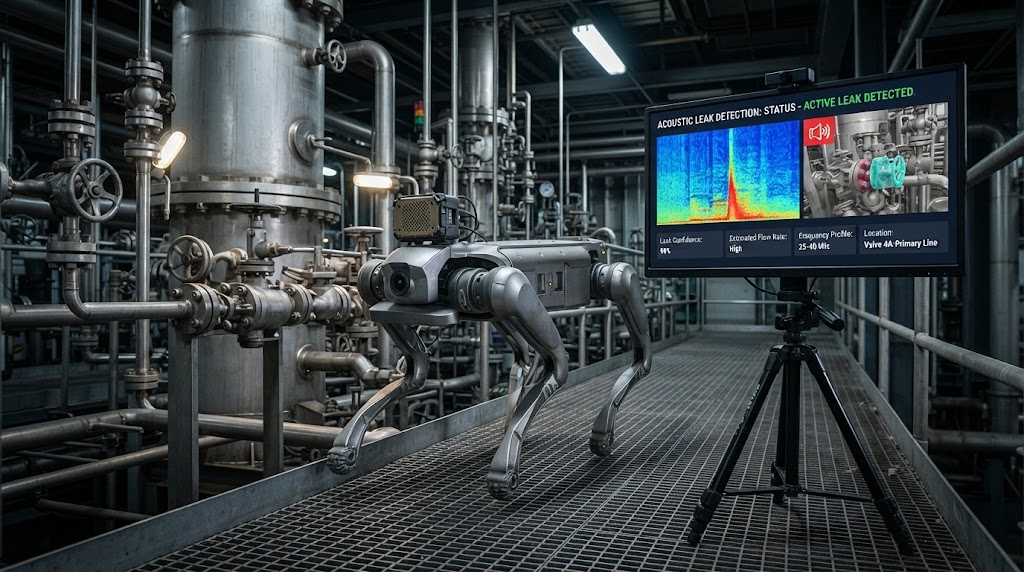
5. Optical Gas Imaging (OGI) for Fugitive Methane Leaks
Robotic payloads integrating cooled mid-wave infrared (MWIR) sensors detect invisible fugitive gas leaks from valve packings, flanges, and compressor seals. Robots patrol predetermined EPA Method 21 compliance routes, automatically cataloging leak volume estimations.
6. High-Temperature Pipe Rack Wall-Thickness Validation
Quadruped robots navigate elevated catwalks to position electromagnetic acoustic transducer (EMAT) and ultrasonic thickness (UT) sensors against process piping. This automates non-destructive testing for pipe erosion without requiring scaffolding construction.
7. Offshore Platform Bilge and Hazardous Zone Inspection
Offshore decks expose personnel to open sea conditions, hazardous vapor pockets, and multi-tier grating. Robot dogs run autonomous structural missions, checking pump seal integrity and flare stack combustion efficiency in non-permissive zones.
Mining, Metals, and Heavy Manufacturing Applications
Heavy extraction and processing environments generate ambient dust, vibration, and thermal extremes that accelerate equipment wear. The ruggedized RZTL-1 industrial quadruped platform handles these demanding structural conditions with an IP67 rating and omnidirectional traction.
8. Subterranean Conveyor Belt Idler Bearing Monitoring
Kilometer-long bulk material conveyors feature thousands of spinning idlers. Seized bearings create friction hotspots that risk catastrophic belt fires. Robot dogs patrol transfer galleries, logging acoustic vibration anomalies and thermal thresholds for every single bearing assembly.
9. Pre-Entry Confined Space Gas Scouting and 3D LiDAR Mapping
Before workers enter underground shafts, storage silos, or utility vaults, the robot descends to sample oxygen, hydrogen sulfide, carbon monoxide, and LEL percentages while generating dense 3D point-cloud collision maps.
10. Molten Metal Transfer Line and Refractory Degradation Auditing
In smelters and steel mills, ladle breakout represents a catastrophic risk. Quadruped platforms scan refractory linings and slag runners from safe standoff distances, identifying refractory thinning before shell rupture occurs.
11. Compressed Air and Steam Loop Acoustic Leak Auditing
Unchecked industrial air and steam leaks account for up to 30% of an industrial facility’s electrical overhead. Autonomous robots systematically sweep production floors using acoustic arrays, pinpointing leaks and calculating direct monetary loss per CFM.
Engineering Insight: “Our field deployment data indicates that moving from reactive manual sweeps to continuous autonomous quadruped acoustic scanning reduces undetected compressed air energy waste by an average of $84,000 annually per 100,000 square meters of production space.”
— Senior Principal Robotics Architect, Intelligent Robot Dog
Modular Payloads and On-Device Edge AI Architecture
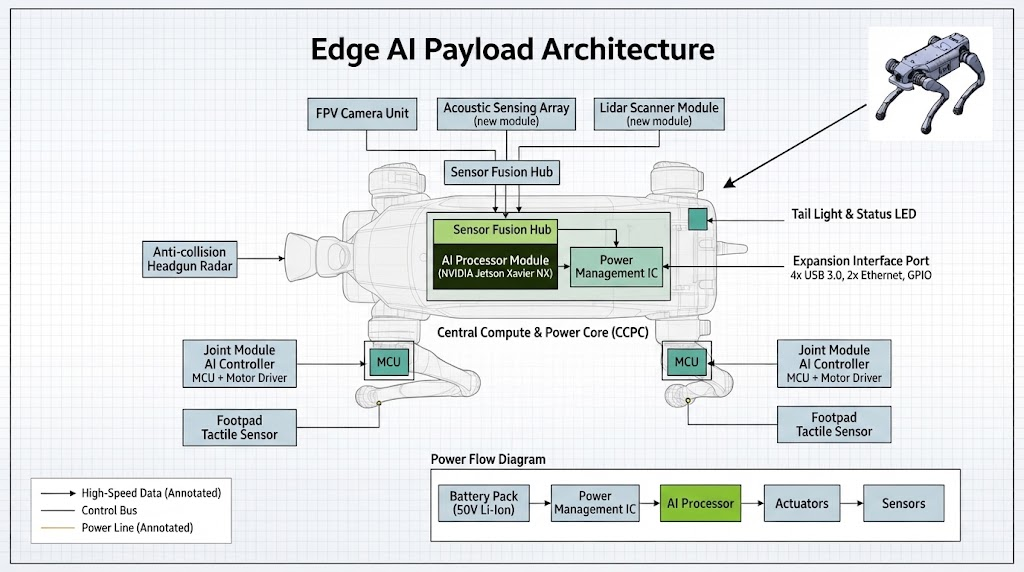
Autonomous inspection success depends heavily on sensor payload flexibility and on-device processing capabilities. Modern architectures process data locally rather than streaming raw 4K video over constrained industrial wireless links.
12. SCADA-Integrated Edge-First Emergency Response
When an alarm trips within an enterprise SCADA or DCS system, the robot dog automatically dispatches to the coordinate origin. It streams optical, thermal, and sniffer data to the central operations center, confirming whether an incident is an actual line rupture or an instrumentation false positive.
- Dual-Spectrum 30x Optical/Radiometric Pan-Tilt Units: For millimeter-level gauge tracking and long-distance electrical isolation checks.
- Acoustic Ultrasound Matrix Arrays: 128-microphone MEMS arrays for instant gas and discharge localization.
- Multigas Sniffer Payloads: Simultaneous measurement of VOCs, SOx, NOx, CH4, and O2 depletion.
- On-Device Tensor Processing Units: Running YOLO-based defect models and auto-OCR on local ROS 2 architecture during complete wireless dropouts.
The Quadruped Industrial Deployment Framework (QIDF)
To accelerate implementation timelines, Intelligent Robot Dog uses the Quadruped Industrial Deployment Framework (QIDF). This four-stage engineering methodology transitions operations from manual inspections to autonomous 24/7 robotic missions within six weeks.
- Phase 1: Site Assess & Digital Twin Mapping: High-density LiDAR mapping of mission pathways, stair angles, charging dock placements, and RF communication blackouts.
- Phase 2: Payload Modular Customization: Integrating specialized sensors such as OGI cameras or RTK-GNSS receivers onto the Tongchui-M1 heavy-duty robot.
- Phase 3: Edge Inference & SCADA API Commissioning: Configuring local neural networks for gauge transcription, threshold alarms, and Modbus/MQTT/OPC-UA industrial integrations.
- Phase 4: Autonomous Closed-Loop Scaling: Commissioning automated self-charging docks for continuous, scheduled patrol cycles with zero human intervention.
B2B Financial Metrics: TCO, ROI, and Pilot Timelines
Deploying quadruped robotic inspection platforms delivers measurable financial returns across asset protection, insurance overhead, and direct labor reallocation.
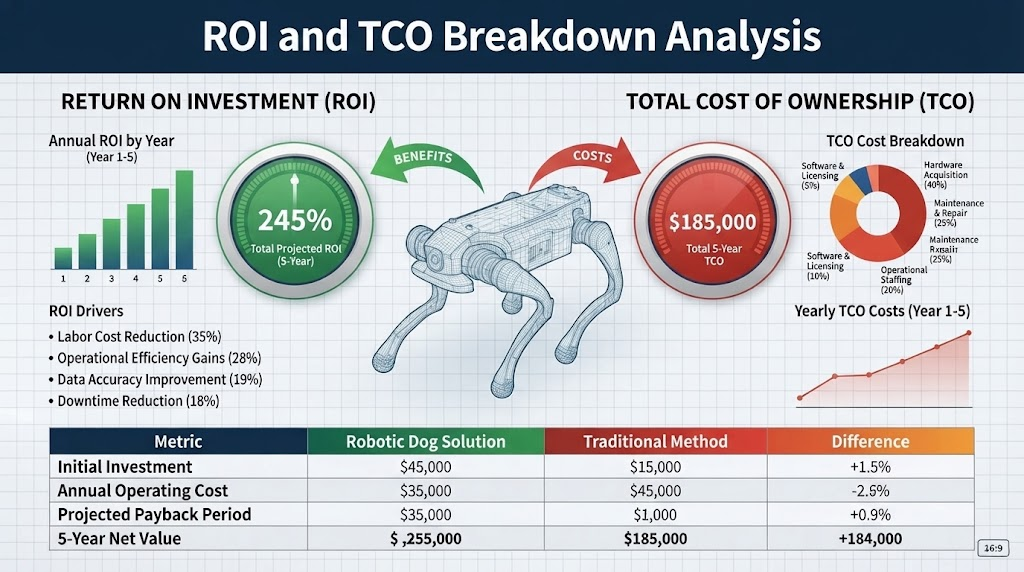
Our field deployment audits show an average capital payback period between 6 and 14 months. For real-world implementation data, review our proven deployment case studies.
- Direct Labor Optimization: Reallocates certified reliability engineers from low-value walking routes to high-value analytical remediation.
- Unplanned Downtime Reduction: Prevents electrical flashovers, bearing fires, and pipe burst events through continuous predictive maintenance (PdM).
- Insurance Premium Reductions: Underwriters offer preferential asset rates for facilities featuring documented autonomous hazard tracking.
Frequently Asked Questions
How do quadruped robots handle steep industrial stairs and open grating?
Quadrupeds use dynamic gait planning and stereo-vision depth estimation to adjust foot placement on each stair tread. High-grip rubber footings prevent slippage on wet or galvanized steel grating at angles up to 35 degrees.
What happens if the robot loses Wi-Fi or cellular connectivity mid-mission?
The robot executes its inspection mission entirely on edge compute. It logs telemetry and anomaly data locally, follows its pre-mapped SLAM path, and syncs full inspection logs once docked or reconnected to the network.
What is the typical operational runtime between battery charges?
Industrial robot dogs operate between 90 and 150 minutes per mission depending on the payload weight and terrain difficulty. When battery levels reach 15%, the unit autonomously returns to its docking station for contact or induction recharging.
Can quadruped robots be certified for explosive ATEX Zone 1 / Class I Div 1 environments?
Standard platforms operate in general industrial and Zone 2 environments. For Zone 1 / Div 1 deployment, robots require specialized pressurized enclosures, intrinsically safe electronics, and non-sparking footings meeting international standards.