Executing an Inspection Robot Pilot Project: Scope and Objectives
A 60-day inspection robot pilot project is a time-bound engineering evaluation designed to validate quadruped mobility, sensor telemetry precision, autonomous docking, and edge inference in operational industrial environments. It provides plant operators with empirical data to verify navigation repeatability, safety system compatibility, and clear return on investment (ROI) before committing capital to full fleet deployments.
Industrial facilities such as power substations, oil refineries, chemical processing plants, and mining sites present extreme challenges for autonomous systems. Deploying autonomous industrial inspection solutions removes human personnel from high-hazard zones while increasing data collection frequency from weekly rounds to continuous, automated shifts.
Without a structured validation scope, pilot programs risk derailment due to feature creep, unnecessary edge-case troubleshooting, and misaligned engineering goals. Establishing clear baseline benchmarks within the first 60 days prevents operational delays and establishes unambiguous go/no-go deployment criteria.
The 4-Stage Quadruped Pilot Validation Framework (QPVF)
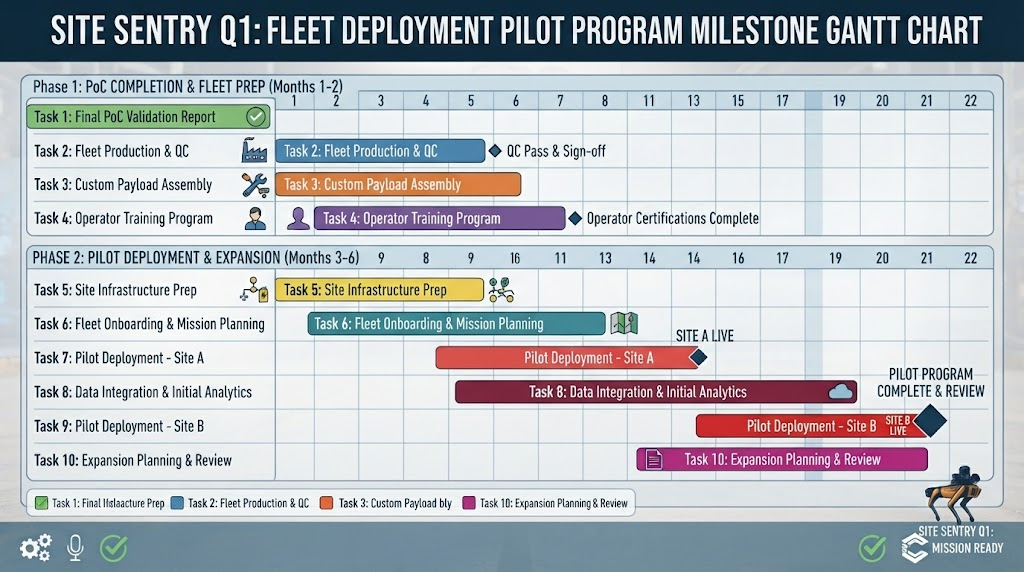
To establish rigorous testing protocols, Intelligent Robot Dog engineers utilize the Quadruped Pilot Validation Framework (QPVF). This methodology divides the 60-day trial into sequential phases: Physical Mobility, Sensor Telemetry, Edge Inference, and Operational Integration.
QPVF Definition: A sequential, milestone-driven evaluation architecture designed to isolate mechanical navigation reliability, payload data integrity, localized computational response, and total cost of ownership under industrial conditions.
Each phase evaluates specific performance indicators to ensure the robotic asset meets standard operating requirements before advancing to enterprise network integration.
| Framework Stage | Testing Duration | Primary Target Metric | Acceptance Threshold |
|---|---|---|---|
| Stage 1: Mobility & Mapping | Days 1–15 | Stair, gravel, and open-grating navigation | >99.5% path completion without manual teleop intervention |
| Stage 2: Sensor & Payload | Days 16–30 | Radiometric thermal, acoustic, and visual zoom precision | Thermal accuracy within ±2°C; 99% optical gauge read accuracy |
| Stage 3: Autonomous Cycles | Days 31–45 | Unattended multi-shift runs and automatic docking | 99.0% docking contact success rate on first attempt |
| Stage 4: Integration & ROI | Days 46–60 | SCADA alarm routing and MTTR / TCO calculations | Telemetry ingestion latency <200ms; calculated payback <14 months |
Phase 1 (Days 1–15): Site Mapping, Path Repeatability, and Sensor Calibration
The initial two weeks focus strictly on environmental modeling and mechanical repeatability. Engineers build a digital twin of the facility using advanced LiDAR SLAM navigation to record dense 3D point-cloud maps of patrol routes.
Mapping Grating, Catwalks, and Obstacles
Industrial sites present unique challenges such as open-mesh steel grating, steep industrial stairs (up to 45°), curb transitions, and dynamic equipment. During Phase 1, the quadruped platform must repeatedly traverse these routes to verify point-to-point waypoint accuracy within ±3 cm.
- Surface Evaluation: Verifying foot traction on wet steel, oil-treated concrete, and unpaved aggregate.
- Dynamic Obstacle Avoidance: Testing real-time path re-planning when routes are blocked by mobile machinery or scaffolding.
- Stair Traversal: Validating climbing cadence, pitch stability, and slip compensation on standard industrial staircases.
Sensor Payload Calibration
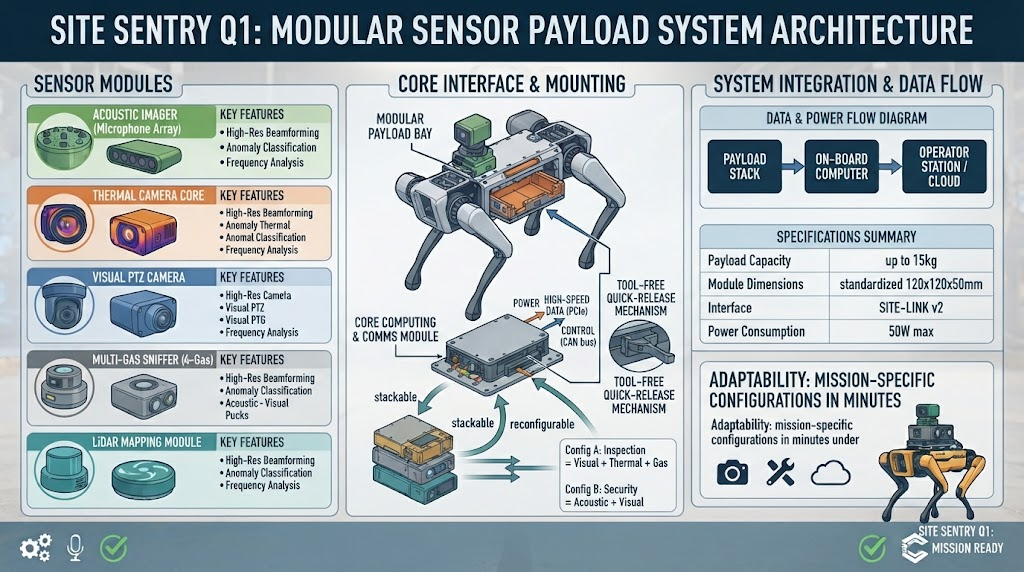
Thermal cameras, high-definition optical pan-tilt-zoom (PTZ) units, acoustic imagers, and gas detectors require baseline calibration against physical plant instruments. Radiometric thermal imagers must be adjusted for surface emissivity and ambient reflection.
Phase 2 (Days 16–45): Autonomous Mission Cycles and Edge Anomaly Detection
Once pathing and sensors are calibrated, the robot transitions to fully autonomous, scheduled missions across day and night operational shifts without human supervision.
Edge AI Inference vs. Cloud Processing
Industrial facilities often feature intermittent Wi-Fi and restricted private 5G coverage. Relying on cloud computation introduces latency and risks telemetry drops. The platform must execute computer vision models directly onboard via high-throughput edge compute modules.
| Metric | Onboard Edge Inference | Cloud-Dependent Processing |
|---|---|---|
| Anomaly Detection Latency | <45 ms (real-time alert trigger) | 1,200–4,500 ms (bandwidth dependent) |
| Network Outage Operation | 100% Autonomous Functionality | System Halts / Mission Abort |
| Data Security Compliance | Local encrypted storage (Zero external leakage) | Requires outbound streaming approval |
| Bandwidth Consumption | Low (Metadata / Alarms only: <50 Kbps) | High (Raw 4K video feeds: >15 Mbps) |
SCADA and DCS Integration Testing
The pilot must verify that anomalies—such as an overheating bearing detected via thermal imaging or a pressurized gas leak—trigger standard industrial protocols (MQTT, OPC UA, or Modbus TCP) to alert control room operators in under one second.
Phase 3 (Days 46–60): Reliability Validation, MTTR, and TCO Modeling
The final phase tests continuous endurance under production conditions. Deploying heavy-duty hardware like the RZTL-1 industrial quadruped platform allows operations teams to measure Mean Time Between Failures (MTBF) and validate self-charging reliability.
Autonomous Docking and Charging Reliability
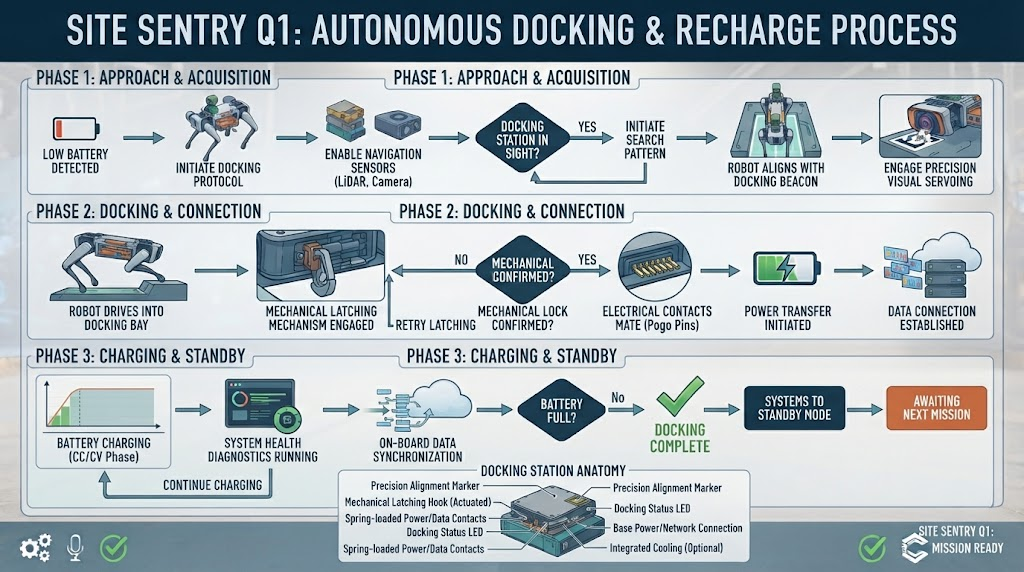
A pilot cannot be considered successful if the robot requires manual docking assistance. Testing must subject the self-aligning charging dock to at least 150 consecutive autonomous recharge cycles across varying lighting conditions and ambient temperatures.
- Alignment Tolerance: Validating charging pad contact within ±5° visual or inductive alignment offsets.
- Thermal Throttling: Monitoring battery cell temperatures during fast-charging cycles in outdoor environments.
- Duty Cycle Ratios: Establishing operational duty cycles (typically 75 minutes runtime to 45 minutes charging).
Financial Justification: CAPEX vs. Robotics-as-a-Service (RaaS)
Asset owners utilize the 60-day telemetry to calculate exact operational savings. The financial model compares traditional manual inspection costs (labor hours, PPE, hazard pay, scaffolding) against upfront CAPEX or subscription-based RaaS models.
Field data collected over 60 days typically demonstrates an inspection frequency increase of 400% while reducing hazardous exposure hours for maintenance personnel by 70% to 85%.
Common Distractions: What NOT to Test During a 60-Day Pilot
Many pilot projects fail because teams attempt to solve every facility edge case rather than proving core operational value. Maintaining a strict validation boundary is essential for success.
- Do NOT Build Custom AI Models from Scratch: Focus on pre-trained computer vision for analog dials, digital displays, and valve positions. Custom model training should occur post-pilot during full operational rollout.
- Do NOT Attempt Complex ERP Write-Back: Verify that the robot generates accurate alarms and API payloads. Do not spend pilot resources configuring automated work-order creation in SAP or IBM Maximo until data accuracy is verified.
- Do NOT Over-Index on Extreme Edge Cases: Focus on standard recurring inspection routes that represent 95% of operational routines. Avoid designing missions around flooded sumps or blocked fire exits that occur less than 1% of the time.
- Do NOT Evaluate Manipulation or Valve Turning: Quadruped inspection pilots must isolate sensing, navigation, and endurance. Adding robotic arm manipulation during the initial 60 days complicates kinematic stability and doubles pilot costs.
Environmental Resilience and Hazardous Area Safety Standards
Industrial reliability demands adherence to international environmental and safety standards. Physical testing must confirm compliance with ingress protection and electrical safety regulations.
Robotic systems operating in outdoor or washdown environments must carry certified IP67 or IP68 ratings according to International Electrotechnical Commission (IEC) standard 60529. This ensures internal electronics remain protected against heavy rain, dust ingress, and temporary submersion.
For chemical and oil & gas assets, units must be evaluated against ATEX Zone 1/2 or IECEx Class I, Division 2 standards to verify non-incendive operation in potentially explosive atmospheres, following guidelines established by ASTM International for autonomous industrial machinery.
Scaling from Pilot to Multi-Robot Fleet Deployment
At Day 60, stakeholders review pilot data against predefined acceptance criteria to approve commercial fleet rollout. Scaling from a single proof-of-concept unit to a multi-robot fleet requires centralized fleet management software.
Fleet orchestration tools manage autonomous mission assignment, dynamic battery charging rotation, multi-robot traffic deconfliction, and unified data aggregation across plant zones.
Frequently Asked Questions About Inspection Robot Pilot Projects
What network infrastructure is required for a 60-day pilot?
A continuous network is not required. Autonomous quadrupeds navigate and process visual data entirely at the edge using LiDAR SLAM and onboard AI compute. The robot only requires intermittent Wi-Fi, private 5G, or an Ethernet connection at its docking station to offload summary logs and telemetry.
How long does it take to create initial 3D LiDAR maps?
Mapping standard industrial routes (500–1,000 meters of inspection path) typically takes 2 to 4 hours via manual teleoperation. The robot’s SLAM algorithms process point clouds in real time to generate an autonomous navigation mesh.
Can inspection robots operate safely alongside human workers?
Yes. Quadruped platforms feature 360-degree depth cameras, ultrasonic proximity sensors, and LiDAR safety zones. If a worker steps into the robot’s dynamic path, the system decelerates, halts, or navigates around the obstruction with a minimum 1.5-meter buffer.
What is the primary factor that causes pilot projects to fail?
Pilot failures are almost always caused by scope creep—such as attempting to integrate legacy enterprise software systems or building custom AI models during the trial—rather than hardware or navigation shortcomings.