Defining the Industrial Robot Proof of Concept: Scope, Benchmark Data & Strategic Value
An industrial robot proof of concept is a controlled, field-level engineering deployment designed to validate mobility, data fidelity, and enterprise software integration before committing capital expenditure. By testing autonomous routines against high-value plant inspection targets, engineering teams quantify predictive maintenance accuracy and determine automated inspection feasibility under real-world operating conditions.
Industrial Robot PoC: A time-boxed empirical validation that quantifies how an autonomous robotics platform gathers actionable condition-monitoring telemetry across target physical assets without degrading facility safety or uptime.
According to research published by the Electric Power Research Institute (EPRI), unplanned outages in heavy industrial environments cost upwards of $12,000 per hour. Staged pilot programs reduce full-scale rollout failures by over 73% by isolating mechanical, communication, and environmental failure points during early deployment.
Rather than deploying a turnkey fleet immediately, an effective industrial robot proof of concept isolates kinematic navigation, sensor payloads, and data pipelines into discrete validation milestones.
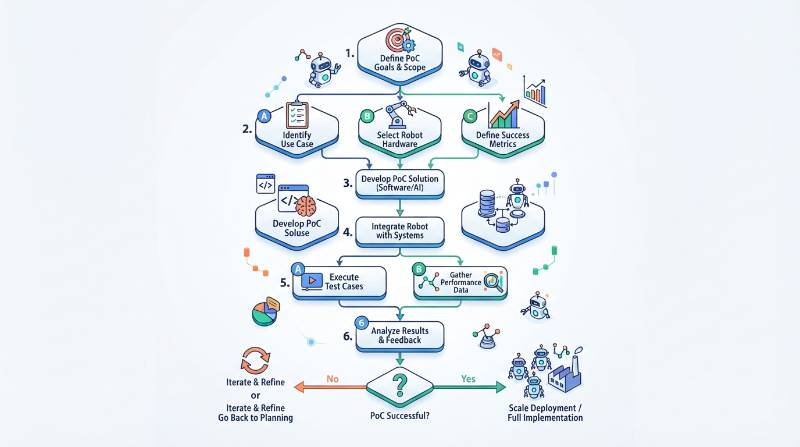
Phase 1: Operational Scoping, Failure Modes, and Measurable Decision Gates
Enterprise automation projects fail when goals remain vague. Engineering teams must avoid testing general automation and instead focus on automating specific, quantifiable condition-monitoring routes.
Begin by mapping the exact physical failure modes of the target facility:
- Thermal Anomalies: Busbar hotspots, bearing friction overheating, transformer coil degradation.
- Acoustic Leaks: Compressed air discharge, high-pressure steam leaks, vacuum system failures.
- Mechanical Deviations: Structural vibration outside ISO 10816 vibration standards, analog dial misalignments, pipeline corrosion.
Pair every asset with a clear Go/No-Go decision gate before introducing physical hardware to the site.
Integrating targeted autonomous robotic inspection solutions allows plants to transition from reactive operator rounds to automated anomaly detection.
Phase 2: Robotic Platform Selection: Quadruped vs. Wheeled and Tracked Systems
Industrial facilities present difficult operational challenges. Plants feature open steel gratings, steep stairs, high thresholds, outdoor mud, and narrow aisles designed strictly for human movement.
The choice of robotic chassis directly dictates terrain traversal success rates during a pilot:
| Feature | Wheeled Robots | Tracked Robots | Quadruped Robot Dogs |
|---|---|---|---|
| Stair Navigation | Incapable (Requires ramps) | Limited (Risk of slip/catch) | Native (Up to 35° incline) |
| Grated Catwalks | High vibration feedback | Debris entrapment risk | High stability via footstep planning |
| Turning Radius | Differential / Ackermann | Skid steer (Floor wear) | Zero-radius omnidirectional |
| Payload Agility | Fixed height perspective | Fixed height perspective | Active pose adjustment (Crouch/Tilt) |
Industrial testing confirms that quadrupeds navigate brownfield plants without requiring infrastructure modifications like custom ramps or floor leveling.
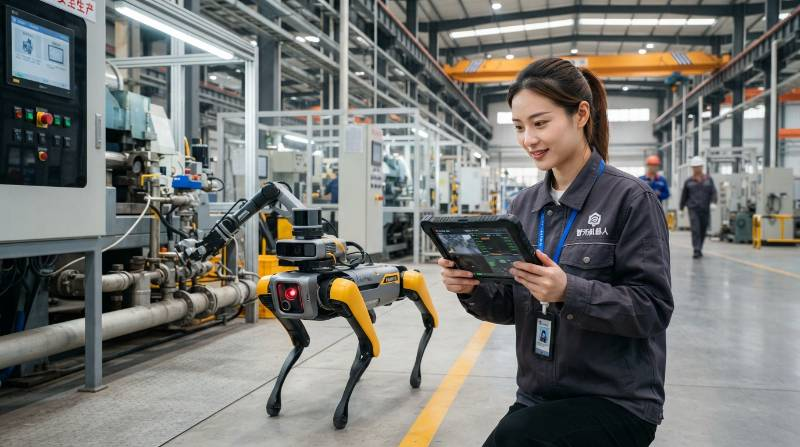
Platforms such as the RZTL-1 industrial quadruped deliver the dynamic balance and modular payload support required for heavy industrial condition monitoring.
Phase 3: Sensor Payload Architecture and Edge AI Vision Pipelines
A robotic dog serves as an agile mobility carrier. Its actual diagnostic capability depends entirely on its onboard sensing suite and real-time computing payload.
Modular Sensor Modalities
- Radiometric LWIR Thermal Imaging: Uncooled long-wave infrared sensors (640×512 resolution, ≤50mK NETD) for non-contact thermal profile analysis conforming to ASTM E3115 standards.
- Acoustic Imaging Arrays: MEMS ultrasonic microphone matrices detecting frequencies from 2 kHz to 96 kHz for fugitive methane emissions and compressed gas leaks.
- Optical Zoom Payloads: High-definition pan-tilt-zoom (PTZ) optical cameras with 30x optical zoom for reading legacy analog gauges, oil levels, and switchgear indicator lights.
Edge AI Inference Stack
Relying on raw cloud streaming across industrial substations or refinery cellars is impractical due to RF shielding and network latency. The PoC must deploy localized edge computing modules such as the NVIDIA Jetson Orin series integrated via ROS 2 Humble.
Video streams (RTSP) feed directly into quantized computer vision models (such as YOLOv8-based pointer detection) running locally on the robot. The system processes gauge angle, compares the reading against predefined pressure thresholds, and flags variances instantly.
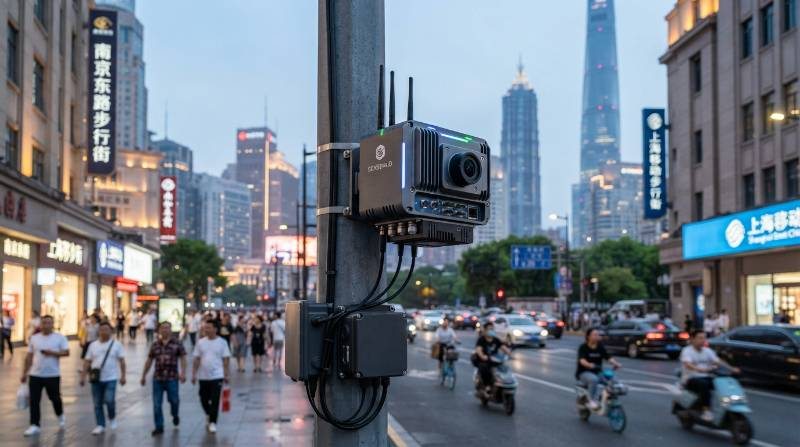
The 4-Tier Intelligent Robot Dog PoC Validation Protocol
To provide clear engineering outcomes, our specialists utilize the 4-Tier Intelligent Robot Dog PoC Validation Protocol. This systematic methodology ensures every technical requirement is validated before moving to full operational commissioning.
Tier 1: Kinematic & Environmental Feasibility
Validates the robot’s ability to navigate targeted plant physical obstacles. Involves multi-floor stair climbs, navigating metal drainage gratings, overcoming 150mm curbs, and verifying continuous operation across wet or dusty zones.
Tier 2: Sensor Payload Calibration & Data Fidelity
Validates raw data repeatability against calibrated handheld instruments. Thermal, acoustic, and visual captures must remain within ±1% variance of baseline manual measurements across various lighting and weather conditions.
Tier 3: Autonomous Localization and Path Repeatability
Quantifies autonomous navigation accuracy using onboard 3D LiDAR SLAM navigation. The robot must navigate predefined multi-point inspection routes repeatedly, stopping within a ±3 cm margin to ensure consistent sensor targeting.
Tier 4: Enterprise SCADA & CMMS Integration Handshake
Verifies the automated pipeline from edge detection to enterprise alert generation. Out-of-spec readings must parse into structured JSON packets and transmit directly into maintenance software without human intervention.
Phase 4: Telematics, SCADA Integration, and CMMS Workflows
An autonomous inspection robot is an extension of plant telemetry. If the gathered data sits isolated on internal solid-state drives, the proof of concept fails its operational purpose.
The pilot program must validate secure, automated outbound communications:
- Telemetry Protocols: Publishing asset health payloads over MQTT/Sparkplug B or standard OPC-UA nodes into distributed control systems (DCS).
- CMMS Work Order Automation: Using REST API integrations with enterprise platforms like SAP PM or IBM Maximo to trigger high-priority maintenance tickets automatically when anomalies are confirmed.
- Secure Network Architecture: Implementing WPA3-Enterprise, local VPN tunneling, and zero-trust segmentation between robot operational control networks and corporate enterprise clouds.
Evaluating Field Results: KPI Scorecards, Executive ROI, and Case Evidence
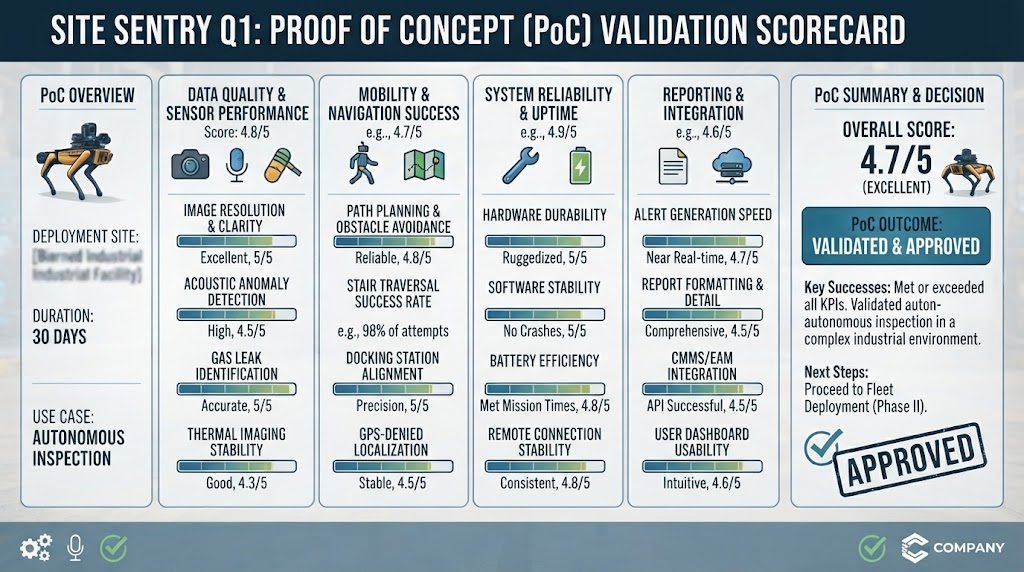
Securing executive sign-off requires presenting clear performance metrics from the trial run. Document the pilot using standardized testing parameters:
| Target KPI | PoC Acceptance Threshold | Measured Operational Value |
|---|---|---|
| Inspection Mission Completion Rate | ≥ 95% unassisted runs | Measures kinematic and SLAM autonomy |
| Defect Identification Accuracy | ≥ 98% true positives | Validates edge AI vision inference quality |
| Data Ingestion Latency | < 5 seconds from edge capture | Confirms real-time CMMS work order generation |
| Mean Time Between Failures (MTBF) | ≥ 150 operating hours | Evaluates hardware and battery endurance |
Real-world data documented across industrial robotics case studies highlights that deploying quadruped condition monitoring reduces human exposure to hazardous areas by up to 85% while increasing inspection frequency fourfold.
Frequently Asked Questions About Industrial Robot Proof of Concepts
How long does an industrial robot proof of concept typically take?
A standard industrial robot PoC runs between 4 to 8 weeks. This timeline covers route mapping, sensor calibration, edge AI model tuning, and 2 to 3 weeks of autonomous shift runs.
Can we validate our inspection routes in simulation before on-site deployment?
Yes. Utilizing ROS 2 and Gazebo simulation frameworks allows engineering teams to import plant 3D CAD/BIM models, verify sensor sightlines, and optimize path trajectories prior to shipping physical robots to the facility.
How do autonomous charging stations factor into the PoC?
Autonomous wireless or contact-based docking stations should be tested in the final two weeks of the PoC to validate continuous mission cycles without human intervention.
Are quadruped inspection robots certified for hazardous (ATEX / Class 1 Div 2) environments?
Specialized explosion-proof and purged enclosures exist for hazardous zones. Standard PoC deployments typically focus on unclassified auxiliary units, substations, and outdoor pipeline corridors before testing inside certified ATEX envelopes.