Core Industrial Inspection Robot Selection Criteria
Industrial inspection robot selection requires balancing multi-terrain physical traversal, edge computing capability, multi-spectral sensor integration, and enterprise SCADA interoperability. Selecting the right platform hinges on finding a system capable of executing non-line-of-sight patrols in harsh operating environments without requiring structural modifications to your facility.
Asset-heavy industries—including electrical substations, oil and gas refineries, mining operations, and chemical processing facilities—require automated routine monitoring to prevent unplanned downtime. Deploying autonomous mobile robots (AMRs) reduces human exposure to high-risk environments while standardizing data collection across critical production infrastructure.
Inspection Robot Definition: An autonomous or semi-autonomous mobile robotic platform engineered with specialized perceptual payloads (thermal, optical, acoustic, chemical) that executes scheduled diagnostic telemetry collection in industrial environments according to ISO 12100 machinery safety standards.
A rigorous evaluation prevents the common operational failure mode: procuring a mobile robot that performs flawlessly in flat laboratory conditions but fails on wet diamond steel grating, stairways, or under high electromagnetic interference (EMI).
Locomotion Analysis: Legged vs. Wheeled vs. Tracked vs. Aerial
Locomotion determines which physical zones of your plant the robot can inspect without human intervention. Selecting an incompatible drive mechanism introduces blind spots across multi-level facilities.
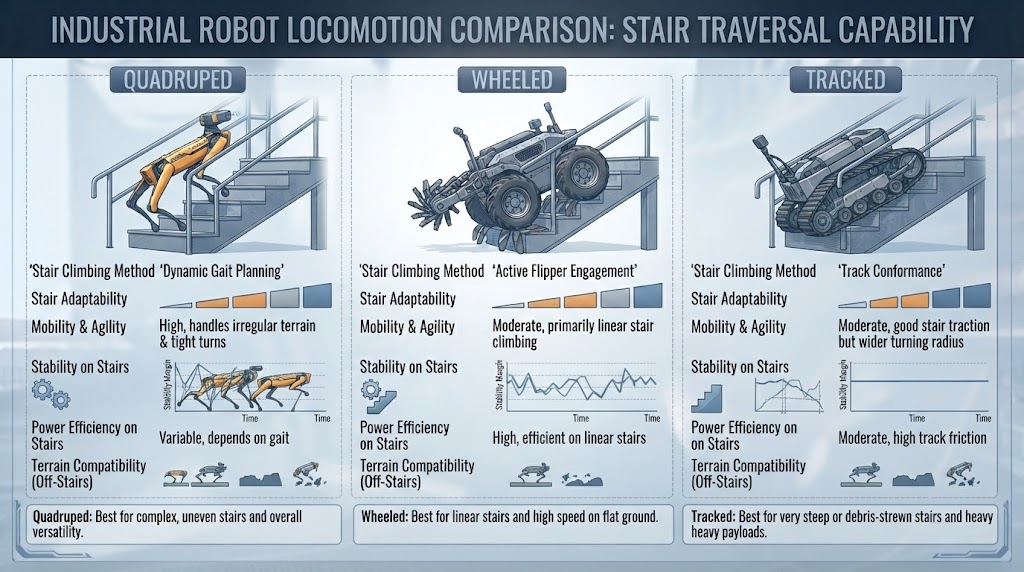
While wheeled AMRs offer high energy efficiency on smooth concrete floors, they cannot traverse standard 35° to 45° industrial staircases, gravel yards, or floor gutters. Tracked platforms manage rough outdoor terrain but cause surface degradation, struggle on open bar grating, and lack agility in narrow pipe racks.
Quadrupedal locomotion (bionic robot dogs) delivers an optimal balance of dynamic balance, obstacle clearance, and footstep planning. For standard industrial facilities containing stairs and catwalks, deploying a purpose-built quadruped like the industrial inspection robot dog Tongchui M1 ensures 100% geometric accessibility without retrofitting ramps.
| Locomotion Type | Stair Climbing | Gravel & Mud Traversal | Energy Efficiency | Payload Capacity |
|---|---|---|---|---|
| Quadruped (Robot Dog) | High (≤ 35°–40°) | High (Dynamic gait) | Moderate (1.5–4 hrs) | 5 kg – 85 kg |
| Wheeled (4WD/Differential) | None (Requires ramps) | Low to Moderate | High (4–8 hrs) | 20 kg – 150 kg |
| Tracked (Crawler) | Moderate (≤ 30°, straight) | High (High traction) | Low to Moderate | 30 kg – 200 kg |
| Aerial (Indoor Drone) | Full 3D Flight | Full Clearance | Very Low (15–30 min) | 0.5 kg – 3 kg |
Environmental Resilience & Ingress Protection (IP & Hazardous Zones)
Deploying robotics in outdoor switchyards, offshore platforms, or chemical processing units demands strict environmental hardening. Failure to specify correct sealing and material compatibility leads to accelerated seal degradation and board-level short circuits.
Ingress Protection and Temperature Ratings
Ensure the robotic chassis holds a verified rating under the IEC 60529 Standard:
- IP66: Protected against high-pressure water jets; suitable for indoor washdown zones.
- IP67: Protected against full water immersion up to 1 meter for 30 minutes; essential for unshielded outdoor substations subject to torrential downpours.
- Thermal Operating Range: Industrial units must operate reliably between -20°C and 55°C without thermal throttling of onboard compute modules.
ATEX and IECEx Hazardous Zone Compliance
For petrochemical processing and flammable gas storage, the platform must meet international explosive atmosphere standards:
- Zone 2 (ATEX / IECEx Category 3G): Robot operates safely where explosive gas is present only abnormally and for short durations.
- Zone 1 (ATEX / IECEx Category 2G): Robot features flameproof enclosures, intrinsically safe electronics (Ex ia/ib), and pressurized sealing for locations where explosive atmospheres occur during standard operations.
Modular Sensor Payload Architecture
An inspection platform is only as effective as the diagnostic intelligence gathered by its sensor stack. Avoid fixed-sensor designs in favor of modular, hot-swappable payload configurations tailored to specific Predictive Maintenance (PdM) workflows.
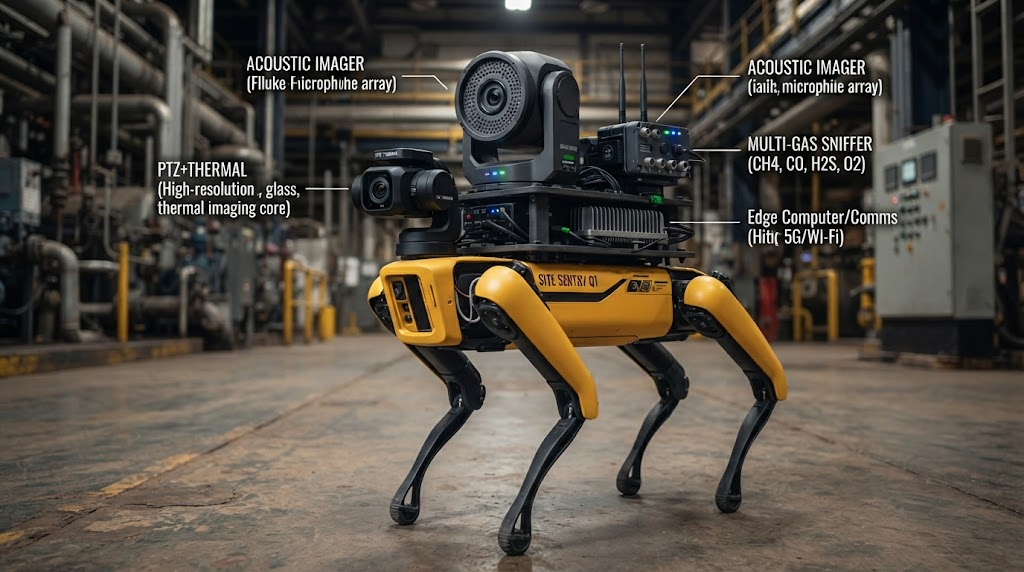
When engineering multi-point telemetry routines, select from our comprehensive autonomous inspection robot solutions to match sensor configurations directly to your asset inspection protocols:
- Radiometric Thermal Imaging: High-resolution FLIR/uncooled microbolometer cores (640×512 or higher) calibrated to ±2°C accuracy for hotspot analysis on transformers, bearings, and switchgear.
- Acoustic Imaging (Ultrasound): Multi-microphone beamforming arrays capable of visualizing partial discharge, corona arcing, and pressurized gas leaks up to 100 kHz.
- High-Magnification Optical Zoom: 30× to 40× optical PTZ cameras with automated optical character recognition (OCR) algorithms to digitize analog pressure gauges, valve positions, and oil level indicators.
- Multi-Gas Detection: Tunable diode laser absorption spectroscopy (TDLAS) or electrochemical sensors targeting CH4, H2S, VOCs, and CO concentrations.
Autonomous Navigation in GPS-Denied Environments
Industrial inspection environments are rarely open to clean GNSS signals. Basements, turbine halls, condenser basements, and metal-dense refineries cause extreme multi-path reflections and satellite outages.
To secure reliable, repeat navigation, prioritize systems built on multi-sensor fusion. Platforms powered by 3D LiDAR SLAM navigation integrate solid-state or mechanical 360° LiDAR sensors, Visual Inertial Odometry (VIO), and kinematic wheel/joint encoders.
This multi-sensor approach limits localization drift to less than 0.1% over a 1,000-meter continuous patrol loop. It maintains accurate positioning even in dynamic environments with moving personnel and changing equipment configurations.
Edge AI Compute vs. Cloud Latency for Real-Time Anomaly Detection
Streaming high-definition video feeds, point clouds, and radiometric streams across 100+ inspection points to the cloud overtaxes industrial wireless bandwidth. In RF-shielded areas, constant cloud connections are impossible.
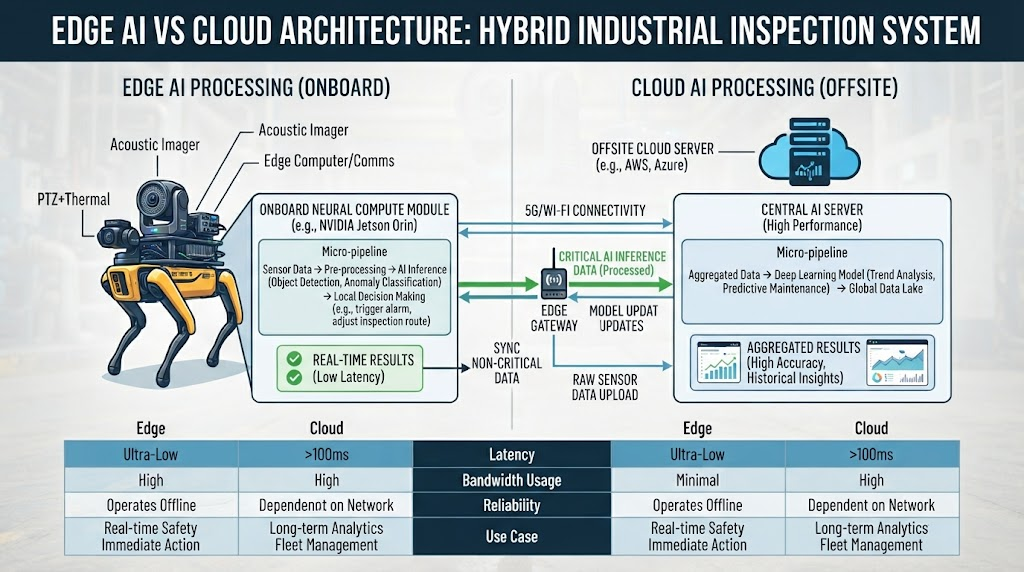
Evaluate platforms featuring onboard accelerated compute modules (such as NVIDIA Jetson Orin series delivering 100 to 275 TOPS). Onboard Edge AI processing provides significant operational advantages:
- Sub-Second Anomaly Triggering: Identifies bearing overheating, gas leaks, or perimeter breaches locally, triggering immediate alerts without waiting for network handshakes.
- Bandwidth Optimization: Transmits structured JSON diagnostic metadata (e.g.,
{"gauge_id": "P-104", "value": 42.6, "unit": "psi", "status": "normal"}) instead of bandwidth-heavy raw video streams. - Autonomous Fail-Safes: Enables continuous obstacle avoidance, dynamic path re-planning, and safe docking procedures even during complete Wi-Fi or private 5G network dropouts.
Power Autonomy, Battery Topologies, and Automated Docking
A mobile robot requiring manual battery swaps by plant technicians defeats the purpose of autonomous remote operations. Evaluate charging infrastructure and battery architecture based on the demands of 24/7 patrol schedules.
Heavy-duty, long-endurance tasks require platforms like the heavy-duty quadruped platform RZTL-1, engineered to manage substantial sensor payloads while sustaining multi-hour industrial inspection rounds.
- Autonomous Contact vs. Inductive Charging Docks: Precision-guided self-aligning contact docks (using visual AprilTags and magnetic docking guides) achieve charging efficiencies above 90%, recharging high-capacity lithium iron phosphate (LiFePO4) or NMC packs in 60 to 90 minutes.
- Duty Cycle Ratios: Target a minimum 3:1 operational-to-charging ratio (e.g., 90 minutes of active inspection for every 30 minutes of fast docking charge).
- Thermal Management in Battery Cells: Integrated battery management systems (BMS) with self-heating elements prevent capacity collapse during sub-zero winter deployments.
The 5-Stage Inspection Robot Selection Matrix (IR-SSM)
To systematically evaluate competing robotic platforms against site requirements, engineering teams can apply our structured 5-stage evaluation framework:
- Stage 1: Terrain & Ingress ProfilingAudit maximum step heights, grating aperture dimensions, stair angles (≤ 35° vs. > 45°), floor wetness/chemical exposure, and narrowest corridor clearances (width > 650 mm).
- Stage 2: Multi-Spectral Sensing RequirementsDefine target asset anomalies: electrical hotspots (thermal), mechanical friction (ultrasound), gauge readout digitization (optical OCR), and fugitive emissions (gas spectroscopy).
- Stage 3: Navigation & Communication TopologyConfirm indoor 3D LiDAR SLAM localization limits, private 5G/Wi-Fi mesh coverage, and onboard Edge AI autonomy to handle network dead zones.
- Stage 4: Enterprise Integration & Safety ComplianceVerify direct SCADA/EAM API endpoints (REST, MQTT), IEC 61508 / ISO 13849 safety stops, and local cybersecurity hardening (TLS 1.3, encrypted storage).
- Stage 5: Lifecycle TCO & Payback ModelingModel the 5-year Total Cost of Ownership including base chassis, payload packages, docking stations, spare parts, and vendor SLA tiers against operational labor and downtime savings.
Enterprise SCADA, EAM Integration, and Cybersecurity
Inspection robots are connected industrial Internet of Things (IIoT) edge nodes. If a platform cannot securely export structured diagnostic telemetry into enterprise systems, it remains an isolated pilot project.
Review real-world deployment data from our industrial robotics case studies to see how enterprise facilities automate maintenance work orders directly through robotics telemetry.
- Software Interoperability: Native MQTT, RESTful APIs, and OPC UA interfaces that push reading logs directly into SCADA, DCS, or Enterprise Asset Management systems like SAP PM and IBM Maximo.
- Work Order Automation: Automated work order generation when a thermal reading breaches preset ISO/IEEE limits (e.g., > 75°C transformer bushing threshold).
- OT Cybersecurity: Hardware-level TPM 2.0 encryption chips, role-based access control (RBAC), end-to-end encrypted video streaming (SRTP/TLS 1.3), and zero unvetted cloud routing dependencies for strictly air-gapped industrial facilities.
Total Cost of Ownership (TCO) & Payback Models
Evaluating an autonomous inspection robot purely on initial hardware purchase price (CAPEX) obscures recurring integration and maintenance realities. A comprehensive evaluation requires a five-year lifecycle cost model.
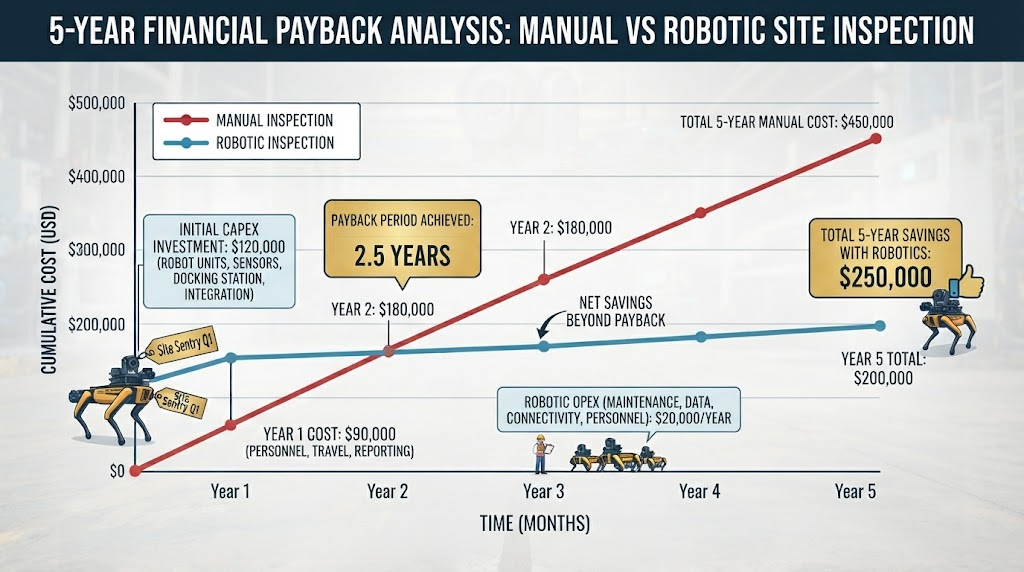
The Industrial Robotics TCO Equation
TCO = CAPEX (Platform + Payloads + Docks + Integration) + OPEX (Fleet Software + Preventative Maintenance + Battery Lifecycle + SLA Support) – [Labor Savings + Downtime Prevention Value]
In high-voltage electrical substations and continuous manufacturing environments, robotic inspection systems regularly deliver full capital payback within 12 to 18 months by catching high-probability asset failures early:
- Labor Redeployment: Eliminates 80% to 90% of manual walking inspections in hazardous zones, reallocating skilled technicians to predictive maintenance execution.
- Catastrophic Outage Avoidance: Identifying a single overheating busbar or high-pressure steam valve leak before failure saves substantial unplanned downtime costs.
- Compliance & Insurance Deductions: Verifiable, auditable digital log trails across critical infrastructure frequently lower facility risk ratings and industrial insurance premiums.
Frequently Asked Questions
How do quadruped inspection robots handle electromagnetic interference (EMI)?
Industrial-grade quadrupeds feature shielded electronics bays, isolated internal wiring harnesses, and high-rejection sensors designed to withstand strong electrical fields near 500kV switchgear and step-up transformers without communication or sensor dropouts.
What are the operating limits for inspection robots in extreme weather?
Ruggedized IP67 platforms operate in wind gusts up to 15 m/s (33 mph) and heavy rain. Dynamic stability algorithms make real-time motor torque adjustments to keep the robot balanced on wet, slippery surfaces and metal grating.
What is the typical deployment timeline for a facility-wide inspection robot?
A standard deployment takes 2 to 4 weeks. This includes initial 3D LiDAR point cloud environment mapping, setting inspection points and routes, integrating SCADA/EAM APIs, and completing autonomous docking validation trials.
Deploy Site-Ready Autonomous Robotic Inspection
Evaluate our advanced quadruped robotics and modular payload systems tailored for high-risk industrial facilities.