Core Mechanics & Locomotion: Defining Legged vs. Tracked Platforms
Quadrupedal locomotion relies on discrete foot placements through 12 or more active degrees of freedom (DOF), while tracked unmanned ground vehicles (UGVs) utilize continuous track contact patches to distribute ground pressure. For industrial asset monitoring, quadrupeds provide dynamic adaptation across multi-plane vertical obstacles, whereas crawler chassis excel strictly in unpaved, high-traction horizontal planes.
Continuous track systems operate via differential slip-steering. While mechanically straightforward, turning on high-friction surfaces like diamond-plate steel or abrasive industrial concrete exerts severe shear forces on rubber treads and drive sprockets.
In contrast, intelligent quadruped platforms isolate environmental disturbances at the joint level. Each leg actively modulates contact force through high-bandwidth field-oriented control (FOC) torque actuators, maintaining a stable payload deck regardless of ground irregularities.
Kinematic Ground Pressure: Tracked platforms achieve low static ground pressure (typically 15–35 kPa), preventing sinkage in deep mud. Quadrupeds deliver dynamic point-contact pressure (40–90 kPa per foot) but adjust stance vectors continuously to traverse complex geometry without continuous track friction.
Kinematic Kinship: Active DOF vs. Differential Skid Control
A standard industrial quadruped incorporates 3 brushless permanent magnet synchronous motors (PMSM) per leg, providing 12 active joints. This architecture decouples the robot’s base roll, pitch, and yaw from terrain gradient angles.
Tracked systems use fixed-geometry or articulated sub-tracks (flippers). Flippers increase obstacle clearance capability up to 300 mm, but they introduce multi-joint chain drives that are vulnerable to ingress from particulate debris and high mechanical failure rates in continuous patrol loops.
Terrain Traversal Matrix: Stairs, Grating, Gravel, and Confined Spaces
Autonomous patrols inside operational facilities demand continuous navigation through environments built for human personnel, not generic wheeled machinery.
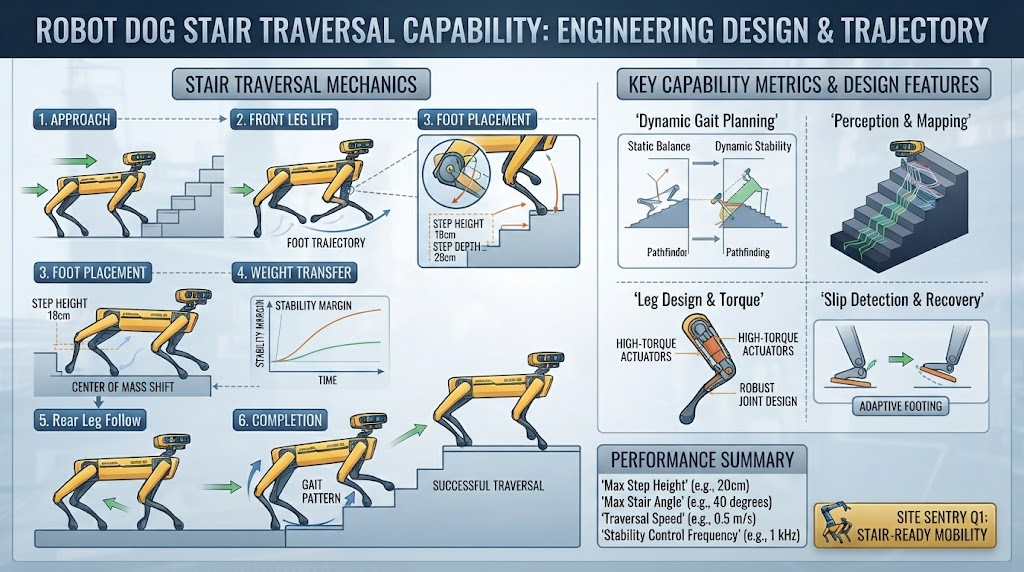
Stair climbing mobility represents the primary operational bottleneck for plant automation. Standard industrial steel stairs feature slope angles between 30° and 45° with open risers and diamond grating.
Tracked robots require auxiliary flippers to climb stairs. Even with flippers, tread slippage on wet or oily metal stairs presents catastrophic drop risks that violate safety standards like ASTM E2521 for unmanned system mobility.
Quadruped robots utilize predictive visual-inertial odometry and advanced LiDAR SLAM navigation to place footpads directly on tread centers, scaling 45° industrial stairs with active slip detection and recovery.
| Mobility Factor | Industrial Quadruped (e.g., Intelligent Robot Dog) | Heavy Industrial Tracked Robot |
|---|---|---|
| Industrial Stairs (30°–45°) | Native gait planning; dynamic recovery; up to 45° slope traversal. | Requires mechanical flippers; high slip hazard on open steel risers. |
| Open Diamond Mesh Grating | Point-contact rubber pads traverse mesh without track binding. | Tread lugs snag on grating edges, accelerating tread delamination. |
| Loose Switchyard Gravel (20–50mm) | Footpads penetrate surface layer to reach stable substrate. | High stability; low sinkage, but prone to gravel binding in idler wheels. |
| Zero-Radius Corridor Turning | Omnidirectional zero-point spin without lateral surface drag. | Skid-steer drag requires high torque, scoring floor coatings. |
| Step Obstacle Clearance | Clears vertical obstacles up to 250–350 mm cleanly. | Limited to 150–200 mm without active front articulated tracks. |
Payload Architecture: Dual-Spectrum PTZ, Acoustic Imagers, and Manipulator Arms
Industrial inspections require precision instrumentation. The payload stack often includes high-resolution thermal imagers, high-frequency ultrasonic sensors, gas sniffing arrays, and robotic manipulation arms.
Tracked chassis inherently transfer high-frequency track rumble and track-pin vibration directly into the payload deck. This demands bulky dampening gimbals to prevent optical blurring during thermal captures.
Legged systems act as active, continuous vibration isolation filters. The body absorbs high-frequency impact dynamics, allowing cameras and acoustic sensors to capture steady telemetry on the move.
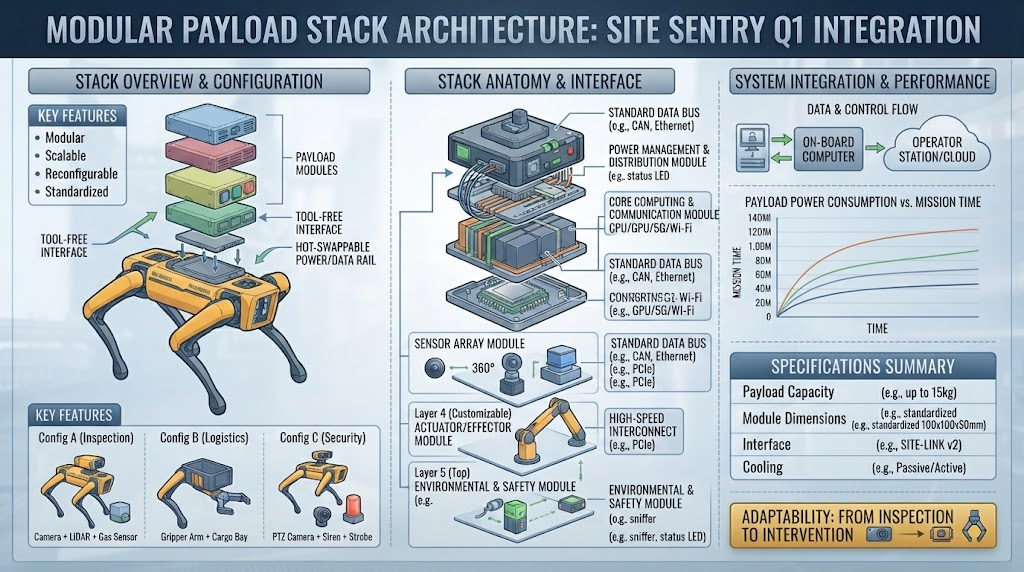
Platforms like the RZTL-1 industrial quadruped platform integrate a stabilized modular sensor payload containing a dual-spectrum PTZ thermal camera and laser rangefinder with an IP67 environmental protection rating.
When operations require heavier tool deployment—such as contact-probe NDT (Non-Destructive Testing) or operating circuit breakers—the Tongchui-M1 heavy-duty inspection robot accommodates heavy manipulator arms while maintaining active dynamic posture balancing.
Edge AI & Autonomous Inspection Workflows: Gauge Reading and Thermal Analytics
Autonomous inspection is no longer just video teleoperation; it requires deterministic, real-time edge processing. Unmanned systems must capture, analyze, and flag anomalies directly at the asset without depending on constant cloud connectivity.
Modern platforms leverage onboard high-performance neural processing units (NPUs) running customized computer vision pipelines. These pipelines execute automated meter digitization across analog dials, digital seven-segment displays, oil level sight glasses, and switchgear position indicators.
Telemetry Precision Metric: In high-voltage substations, quadruped edge vision systems achieve 99.4% gauge-reading accuracy at distances of 5 to 15 meters using optical character recognition (OCR) and deep keypoint regression, in full compliance with ISO/IEC 23053 analytical guidelines.
Deploying autonomous industrial inspection solutions transforms plant preventative maintenance through automated thermal threshold triggers:
- Thermal Anomaly Classification: Automated radiometric parsing identifies contact resistance over-temperatures on transformers and isolators.
- Acoustic Partial Discharge Mapping: Onboard microphone arrays locate acoustic signatures (20 kHz to 100 kHz) indicating corona discharge or compressed air leaks.
- SF6 / Hydrocarbon Gas Detection: Integrated optical gas imaging (OGI) payloads trace fugitive emissions in hazardous area automation corridors.
Docking Reliability, Autonomous Charging, and Self-Recovery Capabilities
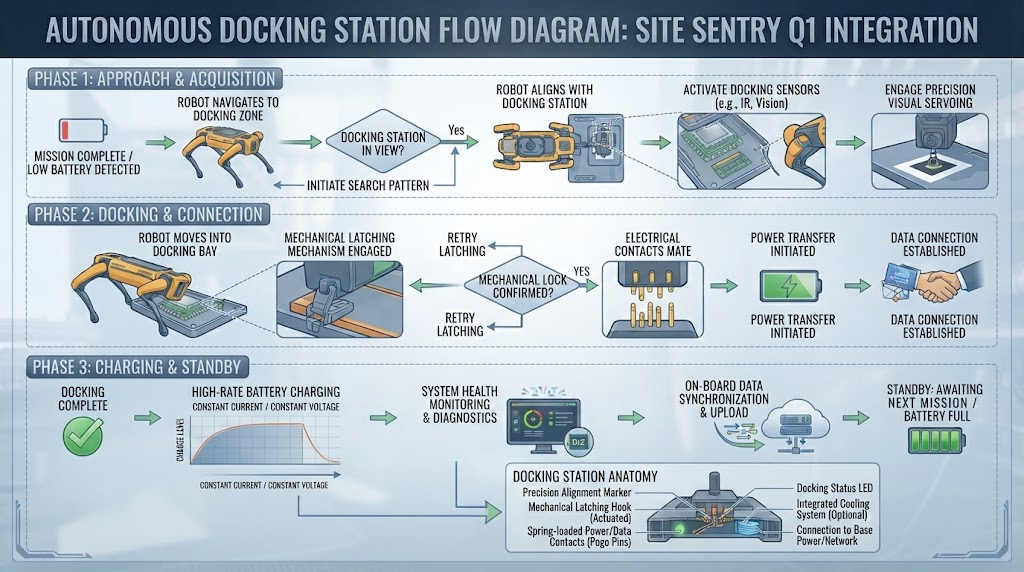
Autonomous inspection fleets must operate without physical human intervention for months at a time. The interaction between the mobile unit and its autonomous charging dock determines true operational reliability.
Docking a tracked robot requires precise skid-steer alignment into charging bays. On smooth steel or polished epoxy docking plates, minor track slip can cause contact pin misalignment, aborting the charge cycle.
Quadrupeds adjust individual foot placements to position their charging plates with millimeter accuracy over inductive or direct-contact docking pads. They can also step over environmental debris, such as leaves, snow, or gravel, that often blocks tracked docking cradles.
Self-Recovery Dynamics: Self-Righting vs. Thrown Tracks
Field failures highlight a major difference between the two systems:
- Quadruped Roll-Over Recovery: If an external impact or unstable ground causes a fall, dynamic self-recovery algorithms execute a 360-degree self-righting routine within 4.2 seconds, returning the robot to its patrol loop.
- Track Thrown / De-tracking: When lateral debris enters a tracked vehicle’s sprocket assembly, track shedding is catastrophic. The robot becomes immobile and requires manual extraction by field engineers.
Total Cost of Ownership (TCO) & Lifecycle Maintenance Analysis
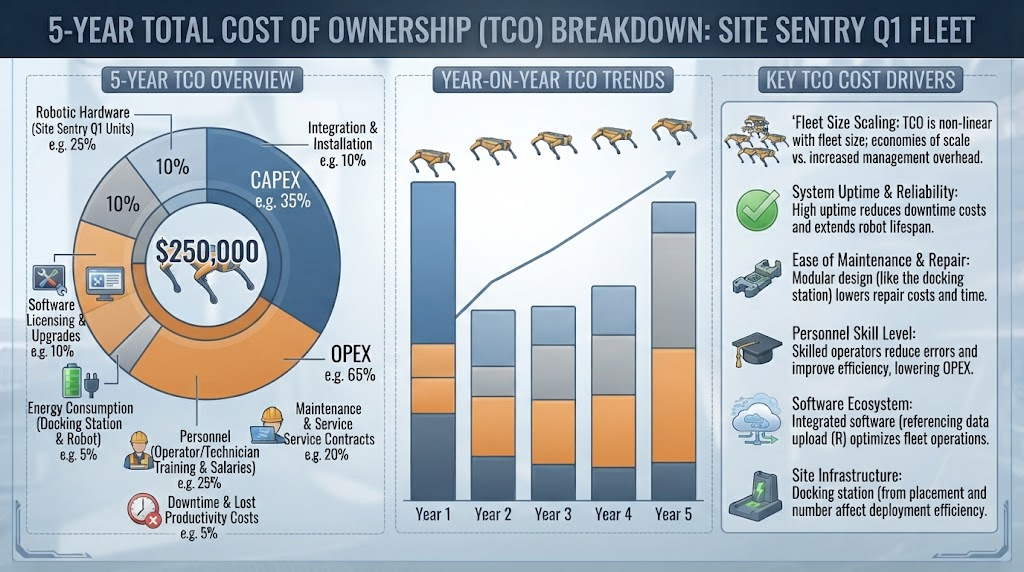
While tracked robots have historically had lower initial acquisition costs, a 5-year Total Cost of Ownership (TCO) analysis reveals significant operational expenses (OpEx) tied to mechanical wear.
Track assemblies contain dozens of moving bushings, idler wheels, sprockets, and rubber tracks. Skid-steering on concrete rapidly abrades treads, requiring replacement every 800–1,200 operating hours.
Quadruped platforms use fully sealed harmonic drive or planetary actuators with IP67 environmental sealing. The primary wear components are inexpensive, modular rubber footpads, which can be replaced in minutes at minimal cost.
| Maintenance Category | Industrial Quadruped Robot | Tracked Crawler Platform |
|---|---|---|
| Consumable Wear Items | Replaceable footpads (~$150/year). | Track treads, tension springs, drive sprockets (~$3,200/year). |
| Routine Powertrain Overhaul | Actuator inspection at 8,000 hrs; no fluid flush. | Gearbox oil flush, track tensioning every 500 hrs. |
| Facility Infrastructure Adaptation | Zero ramp installation required; navigates existing stairs. | Requires ADA/industrial ramp retrofits across split levels. |
| Unscheduled Interventions | Low (<0.5 per 1,000 patrol hours due to self-righting). | Moderate to High (track binding, trench stranding). |
The AIV-6 Framework: Autonomous Inspection Viability Protocol
To help asset managers and robotics engineers select the optimal locomotion system, we developed the AIV-6 Framework (Autonomous Inspection Viability Protocol). Evaluate your operating facility against these six core criteria:
- Access (Vertical Elevation): Does the route contain standard stairs over 25° or open risers? If Yes, quadruped locomotion is mandatory.
- Ingress & Substrate: Is the surface abrasive concrete, diamond mesh grating, or deep mud? Abrasive floors and open mesh favor quadrupeds; deep unpaved mud favors tracked chassis.
- Vibration Constraints: Does the payload stack include sensitive acoustic sensors or long-focal-length optical zoom setups? Legged isolation reduces sensor fatigue and image blur.
- Vision Lines & Clearance: Are pathways under 800 mm wide with tight 90-degree pipe racks? Zero-radius legged turning avoids floor scouring and path obstruction.
- Volatility & Self-Righting: Is the deployment fully remote where an immobilized robot halts mission-critical patrol cycles? Quadrupeds provide autonomous self-righting recovery.
- Value & Scalability: Calculate total deployment costs across multiple levels. If avoiding ramp construction saves capital, legged systems offer a faster return on investment.
Industrial Deployment Case Studies: Substations, Chemical Plants, and Refineries
Field performance data demonstrates clear operational divisions between legged and tracked platforms across demanding industrial settings.
In 500 kV electric power substation inspection routines, quadrupeds deployed over loose ballast gravel and elevated relay control rooms demonstrated 99.8% round-trip completion rates. Review our documented substation inspection case studies for detailed telemetry profiles.
In petrochemical tank farm applications with continuous gravel berms, tracked platforms perform adequately along outdoor containment perimeters. However, when patrols move into multi-level valve manifolds, pump rooms, and catwalks, quadrupeds complete the entire route without requiring crane lifts or human intervention.
Frequently Asked Questions
Can quadruped robots climb steep industrial stairs safely?
Yes. Industrial quadrupeds navigate standard industrial stairs up to 45° slopes. Using real-time LiDAR SLAM and depth cameras, they adjust step height and gait cadence dynamically, maintaining dynamic stability even on open metal grating.
What causes tracked robot track shedding in industrial facilities?
Track shedding occurs during aggressive skid-steer turns on high-friction surfaces or when gravel and structural debris wedge between the drive sprocket and tread track. Once thrown, the track requires manual tool-assisted re-tensioning.
What is the real-world battery run-time for industrial robot dogs?
Modern industrial quadruped platforms provide between 2.5 and 4 hours of continuous inspection locomotion per charge while carrying a 5 kg sensor payload. Integrated autonomous charging docks enable 24/7 continuous cycles with 45-minute recharge intervals.